Last updated: June 25, 2026
Quick Answer
For most Canadian homeowners, insulated steel is the best all-around garage door material. It handles extreme cold, resists denting better than aluminum, and requires far less maintenance than wood. Aluminum suits coastal regions where salt air is the bigger threat. Wood looks exceptional but demands consistent upkeep to survive Canada’s freeze-thaw cycles.
Key Takeaways
- Steel accounts for roughly 80% of residential garage doors sold in North America and remains the dominant choice in Canada’s cold-climate provinces.
- Insulated steel doors with polyurethane cores deliver the highest R-values among the three materials, making them the strongest performers for attached garages in Ontario, Quebec, and the Prairies.
- Aluminum resists rust naturally, making it the preferred choice for coastal British Columbia and other high-humidity regions, but it dents more easily than steel and typically achieves lower insulation values.
- Wood garage doors are the most maintenance-intensive option in Canada; freeze-thaw cycles, humidity swings, and road salt exposure accelerate warping, cracking, and paint failure.
- “Wood-look” steel and composite doors offer the aesthetic of wood with significantly better weather resistance and lower long-term maintenance costs.
- Homeowners in heavy snowfall areas should prioritize door weight, bottom seal quality, and insulation rating over material appearance alone.
- Steel doors in salt-affected provinces like Ontario require powder-coated or galvanized finishes and prompt touch-up of any chips to prevent rust at the bottom panel.
- An insulated garage door is not optional in Canada if the garage is attached to the home; heat loss through an uninsulated door adds measurable cost to heating bills.
What Is the Best Garage Door Material for Canadian Winters?
Insulated steel is the best garage door material for Canadian winters. It combines structural strength, high thermal resistance, and durability against snow, ice, and wind in a single package. For most cold-climate provinces, it outperforms both aluminum and wood across every practical measure.
Canadian winters are not a single condition. A homeowner in Winnipeg faces sustained temperatures below -30°C and dry cold. A homeowner in Vancouver deals with damp, salt-laden air and constant freeze-thaw cycling. A homeowner in Halifax manages coastal humidity, ice storms, and road salt. The comparison of steel vs aluminum vs wood garage doors for Canadian climates must account for all of these scenarios, not just a generic “cold weather” benchmark.
Here is how each material stacks up at a high level:
| Material | Cold Resistance | Insulation Potential | Rust/Moisture Resistance | Maintenance Level | Typical Lifespan |
|---|---|---|---|---|---|
| Insulated Steel | Excellent | Excellent (R-12 to R-18+) | Moderate (needs coating) | Low to Moderate | 20-30+ years |
| Aluminum | Good | Moderate (approx. R-6) | Excellent | Low | 20-25 years |
| Wood | Moderate | Moderate | Poor without sealing | High | 15-30 years (with care) |
How Do Steel, Aluminum, and Wood Garage Doors Handle Extreme Cold?
Steel handles extreme cold better than either aluminum or wood, provided it has a proper insulated core. Multi-layer steel doors with polyurethane foam fill maintain structural integrity at temperatures well below -30°C and resist the contraction-expansion stress that damages less rigid materials.
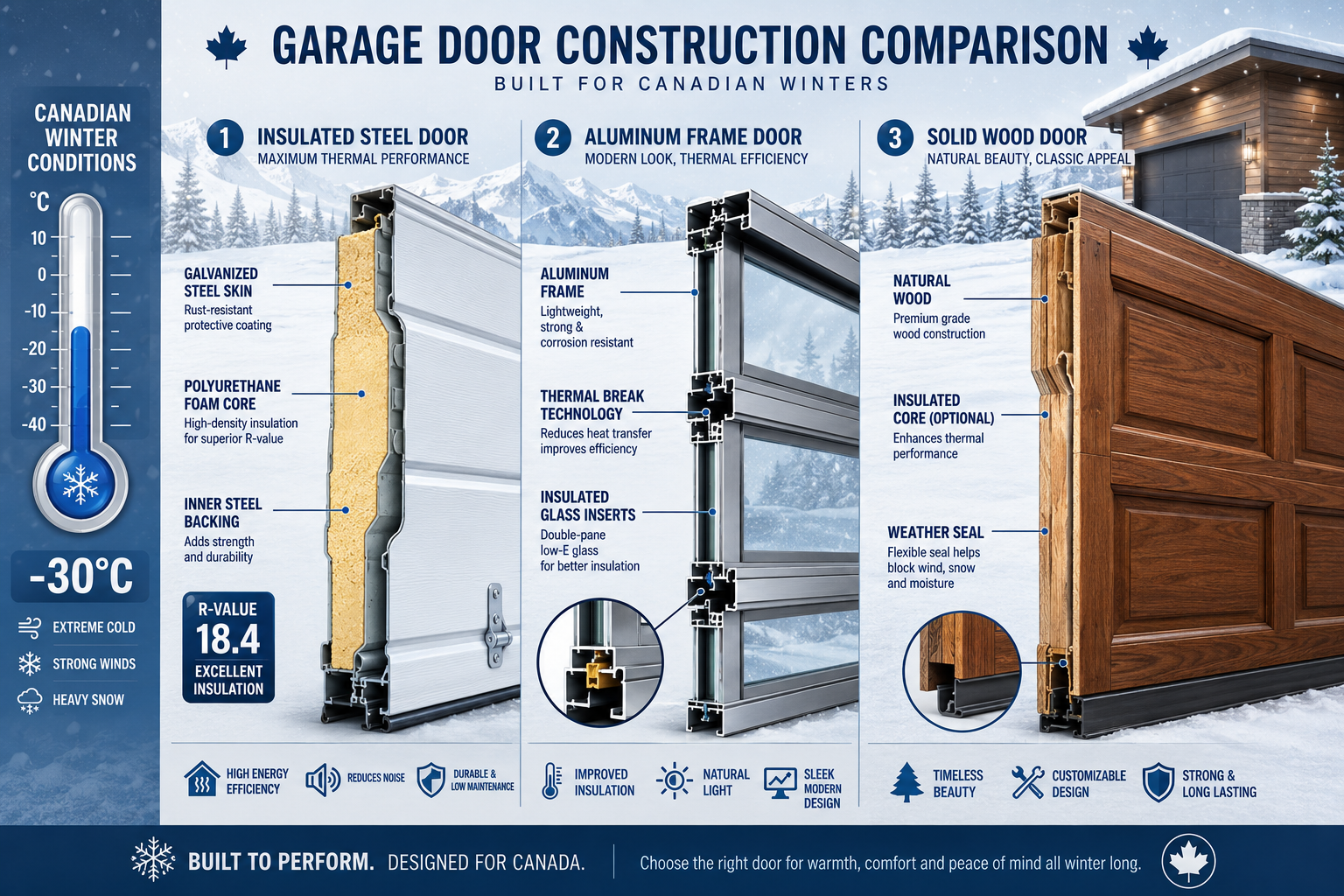
Steel in extreme cold: Galvanized or powder-coated steel panels hold their shape through repeated freeze-thaw cycles. The main vulnerability is the bottom seal and any scratched or chipped areas where bare metal is exposed to road salt and moisture. Multi-layer “sandwich” construction, typically two steel skins bonded to a polyurethane or polystyrene foam core, dramatically reduces heat transfer and prevents the door from becoming a cold radiator inside the garage.
Aluminum in extreme cold: Aluminum is naturally resistant to rust, but it is a softer metal than steel. In very cold temperatures, aluminum becomes more brittle and is more prone to denting from ice, snow buildup, or minor impacts. Standard insulated aluminum doors often achieve around R-6, which is adequate for mild winters but falls short for a -30°C Prairie winter in an attached garage.
Wood in extreme cold: Wood is the most vulnerable of the three. It expands and contracts with temperature and humidity changes, and Canadian winters create the most aggressive version of those swings. Without regular sealing and finishing, wood panels crack, warp, and allow moisture infiltration. A wood door that looks fine in September can show visible joint separation and paint failure by March.
A key decision rule: if the garage is attached to the home and temperatures drop below -20°C regularly, choose insulated steel with a polyurethane core. The thermal performance difference between a single-layer door and a multi-layer insulated door is significant enough to affect home heating costs.
Are Steel Garage Doors Better Than Aluminum for Insulation?
Yes, steel garage doors are generally better than aluminum for insulation. Insulated steel doors routinely achieve R-values between R-12 and R-18 or higher, while standard insulated aluminum doors typically land around R-6. For attached garages in cold Canadian climates, that gap is meaningful.
The reason comes down to construction. High-performance steel doors use a three-layer or five-layer build: steel outer skin, polyurethane foam core, and a steel or composite inner skin. The foam is injected or bonded under pressure, filling the panel cavity completely. Aluminum doors, particularly full-view designs with large glass panels, are harder to insulate densely without adding significant weight.
When aluminum insulation is sufficient:
- Detached garages used only for storage
- Mild coastal climates like the Lower Mainland of BC
- Modern full-view aluminum doors with thermal break frames and double or triple-pane glass, which can close the insulation gap considerably
For homeowners in Ontario, Quebec, Manitoba, or Saskatchewan, the insulation advantage of steel is hard to justify giving up. If the goal is energy efficiency in an attached garage, insulated steel wins the comparison.
Do I Really Need an Insulated Garage Door in Canada?
For an attached garage in Canada, yes, insulation is effectively mandatory. An uninsulated garage door in a cold Canadian winter allows heat to bleed out of the home continuously, raises the risk of frozen pipes in the garage, and makes the space uncomfortable or unusable for much of the year.
For a detached garage used only for parking or storage, a non-insulated door is more defensible, but even then, insulation protects the door itself from thermal stress and reduces noise. The cost difference between an insulated and non-insulated door at the time of purchase is relatively modest compared to the long-term heating savings and reduced wear on the door’s mechanical components.
See this case study on insulated door replacement in West Oak Trails for a real-world example of the performance difference an insulated steel door makes in an Ontario home.
Steel vs Aluminum Garage Doors: Cost Comparison for Canada
Steel garage doors are generally less expensive than aluminum at comparable quality levels, though the gap narrows for premium insulated products. For a standard double-car insulated steel door installed in Ontario, expect to pay roughly $1,200 to $2,500 depending on gauge, insulation rating, and finish. Insulated aluminum doors, particularly full-view or contemporary designs, typically start around $2,000 and can run $5,000 or more for custom configurations.
Cost factors that shift the comparison:
- Gauge and layers: Heavier-gauge steel (24-gauge vs. 28-gauge) costs more but resists denting far better, especially in cold weather.
- Insulation core: Polyurethane-core doors cost more than polystyrene-core doors but deliver higher R-values and better structural rigidity.
- Finish: Powder-coated and factory-painted steel doors cost more upfront but reduce long-term maintenance costs significantly.
- Style: Aluminum full-view doors with glass panels carry a premium for both the frame and the glazing.
Wood doors vary widely. A basic raised-panel wood door might cost $1,500 to $3,000 installed, but custom carriage-house wood doors can exceed $8,000. The total cost of ownership for wood, including regular painting, sealing, and potential panel repairs, adds substantially to that initial figure over a 10- to 15-year period.
For a full breakdown of what goes into a garage door quote, the guide on how to read a garage door quote explains each line item clearly.
Do Aluminum Garage Doors Rust in Canadian Salt Air?
No, aluminum does not rust. This is one of its most significant advantages in Canadian coastal regions. Unlike steel, aluminum forms a natural oxide layer that protects it from corrosion, making it the preferred material in areas with persistent salt air, high humidity, and marine exposure.
In regions like coastal British Columbia, Nova Scotia, and parts of New Brunswick, steel doors require diligent maintenance to resist salt corrosion. A powder-coated finish helps, but any chip or scratch in the coating exposes bare steel to salt air and moisture. Aluminum has no such vulnerability.
Where aluminum genuinely outperforms steel:
- Properties within a few kilometres of the ocean or a saltwater estuary
- Homes in areas with heavy road salt application and poor drainage near the garage
- Lakefront properties where humidity and moisture exposure are constant
The trade-off is dent resistance. Aluminum is softer than steel, and in cold temperatures it becomes more susceptible to impact damage. A minor collision with a bicycle, a hockey stick, or a snow shovel that would leave a small mark on steel may leave a more visible dent on aluminum. For lakefront and coastal properties in Ontario, the article on Bronte garage door installation for lakefront homes covers material selection in detail.
Do Aluminum Garage Doors Dent Easily in Cold Weather?
Yes, aluminum dents more easily than steel, and the problem is more pronounced in cold weather. As temperatures drop, aluminum becomes less ductile and more susceptible to impact damage. A dent that might be minor in summer can be more severe in January.
This is a real practical concern for Canadian homeowners. Garage doors take regular low-impact abuse: garbage bins rolling against them, kids’ bikes, snow falling from the roof edge, or a car door opening too wide. Steel at 24-gauge handles these impacts better than aluminum of comparable thickness.
If denting does occur on either material, garage door panel replacement is often the most cost-effective repair rather than replacing the entire door, provided the frame and hardware are in good condition.
Can Wood Garage Doors Warp in Canadian Humidity and Temperature Swings?
Yes, wood garage doors warp, crack, and swell in response to humidity and temperature swings, and Canada’s climate creates some of the most demanding conditions for this. The combination of dry winter cold, spring thaw moisture, summer humidity, and fall temperature drops cycles wood through extreme stress repeatedly every year.
What happens to wood in Canadian conditions:
- Warping: Uneven moisture absorption across the panel face causes the wood to bow or twist, which affects both appearance and the door’s ability to seal properly at the bottom.
- Joint separation: Wood panels are typically assembled from multiple pieces. Freeze-thaw cycling causes these joints to open and close, eventually leading to gaps that allow water infiltration.
- Paint and finish failure: Expansion and contraction stress paint and sealant coatings, causing cracking and peeling. Once the finish fails, moisture enters the wood directly.
- Swelling: A door that fits perfectly in October may bind in the tracks or fail to seal at the bottom in a wet spring.
Proper maintenance, including annual inspection, sanding, repainting, and resealing, can extend a wood door’s life significantly. But this is a genuine annual commitment, not a one-time task. For homeowners who want the look of wood without the maintenance burden, wood-look steel doors with embossed grain finishes or composite overlays are a far more practical choice in most Canadian regions.
Which Garage Door Material Lasts Longest in Canada?
Properly maintained insulated steel lasts longest in most Canadian climates, with a realistic lifespan of 30 years or more. Aluminum is close behind at 20 to 25 years, with the advantage that its lifespan is less dependent on maintenance. Wood has the most variable lifespan: a well-maintained wood door in a dry climate can last 25 to 30 years, but a neglected wood door in a wet or cold province may show serious deterioration in 10 to 15 years.
Lifespan by material and condition:
- Steel (insulated, powder-coated): 25-30+ years with basic maintenance (lubrication, touch-up of chips)
- Steel (single-layer, painted): 15-20 years; more vulnerable to rust and denting
- Aluminum (insulated): 20-25 years; minimal maintenance required
- Wood (maintained annually): 20-30 years in dry climates, 15-20 years in wet or cold provinces
- Wood-look steel or composite: 25-30 years; combines durability with low maintenance
Regular lubrication of hinges, rollers, and springs is important for all door types regardless of material. Using the right lubricant matters, particularly in cold climates where standard greases thicken. The guide on best garage door lubricant for Ontario’s climate covers which products work best through Canadian winters.
Garage Door Material for Coastal vs Prairie Canadian Regions
The best material differs meaningfully between coastal and Prairie Canadian regions. Aluminum is the stronger choice for coastal BC, Atlantic Canada, and other high-humidity marine environments. Insulated steel is the clear choice for Prairie provinces and inland cold climates.
Coastal regions (BC Lower Mainland, Nova Scotia, PEI, New Brunswick):
- Salt air and persistent moisture make rust resistance the top priority
- Aluminum’s natural corrosion resistance is a genuine advantage
- Full-view aluminum doors with thermal breaks are popular in urban coastal markets like Vancouver
- Steel remains viable with high-quality powder coating and diligent maintenance
Prairie provinces (Alberta, Saskatchewan, Manitoba):
- Extreme cold (-30°C to -40°C) and dry conditions make insulation the top priority
- Insulated steel with polyurethane cores is the dominant and most practical choice
- Wood performs better in dry cold than in wet cold, but still requires maintenance
- Aluminum’s lower insulation values are a real disadvantage in sustained deep cold
Ontario and Quebec (mixed climate):
- Road salt exposure is heavy, making coating quality critical for steel
- Freeze-thaw cycling is aggressive, which penalizes wood
- Insulated steel with powder-coated finish is the most common and best-supported choice
- Aluminum suits properties near the Great Lakes shoreline or in urban markets where contemporary aesthetics are a priority

What Garage Door Do I Need for Heavy Snowfall Areas?
In heavy snowfall areas, the priorities are a strong bottom seal, a rigid door that won’t flex under snow load on the roof edge, and high insulation to prevent the garage from becoming a cold zone that stresses mechanical components. Insulated steel meets all three criteria better than aluminum or wood.
Specific considerations for heavy snow regions:
- Bottom seal quality: The bottom rubber seal is the first line of defense against snow and cold air infiltration. It should be inspected and replaced if cracked or compressed. This applies to all materials.
- Door rigidity: A door that flexes under the weight of snow sliding off the roof or from wind pressure can rack the tracks. Multi-layer steel is the most rigid option.
- Spring tension: Cold temperatures cause metal springs to contract and lose tension. A door that operates smoothly in October may feel heavy or sluggish by January. Regular maintenance and proper spring sizing matter. If springs are struggling, see the guide on garage door spring repair in Oakville for context on what proper spring maintenance involves.
- Opener capacity: Heavier doors (wood, thick multi-layer steel) require more powerful openers. In cold weather, a marginal opener may fail to lift a heavy door reliably.
Steel vs Aluminum vs Wood Garage Doors: Which Is Quieter?
Steel garage doors are generally quieter than aluminum, and both are quieter than wood when wood has begun to warp or develop loose joints. The noise from a garage door comes primarily from the hardware (springs, rollers, hinges) rather than the door material itself, but material rigidity plays a role.
Aluminum doors, particularly full-view designs with large glass panels, can rattle more in wind or when the opener engages, because the frame is lighter and the glass panels can vibrate. Steel doors with polyurethane foam cores are notably quiet because the foam dampens vibration throughout the panel.
Wood doors are quiet when new and well-fitted, but as they age and joints loosen, they can creak and rattle in ways that steel and aluminum do not.
For any material, switching from metal rollers to nylon rollers and keeping hinges properly lubricated will reduce operational noise more than changing door material. If noise from the opener itself is the issue, that is a separate mechanical problem worth addressing through garage door opener repair.
What Garage Door Material Is Best for Low Maintenance?
Aluminum is the lowest-maintenance garage door material overall. It does not rust, does not need painting, and does not warp. The main maintenance task is cleaning and occasional inspection of seals and hardware.
Insulated steel is a close second. It requires periodic inspection for chips and scratches, prompt touch-up of any damaged coating, and regular lubrication of hardware. In salt-affected provinces, the bottom section of a steel door deserves particular attention each spring.
Wood is the highest-maintenance option by a significant margin. Annual or biennial painting or staining, regular sealant application, inspection for warping and joint separation, and prompt repair of any finish failure are all necessary to keep a wood door performing and looking its best in Canadian conditions.
Maintenance summary by material:
- Aluminum: Clean annually, inspect seals and hardware, no painting required
- Steel: Lubricate hardware twice yearly, inspect and touch up coating chips, check bottom seal
- Wood: Sand, paint or stain, and seal annually or every two years; inspect joints and hardware; repair finish failures promptly
For homeowners who want the appearance of wood without the maintenance commitment, composite or wood-look steel doors are the practical answer. They use embossed steel panels or composite overlays that mimic wood grain convincingly, while offering the durability and low maintenance of steel construction.
Choosing Between Steel vs Aluminum vs Wood Garage Doors for Canadian Climates: A Decision Framework
The right choice depends on where in Canada the home is located, how the garage is used, and what the homeowner values most. Here is a direct decision framework:
Choose insulated steel if:
- The garage is attached to the home in any cold-climate province
- The region experiences temperatures below -20°C regularly
- Low long-term maintenance and high insulation are the priorities
- Budget is moderate and ROI matters (steel doors consistently show strong return on investment at resale)
Choose aluminum if:
- The property is in a coastal or high-humidity region where salt air is the dominant concern
- A contemporary full-view or glass-panel aesthetic is a priority
- The garage is detached or insulation is less critical
- Lightweight construction is needed to reduce strain on aging springs or openers
Choose wood if:
- Curb appeal and a traditional or carriage-house aesthetic are the top priorities
- The homeowner is prepared to commit to annual maintenance
- The home is in a drier region (interior BC, parts of Alberta) where moisture stress is lower
- Budget allows for premium materials and ongoing upkeep
Choose wood-look steel or composite if:
- The aesthetic goal is a wood appearance
- The climate is wet, cold, or involves heavy road salt exposure
- Low maintenance is important but traditional styling is desired
FAQ
Is steel or aluminum better for a garage door in Ontario? Steel is better for most Ontario homeowners. Ontario’s combination of heavy road salt use, freeze-thaw cycling, and cold winters favors insulated steel with a powder-coated finish. Aluminum is a reasonable choice for properties near Lake Ontario or Lake Erie where salt air and humidity are more significant factors than sustained deep cold.
How often does a wood garage door need to be repainted in Canada? In most Canadian climates, a wood garage door needs repainting or restaining every one to two years to maintain its protective finish. Wet climates like coastal BC or Ontario may require annual attention. Dry inland climates may allow a two-year interval with proper initial sealing.
What R-value should a garage door have in Canada? For an attached garage in a cold Canadian climate, a minimum R-12 is a reasonable target, with R-16 or higher preferred for provinces like Manitoba, Saskatchewan, and northern Ontario. For a detached storage garage, R-6 to R-9 is generally sufficient.
Can a steel garage door rust in Canada? Yes, steel can rust if the coating is damaged and bare metal is exposed to moisture and road salt. The bottom panel is most vulnerable. Using a galvanized or powder-coated steel door, inspecting for chips annually, and touching up any exposed areas promptly prevents rust from developing.
Are full-view aluminum garage doors practical in Canadian winters? Full-view aluminum doors are practical in milder Canadian climates, particularly coastal BC, when they include thermal break frames and double or triple-pane insulated glass. In Prairie provinces or areas with sustained temperatures below -25°C, the insulation limitations of standard full-view aluminum doors are a real drawback.
Does a heavier garage door cause more wear on springs and openers? Yes. Wood doors and thick multi-layer steel doors are heavier than aluminum doors, and that weight increases stress on torsion springs and opener motors. This is particularly relevant in cold weather, when springs lose some tension. Proper spring sizing and regular maintenance address this, but it is a factor worth discussing at the time of installation.
What is the most popular garage door material in Canada? Insulated steel is the most popular garage door material in Canada, consistent with North American market data showing steel accounts for roughly 80% of residential garage door sales. Its combination of durability, insulation performance, and moderate cost makes it the default choice for most Canadian homeowners.
Is a wood-look steel door a good compromise? Yes, for most Canadian homeowners who want a traditional or carriage-house appearance, a wood-look steel door is an excellent compromise. It delivers the visual appeal of wood with the durability, insulation, and low maintenance of steel construction, and it holds up far better through Canadian winters than real wood.
How does road salt affect different garage door materials? Road salt is most damaging to steel, where it accelerates rust if the coating is compromised. Aluminum is naturally immune to salt corrosion. Wood absorbs moisture and salt residue, which accelerates finish degradation. In high-salt-exposure areas, aluminum or well-coated steel with regular inspection is the safest choice.
Should I replace just a damaged panel or the whole door? If the door frame and hardware are in good condition and only one or two panels are damaged, panel replacement is often the most cost-effective option. If the door is older, the insulation is degraded, or multiple panels are affected, full replacement makes more sense. See the garage door panel replacement guide for a detailed breakdown of when each approach makes sense.
Conclusion
The comparison of steel vs aluminum vs wood garage doors for Canadian climates comes down to one core principle: match the material to the specific demands of the region and the way the garage is used.
For the majority of Canadian homeowners, insulated steel is the right answer. It handles cold, resists mechanical stress, insulates effectively, and lasts decades with modest upkeep. Aluminum earns its place in coastal and high-humidity regions where rust resistance outweighs the need for maximum insulation. Wood remains a legitimate choice for homeowners who prioritize aesthetics and are genuinely prepared to maintain it, but it is the most demanding option in Canada’s climate by a wide margin.
Actionable next steps:
- Identify the primary climate challenge for the property: sustained deep cold, coastal salt air, heavy road salt exposure, or high humidity.
- Determine whether the garage is attached to the home; if yes, prioritize insulation (R-12 minimum).
- Get quotes for insulated steel as the baseline, then compare aluminum or wood-look steel if aesthetics or corrosion resistance are specific concerns.
- Ask about gauge, insulation core type (polyurethane vs. polystyrene), and finish quality when comparing steel options.
- Factor in long-term maintenance costs, not just the purchase price, when comparing wood against steel or aluminum.
For homeowners in the Oakville, Burlington, Mississauga, and Hamilton areas, professional installation guidance and material selection support are available through Oakview Garage Doors’ installation service. Choosing the right material is the first step; having it installed correctly and sized for the local climate is what makes it perform for the next 25 years.