Last updated: June 26, 2026
Quick Answer
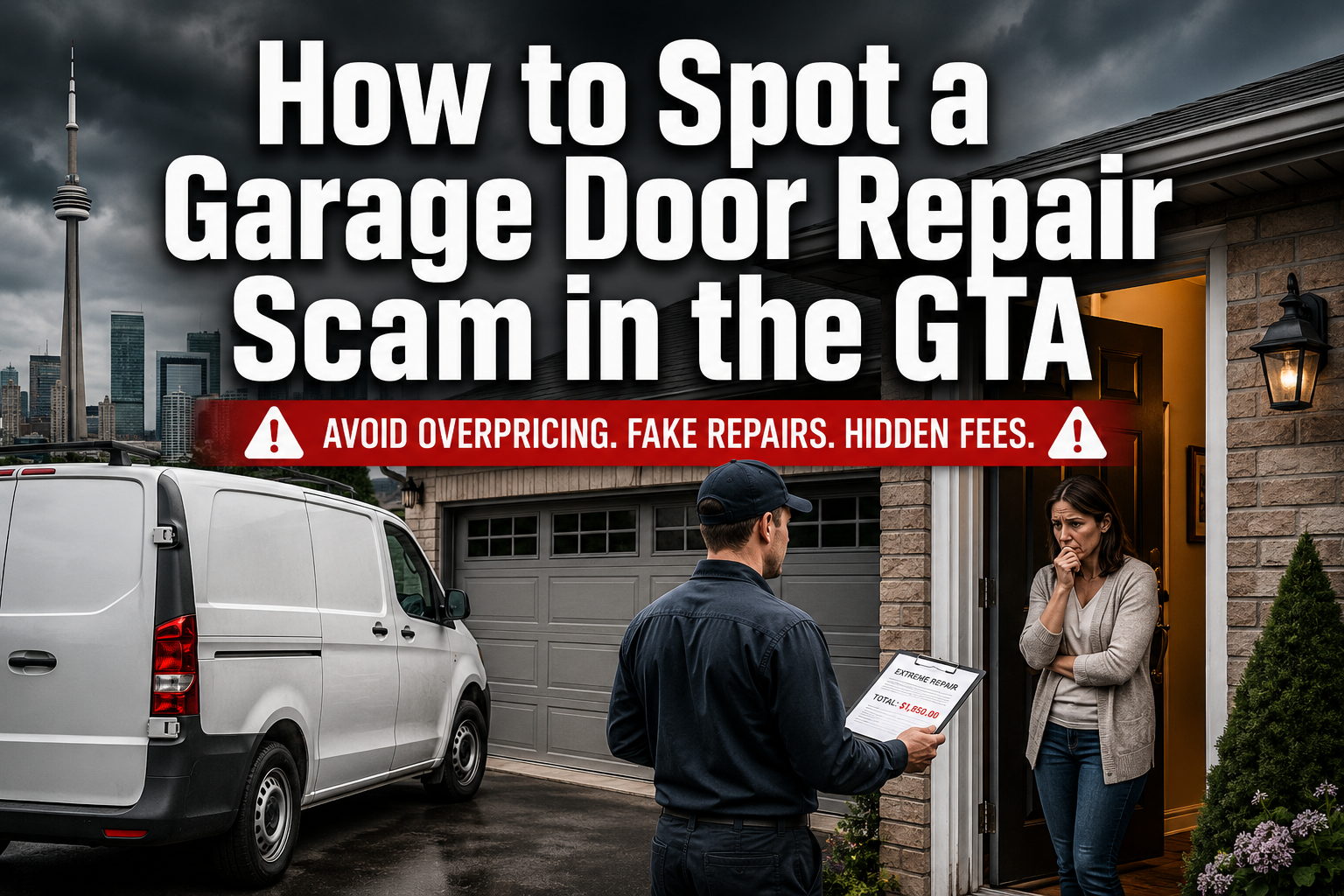
Garage door repair scams in the Greater Toronto Area follow predictable patterns: a suspiciously low service-call fee, a technician who suddenly discovers a long list of urgent problems, and a final invoice that can run into the thousands of dollars. Knowing how to spot a garage door repair scam in the GTA before you book a technician is the single most effective way to protect yourself. The key signals are inconsistent company branding, no verifiable physical address, high-pressure upselling, and vague or verbal-only quotes.
Key Takeaways
- Scam companies in the GTA frequently advertise under one name, answer the phone under another, and invoice under a third — inconsistent branding is a primary red flag.
- A legitimate service call in the GTA typically costs between $75 and $150 CAD; anything advertised at $20–$50 is almost certainly bait pricing designed to get a technician on your property.
- Spring replacement for a standard residential door should cost roughly $250–$450 CAD for parts and labor; invoices above $700–$800 for a single spring warrant serious scrutiny.
- Fake Google Business Profile listings with no real address are a documented and ongoing problem in Ontario — always cross-reference the company name, phone number, and address across multiple platforms before calling.
- The International Door Association (IDA) maintains a “Find a Pro” directory that lets homeowners verify legitimate member companies before booking.
- Always get a written, itemized quote before any work begins; refuse to authorize work based on a verbal estimate alone.
- Seniors are disproportionately targeted by garage door scammers in Ontario, according to warnings circulating in industry and consumer groups in 2026.
- Getting two or three quotes for any repair over $300 is standard practice and protects you from inflated pricing.
- Verify insurance and ask for the technician’s employer name, company address, and vehicle branding before they begin work.
- If a technician pressures you to decide immediately or claims your door is “dangerous” without showing you specific evidence, that is a pressure tactic, not a safety concern.
What Are the Most Common Garage Door Repair Scams in Toronto
The most common scams in Toronto and the broader GTA involve bait-and-switch pricing, fake local listings, and unnecessary part replacements. These tactics have been documented in consumer complaints, industry warnings, and social media posts throughout 2025 and 2026.
Bait-and-switch pricing is the most widespread tactic. A company advertises a $25–$50 service call, then the technician arrives and claims that cables, springs, rollers, and the opener all need immediate replacement. The final bill can easily reach $1,500–$2,000 for work that a reputable company would complete for $300–$500.
Fake local listings are a close second. In spring 2026, a GTA homeowner shared a detailed account of being charged approximately $1,700 CAD by a company trading online as “Doors Repair Burlington” and related domains. The company’s credit-card descriptor read “DOORS REPAIR MAPLE ON,” and its listed address at 7250 Keele St., Vaughan housed multiple unrelated renovation businesses with no garage door company present. This pattern — a legitimate-sounding local name attached to a virtual or shared address — is now one of the clearest warning signs in the GTA market.
Unnecessary part replacements are also common. A technician may show a homeowner a spring or cable and claim it is “about to snap” or “already failed,” even when the component is functional. Without a second opinion, most homeowners have no way to verify the claim on the spot.
Other documented scam patterns include:
- “Lifetime guarantee” schemes: Low-quality parts are installed with a vague lifetime warranty. The scammer then bills repeatedly for “warranty service” calls.
- Door-to-door cold calls: A technician claims to be “working in your neighborhood” and offers a free inspection, then manufactures urgent problems.
- Fake emergency services: Ads targeting people whose doors are stuck promise same-day response, then exploit the urgency to push inflated repairs. If you need legitimate emergency garage door repair, always verify the company first.
- Cluster listings: Multiple near-identical Google Business Profiles with generic names and shared phone numbers designed to dominate local search results.
How Much Should Garage Door Repair Cost in the GTA
Fair pricing for common garage door repairs in the GTA in 2026 falls within established ranges. Knowing these benchmarks before you call anyone is one of the most practical ways to spot a garage door repair scam in the GTA.
| Repair Type | Reasonable GTA Price Range (CAD) |
|---|---|
| Service / diagnostic call | $75 – $150 |
| Single torsion spring replacement | $250 – $450 |
| Double torsion spring replacement | $350 – $550 |
| Cable replacement (per cable) | $150 – $300 |
| Roller replacement (full set) | $150 – $250 |
| Opener repair (labor only) | $100 – $200 |
| Opener replacement (supply + install) | $350 – $700 |
| Panel replacement | $200 – $600 per panel |
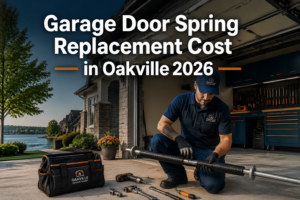
These are estimates based on typical market rates for the GTA region in 2026. Prices vary by door size, brand, and complexity. For a detailed breakdown of spring costs specifically, see this guide on garage door spring replacement costs in Oakville.
Common mistake: Accepting a verbal quote. Always ask for a written, itemized quote that lists the brand and model of any parts being installed, the labor cost separately, and any applicable taxes. A guide on how to read a garage door quote can help you understand exactly what each line item should cover.
If a quote is significantly higher than these ranges, ask the technician to explain each line item. An honest technician will do so without hesitation.
Red Flags to Watch for When Hiring a Garage Door Technician
Several clear warning signs indicate a fraudulent or predatory garage door company. Spotting these before work begins can save hundreds or thousands of dollars.
Before you book:
- The company advertises an unusually low service call fee ($20–$50 CAD range).
- The Google Business Profile has no street address, a shared commercial address, or an address that does not match the company website.
- The company name on the ad differs from the name on the website or the phone greeting.
- Reviews are overwhelmingly five-star but were all posted within a short window, or the company has no reviews older than six months.
- No company website exists, or the website was registered very recently.
When the technician arrives:
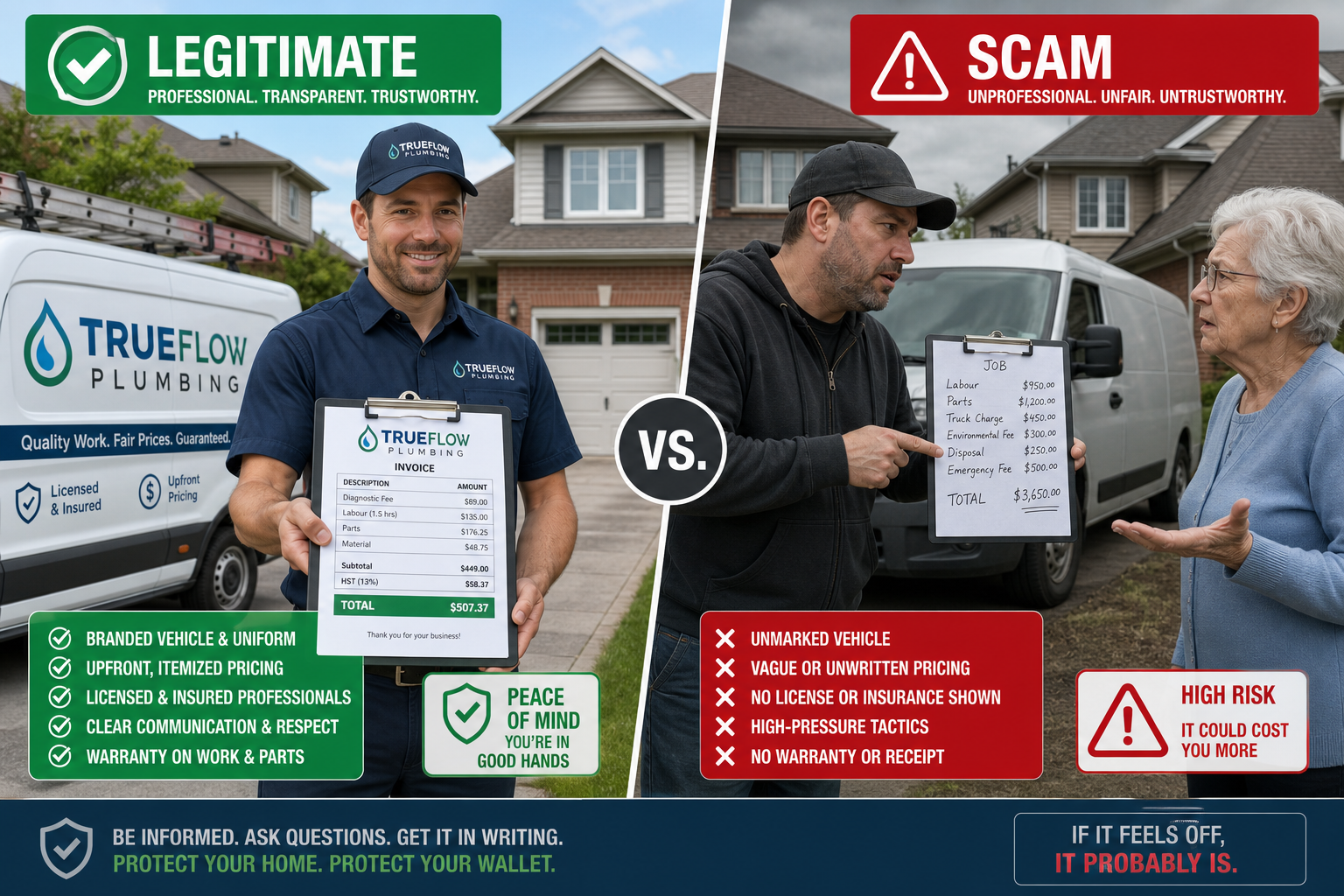
- The vehicle has no company branding, or the branding does not match the company name you booked.
- The technician cannot provide a business card or written company information.
- The technician immediately claims multiple components are broken without demonstrating the failures to you.
- You are pressured to approve work before receiving a written quote.
- The technician claims your door is “dangerous” and must be fixed right now, without showing you specific evidence of the hazard.
On the invoice:
- The company name on the invoice differs from the name you booked under.
- The credit-card descriptor is a different name from the company.
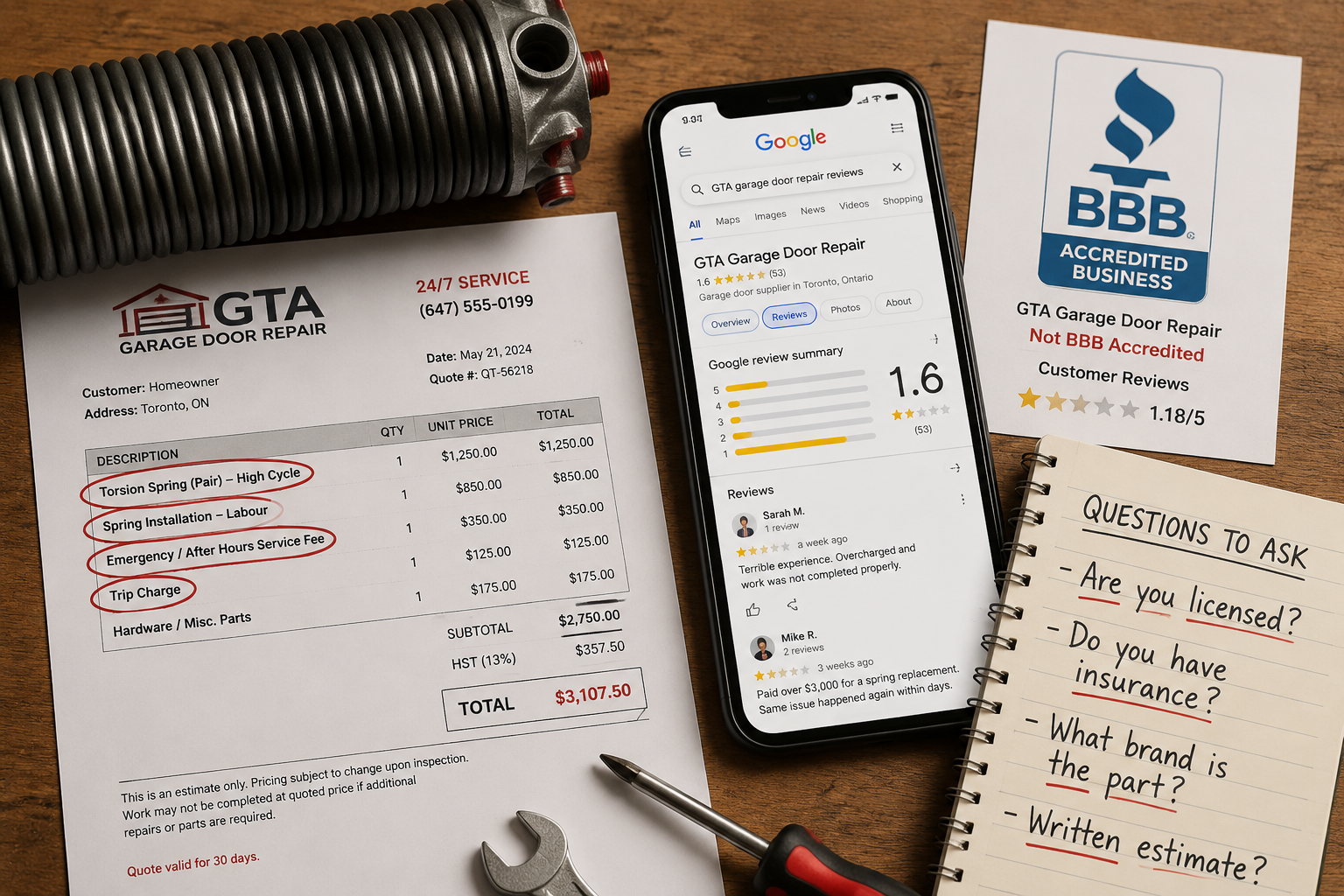
- Parts are listed without brand names or model numbers.
- Labor charges are bundled together with no breakdown.
What Questions Should You Ask a Garage Door Repair Company Before Hiring
Asking the right questions before booking filters out most scam operators quickly, because fraudulent companies cannot answer them consistently. A legitimate company will answer every one of these without hesitation.
Ask these questions when you call:
- What is the full legal name of your company?
- What is your physical business address (not a P.O. box)?
- Are you licensed and insured to work in Ontario?
- Can you provide proof of liability insurance before starting work?
- Will you provide a written, itemized quote before any work begins?
- What brand of parts do you use, and do they carry a manufacturer warranty?
- How long has your company been operating under this name?
- Are you a member of the International Door Association (IDA)?
Decision rule: If the person on the phone hesitates, gives vague answers, or cannot name a specific physical address, end the call and contact a different company. Legitimate dealers have a single, stable name across their website, phone greeting, paperwork, and vehicle signage. Scammers frequently answer as “garage doors” or “door service” rather than a proper company name.
Is My Garage Door Problem Actually Fixable, or Is It a Scam
Most common garage door problems are straightforward, affordable repairs. When a technician claims that a minor symptom requires a full system overhaul, that is often a scam rather than an accurate diagnosis.
Common problems and what they actually require:
- Door won’t open or close: Usually a spring, cable, or opener issue. A single broken spring is a one-component repair, not a reason to replace the entire door.
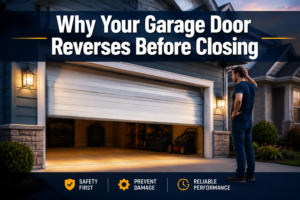
- Door reverses before closing: Often a sensor alignment or limit-switch adjustment. This is typically a $75–$150 service call, not a $500+ repair. See why your garage door reverses before closing for a full explanation.
- Loud grinding or squeaking: Usually requires lubrication or roller replacement, not a new door. A garage door tune-up covers most of these issues.
- Opener not responding: Often a dead battery, reprogram issue, or logic board fault. A full opener replacement is only warranted if the motor or drive is confirmed faulty.
- Broken spring: A real repair that does require professional service, but only the spring (and possibly cables) need replacing, not the door, opener, and rollers simultaneously.
Edge case: If a technician claims that a door is “beyond repair” and needs full replacement after a minor incident like a dented panel or a single broken spring, get a second opinion before agreeing to anything. Panel replacement is often a viable alternative to full door replacement. See garage door panel replacement for guidance on when panels can be swapped versus when a full door makes more sense.
How to Tell If Your Garage Door Spring Really Needs Replacing
A broken torsion spring is one of the most common genuine repairs, but it is also one of the most commonly faked or exaggerated by scam technicians. Knowing the real signs helps you verify whether the diagnosis is accurate.
Genuine signs of a broken or failing spring:
- The door is very heavy and barely moves when you disconnect the opener and try to lift it manually (a balanced door should lift smoothly with one hand).
- You heard a loud bang from the garage, often described as a gunshot sound — this is a spring snapping.
- There is a visible gap in the coil of the torsion spring above the door.
- The door opens a few inches and then stops, or one side hangs lower than the other.
- Cables have come off the drums, which often happens when a spring breaks.
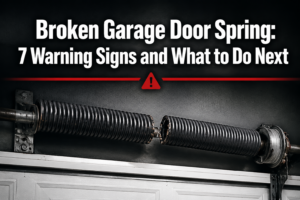
For a detailed breakdown of warning signs, see broken garage door spring: 7 warning signs and what to do next.
What a scammer might claim instead:
- That both springs must be replaced even when only one is broken (replacing both at the same time is actually reasonable advice for longevity, but the price should reflect two springs, not four).
- That the spring is “about to break” based on visual inspection alone, with no measurable evidence.
- That the spring failure has also damaged the opener, cables, rollers, and tracks — all requiring immediate replacement.
Decision rule: If a technician claims more than two components are simultaneously failing on a door that was working normally before the spring broke, ask them to demonstrate each failure specifically before authorizing any work.
How to Verify a Garage Door Repair Company Is Licensed in Ontario
Ontario does not currently require a specific provincial license for garage door repair technicians, but there are still several ways to verify that a company is legitimate and accountable.
Verification steps:
- Search the Ontario Business Registry at ontario.ca/businessregistry to confirm the company is a registered business entity. Cross-reference the legal name against what appears on their invoice and website.
- Check the IDA “Find a Pro” directory at the International Door Association website. On June 24, 2026, the IDA explicitly reminded consumers to verify any company against this database before calling, framing it as a direct scam-prevention tool.
- Check HomeStars (homeadvisor.ca or homestars.com) for verified reviews and the company’s rating history. Look for reviews that span multiple years, not just a recent cluster.
- Check the Better Business Bureau (bbb.org) for complaints and accreditation status.
- Verify liability insurance: Ask the company to email a certificate of insurance before the technician arrives. Any legitimate company carries general liability coverage.
- Confirm the physical address: Search the address on Google Maps Street View. If it shows a residential home, a parking lot, or an unrelated business, treat that as a serious warning sign.
What to look for in reviews: Consistent, long-term reviews across multiple platforms carry far more weight than testimonials shown only on the company’s own website, where they can be fabricated. A company with 200 reviews on HomeStars over five years is meaningfully different from one with 50 five-star Google reviews posted in the last three months.
What’s the Difference Between a Legitimate Repair and an Unnecessary Replacement
A legitimate repair addresses the specific component that has failed. An unnecessary replacement involves swapping out functional parts or recommending a full door replacement when repair is the appropriate solution.
Legitimate repair scenarios:
- Replacing a broken torsion spring and inspecting cables for wear at the same time.
- Replacing frayed or snapped lift cables.
- Repairing or replacing a faulty opener logic board or drive mechanism.
- Replacing worn rollers during a tune-up.
Unnecessary replacement red flags:
- Recommending a full door replacement because of a single dented panel or a broken spring.
- Insisting that an opener must be replaced because of a sensor issue that costs $30–$50 to fix.
- Replacing all rollers, cables, springs, and the opener simultaneously on a door that had one specific problem.
- Claiming that a door is “not up to code” without citing a specific Ontario Building Code provision.
The clearest test: Ask the technician to show you the failed component and explain exactly why it cannot be repaired. A broken spring has a visible gap. A snapped cable is obvious. A claim that something “looks worn” or “could fail soon” is not a diagnosis — it is a sales pitch.
Should You Get Multiple Quotes for Garage Door Repair
Yes, for any repair estimated above $300 CAD, getting two or three quotes is standard practice and is strongly recommended by consumer advocates and industry professionals alike.
Why multiple quotes matter:
- Price variation for the same repair among GTA companies can be significant. A spring replacement that one company quotes at $800 may be $350 at another.
- Getting a second opinion also helps confirm whether the diagnosis is accurate. If two independent technicians identify the same problem, the diagnosis is likely correct.
- The process of calling multiple companies also lets you compare how each one answers your questions — a company that is evasive or pushes you to book immediately before you can call others is showing a warning sign.
When multiple quotes are less critical:
- For a basic service call or tune-up under $150, the time cost of getting multiple quotes may not be worth it.
- In a genuine emergency where the door is stuck and security is at risk, prioritize a verified, reputable company over the cheapest available option. For urgent situations, same-day garage door repair services from a verified local provider are a safer choice than calling the first number that appears in an ad.
Common mistake: Accepting the first quote under time pressure. Scam operators deliberately create urgency (“I can only hold this price for today”) to prevent you from comparing options. A legitimate company will give you time to consider a written quote.
How Do Scammers Pressure You Into Expensive Garage Door Repairs
Pressure tactics are the operational core of most garage door scams. Recognizing them in the moment is critical because they are designed to override your normal decision-making.
The most common pressure tactics used in the GTA:
- Manufactured urgency: “Your spring is about to snap — if it goes while the door is moving, it could seriously injure someone.” This creates fear that makes homeowners authorize work immediately.
- The sunk-cost setup: The technician partially disassembles the door, then presents an inflated quote. The homeowner feels trapped because the door is now non-functional.
- The “working in your neighborhood” approach: A technician cold-calls or knocks on doors claiming to offer a free inspection, then finds problems that require immediate repair.
- Lowball-then-escalate: The advertised $30 service call becomes a $1,500 invoice once the technician is on site and has assessed the door.
- Social proof manipulation: “I just did your neighbor’s door last week — same problem.” This is unverifiable and designed to build false trust quickly.
How to respond: Tell the technician you need to review the written quote before authorizing anything, and that you will call them back. A legitimate technician will leave the quote with you. A scammer will escalate pressure or claim the price will change if you wait.
Can You Repair Your Garage Door Yourself Instead of Calling Someone
Some garage door repairs are safe for a competent homeowner to attempt; others are genuinely dangerous and should only be handled by a trained technician.
DIY-appropriate tasks:
- Lubricating hinges, rollers, and tracks (use a silicone or lithium-based lubricant appropriate for Ontario’s climate — see best garage door lubricant for Ontario).
- Reprogramming a keypad or remote.
- Realigning safety sensors.
- Tightening loose hardware.
- Replacing weather stripping.
Tasks that require a professional:
- Torsion spring replacement is the most important item on this list. Torsion springs are under extreme tension and can cause serious injury or death if handled incorrectly. This is not a liability disclaimer — it is a genuine mechanical hazard that industry professionals and safety organizations consistently flag.
- Cable replacement, because cables are directly connected to the spring system and carry the same tension risks.
- Opener motor or logic board replacement if it involves electrical work beyond a simple plug-in unit.
Practical guidance: Before calling anyone, search the specific symptom your door is showing. A quick search for the symptom often reveals whether it is a $10 DIY fix or a legitimate professional repair. This also helps you walk into any service call with enough knowledge to recognize when a technician’s diagnosis does not match the actual problem.
What Certifications Should a Real Garage Door Technician Have
Ontario does not mandate a specific trade license for garage door technicians, but professional certifications and affiliations provide meaningful indicators of legitimacy and competence.
Credentials worth looking for:
- IDA membership: The International Door Association is the primary industry body for garage door professionals in North America. Member companies agree to a code of ethics and can be verified through the IDA’s public directory.
- IDEA certification: The Institute of Door Dealer Education and Accreditation offers training and certification programs for garage door technicians. IDEA-certified technicians have completed structured training in installation, repair, and safety.
- WSIB coverage: In Ontario, any company with employees must be registered with the Workplace Safety and Insurance Board. Ask for the company’s WSIB account number and verify it at wsib.ca.
- General liability insurance: While not a certification, a certificate of liability insurance from a recognized insurer is a baseline requirement for any legitimate contractor working on your property.
What the absence of credentials means: A company that cannot point to any of the above is not automatically a scam, but it is operating without external accountability. Combined with other red flags, the absence of verifiable credentials should weigh heavily in your decision.
Garage Door Repair Companies to Watch Out for in the GTA
Rather than naming every bad actor (which changes frequently as scam operations rebrand), the more useful approach is to understand the documented patterns that have appeared in the GTA market in 2025 and 2026.
Documented patterns from 2026:
- In April 2026, warnings circulated in Ontario homeowner groups about a company operating as “C&A Garage Door Repair and Locksmith (10797359 CANADA INC.)” that was allegedly charging seniors many times the normal rate for basic repairs across Ontario, including the GTA. The warnings, which included a video published by a legitimate Ontario garage door company, described systematic overcharging targeting older homeowners.
- A separate April 2026 incident involved a company advertising as “Doors Repair Burlington,” “Doors Repair Newmarket,” and “Doors Repair Oakville,” all routing to the same credit-card descriptor (“DOORS REPAIR MAPLE ON”) and a shared address at 7250 Keele St., Vaughan that housed no actual garage door business.
- In early 2026, industry advocates highlighted clusters of fake Google Business Profiles with generic names that remained active for weeks despite being reported, dominating local search results for GTA garage door repair.
How to protect yourself specifically:
- Search the company name plus “scam” or “complaint” before booking.
- Verify the address on Google Maps Street View.
- Check whether the same phone number appears under multiple company names in search results — this is a strong indicator of a scam operation.
- Cross-reference the company name across its ad, website, phone greeting, and invoice. Any mismatch is a warning sign.
Conclusion
Knowing how to spot a garage door repair scam in the GTA is not complicated, but it does require a few deliberate steps before and during any service call. The patterns are consistent: bait pricing, fake local listings, manufactured urgency, and invoices that bear no resemblance to fair market rates.
Actionable next steps:
- Before calling anyone, look up the company on the Ontario Business Registry, HomeStars, and the IDA “Find a Pro” directory.
- Ask the company directly for their physical address, proof of liability insurance, and WSIB account number. Note how they respond.
- Request a written, itemized quote before authorizing any work. Do not allow partial disassembly before you have a quote in hand.
- For any repair over $300, get at least two quotes from verified companies.
- If you are unsure whether a diagnosis is accurate, ask the technician to show you the specific failed component and explain why it cannot be repaired.
- If you feel pressured, end the service call. You are entitled to stop at any point before authorizing work.
- If you believe you have been scammed, file a complaint with the Better Business Bureau, the Ontario Ministry of Public and Business Service Delivery’s consumer protection branch, and leave a detailed public review to warn other homeowners.
For homeowners in the GTA who want a verified, transparent repair experience, working with a local company that has a stable name, branded vehicles, and a verifiable address is the most reliable protection against the scams described in this article.
Frequently Asked Questions
How do I know if a garage door repair company is legitimate in the GTA? Check the Ontario Business Registry for their registered name, verify them on the IDA “Find a Pro” directory, and confirm their physical address on Google Maps Street View. A legitimate company will have consistent branding across their ad, website, phone greeting, and invoice.
What is a fair service call fee for garage door repair in Toronto? A fair diagnostic or service call fee in the GTA in 2026 is typically $75–$150 CAD. Any advertised fee below $50 is almost certainly bait pricing intended to get a technician on your property before presenting a much larger quote.
Is it safe to replace a garage door spring myself? No. Torsion springs are under extreme mechanical tension and can cause serious injury or death if handled without proper training and tools. Spring replacement should always be done by a qualified technician.
What should I do if I think I was overcharged for garage door repair? File a complaint with the Better Business Bureau (bbb.org), the Ontario Ministry of Public and Business Service Delivery’s consumer protection branch, and your credit card company if you want to dispute the charge. Leave a detailed public review to protect other homeowners.
Why do scam garage door companies use different names on their ads versus their invoices? Using different names makes it harder for consumers to trace complaints back to the company and allows the operation to rebrand quickly when negative reviews accumulate. Consistent naming across all touchpoints is a baseline marker of legitimacy.
How many quotes should I get for garage door repair? For any repair estimated above $300 CAD, get at least two or three quotes from verified companies. For basic service calls under $150, one quote from a verified company is generally sufficient.
Can a garage door company refuse to give a written quote? Legitimate companies will always provide a written, itemized quote on request. Refusing to do so, or insisting on verbal-only pricing, is a significant warning sign.
What is the IDA “Find a Pro” directory? The International Door Association (IDA) maintains a public directory of member companies who have agreed to a professional code of ethics. Searching this directory before booking is a recommended verification step. The IDA explicitly promoted this tool as a scam-prevention resource in June 2026.
Are seniors specifically targeted by garage door scammers in Ontario? Yes. Warnings circulating in Ontario in 2026 specifically identified seniors as a primary target demographic for garage door scam operations, with at least one named company allegedly charging many times the normal rate for basic repairs when dealing with older homeowners.
What does it mean if a garage door company has no branded vehicle? An unmarked vehicle is not automatically a scam indicator for a small independent operator, but combined with other red flags — no written quote, inconsistent company name, high-pressure tactics — it reinforces concern. Established companies with multiple technicians typically use branded vehicles.
How do fake Google Business Profile listings work for garage door scams? Scam operators create multiple Google Business Profiles using generic names, fake or shared addresses, and local phone numbers. These listings appear in local search results and Google Maps, giving the impression of a nearby, established business. The phone number often routes to a call center that dispatches technicians with no local presence.
What should I do if a technician starts work before I approve a quote? Stop the work immediately and ask for a written quote before anything proceeds. You are not obligated to pay for unauthorized work. If the technician refuses to stop or becomes aggressive, contact local police.
References
- International Door Association (IDA). “Find a Pro” member directory and scam awareness resources. ida.com. June 2026.
- Ontario Ministry of Public and Business Service Delivery. Ontario Business Registry. ontario.ca/businessregistry.
- Better Business Bureau Canada. Consumer complaint and accreditation database. bbb.org.
- HomeStars. Verified contractor reviews, Canada. homestars.com.
- Government of Canada. Bill C-244 and Bill C-294, Copyright Act amendments supporting right to repair. 2024.
- Ontario Legislative Assembly. Bill 91, Right to Repair Act, 2025.
- CBC Marketplace. Garage door repair scam investigation, Greater Toronto Area. (Referenced in r/PersonalFinanceCanada community discussion.)
- Institute of Door Dealer Education and Accreditation (IDEA). Technician training and certification program overview. idea.org.
- Workplace Safety and Insurance Board (WSIB) Ontario. Employer registration and verification. wsib.ca.