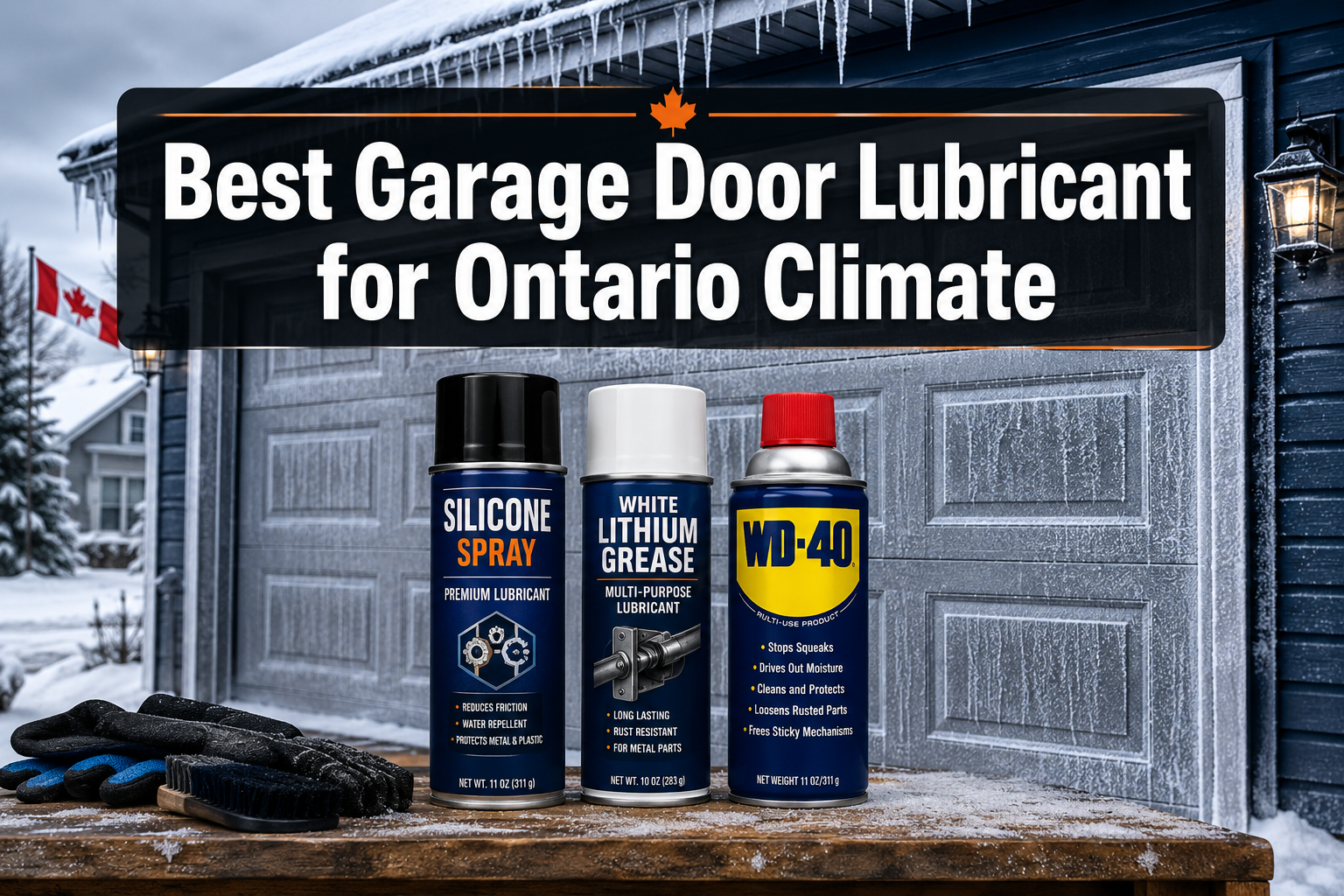
For Ontario’s climate, silicone-based spray is the top choice for most garage door parts, especially in winter. It stays fluid well below freezing, won’t attract grime, and is safe on rubber, nylon, and painted metal. Lithium grease is the better pick for heavy metal-on-metal components like torsion springs. Standard WD-40 (the classic blue-and-yellow can) is not a lubricant for ongoing use — it’s a water displacer and cleaner that dries out quickly and can leave parts worse off over time.
Key Takeaway
- Silicone spray is the best all-around lubricant for Ontario garage doors: it stays effective from roughly -50°C to +200°C, won’t stiffen in cold, and is safe on nylon rollers, rubber weather-stripping, and painted panels.
- White lithium grease is the professional’s choice for torsion springs, hinges, and other heavy metal-on-metal contact points where a thicker film is needed.
- Standard WD-40 is a degreaser and water displacer, not a long-term lubricant. Using it as one can dry out seals and leave parts under-protected within weeks.
- WD-40’s own Specialist line (white lithium grease spray, silicone spray) is a completely different product from the classic formula and is appropriate for garage door use.
- Ontario winters regularly bring temperatures below -20°C. A lubricant that stiffens or gums up at those temperatures will increase strain on your opener motor and accelerate hardware wear.
- Lubricate your garage door at least twice a year in Ontario: once before winter (October/November) and once in spring (March/April). High-use doors benefit from a third application mid-summer.
- Never lubricate nylon roller surfaces directly with petroleum-based products — they can degrade the plastic over time. Silicone spray is the safe option here.
- Using the wrong lubricant can, in some cases, void manufacturer warranties on openers and door hardware.
- Purpose-built garage door lubricants (like 3-IN-ONE Professional or Blaster Garage Door Lubricant) are worth the modest price premium over generic sprays.
- If your door is grinding, squealing, or moving unevenly despite fresh lubrication, the issue may be mechanical — a worn spring or damaged roller — not just a lubrication problem.
What’s the Difference Between Silicone and Lithium Lubricant for Garage Doors?
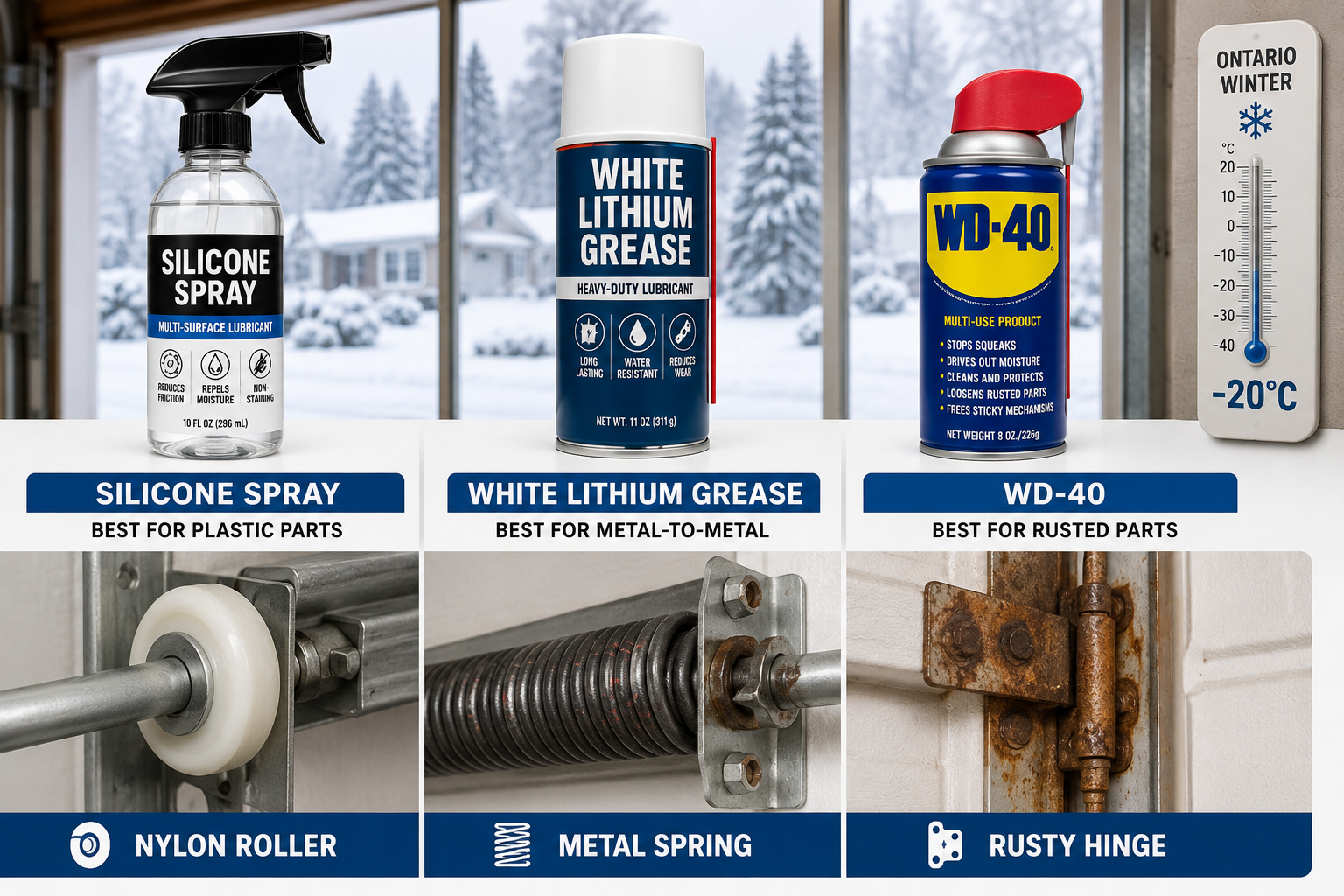
Silicone lubricant is a synthetic, water-thin spray that coats surfaces with a clear, non-greasy film. White lithium grease is a thicker, petroleum-based compound that clings to metal surfaces under heavy load. Both are legitimate lubricants for garage doors, but they suit different parts and conditions.
Silicone Spray
- Base: Synthetic silicone polymer
- Consistency: Very thin, clear, dries to a light film
- Best for: Nylon rollers, rubber weather-stripping, vinyl tracks, painted panels, hinges, cables
- Temperature range: Remains effective in extreme cold (well below -40°C) and high heat
- Dirt attraction: Very low — silicone doesn’t grab dust or grit the way grease does
- Material safety: Safe on rubber, plastic, nylon, and most painted metals
White Lithium Grease
- Base: Petroleum or synthetic oil thickened with lithium soap
- Consistency: Thick, white, paste-like or spray foam
- Best for: Torsion springs, metal hinges, metal-on-metal contact points, drive screws on openers
- Temperature range: Good cold performance, though thicker grades can slow slightly below -20°C
- Dirt attraction: Moderate — the thicker film can collect grit over time, especially on tracks
- Material safety: Can degrade some plastics and rubber with prolonged contact; avoid on nylon roller bearings
Choose silicone if: Your door has nylon rollers, rubber seals, or mixed materials. It’s also the better choice if you want a product that stays clean and doesn’t need frequent reapplication.
Choose lithium grease if: You’re working on torsion springs, bare metal hinges, or a screw-drive opener rail where a thick, clinging film is needed.
How Do Winter Temperatures in Ontario Affect Garage Door Lubrication?
Ontario winters are genuinely harsh on garage door hardware. Southern Ontario (Hamilton, Burlington, Oakville, Mississauga) regularly sees -15°C to -25°C during January and February, while Northern Ontario can drop below -35°C. At those temperatures, the wrong lubricant doesn’t just underperform — it can actively make things worse.
Here’s what cold does to common lubricants:
| Lubricant Type | Behaviour at -20°C | Risk |
|---|---|---|
| Silicone spray | Stays fluid, clear film intact | Very low |
| White lithium grease (spray) | Slight thickening, still functional | Low |
| Petroleum-based grease (generic) | Stiffens significantly | High — increases motor strain |
| Standard WD-40 | Evaporates quickly, leaves no protective film | High — parts run dry |
| 3-IN-ONE oil (standard) | Thickens, may congeal on tracks | Moderate |
When a lubricant stiffens in cold weather, your garage door opener motor works harder to move the door. Over a winter season, that extra strain accelerates wear on the motor, drive belt or chain, and the door’s moving parts. If you’ve noticed your door moving slower or sounding louder in January than in July, inadequate cold-weather lubrication is a likely cause.
Industry professionals who work in cold climates consistently recommend silicone-based lubricants for tracks, rollers, and seals in sub-zero conditions. The reasoning is straightforward: silicone doesn’t stiffen, doesn’t attract the salt and grit that Ontario roads and driveways generate all winter, and won’t freeze into a gummy residue on your tracks.
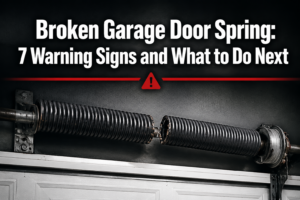
For torsion springs specifically — which are under enormous tension year-round — a quality white lithium grease maintains its protective film through freeze-thaw cycles better than standard petroleum oils. If you’re dealing with spring wear or fatigue, that’s a separate issue from lubrication; see this guide on broken garage door spring warning signs for what to watch for.
Which Lubricant Works Best When It’s Below Freezing Outside?
Silicone-based spray is the clear winner for below-freezing conditions. Its synthetic base doesn’t thicken or congeal in cold, and it stays bonded to surfaces even when temperatures swing rapidly — which is exactly what happens in Ontario during late fall and early spring.
Multiple garage door service professionals and industry suppliers specifically call out silicone as the preferred cold-weather lubricant. The reasoning is consistent: silicone remains fluid at temperatures that would cause petroleum-based products to stiffen, and it doesn’t attract the road salt and grit that get tracked into garages during Ontario winters.
Practical cold-weather lubrication tips:
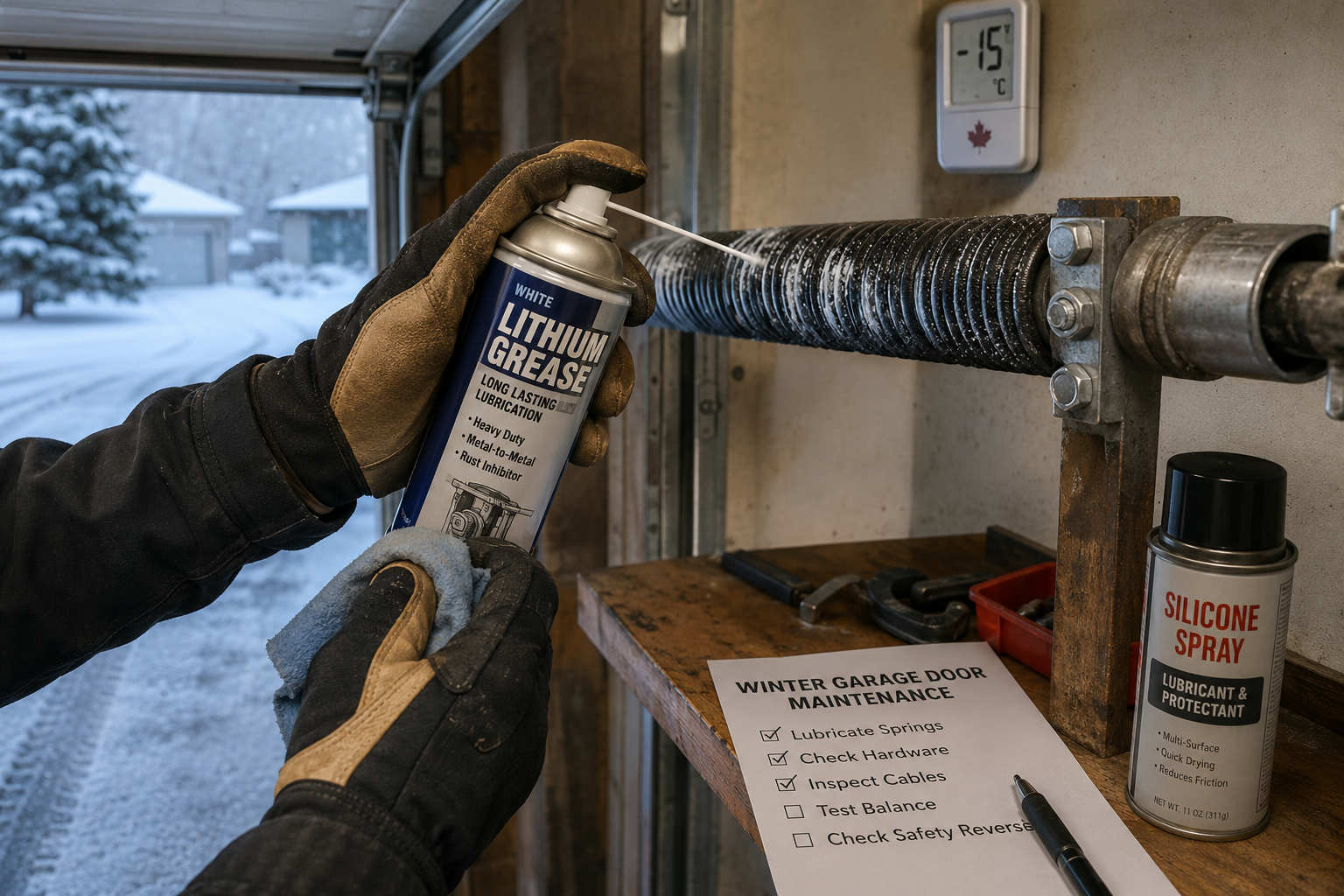
- Apply lubricant before the first hard freeze — ideally in October or early November. Cold metal is harder to coat evenly.
- Warm the garage slightly before applying if temperatures are already below -10°C. Even running the car for a few minutes raises the ambient temperature enough to help the lubricant penetrate.
- Wipe tracks clean first. Salt, sand, and old gummy lubricant residue should be removed before applying fresh product. A rag dampened with the classic WD-40 formula works well as a cleaner here — just don’t leave it as the lubricant.
- Apply a light, even coat — more is not better. Excess lubricant on tracks collects grit and can cause the door to slip.
- Test the door manually after application to confirm smooth movement before relying on the opener.
Can WD-40 Actually Damage My Garage Door Hardware?
Yes — using standard WD-40 as an ongoing lubricant for garage door parts can cause real damage over time. The classic WD-40 formula is primarily a water displacer and penetrating solvent. It does provide very short-term lubrication, but it evaporates quickly and leaves metal surfaces essentially dry within days or weeks.
Here’s the specific risk by component:
- Rubber weather-stripping: WD-40’s petroleum solvents can dry out and crack rubber seals, reducing their ability to keep out cold air, water, and pests.
- Nylon rollers: Repeated solvent exposure can weaken the plastic, leading to cracking or premature wear.
- Springs: WD-40 evaporates and leaves no lasting film. Springs that run dry under high tension wear faster and are more prone to fatigue cracking. For more on spring health, see garage door spring repair in Oakville.
- Tracks: WD-40 can loosen old grease and grit, which then redistributes onto the track surface and creates an abrasive slurry.
The important distinction: WD-40’s Specialist product line — including their White Lithium Grease Spray and Silicone Lubricant Spray — is formulated differently from the classic product and is appropriate for garage door use. The label matters. If the can says “WD-40 Specialist,” it’s a different product entirely.
💡 Rule of thumb: Use classic WD-40 to clean and degrease parts before lubrication. Then follow up with a purpose-built silicone or lithium product as the actual lubricant.
How Often Should You Lubricate a Garage Door in Ontario’s Cold Climate?
In Ontario, lubricate your garage door at minimum twice per year: once in fall before freezing temperatures arrive, and once in spring after the last hard freeze. High-use doors (used four or more times daily) benefit from a third application in mid-summer.
A simple schedule that works for most Ontario homeowners:
| Season | Timing | Focus Areas |
|---|---|---|
| Fall | October–early November | Full lubrication of all moving parts before first freeze |
| Spring | March–April | Clean off winter grime, re-lubricate all parts |
| Summer (optional) | July | Light re-application on springs and hinges for high-use doors |
Signs you should lubricate sooner than scheduled:
- The door makes grinding, squeaking, or scraping noises during operation
- Movement feels jerky or uneven
- The opener motor sounds like it’s working harder than usual
- You can see dry, rust-coloured residue on springs or hinges
If lubrication doesn’t resolve these symptoms within a cycle or two, the issue is likely mechanical. A worn roller, misaligned track, or fatigued spring won’t be fixed by any lubricant. In that case, it’s worth getting a professional assessment — same-day garage door repair is available across the Oakville and Hamilton area for situations that need more than maintenance.
Are There Special Lubricants for Metal vs Plastic Garage Door Parts?
Yes — the material matters, and using the wrong lubricant on plastic or rubber components can accelerate wear. This is one of the most commonly overlooked aspects of garage door maintenance.
Metal Components (springs, hinges, tracks, cables)
- White lithium grease: Best for springs and metal hinges where a thick, clinging film is needed under load.
- Silicone spray: Works well on metal tracks and cable surfaces; leaves a clean, non-sticky film.
- Avoid: Heavy petroleum greases (like axle grease or bearing grease) — they’re too thick, attract grit, and are hard to remove.
Plastic and Nylon Components (nylon rollers, plastic brackets)
- Silicone spray: The only safe choice for nylon roller bearings and plastic hardware. It lubricates without degrading the material.
- Avoid: Petroleum-based lithium greases on nylon roller surfaces — they can cause the plastic to swell or crack over time.
- Avoid: Standard WD-40 on plastic — the solvents can weaken the material with repeated use.
Rubber Components (weather-stripping, bottom seal)
- Silicone spray: Safe and effective. Keeps rubber supple and prevents cracking in cold weather.
- Avoid: Any petroleum-based product on rubber seals. They dry out and degrade rubber.
Quick reference:
| Component | Best Lubricant | Avoid |
|---|---|---|
| Torsion/extension springs | White lithium grease | Standard WD-40, petroleum grease |
| Metal hinges | White lithium grease or silicone | Heavy grease |
| Nylon rollers (bearing) | Silicone spray | Lithium grease, WD-40 |
| Metal tracks | Silicone spray (light coat) | Any heavy grease |
| Cables | Silicone spray | Heavy grease |
| Weather-stripping | Silicone spray | Petroleum products |
| Opener drive chain/belt | White lithium grease (chain only) | Silicone (insufficient for chain) |
Can I Use the Same Lubricant for Hinges and Rollers?
Silicone spray is the one product that works safely on both hinges and rollers, making it the most practical single-product solution for most homeowners. However, the ideal lubricant differs slightly depending on whether your rollers are nylon or metal.
- Nylon rollers + metal hinges: Use silicone spray on both. It’s safe for the nylon and effective enough for the hinge pivot points.
- Metal rollers + metal hinges: Either silicone spray or white lithium grease works. Lithium grease provides a longer-lasting film on metal-on-metal contact.
- If you want one product for the whole door: Choose a purpose-built garage door lubricant spray (like 3-IN-ONE Professional Garage Door Lubricant or Blaster Garage Door Lubricant). These are formulated to be safe across all door materials and components.
The one exception: opener drive chains. A chain-drive opener requires a heavier lubricant — white lithium grease specifically — because the chain is under load and needs a film that won’t fling off. Belt-drive and screw-drive openers have their own lubrication requirements outlined in the opener manual. For opener-specific issues, garage door opener repair may be needed if lubrication alone doesn’t resolve the problem.
What Common Mistakes Do Homeowners Make When Lubricating Garage Doors?
The most common mistake is using the wrong product — specifically, reaching for standard WD-40 because it’s already in the garage. But there are several other errors that reduce effectiveness or cause damage.
Mistake 1: Lubricating the tracks Tracks should be clean, not lubricated. Applying grease or oil to the inside of the track creates a sticky surface that collects grit and causes the rollers to slip or bind. Wipe tracks clean with a dry rag or a small amount of WD-40 on a cloth, then leave them dry.
Mistake 2: Over-applying lubricant More product doesn’t mean better protection. Excess lubricant drips onto the floor, attracts dirt, and can get onto the door panels or driveway. A light, even coat is all that’s needed.
Mistake 3: Skipping the cleaning step Applying fresh lubricant over old, gummy residue just traps the old product in place. Always wipe down hinges, rollers, and springs with a clean rag before applying new lubricant.
Mistake 4: Lubricating the wrong side of the roller The roller stem (the shaft that goes through the hinge) needs lubrication. The roller wheel surface that contacts the track does not — especially for nylon rollers.
Mistake 5: Ignoring the bottom seal and weather-stripping These rubber components dry out and crack in Ontario winters, letting in cold air and moisture. A light application of silicone spray keeps them supple and extends their life.
Mistake 6: Not testing the door after lubrication Always run the door through two or three full cycles after lubricating to distribute the product evenly and confirm the door moves smoothly. If it still sounds rough or moves unevenly, the problem is mechanical, not lubrication-related. Check for signs you need garage door repair if symptoms persist.
Will a Bad Lubricant Void My Garage Door Warranty?
Yes, in some cases it can. Most garage door opener manufacturers and door hardware suppliers specify approved lubricant types in their warranty documentation. Using a product that damages seals, degrades plastic components, or causes corrosion can give the manufacturer grounds to deny a warranty claim.
The most common warranty-relevant scenarios:
- Opener warranties: Many opener manufacturers (LiftMaster, Chamberlain, Genie) specify silicone or lithium-based lubricants for the rail and drive components. Using a petroleum solvent that damages the rail’s plastic components can void coverage.
- Roller warranties: Nylon roller manufacturers typically specify silicone-only lubrication. Petroleum-based products that crack or swell the nylon may void the roller warranty.
- Spring warranties: Less common, but some spring manufacturers note that certain chemical lubricants can affect the temper of the steel. Sticking to purpose-built garage door lubricants avoids this risk.
Practical advice: Check the warranty documentation that came with your door, opener, and hardware. If it’s not available, the manufacturer’s website typically lists approved maintenance products. When in doubt, a purpose-built garage door lubricant (clearly labelled as such) is the safest choice for warranty compliance.
Is It Worth Paying More for a Professional-Grade Lubricant?
For most Ontario homeowners, yes — the price difference is small and the performance gap is meaningful. Purpose-built garage door lubricants typically cost between $10 and $20 CAD per can at hardware stores. Generic silicone sprays or WD-40 run $6 to $12. The gap is roughly $5 to $10 per application, and a single can typically covers two or three full maintenance sessions.
What you get with a purpose-built product:
- Formulated temperature range: Products like Blaster Garage Door Lubricant and 3-IN-ONE Professional are specifically tested for the temperature extremes garage door hardware experiences — from Ontario winter lows to hot summer garage interiors.
- Material compatibility: Purpose-built formulas are tested across the mix of materials in modern garage doors (nylon, rubber, painted steel, galvanized hardware). Generic products may not be.
- Rust inhibitors: Many dedicated garage door lubricants include corrosion inhibitors that generic sprays don’t. This matters in Ontario where road salt gets tracked into garages from November through April.
- Warranty compliance: As noted above, purpose-built products are less likely to create warranty issues.
The products most commonly recommended by professional garage door technicians include:
- 3-IN-ONE Professional Garage Door Lubricant (silicone-based, widely available at Canadian Tire and Home Depot)
- Blaster Garage Door Lubricant (purpose-built, rust protection, safe on mixed materials)
- WD-40 Specialist White Lithium Grease Spray (for springs and metal components)
- WD-40 Specialist Silicone Lubricant (for rollers, seals, and tracks)
How Do You Know If Your Current Garage Door Lubricant Is Failing?
The clearest signs are noise, resistance, and visible residue. A properly lubricated garage door in good mechanical condition should open and close quietly and smoothly. When the lubricant stops working, the door tells you.
Warning signs to watch for:
- Squeaking or grinding during operation — metal-on-metal contact from dried-out hinges or rollers
- Jerky or uneven movement — stiff hinges or rollers not rolling freely
- Louder opener motor — the motor working harder to overcome friction
- Visible rust or orange residue on springs, hinges, or roller stems
- Gummy black or brown buildup on hinges or tracks — old lubricant mixed with grit
- Stiff or cracked weather-stripping — rubber that hasn’t been maintained with silicone
- Door moving slower in January than in July — lubricant that has stiffened in cold
If you see rust on springs or cables, lubrication alone may not be enough. Rust compromises the structural integrity of springs and cables, which are under significant tension. This is a safety issue, not just a maintenance one. See garage door cable replacement: cost, signs, and safety risks if cables show visible wear.
Do Professional Technicians Recommend Silicone or Lithium Spray?
Most professional garage door technicians recommend both — but for different parts. The consistent professional guidance is: silicone for rollers, seals, tracks, and cables; lithium grease for springs, metal hinges, and chain-drive opener rails.
The professional consensus also draws a clear line between the classic WD-40 formula and proper lubricants. Experienced technicians describe standard WD-40 as “more of a cleaner than a lubricant” — useful for removing old grease and rust, but not appropriate as an ongoing protective product. This view is consistent across garage door service companies across Ontario and North America.
For chain-drive openers specifically, white lithium grease is the near-universal professional recommendation. The chain is under load and needs a film that clings and doesn’t fling off at speed. Silicone spray is too thin for this application.
For everything else — rollers, hinges, springs, cables, weather-stripping — the split between silicone and lithium depends on the material, with silicone winning on versatility and cold-weather performance.
If you’re unsure whether your door needs maintenance or a more significant repair, a professional inspection can identify issues before they become emergencies. Emergency garage door repair is available for situations that can’t wait.
What Are the Cheapest Garage Door Lubricants That Still Work Well?
A $10–$15 can of purpose-built garage door lubricant is genuinely the budget-smart choice — it outperforms generic alternatives and lasts through multiple applications.
Budget options that deliver real performance:
- 3-IN-ONE Professional Garage Door Lubricant (~$12–$15 CAD): Widely available, silicone-based, safe on all door materials. The straw applicator makes it easy to hit hinges and roller stems precisely.
- WD-40 Specialist Silicone Spray (~$10–$14 CAD): Effective, widely available at Canadian Tire, Home Depot, and Walmart. Not the same as classic WD-40.
- Blaster Garage Door Lubricant (~$10–$13 CAD): Purpose-built with rust inhibitors. Good value for Ontario conditions.
What to avoid at the budget end:
- Generic “household oil” or 3-IN-ONE standard oil (not the garage door version) — too thin, no cold-weather additives
- Cooking spray or petroleum jelly — not appropriate for mechanical components
- Classic WD-40 as a lubricant — false economy, as it evaporates quickly and requires more frequent reapplication
The math is simple: a $12 can of proper lubricant applied twice a year costs about $24 annually. A single service call for a worn roller or damaged spring that proper maintenance could have prevented costs several hundred dollars. For context on repair costs in the region, see how much does garage door spring replacement cost in Oakville in 2026.
FAQ: Best Garage Door Lubricant for Ontario Climate
Q: Can I use vegetable oil or cooking spray as a garage door lubricant? No. Cooking oils go rancid, attract insects, and leave a sticky residue that collects grit. They’re not appropriate for mechanical components and will cause more problems than they solve.
Q: How long does garage door lubricant last in Ontario winters? A quality silicone or lithium spray applied in October should last through the winter season (roughly 4–5 months) under normal use. High-use doors or doors exposed to extreme cold may benefit from a mid-winter check.
Q: Should I lubricate the garage door tracks? No. Tracks should be kept clean and dry. Lubricating tracks causes rollers to slip and attracts grit. Wipe tracks clean with a dry cloth; do not apply lubricant inside the track channel.
Q: My garage door squeaks only in cold weather. What’s causing it? This is almost always a lubricant that has stiffened in cold temperatures. Switch to a silicone-based spray rated for sub-zero conditions and apply it before the next cold snap.
Q: Is silicone spray safe on painted garage door panels? Yes. Silicone spray is safe on painted metal and won’t stain or discolour the finish. Avoid spraying it on the exterior panel surface itself — focus the application on hinges, rollers, and moving hardware.
Q: How much lubricant should I apply to each hinge? A short 1–2 second spray directly at the hinge pivot point is enough. Wipe away any excess with a rag. More product does not mean better protection.
Q: Can I lubricate a garage door in freezing temperatures? It’s better to apply lubricant before temperatures drop. If the door is already frozen or stiff, bring the garage temperature up slightly before applying lubricant so it can penetrate the joints properly.
Q: Do I need to lubricate a new garage door? New doors come with factory lubrication, but it’s worth applying a fresh coat of silicone spray to rollers and weather-stripping after the first 30–60 days of use, and then following the regular twice-yearly schedule.
Q: What happens if I never lubricate my garage door? Without regular lubrication, metal components corrode, rollers wear out faster, hinges develop play, and springs fatigue more quickly. In Ontario’s climate, unlubricated doors are also more likely to freeze or bind in winter, putting extra strain on the opener motor.
Q: Is white lithium grease safe on rubber weather-stripping? No. Use silicone spray on rubber seals and weather-stripping. Petroleum-based lithium grease can dry out and degrade rubber over time.
Q: How do I remove old, gummy lubricant buildup before applying fresh product? Spray a small amount of classic WD-40 (the original formula) onto a rag and wipe down the affected area. It dissolves old grease and grime effectively. Let it dry or wipe clean before applying your new silicone or lithium product.
Q: Can lubricant fix a garage door that reverses before closing? Probably not. A door that reverses before closing is usually responding to a sensor, force setting, or mechanical obstruction issue. See why your garage door reverses before closing and how to fix it for a full diagnostic guide.
Conclusion: Choosing the Right Lubricant for Ontario Conditions
Ontario’s climate demands more from garage door maintenance than most homeowners realize. The combination of deep winter cold, road salt, freeze-thaw cycles, and high seasonal humidity creates conditions that quickly expose the limits of generic lubricants.
The practical takeaway is straightforward:
- Use silicone spray as your primary lubricant for rollers, weather-stripping, cables, and tracks. It’s the safest, most versatile option for Ontario’s temperature range.
- Use white lithium grease on torsion springs, metal hinges, and chain-drive opener rails where a thicker film is needed.
- Keep classic WD-40 in the garage — but use it as a cleaner and degreaser before lubrication, not as the lubricant itself.
- Lubricate twice a year at minimum: once in fall before the first freeze, once in spring after the last hard frost.
- Buy a purpose-built garage door lubricant rather than a generic spray. The $5–$10 price difference is trivial compared to the cost of premature hardware wear.
If lubrication doesn’t resolve noise, stiffness, or uneven movement, the problem is mechanical. Worn rollers, fatigued springs, and damaged cables don’t get better with maintenance products — they need professional attention. Catching those issues early is far less expensive than an emergency call in January when the door won’t open.