Last updated: May 28, 2026
Quick Answer: Bronte garage door installation for lakefront homes requires more than a standard product swap. Homes near Lake Ontario face elevated humidity, airborne moisture, wind-driven weather, and freeze-thaw cycles that accelerate corrosion and mechanical wear. Choosing the right materials, insulation rating, and wind resistance — and having the door installed by someone familiar with waterfront conditions — is what separates a 20-year door from one that fails in five.
Key Takeaways
- Lakefront homes in Bronte face unique stressors: salt-laden air, high humidity, lake-effect wind gusts, and rapid temperature swings.
- Standard steel doors without corrosion-resistant coatings or wind ratings are a poor fit for waterfront properties.
- Galvanized steel, aluminum, or fiberglass doors with marine-grade or powder-coat finishes are the top material choices.
- Insulated doors rated R-12 to R-18 are strongly recommended for garages adjacent to living space near the lake.
- Wind-rated doors (tested to ANSI/DASMA 108 or ASTM E330) provide measurable protection against lake-effect gusts and severe storms.
- A monthly freshwater rinse of all visible hardware is the single most effective low-cost maintenance step for waterfront garage doors.
- Expect to pay a 15–30% premium over inland installation costs for a properly specified lakefront door.
- Hire an installer with demonstrated experience in waterfront or high-humidity environments, not just the lowest bidder.
- Neglecting maintenance in a humid lake environment can cut a door’s lifespan by half.
- Smart opener upgrades add convenience but should also be corrosion-rated for damp environments.
What Makes Garage Door Installation Different for Lakefront Homes?
Lakefront garage door installation in Bronte differs from inland projects because the environment itself becomes an active threat to every component of the door system. Lake Ontario generates persistent humidity, airborne moisture, and chloride particles that attack metal surfaces, seals, and mechanical parts year-round.
Three factors set lakefront installations apart:
- Corrosion pressure — Moisture and chloride loads near the lake are significantly higher than even a few kilometres inland. Standard galvanized coatings that last decades inland can show rust within a few years at the waterfront without proper specification.
- Wind exposure — Bronte’s shoreline is directly exposed to westerly and southwesterly winds off Lake Ontario. Gusts during storms can reach speeds that standard non-rated doors are not designed to handle.
- Thermal cycling — The lake moderates temperature somewhat, but freeze-thaw cycles still stress weatherstripping, panel joints, and hardware. Moisture trapped in these joints accelerates the damage.
Common mistake: Many homeowners treat a lakefront garage door purchase the same as any other home improvement — picking based on appearance and price. Without accounting for the waterfront environment, even a premium-looking door can fail prematurely.
For homeowners in the broader Oakville and Bronte area, working with a team that understands local conditions is essential. See the full range of garage door installation options in Oakville to understand what a properly specified installation looks like.
Best Materials to Prevent Rust and Water Damage in Bronte Waterfront Homes
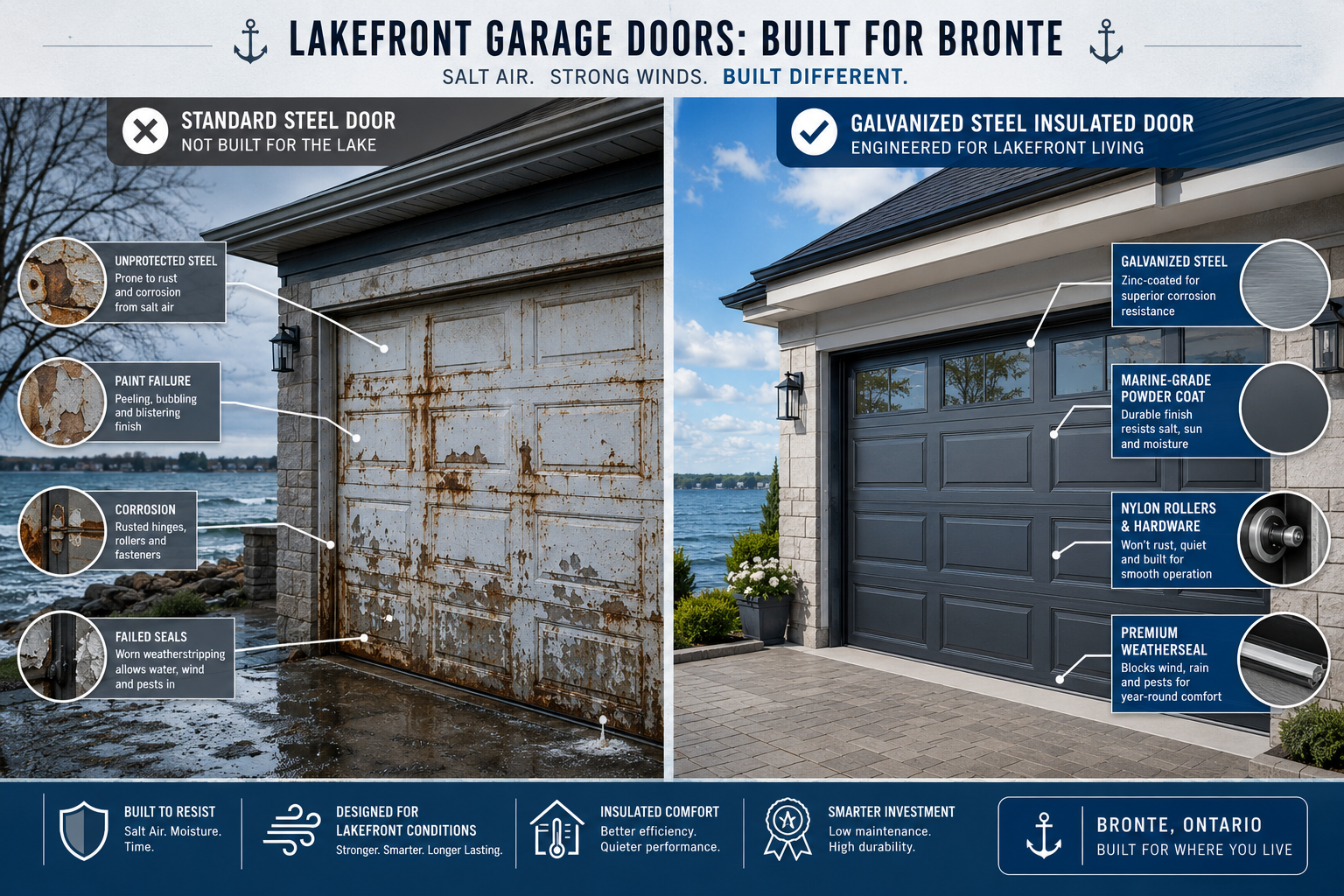
For Bronte lakefront homes, galvanized steel with a marine-grade powder-coat finish, aluminum, or fiberglass are the three materials that consistently outperform standard options in high-moisture environments. Each has trade-offs worth understanding before committing.
| Material | Corrosion Resistance | Insulation Potential | Weight | Relative Cost |
|---|---|---|---|---|
| Galvanized steel (powder-coat) | High | High (with foam fill) | Medium-Heavy | Moderate |
| Aluminum | Very High | Moderate | Light | Moderate-High |
| Fiberglass | Excellent | Moderate | Light | High |
| Standard steel (painted) | Low | Moderate | Medium | Low |
| Wood | Poor (without sealing) | Low | Heavy | Variable |
Key specifications to request:
- Galvanized or hot-dipped zinc coating on all steel panels and hardware
- Marine-grade or PVDF powder-coat finish — resists UV and moisture better than standard paint
- Nylon rollers instead of steel — they don’t rust and run quieter
- Stainless steel springs and cables where available, or zinc-coated alternatives
- Silicone-based lubricants for all moving parts (petroleum-based lubricants attract grit and degrade faster in humid conditions)
Choose aluminum if: the home is within 100 metres of the shoreline and aesthetics matter — aluminum doesn’t rust at all and accepts a wide range of finishes.
Choose galvanized steel if: insulation performance is a priority and budget is a constraint — it offers the best balance of durability and thermal performance per dollar.
Avoid: bare or lightly painted standard steel doors, and untreated wood, both of which require constant maintenance to survive a Bronte waterfront environment.
Do I Need Special Insulation for a Garage Door Near the Lake?
Yes — insulated garage doors are strongly recommended for lakefront homes in Bronte, especially when the garage is attached to the house or has living space above it. Lake-effect winters drive cold air and moisture against the garage door face, and a thin uninsulated door does little to protect the garage interior or the home’s overall thermal envelope.
What the numbers mean:
- R-6 to R-9: Adequate for detached garages used only for vehicle storage
- R-12 to R-16: Recommended for attached garages or garages below living space
- R-18+: Best choice when the garage is a heated workshop or has a finished interior
Higher R-values also reduce condensation on the door’s interior surface — a real problem in humid lakefront environments where temperature differentials between inside and outside can cause moisture to collect on uninsulated metal panels.
Construction type matters too. Look for doors with polyurethane foam injected between steel skins (two-layer construction) rather than polystyrene panels inserted into a frame (three-layer construction can be good, but verify the foam fill is continuous, not just inserts at the edges).
💡 Pro tip: Pair a high-R door with quality bottom and side weatherstripping rated for low-temperature flexibility. Standard rubber seals can stiffen and crack in cold lake-effect conditions, defeating the insulation benefit.
What Wind Resistance Ratings Should I Look for in a Lakeside Garage Door?
For Bronte lakefront properties, look for garage doors with tested wind pressure ratings and a label indicating compliance with ANSI/DASMA 108 or ASTM E330. A door without a tested pressure rating — in positive and negative pounds per square foot (PSF) — provides no reliable protection during severe lake-effect wind events.
Why this matters more than people expect:
Research from the Insurance Institute for Business & Home Safety (IBHS) has consistently shown that when a garage door fails in high winds, the resulting internal pressure increase dramatically raises the risk of roof and wall damage — a cascade effect that can turn a manageable storm event into a catastrophic loss. IBHS has confirmed that roughly 90% of homes whose garage door survived a severe wind event experienced no structural roof damage.
What to look for on the product label:
- Design pressure rating in +PSF / -PSF (positive and negative)
- Reference to a tested standard (ANSI/DASMA 108, ASTM E330, or TAS 202)
- Wind speed equivalency (some manufacturers use WindCode® ratings W1–W9)
For Bronte specifically: Ontario’s building code sets minimum design loads, but choosing a door rated above the code minimum is wise for shoreline-exposed properties. A door rated for approximately +23 / -29 PSF or higher for a standard single-car opening provides meaningful margin above typical storm conditions.
Common mistake: Assuming a door marketed as “heavy-duty” or “storm-resistant” without a tested PSF label actually meets any wind standard. If there’s no label, there’s no verified rating.
How Do Salt and Moisture Affect Garage Door Mechanisms?
Salt and moisture attack garage door mechanisms through two main pathways: direct corrosion of metal components and degradation of lubricants and seals. In Bronte’s lakefront environment, both processes happen faster than most homeowners expect.
What gets damaged first:
- Torsion springs — High-tension steel springs are among the most vulnerable components. Surface rust forms quickly in humid conditions and can cause premature fatigue and failure. A broken spring is one of the most common lakefront garage door problems; see this guide on broken garage door spring warning signs to know what to watch for.
- Cables and drums — Steel cables corrode from the inside out; by the time surface rust is visible, the cable may already be weakened. For more on this risk, the garage door cable replacement guide covers costs and safety considerations.
- Rollers and hinges — Steel rollers pit and seize; hinges develop rust that increases operating friction and strains the opener motor.
- Opener components — Electronic circuit boards and motor housings in openers not rated for damp environments can fail from condensation. Consider a smart garage door opener with a sealed or weather-resistant housing for lakefront installations.
- Bottom seal — Constant ground moisture and freeze-thaw cycles crack rubber seals, allowing water infiltration at the base.
The single most effective low-cost prevention step: A monthly freshwater rinse of all visible hardware — springs, hinges, rollers, tracks, and the door panels themselves — removes chloride deposits before they can initiate corrosion. This routine, recommended by coastal installation specialists, costs nothing but time and extends hardware life significantly.
Are There Specific Garage Door Styles That Work Best for Bronte Waterfront Properties?
For Bronte waterfront properties, raised-panel and flush-panel sectional doors in aluminum or galvanized steel with a contemporary finish tend to perform best — both aesthetically and functionally. Carriage-house style doors with decorative hardware also work well, provided the hardware is stainless steel or marine-grade coated.
Style considerations for lakefront homes:
- Sectional steel or aluminum doors are the most practical choice — they seal well, accept insulation easily, and are available in wind-rated configurations.
- Full-view aluminum and glass doors are popular on higher-end lakefront properties for the visual connection to the water. They require aluminum frames (not steel) and tempered or laminated glass panels rated for impact and wind pressure.
- Carriage-house style works well aesthetically with traditional Bronte architecture, but confirm all decorative hardware is stainless or powder-coated — cheap zinc hardware corrodes visibly within a season near the lake.
- Wood and wood-composite doors are a poor fit for waterfront unless the homeowner commits to annual sealing and finishing — the maintenance burden in a high-humidity environment is substantial.
Design tip: Darker door colors absorb more heat from the sun, which can help drive off surface moisture in damp conditions. Light colours look striking against a lake backdrop but may show water staining and mineral deposits more readily.
Can Standard Garage Doors Handle Lake Effect Weather Conditions?
Standard non-wind-rated sectional doors are not well-suited for Bronte’s lakefront conditions. Lake-effect weather can generate sustained winds and gusts that exceed what a standard door is designed to resist, and the persistent humidity accelerates the material degradation that eventually leads to mechanical failure.
The core problem with standard doors in lake-effect zones:
Most standard residential sectional doors carry no tested wind pressure rating at all. Industry experts and IBHS research confirm that non-rated doors may fail structurally in wind events that a properly rated door would survive. Once a door fails, the resulting internal pressure can compromise the entire building envelope — roof, walls, and all.
What “lake-effect” actually means for a garage door:
Lake Ontario generates lake-effect snow and rain events that combine high moisture with significant wind. These aren’t just aesthetic concerns — wet, wind-driven conditions stress door panels, seals, tracks, and hardware simultaneously. A standard door installed without wind rating or corrosion-resistant hardware will show accelerated wear within two to three seasons of lakefront exposure.
The retrofit option: If replacing a standard door isn’t immediately feasible, retrofit bracing kits can improve wind resistance at a lower upfront cost. However, only a fully tested wind-rated door carries a certified design-pressure label that satisfies insurance or building code requirements. Bracing kits are a temporary measure, not a permanent solution.
What Maintenance Is Required for a Garage Door Near the Water?
Lakefront garage doors in Bronte need more frequent maintenance than inland doors — roughly every three to four months rather than annually. The combination of humidity, airborne moisture, and temperature cycling means that standard annual service intervals leave too much time for corrosion and wear to accumulate undetected.
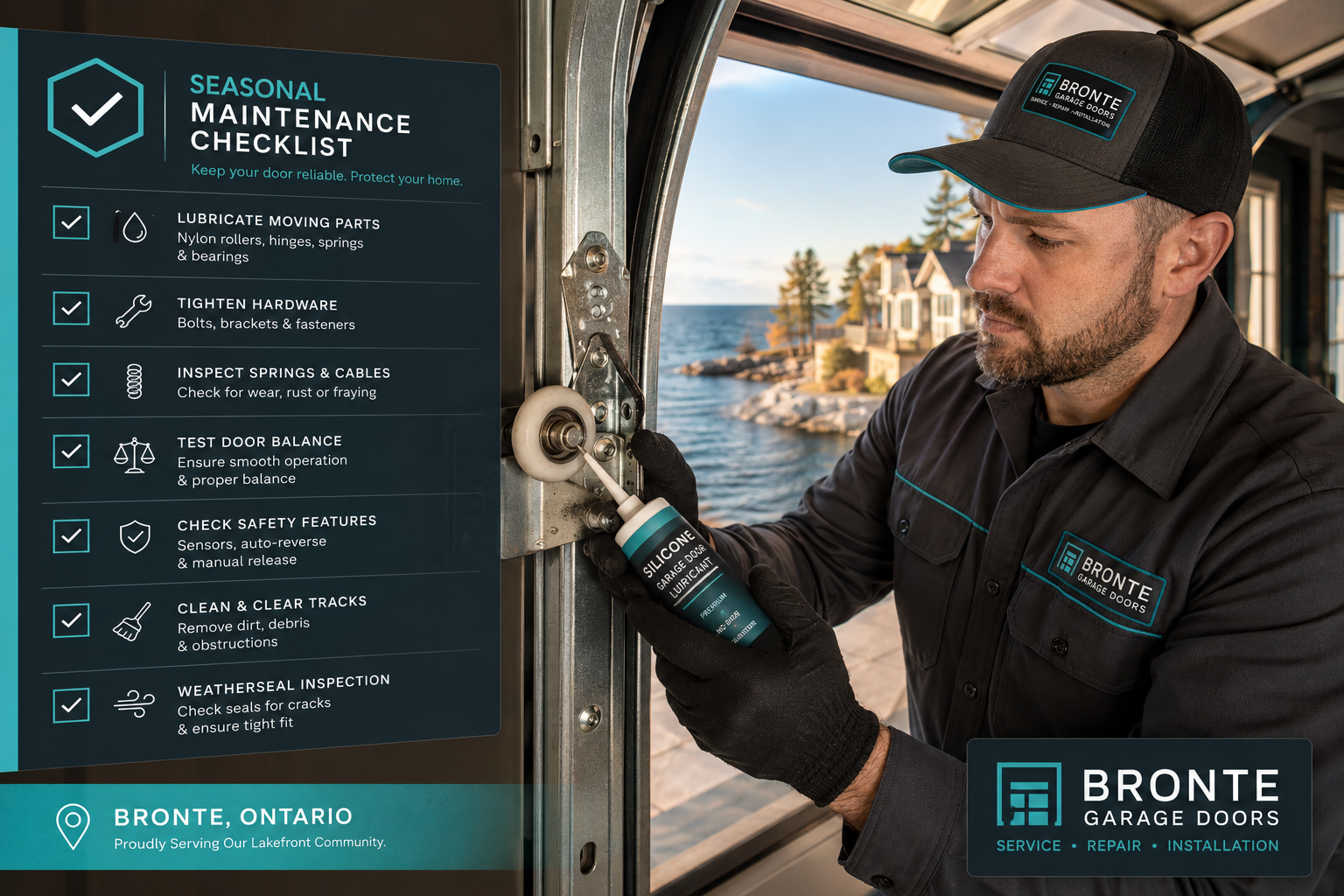
Seasonal maintenance checklist:
- ✅ Monthly: Freshwater rinse of all hardware, panels, and tracks to remove chloride deposits
- ✅ Every 3–4 months: Apply silicone-based lubricant to rollers, hinges, springs, and tracks
- ✅ Spring: Inspect weatherstripping for cracking or stiffening; replace if seals don’t compress evenly
- ✅ Fall: Check spring tension and cable condition before winter; cold amplifies any existing fatigue
- ✅ Annually: Full professional inspection of springs, cables, drums, opener, and panel alignment
Signs that service is overdue:
- Visible rust on springs, cables, or hinges
- Door hesitates, jerks, or makes grinding sounds during operation
- Gaps in the bottom seal when the door is closed
- Opener straining or running longer than usual to complete a cycle
If the door is reversing unexpectedly or behaving erratically, this guide on why garage doors reverse before closing covers the most common causes and fixes.
For urgent issues, same-day garage door repair in Oakville is available for lakefront homeowners who can’t wait on a standard service schedule.
Who Should Install Garage Doors for Lakefront Homes in Bronte?
Lakefront garage door installation in Bronte should be handled by an installer with specific experience in high-humidity or waterfront environments — not just any residential garage door company. The product selection, hardware choices, and installation details that matter at the waterfront are different from standard suburban installations.
What to look for in a Bronte lakefront installer:
- Experience with corrosion-resistant hardware and marine-grade finishes
- Familiarity with wind-rated door products and local building code requirements
- Willingness to specify and document the door’s wind pressure rating
- Knowledge of proper weatherstripping selection for freeze-thaw environments
- A clear maintenance plan provided at installation
Questions to ask before hiring:
- Have you installed doors on lakefront or waterfront properties before?
- Can you provide a door with a tested wind pressure rating (PSF label)?
- What hardware and finish specifications do you recommend for this location?
- What is included in the warranty, and does it cover corrosion?
Avoid: Installers who offer only standard product lines without discussing the waterfront environment, or who quote based solely on price without asking about the home’s location and exposure.
Oakview Garage Doors serves the Bronte and Oakville area with installation expertise suited to local waterfront conditions. Their Oakville garage door installation service covers product selection through final installation, including guidance on materials and ratings appropriate for lakefront homes.
How Much Does a Custom Garage Door Cost Near Lake Ontario, and What’s the Lakefront Premium?
A properly specified custom garage door installation for a lakefront home in Bronte typically costs 15–30% more than an equivalent inland installation, primarily due to upgraded materials, corrosion-resistant hardware, and wind-rated products. As a general estimate for 2026, expect total installed costs in the range of $2,500–$6,500+ CAD for a single-car door, depending on material, insulation level, and wind rating.
Cost breakdown by factor:
| Cost Factor | Inland Estimate | Lakefront Premium |
|---|---|---|
| Door panel (standard steel) | $800–$1,800 | +$200–$600 for marine-grade finish |
| Insulation upgrade (R-12+) | +$200–$400 | Same — already recommended |
| Wind-rated hardware/bracing | N/A | +$300–$700 |
| Stainless/nylon hardware | Minimal | +$150–$350 |
| Installation labour | $300–$600 | +$100–$200 (more complex spec) |
| Full-view aluminum/glass door | $3,000–$6,000+ | Higher end of range |
Note: These are estimates based on 2026 market conditions in the Oakville/Bronte area. Actual costs vary by supplier, door size, and site-specific requirements. Get at least two written quotes.
Where the money is well spent: Don’t cut corners on hardware. A premium door panel on cheap steel hardware in a lakefront environment will still fail early. The hardware upgrade is where the real durability gain comes from.
For context on related costs, the garage door spring replacement cost guide for Oakville in 2026 shows what reactive repairs cost when preventive specifications are skipped.
Common Mistakes Homeowners Make With Garage Doors in Humid Lake Environments
The most common mistake is treating a lakefront garage door purchase as a standard home improvement decision — choosing based on appearance and price without accounting for the waterfront environment. The second most common mistake is skipping maintenance once the door is installed.
The full list of mistakes worth avoiding:
- Buying a standard door without wind or pressure ratings — No label means no verified protection.
- Choosing steel hardware without corrosion-resistant coatings — Standard zinc-plated hardware rusts visibly within one to two seasons at the waterfront.
- Using petroleum-based lubricants — They attract grit, break down faster in humidity, and leave residue that accelerates wear.
- Ignoring weatherstripping until it fails completely — Degraded seals allow moisture infiltration that damages the garage interior and accelerates hardware corrosion from the inside.
- Annual-only maintenance — In a lakefront environment, annual service leaves too long a window for corrosion to develop between inspections.
- Assuming a “heavy-duty” marketing claim equals a wind rating — Only a tested PSF label on the door itself confirms wind resistance.
- Not asking about the opener’s environmental rating — Standard openers in damp environments can fail from condensation on circuit boards.
If a door is already showing signs of wear from lakefront exposure, garage door panel replacement in Oakville is one option to address cosmetic and structural damage before it spreads to the full door system.
FAQ: Bronte Garage Door Installation for Lakefront Homes
Q: Does lake air really cause that much more corrosion than regular outdoor exposure? Yes. Airborne moisture and chloride particles near Lake Ontario create a corrosive environment that is meaningfully more aggressive than typical suburban conditions. Metal components that last 15–20 years inland can show significant corrosion in 5–8 years without proper material specification and maintenance.
Q: Is a wind-rated door required by Ontario building code for lakefront homes? Ontario’s building code sets minimum design loads based on location and exposure. Shoreline properties in Bronte may fall into higher wind exposure categories that require rated products. Confirm requirements with your local building department or a qualified installer — and consider exceeding the minimum regardless.
Q: Can I add a wind brace kit to my existing standard door instead of replacing it? Retrofit bracing kits improve wind resistance and are a lower-cost option. However, they do not give the door a certified tested pressure rating. If insurance compliance or FORTIFIED-style resilience standards are a goal, only a fully tested wind-rated replacement door qualifies.
Q: How often should I lubricate a garage door near the lake? Every three to four months, using a silicone-based lubricant on rollers, hinges, springs, and tracks. In addition, rinse all visible hardware with fresh water monthly to remove chloride deposits before lubricating.
Q: Are glass panel garage doors a good choice for lakefront homes? Full-view aluminum and glass doors work well aesthetically and structurally on lakefront properties, provided the frame is aluminum (not steel) and the glass is tempered or laminated with an appropriate wind pressure rating. They require more frequent cleaning due to water spotting and mineral deposits.
Q: What R-value do I need for a garage door on a Bronte lakefront property? R-12 to R-16 for attached garages or garages below living space. R-18+ if the garage is a heated workspace. Uninsulated doors are acceptable only for detached storage garages with no adjacent living space.
Q: How long should a properly specified lakefront garage door last? A well-specified door with corrosion-resistant materials and regular maintenance should last 20–25 years in a Bronte lakefront environment. A standard door without proper specification or maintenance may need significant repair or replacement in 7–12 years.
Q: Do smart garage door openers work in the humid lakefront environment? Yes, but choose a model with a weather-resistant or sealed housing. Standard openers can suffer condensation-related circuit board failures in persistently damp environments. See the myQ Secure View smart lock review for one example of a modern smart opener evaluated for 2026 conditions.
Q: What should I do if my lakefront garage door fails during a storm? Stop using the door manually if the tracks or panels are visibly damaged — a compromised door can fail suddenly under load. Contact an emergency repair service. Emergency garage door repair in Oakville provides same-day response for urgent situations.
Q: Is fiberglass worth the higher cost for a Bronte waterfront home? Fiberglass offers excellent corrosion resistance and is lighter than steel, but it has lower insulation potential and can crack under impact in cold temperatures. It’s a strong choice for mild-climate lakefront homes but may not be the best fit for Bronte’s cold winters. Aluminum with a quality finish is often a better balance of durability and cost.
Conclusion: Getting Bronte Garage Door Installation Right the First Time
Bronte garage door installation for lakefront homes is a specialized project that rewards careful planning. The combination of Lake Ontario’s humidity, airborne chlorides, lake-effect winds, and freeze-thaw cycles creates a demanding environment that standard residential garage doors are simply not built for.
Actionable next steps:
- Assess your exposure. How close is the garage to the shoreline? Is it directly facing the lake? The closer and more exposed, the more critical every specification becomes.
- Specify the right materials. Galvanized steel with marine-grade powder-coat, aluminum, or fiberglass — with stainless or nylon hardware throughout.
- Confirm insulation and wind ratings. Request R-12 minimum for attached garages and a tested wind pressure rating (PSF label) for any shoreline-exposed property.
- Hire an experienced installer. Ask directly about waterfront installation experience and get the door’s wind rating documented in writing.
- Set up a maintenance schedule. Monthly freshwater rinse, quarterly lubrication with silicone-based product, and a professional inspection every spring and fall.
- Budget realistically. A 15–30% premium over inland costs is normal and worthwhile — it’s far less than the cost of premature failure and emergency repairs.
The right door, properly installed and maintained, will protect a Bronte lakefront home for two decades or more. The wrong door, chosen on price alone, can become an expensive problem within a few seasons.
For a consultation on installation options suited to Bronte and Oakville waterfront properties, contact Oakview Garage Doors to discuss specifications, wind ratings, and material choices for your specific location.