Last updated: June 8, 2026
Quick Answer
When one garage door spring breaks, replace both springs at the same time. Springs installed together age at the same rate, so if one has failed, the other is nearly worn out and will likely break within weeks or months. Replacing both in a single service call costs far less than paying for two separate visits, and it keeps the door balanced and safe.
Key Takeaways
- Replace both springs whenever they were installed at the same time, which is the case for the vast majority of residential garage doors.
- Springs share the same cycle count, so a surviving spring is almost always as worn as the one that just broke.
- Replacing both at once typically costs only slightly more than replacing one, but saves the full labor charge of a second call.
- The only reasonable exception is when the surviving spring is documented to be significantly newer and has far fewer cycles on it.
- Torsion springs (the horizontal bar above the door) and extension springs (the long springs along the tracks) both follow this same paired-replacement logic.
- DIY spring replacement carries serious injury risk. Roughly 20,000 Americans are injured each year attempting garage door repairs, with springs and cables among the leading causes.
- Standard springs last approximately 7 to 9 years or around 10,000 cycles under normal residential use.
- Heavy or oversized doors may require high-cycle springs rated for 25,000 to 100,000 cycles, and these should always be installed as a matched pair.
- Warning signs of a spring nearing failure include a door that moves unevenly, feels unusually heavy, or makes a loud bang during operation.
Why Do Garage Door Springs Break in the First Place?
Garage door springs break because of metal fatigue, not sudden force. Every time the door opens and closes, the spring completes one cycle. Standard springs are rated for roughly 10,000 cycles, which works out to about 7 to 9 years of typical residential use (two to four cycles per day). Once a spring reaches or exceeds that cycle rating, the metal becomes brittle and snaps, often without warning and sometimes with a loud bang loud enough to be mistaken for a gunshot inside the garage.
Several factors accelerate this wear:
- Rust and corrosion: Moisture causes surface rust that weakens the coils. Ontario’s freeze-thaw cycle is particularly hard on springs. Regular lubrication with a silicone or lithium-based product slows this process significantly. See the guide on best garage door lubricant for Ontario’s climate for product-specific advice.
- Improper spring sizing: A spring that is too light for the door’s weight wears out faster because it works harder on every cycle.
- Temperature swings: Cold weather makes metal less flexible. Springs in unheated garages in colder climates tend to break more often in winter.
- Lack of maintenance: Springs that are never lubricated or inspected wear faster and fail without warning.
Understanding why springs break explains why the surviving spring is almost never “fine.” It has been through exactly the same conditions and the same number of cycles as the one that just snapped.
Should You Replace One Spring or Both: The Honest Answer on Cost
Replacing both springs at once costs only modestly more than replacing one, and it almost always costs less than paying for two separate service calls. This is the core financial argument for paired replacement.
In the Oakville and Greater Toronto Area market, a single torsion spring replacement typically runs in the range of $150 to $300 CAD for parts and labor. Adding a second spring to the same job usually adds $50 to $100 in parts, with little or no additional labor charge because the technician is already on-site with the door disassembled. A second service call for the surviving spring, which could fail weeks or months later, would cost the full labor rate again.
For a detailed breakdown of current local pricing, the guide on garage door spring replacement cost in Oakville in 2026 covers parts, labor, and what to expect on your invoice.
Cost comparison summary:
| Scenario | Approximate Cost (CAD) |
|---|---|
| Replace one spring now | $150 – $250 |
| Second spring fails later, second call | $150 – $250 |
| Total for two separate calls | $300 – $500 |
| Replace both springs in one visit | $200 – $350 |
| Estimated savings from paired replacement | $100 – $150+ |
The numbers make the decision straightforward for most homeowners. Paying twice for two separate visits is simply poor value, and that does not account for the inconvenience of a second breakdown.
What Happens If You Only Replace One Spring?
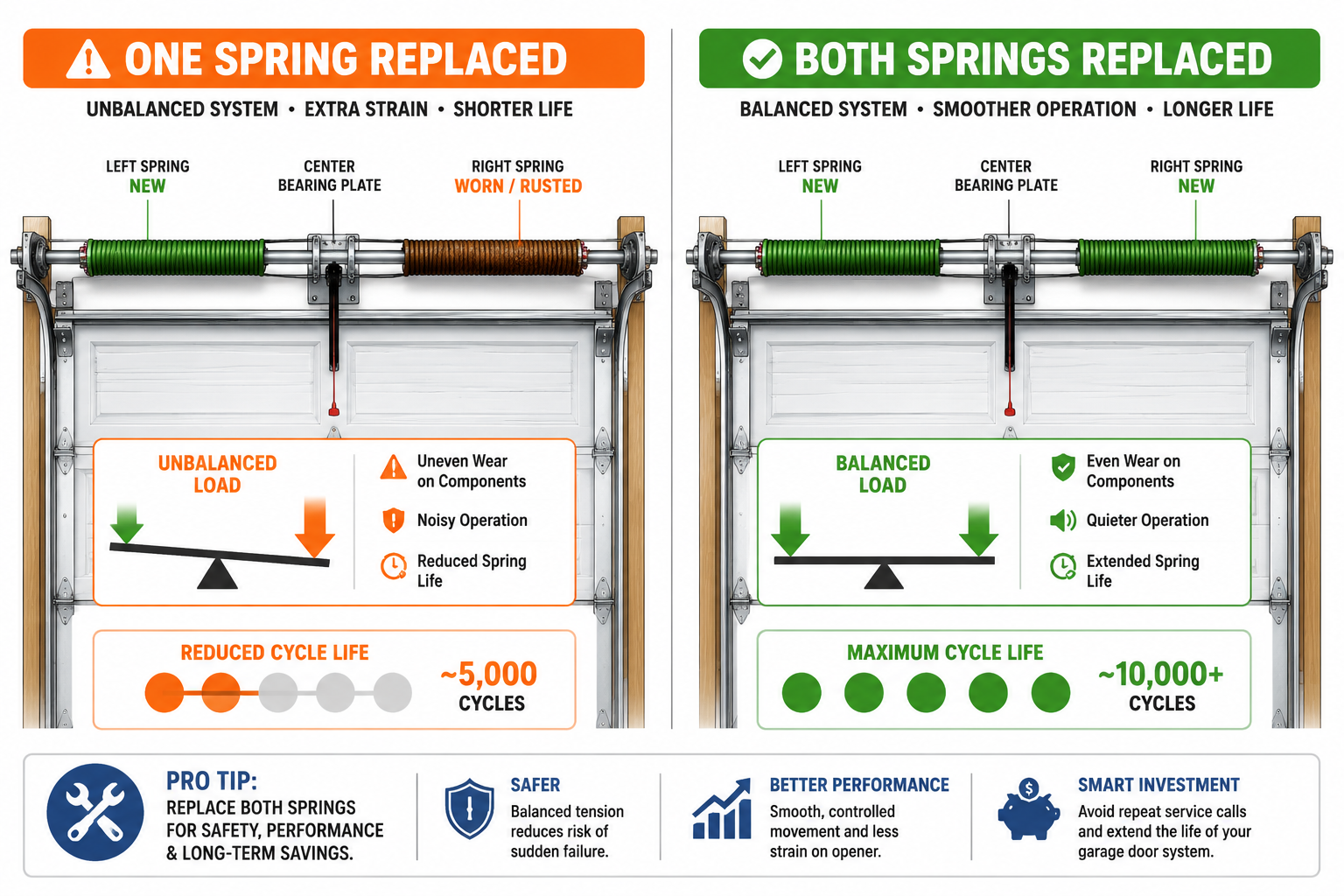
Replacing only one spring on a two-spring system creates two problems: imbalance and near-certain repeat failure.
Imbalance: A new spring and a worn spring have different tension levels. This forces the garage door opener to work harder, strains the cables, and causes the door to rise and lower unevenly. Over time, this uneven load can damage the opener motor, wear out the cables prematurely, and put stress on the door panels themselves. For related context on how cable wear connects to spring condition, see this overview of garage door cable replacement costs and safety risks.
Near-certain repeat failure: The surviving spring has logged the same number of cycles as the one that broke. It is, by definition, at or near the end of its service life. Most technicians who replace only one spring on a matched pair are essentially scheduling their own return visit. Industry consensus across multiple professional sources is consistent: if both springs were installed at the same time, replacing just one is false economy.
The one legitimate exception is when the surviving spring is documented to be significantly newer, which a trained technician can assess using spring color codes and service history. In that case, a professional may judge that the newer spring still has substantial life remaining and that replacement can wait. This is a judgment call that requires hands-on assessment, not a rule homeowners should apply on their own.
How Long Do Garage Door Springs Typically Last?
Standard residential garage door springs last approximately 10,000 cycles, which translates to roughly 7 to 9 years for a household that uses the door two to four times per day. This is the industry benchmark cited consistently across professional sources and spring manufacturers.
A few variables shift this range:
- Cycle frequency: A household that uses the garage as the primary entry point (six or more cycles per day) may wear through standard springs in four to five years.
- Spring quality: Budget springs may fall short of 10,000 cycles. High-cycle springs, rated for 25,000 to 100,000 cycles, last proportionally longer and are worth considering for heavy doors or high-use households.
- Maintenance: Lubricated, properly tensioned springs consistently outlast neglected ones.
- Door weight: Heavier doors (solid wood, heavily insulated steel) put more load on springs with every cycle.
Knowing the approximate age of the springs is useful context when deciding whether to replace one or both. If the door was installed eight years ago and the springs have never been replaced, both are near end of life regardless of which one broke first.
How to Tell Which Spring Needs to Be Replaced
A broken spring is usually obvious: the door will not open, the opener strains or trips its safety mechanism, and a visual inspection reveals a gap in the coil or a spring that is clearly separated. But identifying which spring failed (and assessing the condition of the surviving one) requires knowing what type of spring system the door uses.
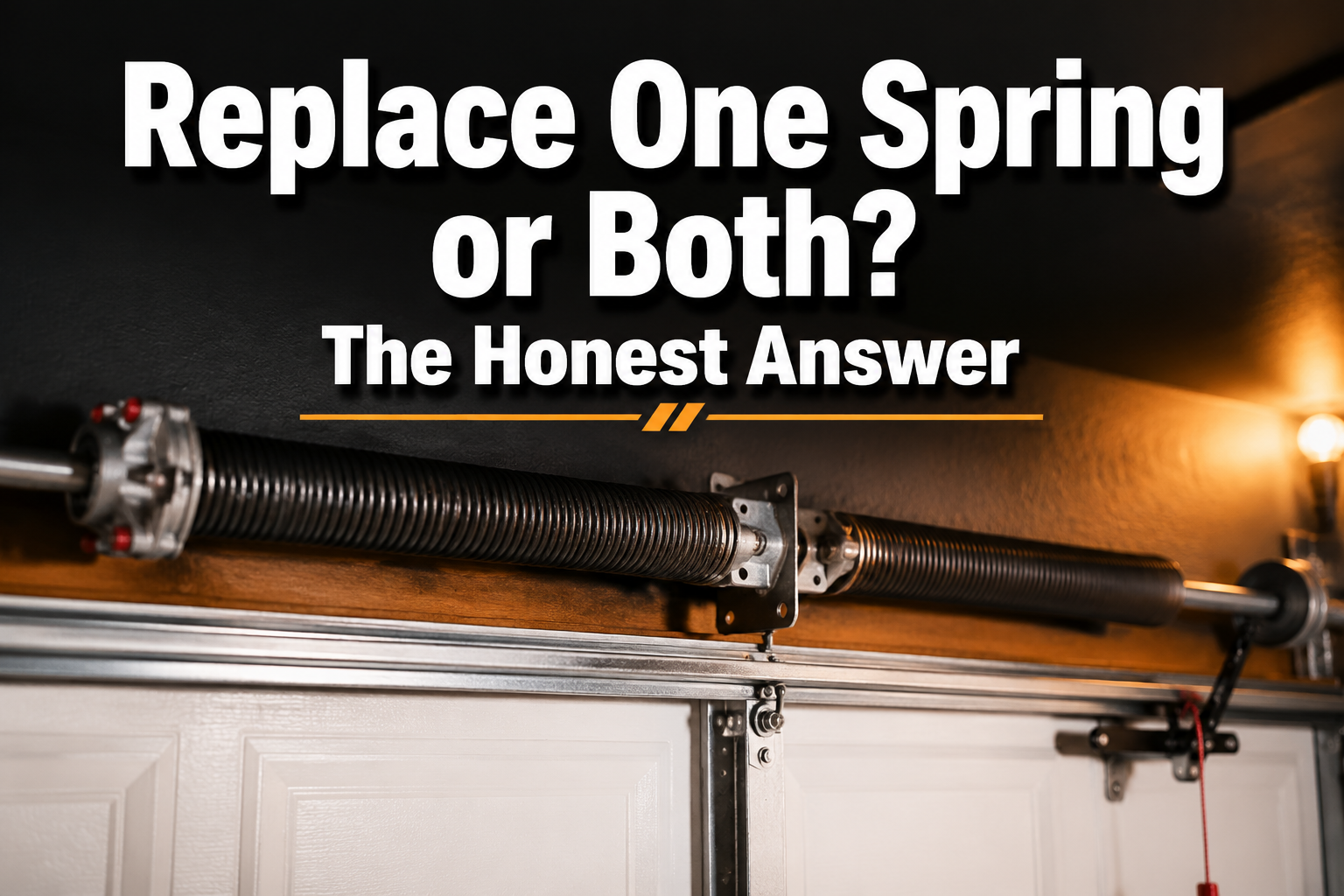
Torsion springs sit on a horizontal metal bar directly above the door opening. Most modern residential doors use one or two torsion springs. A broken torsion spring will show a visible gap in the coil, often near the center or at one end.
Extension springs run along the horizontal tracks on either side of the door. They stretch and contract as the door moves. A broken extension spring will appear slack, disconnected, or visibly snapped.
To assess the surviving spring’s condition:
- Look for rust, corrosion, or gaps forming in the coils.
- Check whether the door lifts evenly when manually disconnected from the opener.
- Ask the technician to check the spring’s color code, which indicates its cycle rating and approximate age.
For a full breakdown of warning signs before a spring fails completely, the article on broken garage door spring warning signs covers seven specific indicators to watch for.
Are Torsion Springs Different from Extension Springs When Replacing?
Yes, there are meaningful differences between torsion and extension spring systems, though the core replace-both recommendation applies to both types.
Torsion springs store energy by twisting around a steel shaft. They are more precise, longer-lasting, and safer than extension springs because the energy is contained on the shaft rather than released along the full length of the spring. Most professional installers prefer torsion systems for new installations.
Extension springs stretch along the tracks and are more common on older doors and lighter single-car doors. Because they run along each side of the door, a broken extension spring creates immediate imbalance and can cause the door to jam or drop on one side.
For extension springs, the replace-both argument is especially strong. An uneven extension spring system is more likely to cause the door to bind, jump off the tracks, or fall. For torsion springs, the same logic applies, but some professionals note that if one torsion spring is verifiably newer and the door still balances correctly, a replace-one approach is not catastrophically wrong. That said, the overwhelming professional consensus still favors replacing both torsion springs at the same time.
The distinction matters most when choosing replacement springs. Torsion and extension springs are not interchangeable, and the replacement spring must match the door’s weight, height, and track configuration precisely.
Should You Replace One Spring or Both: What the Professionals Say
Professional technicians, industry guides, and safety-focused sources are unusually consistent on this question. The honest answer is: replace both, and the reasoning is not an upsell.
The core argument from professionals across multiple sources:
- Both springs were installed at the same time and have completed the same number of cycles.
- If one has reached failure, the other is at or very near the same point.
- Returning for the second spring within months means paying full labor twice.
- A mismatched spring pair (one new, one worn) creates load imbalance that stresses the opener, cables, and door panels.
One nuance worth noting: some technicians draw a distinction between extension and torsion systems, suggesting that torsion systems can sometimes run acceptably with one older spring if the door balances correctly and the older spring passes a professional assessment. This is a minority position and applies only when there is documented evidence that the springs have meaningfully different installation dates.
For homeowners in Oakville and surrounding areas, the garage door spring repair service page provides local context on how technicians approach this assessment.
What Safety Risks Are Involved in Garage Door Spring Replacement?
Garage door spring replacement is one of the most dangerous DIY home repair tasks. Approximately 20,000 Americans are injured each year attempting garage door repairs, with springs and cables among the leading causes of serious injury. A torsion spring under full tension stores enough energy to cause severe lacerations, broken bones, and eye injuries if it releases suddenly.
Key safety risks:
- Sudden spring release: A torsion spring that slips during winding or unwinding can strike with significant force.
- Winding bar ejection: Improper use of winding bars (the rods used to wind torsion springs) can cause the bar to eject at high speed.
- Cable snap: Worn or improperly tensioned cables can snap when the spring tension changes, creating a secondary hazard.
- Door drop: A door that is not properly secured during spring work can fall, causing crush injuries.
For most homeowners, the correct answer is to hire a licensed technician. The cost of professional service is a fraction of the cost of an emergency room visit, and the job is done correctly the first time. If any signs of spring trouble appear, such as unusual noise, uneven movement, or a door that feels heavier than normal, see the 5 signs you need garage door repair now for guidance on when to call immediately.
Can You Replace a Garage Door Spring Yourself?
Technically, a mechanically skilled homeowner can replace a garage door spring, but it is not recommended and carries real injury risk. The tools required (winding bars, a sturdy ladder, proper spring sizing knowledge) are not commonly owned, and the margin for error is narrow.
If you are considering DIY spring replacement, consider these factors:
- Do you have the correct spring specifications (wire diameter, inside diameter, length, and wind direction)?
- Do you have proper winding bars? Using a screwdriver or improvised tool is a leading cause of injury.
- Is the door properly secured so it cannot fall during the repair?
- Do you understand how to safely unwind the remaining tension on the old spring before removing it?
For extension springs, DIY replacement is somewhat more approachable because the springs are under less tension and the system is simpler. For torsion springs, the energy stored is substantially higher and the technique is more precise. Most safety-focused sources recommend professional service for torsion systems without qualification.
If an emergency occurs, such as a spring breaking and the door being stuck open or shut, emergency garage door repair services are available for same-day response in the Oakville area.
What Type of Springs Work Best for Heavy Garage Doors?
Heavy garage doors, including solid wood doors, heavily insulated steel doors, and oversized double doors, require springs rated for higher load capacity and, ideally, higher cycle counts.
For heavy doors, consider:
- High-cycle torsion springs: Rated for 25,000 to 100,000 cycles versus the standard 10,000. These use thicker wire and are built to handle the additional load without premature fatigue.
- Dual torsion spring systems: Two torsion springs on the same shaft share the load, reducing stress on each spring and extending overall service life.
- Properly sized extension springs: If the door uses extension springs, the springs must be sized to match the door’s exact weight. Undersized springs wear out quickly and create safety risks.
When upgrading to high-cycle springs, always install them as a matched pair. Mismatched cycle ratings undermine the upgrade’s value because the lower-rated spring will fail first, leaving the door in the same imbalanced condition as before. This is especially relevant for homeowners investing in a premium spring upgrade who want the full benefit of the longer service life.
For homeowners considering a full door replacement alongside spring upgrades, the garage door installation options in Oakville page covers current supply and install options.
Common Mistakes People Make When Replacing Garage Door Springs
Even when homeowners make the right call to hire a professional, certain mistakes in the process can lead to poor outcomes.
Mistake 1: Replacing only the broken spring. As covered throughout this article, this is the most common and costly mistake. The surviving spring is almost always near end of life, and the cost savings are illusory.
Mistake 2: Choosing the cheapest spring available. Budget springs often fall short of their rated cycle count. Spending slightly more on a quality spring from a reputable manufacturer pays for itself in extended service life.
Mistake 3: Not asking about high-cycle upgrades. If the door is used frequently or the standard springs have already failed once, upgrading to high-cycle springs at replacement time costs relatively little extra and significantly extends the time before the next replacement.
Mistake 4: Ignoring related components. A spring failure often coincides with cable wear, worn rollers, or a stressed opener. A good technician will inspect these during the service call. Replacing springs on a door with frayed cables is a short-term fix. See the garage door tune-up guide for what a comprehensive inspection covers.
Mistake 5: Delaying the repair. Operating a garage door with a broken or severely worn spring puts additional strain on the opener motor and cables. What starts as a spring replacement can become a more expensive multi-component repair if the door is used in a compromised state.
How to Tell If a Garage Door Spring Is About to Fail
Springs rarely give much warning before they snap, but there are observable signs that indicate a spring is nearing the end of its service life.
Signs to watch for:
- The door feels unusually heavy when lifted manually after disconnecting the opener. A properly tensioned spring should allow the door to be lifted with one hand and hold position at waist height.
- The door moves unevenly or one side rises faster than the other.
- Visible rust or corrosion on the spring coils, particularly in the gaps between coils.
- Gaps forming in the coil even before a full break occurs.
- The opener strains or reverses when trying to open the door, triggering the safety mechanism.
- A loud bang from the garage, even when the door was not in use, often indicates a spring has snapped.
If any of these signs are present, scheduling a professional inspection before the spring fully fails is the most cost-effective approach. A technician can assess remaining spring life and replace both springs proactively, avoiding the inconvenience of a door that will not open.
Do Different Garage Door Sizes Require Different Spring Replacement Strategies?
Yes, door size and weight directly affect spring specifications and replacement strategy. A standard single-car door (roughly 8 by 7 feet) has very different spring requirements than a double-wide door (16 by 7 feet) or a tall door (7 or 8 feet high).
Single-car doors typically use one torsion spring or two extension springs. The replace-both logic applies to two-extension-spring systems. Single torsion spring systems obviously require only one replacement spring, though upgrading to a dual torsion system at replacement time is worth considering for longevity.
Double-car doors almost always use two torsion springs because the door’s weight requires the load to be shared. Replacing both is standard practice and not optional for balanced operation.
Oversized or custom doors (used in RV garages, commercial applications, or custom residential builds) require springs engineered specifically for the door’s weight and dimensions. Off-the-shelf springs are not appropriate, and professional sizing is essential.
The key variable in all cases is the door’s weight, not just its size. A heavily insulated steel door and a lightweight aluminum door of the same dimensions require different springs. A professional technician measures or calculates door weight before specifying replacement springs, which is another reason DIY replacement carries risk: incorrect spring sizing is a common cause of premature failure and imbalance.
FAQ
Q: Is replacing both springs always necessary, or is it just an upsell? A: It is genuine professional advice, not an upsell. Springs installed together age at the same rate. If one breaks, the other is almost certainly near the end of its service life. Replacing both in one visit costs far less than two separate service calls.
Q: How much does it cost to replace both garage door springs? A: In the Oakville and GTA market, replacing both torsion springs in a single visit typically costs between $200 and $350 CAD, depending on spring type, door size, and labor rates. Replacing one spring at a time across two visits can easily cost $300 to $500 or more.
Q: Can a garage door work with only one spring? A: A door designed for two springs can often be forced open with one spring, but it will be unbalanced, strain the opener, and accelerate wear on cables and rollers. It is not a safe or sustainable operating condition.
Q: How do I know if my garage door uses torsion or extension springs? A: Torsion springs are mounted on a horizontal metal bar directly above the door opening. Extension springs run along the horizontal tracks on either side of the door. Most modern residential doors use torsion springs.
Q: How long will new garage door springs last? A: Standard springs are rated for approximately 10,000 cycles, which is roughly 7 to 9 years at typical residential use. High-cycle springs are available rated for 25,000 to 100,000 cycles and last proportionally longer.
Q: Is it safe to use the garage door after a spring breaks? A: No. Operating a door with a broken spring puts severe strain on the opener motor and cables and creates a risk of the door falling. The door should not be used until the spring is replaced.
Q: What is the difference between a single and double torsion spring system? A: A single torsion spring handles the full load of the door on its own. A double torsion spring system uses two springs on the same shaft, sharing the load and typically lasting longer. Double systems are standard on heavier double-car doors.
Q: Can I replace extension springs myself? A: Extension springs are under less tension than torsion springs and are somewhat more approachable for a mechanically skilled homeowner. However, they are still under significant tension and can cause injury if released suddenly. Professional replacement is still the safer choice.
Q: What happens if the wrong size spring is installed? A: An undersized spring will wear out prematurely and may not fully counterbalance the door’s weight. An oversized spring can cause the door to fly open with excessive force. Correct sizing is essential for safety and longevity.
Q: How can I extend the life of my garage door springs? A: Lubricate the springs every six months with a silicone or lithium-based lubricant, keep the door balanced and properly adjusted, and schedule a professional tune-up every one to two years to catch wear before it becomes a failure.
Q: Should I replace springs at the same time as other components? A: If cables, rollers, or hinges show significant wear when the springs are being replaced, addressing them in the same service call makes sense. The door is already disassembled, so the incremental labor cost is minimal.
Q: What should I do if my garage door spring breaks in the middle of the night? A: Do not attempt to operate the door. If the door is stuck open, secure the garage as best you can and call for emergency service in the morning, or contact a same-day service provider if security is a concern.
Conclusion
The question of whether to replace one spring or both has a clear, well-supported answer: replace both whenever the springs were installed at the same time, which covers the vast majority of residential garage doors. The surviving spring has logged the same number of cycles, faced the same conditions, and is almost certainly near the end of its service life. Replacing both in a single visit is more cost-effective, safer, and better for the long-term health of the door system.
Actionable next steps:
- If a spring has just broken: Do not operate the door. Contact a licensed garage door technician and specifically request that both springs be assessed and replaced together.
- If the door is showing warning signs: Schedule a professional inspection before the spring fails completely. Proactive replacement on your schedule is less disruptive and often less expensive than an emergency call.
- If the springs are more than seven years old: Ask your technician about the remaining service life at the next maintenance visit. Replacing springs before they fail avoids the inconvenience of an unexpected breakdown.
- If you have a heavy or high-use door: Ask about high-cycle spring upgrades. The incremental cost is modest, and the extended service life is worth it.
- For local service in Oakville and surrounding areas: The garage door spring repair team at Oakview Garage Doors can assess both springs, provide an honest recommendation, and complete the replacement in a single visit.
Replacing both springs is not the cautious choice. It is the correct one.