A professional garage door tune up typically costs between $100 and $250 USD for a standard residential door and takes roughly 45 minutes to one hour. The service covers a multi-point safety inspection, lubrication of all moving parts, hardware tightening, balance testing, and safety sensor verification. It is not just a quick spray of lubricant, a proper tune up is a structured maintenance visit that can prevent costly repairs down the road.
Key Takeaways
- Cost range: $100–$250 for most residential tune ups in 2026, with metro areas trending toward the higher end.
- Duration: A thorough professional tune up takes 45 minutes to 1 hour, not 5 minutes.
- What’s included: A 25-point inspection, lubrication, hardware tightening, balance test, opener force check, and safety reversal test.
- Frequency: Most experts recommend once per year, or twice yearly for high-use doors.
- DIY limits: Homeowners can lubricate and visually inspect, but spring, cable, and track work should always be left to professionals.
- Skip it at your cost: Skipping annual maintenance often leads to spring failures, opener burnout, or cable snaps, repairs that typically run $150–$600+.
- Best timing: Late summer or early fall is ideal before cold weather stresses door components.
- Warning signs: Grinding noises, slow movement, visible rust, or a door that reverses unexpectedly all signal a tune up is overdue.
- Parts cost pressure: Manufacturer price increases in 2026 have pushed parts costs up, making preventive maintenance even more cost-effective than reactive repair.
- Safety matters: Garage door accidents injure tens of thousands of people annually in the U.S. a functioning auto-reverse system is non-negotiable.
What Exactly Do Technicians Check During a Garage Door Tune Up?
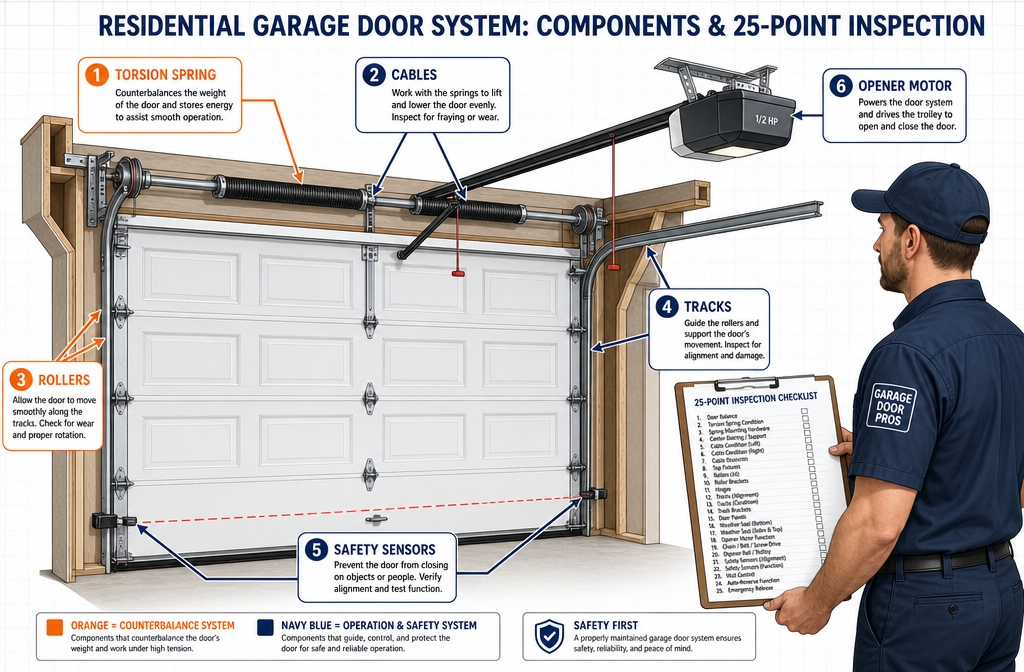
A professional garage door tune up covers far more than most homeowners expect. A qualified technician works through a structured checklist, commonly a 25-point inspection, that touches every major mechanical and safety component of the door system.
Here is what a thorough tune up typically includes:
Mechanical inspection and adjustments:
- Torsion or extension springs — checked for wear, rust, and correct tension
- Cables – inspected for fraying, kinking, or uneven wear on the drum
- Rollers – examined for cracking, flat spots, or excessive play
- Tracks – checked for alignment, dents, and debris buildup
- Hinges and brackets – tightened and inspected for metal fatigue
- Drums and bearings – checked for smooth rotation
Operational and safety checks:
- Balance test – the door is disconnected from the opener and manually lifted to mid-height; a well-balanced door stays put without drifting
- Opener force settings – adjusted so the motor doesn’t strain or over-pull
- Auto-reverse test – a 2×4 board is placed under the door to confirm it reverses on contact
- Photo-eye sensor alignment – sensors are cleaned and verified to interrupt the beam correctly
- Travel limit settings – ensures the door opens and closes fully without over-travel
- Lock and manual release – confirmed to be functional
Lubrication:
- Springs, rollers, hinges, tracks (top section only), and the opener’s drive chain or screw are lubricated with appropriate products — typically a silicone spray or white lithium grease, not WD-40.
💡 Quick note on lubrication: WD-40 is a degreaser, not a lubricant. Using it on garage door parts can actually accelerate wear. Professionals use silicone-based or lithium-based products designed for metal-on-metal contact.
Common mistake: Many homeowners assume a tune up is just lubrication. In reality, the balance test and opener force check are the most safety-critical steps, and they’re the ones most likely to catch a problem before it becomes a breakdown.
How Much Does a Typical Garage Door Tune Up Cost?
In 2026, most homeowners pay between $100 and $250 USD for a professional residential garage door tune up. The national average sits closer to $150 for a standard single-door visit that includes inspection, lubrication, and minor adjustments.
What affects the price:
| Factor | Lower Cost | Higher Cost |
|---|---|---|
| Location | Small town or suburb | Large metro area |
| Door size | Single car door | Double or custom door |
| Add-ons | Inspection only | Roller swap, sensor realignment |
| Company type | Local independent | National franchise |
| Promo pricing | Advertised special | Standard rate |
A word on “cheap” specials: Some companies advertise tune ups as low as $49 on social media. These promotions often serve as entry points for on-site upselling. The all-in cost after recommended add-ons frequently lands in the $100–$200+ range anyway. It’s worth asking upfront what is and isn’t included in the quoted price.
Parts cost pressure in 2026: Manufacturer price increases on residential door components, including springs, rollers, and cables, have pushed underlying parts costs higher this year. This means that if a technician needs to swap a roller or adjust a cable drum during a tune up, expect the total to land at the higher end of the range.
For context, the average cost of a full garage door repair (not a tune up) runs around $269 nationally, with a range of $150–$600 depending on what failed. A $150 tune up that prevents a $400 spring replacement is straightforward math.
For a detailed look at what spring repairs specifically cost, see how much garage door spring replacement costs in Oakville in 2026.
Can You Do a Garage Door Tune Up Yourself, or Do You Need a Professional?
Homeowners can handle a portion of garage door maintenance themselves, but a full tune up requires professional tools, training, and judgment. The short answer: DIY for the basics, hire a pro for anything involving springs, cables, or tension adjustments.
What homeowners can safely do:
- Monthly visual inspection of rollers, tracks, and cables
- Wiping down tracks to remove dirt and debris
- Applying silicone or lithium lubricant to rollers, hinges, and the top section of the track
- Testing the auto-reverse by placing a 2×4 under the door and pressing close
- Checking that photo-eye sensors are aligned (LED indicator lights confirm this on most openers)
What should always be left to professionals:
- Adjusting or replacing torsion springs – these are under extreme tension and can cause serious injury if handled incorrectly
- Replacing or re-winding cables – cables are connected to the spring system and carry the full weight of the door
- Adjusting opener force limits and travel settings beyond basic presets
- Any work involving the bottom bracket (directly connected to the cable and spring system)
⚠️ Safety fact: Garage door accidents send an estimated 20,000-30,000 people to emergency rooms annually in the U.S. The majority of serious injuries involve springs and cables under tension. This is not an area to experiment with.
For more on cable-related risks, the garage door cable replacement guide covers what’s involved and why professional handling matters.
Choose DIY if: The task is visual inspection or lubrication only, and no component shows signs of wear or damage.
Choose a professional if: The door is noisy, slow, unbalanced, or any hardware looks worn or if it’s been more than a year since the last service.
Signs Your Garage Door Needs Maintenance Right Now
Several clear signals indicate a tune up shouldn’t wait until the next scheduled visit. Catching these early is exactly what annual maintenance is designed to do.
Act soon if you notice:
- Grinding, squeaking, or banging sounds during operation, often rollers, hinges, or a dry spring
- Slower than normal movement – can indicate spring tension loss or opener strain
- Door reverses before fully closing – usually a sensor or force setting issue (see why your garage door reverses before closing)
- Visible gaps or uneven alignment when the door is closed
- Rust or corrosion on springs, cables, or tracks
- Opener running louder or longer than it used to
- Visible fraying on cables – this is a stop-everything situation; do not operate the door
Warning signs of a garage door that needs immediate repair (not just a tune up):
If the door won’t open at all, a cable has visibly snapped, a spring is broken (often heard as a loud bang), or the door is hanging at an angle, that’s an emergency repair, not a maintenance visit. In those cases, stop using the door and call a technician immediately.
For urgent situations, same-day emergency garage door repair is available for Oakville-area residents.
For a broader list of warning signs, 5 signs you need garage door repair now covers the most common indicators.
How Often Should You Get Your Garage Door Serviced?
Once per year is the standard recommendation for most residential garage doors. Doors used as a primary entry point, meaning the household uses the garage door instead of the front door multiple times daily — benefit from service every six months.
Frequency guidelines by use level:
| Usage Level | Recommended Service Interval |
|---|---|
| Light (1–2 cycles/day) | Once per year |
| Moderate (3–5 cycles/day) | Once per year |
| Heavy (6+ cycles/day) | Every 6 months |
| After extreme weather | As needed |
| New home purchase | Immediately (unknown history) |
Between professional visits, a monthly visual check takes less than five minutes and can catch developing problems early. Look at the cables, rollers, and tracks while the door is in motion. Listen for new sounds. Test the auto-reverse function quarterly.
Common Garage Door Problems That Regular Tune Ups Prevent
Consistent annual maintenance prevents the most expensive and most common garage door failures. Here are the problems a tune up is specifically designed to catch before they escalate:
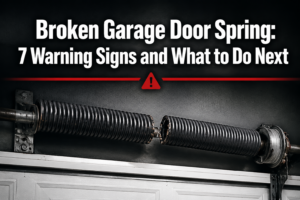
1. Spring failure Springs have a finite cycle life (typically 10,000 cycles for standard torsion springs). A technician can identify wear and uneven tension before a spring snaps. A broken spring makes the door inoperable and is one of the more expensive repairs. See broken garage door spring warning signs for what to watch for.
2. Cable fraying and snapping Cables fray gradually over time, especially near the bottom drum. A tune up catches early fraying before a cable snaps under load which can cause the door to fall suddenly.
3. Roller and track wear Worn rollers cause the door to bind against the track, putting extra load on the opener motor. Replacing rollers during a tune up costs far less than replacing a burned-out opener.
4. Opener motor strain An unbalanced door forces the opener to work harder on every cycle. Over time, this burns out the motor. The balance test during a tune up directly addresses this.
5. Sensor misalignment Photo-eye sensors drift out of alignment from vibration over time. A misaligned sensor either prevents the door from closing or worse fails to stop a closing door when something is in the way.
6. Track misalignment Minor track shifts accumulate over time. Left unchecked, they cause rollers to jump the track or the door to bind mid-travel.
What Happens If You Skip Annual Garage Door Maintenance?
Skipping a tune up doesn’t cause immediate failure but it accelerates wear on every component simultaneously. The consequences tend to show up 12–24 months after maintenance lapses.
Typical outcomes of deferred maintenance:
- Higher repair bills: A $150 tune up that catches a worn spring early prevents a $200–$350 spring replacement later. Skipping maintenance doesn’t save money; it defers and increases costs.
- Shorter opener lifespan: Opener motors are rated for a certain number of cycles under normal load. An unbalanced or binding door can cut that lifespan significantly.
- Safety risk: Auto-reverse systems and photo-eye sensors can drift out of spec without anyone noticing. A door that doesn’t reverse properly is a genuine hazard, especially for children and pets.
- Voided warranties: Some opener and door manufacturers require documented annual maintenance to keep warranties valid. Check your documentation.

Are Garage Door Tune Ups Worth the Money?
Yes, for most homeowners, a professional tune up is one of the better-value home maintenance investments available. The math is straightforward: a $100–$250 annual service prevents repairs that typically cost $150–$600 or more, extends the life of the opener and springs, and verifies that critical safety systems are working.
The case for tune ups:
- Preventive cost is always lower than reactive repair cost
- A functioning auto-reverse system is a legal and safety requirement
- Technicians often catch issues the homeowner never would (e.g., a cable with 20% of its strands frayed)
- The service pays for itself if it prevents even one emergency call
When a tune up may not be the priority:
- If the door is over 20 years old and multiple major components are failing, a full garage door replacement may be more cost-effective than repeated maintenance on aging hardware.
- If the door was just professionally installed or serviced within the past 6 months, another full tune up isn’t necessary yet.
Bottom line: For a door in regular use with no known major issues, an annual tune up is worth it.
Difference Between Cheap and Expensive Garage Door Tune Ups
The price difference between a $75 special and a $200 professional service often comes down to what’s actually done and who’s doing it.
Lower-cost tune ups (under $100) often include:
- Basic lubrication of visible parts
- A quick visual check
- No balance test or force adjustment
- Technicians who are incentivized to upsell on-site
Higher-cost tune ups ($150–$250) typically include:
- Full 25-point structured inspection
- Balance test and opener force calibration
- Safety reversal and sensor verification
- Minor hardware adjustments included in the flat rate
- Documented service record
What to ask before booking:
- Is the balance test included?
- Are minor adjustments (sensor alignment, hardware tightening) part of the flat rate or billed separately?
- Does the technician provide a written inspection report?
- What is the company’s policy if they find a problem during the visit?
A company that answers these questions clearly and offers a written report is almost always worth the higher price.
Best Time of Year to Schedule a Garage Door Tune Up
Late summer or early fall is the best time to schedule a garage door tune up for most North American climates. Servicing the door before cold weather arrives means springs, cables, and lubricants are in optimal condition heading into the season that stresses them most.
Why timing matters:
- Cold temperatures make metal components contract, increasing spring tension and making lubricants less effective
- Extreme heat in summer can dry out lubricants faster than expected
- A fall tune up catches any wear from the high-use summer months before winter amplifies it
Secondary option: Early spring, after winter, is also a practical time, especially if the door was exposed to road salt, ice, or temperature swings that can accelerate corrosion.
Avoid scheduling during: Peak demand periods (mid-winter when doors fail most often) if possible, as booking lead times are longer and pricing may be less flexible.
How Long Does a Standard Garage Door Tune Up Take?
A proper professional tune up takes 45 minutes to 1 hour for a standard single residential door. This timing reflects a full 25-point inspection, lubrication, and all minor adjustments — not a rushed spray-and-go visit.
Factors that extend the visit:
- Double or oversized doors (add 15–20 minutes)
- Significant hardware issues discovered during inspection
- Opener programming or sensor realignment needed
- Heavy rust or debris requiring extra cleaning
If a technician quotes a 15-minute visit for a full tune up, that’s a red flag. A thorough inspection of springs, cables, balance, force settings, and sensors simply cannot be done responsibly in that time.
What Tools Do Professionals Use During a Garage Door Service?
Professionals bring a specific set of tools that go well beyond what most homeowners keep in the garage. This is part of why professional tune ups catch things DIY checks miss.
Standard professional toolkit:
- Winding bars -for safely adjusting torsion spring tension (never use a screwdriver for this)
- Torque wrench – for precise hardware tightening
- Level – to check track alignment
- Multimeter – to test opener motor and sensor circuits
- Lubricant applicators – silicone spray and white lithium grease, applied precisely
- Clamps and locking pliers – to secure the door safely during spring work
- Tape measure – for gap measurement and travel limit verification
- Inspection light – for checking dark areas of the track and cable drum
The winding bars alone are a meaningful differentiator. Torsion spring adjustment without proper winding bars is one of the leading causes of serious DIY garage door injuries. Professionals use them as standard equipment.
FAQ: Garage Door Tune Up Questions Answered
Q: How much does a garage door tune up cost in 2026? A: Most homeowners pay $100–$250 USD for a professional residential tune up. The average is around $150 for a standard single-door visit. Metro areas and visits that include minor parts swaps trend toward the higher end.
Q: What is included in a garage door tune up? A: A thorough tune up includes a 25-point inspection of springs, cables, rollers, tracks, hinges, and sensors; a balance test; opener force and travel limit calibration; safety reversal verification; and lubrication of all moving parts.
Q: How long does a garage door tune up take? A: A proper tune up takes 45 minutes to 1 hour. A significantly shorter visit likely means the inspection was incomplete.
Q: Can I do a garage door tune up myself? A: Homeowners can safely lubricate rollers, hinges, and tracks, and perform basic visual checks. Spring tension adjustment, cable work, and opener force calibration require professional tools and training.
Q: How often should a garage door be serviced? A: Once per year for most residential doors. Doors used as the primary home entry point (high cycle count) benefit from service every six months.
Q: What happens if I never get my garage door tuned up? A: Components wear faster, the opener motor works harder, and safety systems like auto-reverse can drift out of spec. The result is usually a more expensive repair within 1–3 years and an increased safety risk.
Q: Is a garage door tune up worth it? A: Yes, for most homeowners. A $100–$250 annual service prevents repairs that cost $150–$600+, extends component life, and verifies that safety systems are functioning correctly.
Q: What’s the best time of year to get a garage door tune up? A: Late summer or early fall is ideal — before cold weather stresses springs and lubricants. Early spring is a good secondary option after winter exposure.
Q: What are signs that a garage door tune up is overdue? A: Grinding or squeaking sounds, slower movement, visible rust on springs or cables, a door that reverses unexpectedly, or an opener that sounds louder than usual.
Q: What’s the difference between a tune up and a repair? A: A tune up is preventive maintenance performed on a functioning door. A repair addresses a specific failure broken spring, snapped cable, failed opener. Tune ups prevent repairs.
Q: Should I tip a garage door technician? A: Tipping is not standard or expected for garage door service, but it is appreciated for exceptional work or a particularly thorough visit. A positive online review is equally valuable to small service companies.
Q: Can a tune up fix a broken spring? A: No. A broken spring is a repair, not a maintenance item. If a spring has snapped, the door should not be operated and a technician should be called for garage door spring repair specifically.
Conclusion: What to Do Next
A garage door tune up is one of the most straightforward home maintenance investments available — a modest annual cost that protects a heavy, high-cycle mechanical system that most households rely on every single day.
Actionable next steps:
- Check when the door was last serviced. If it’s been more than 12 months, schedule a tune up now, before fall or winter weather adds stress to the system.
- Do a quick visual check today. Look at the cables for fraying, the springs for rust, and the rollers for cracking. Listen during a full open-and-close cycle for any new sounds.
- Test the auto-reverse. Place a 2×4 flat on the ground under the door and press close. The door must reverse when it contacts the board. If it doesn’t, call a technician immediately.
- Ask the right questions when booking. Confirm that the balance test, opener force calibration, and safety sensor check are included in the quoted price.
- Don’t attempt spring or cable work yourself. These components are under significant tension and cause serious injuries when handled without proper training and tools.
For homeowners in the Oakville, Burlington, or Mississauga area, professional tune up services are available with same-day or next-day scheduling through Oakview Garage Doors. If a more urgent issue has already developed, same-day emergency repair is also available.
A well-maintained garage door is quieter, safer, and significantly cheaper to own over time. The tune up is where that maintenance starts.