Last updated: June 16, 2026
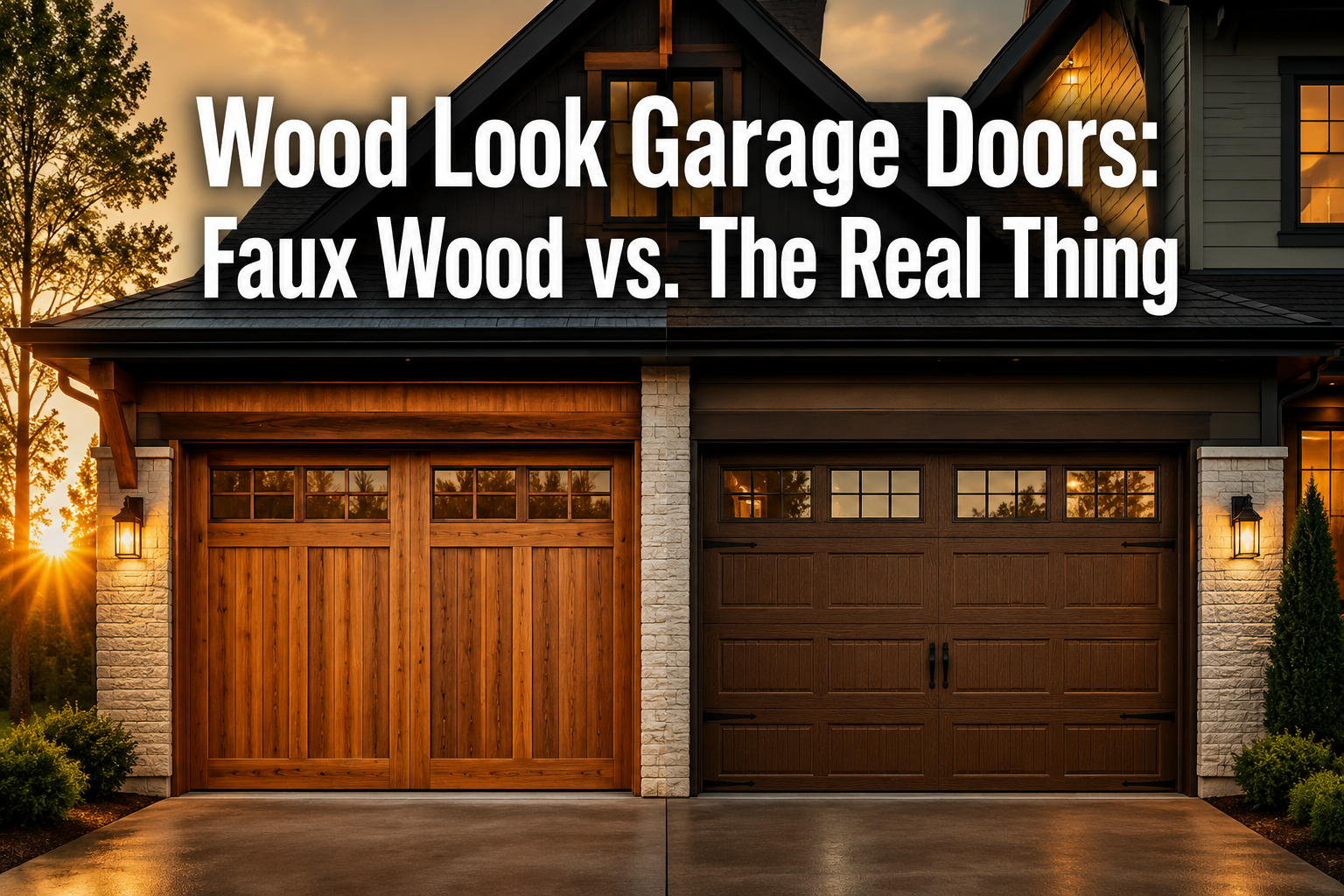
Quick Answer: Faux wood garage doors, typically made from steel or composite materials with an embossed wood-grain finish, deliver most of the visual appeal of real wood at a significantly lower cost and with far less ongoing maintenance. Real wood offers unmatched authenticity and depth, but it demands regular refinishing, is vulnerable to moisture and pests, and generally costs more upfront. For most homeowners in variable climates, faux wood is the more practical choice. For those who prioritize material authenticity and are willing to invest in upkeep, real wood remains a compelling option.
Key Takeaways
- Faux wood garage doors are usually constructed from steel with an embossed wood-grain skin, or from composite materials that mimic wood texture and color.
- Real wood garage doors cost more upfront and require staining or sealing every two to three years to prevent rot, warping, and pest damage.
- High-quality faux wood doors are difficult to distinguish from real wood at street distance, especially with modern deep-grain embossing technology.
- Steel-based faux wood doors can dent from impact, while real wood can be sanded and refinished but is more prone to moisture-related swelling.
- Faux wood performs better in humid, wet, or temperature-extreme climates because it does not absorb moisture the way natural wood does.
- Both door types can add curb appeal and support home resale value, though real wood custom doors may carry a slight premium in luxury markets.
- Most faux wood doors cannot be stained like real wood, but many can be repainted or come in a wide range of factory finishes.
- Annual maintenance for faux wood doors is minimal: cleaning, lubrication of hardware, and occasional touch-up of chips or scratches.
- Top brands producing convincing faux wood looks in 2026 include Clopay, Haas Door, and Wayne Dalton, among others.
- DIY installation is possible for experienced homeowners but carries real safety risks; professional installation is recommended for most.
What Exactly Is a Faux Wood Garage Door Made Of
Faux wood garage doors are not a single product type but a category that includes several construction methods. The most common version is a steel door with a deeply embossed wood-grain pattern pressed into the outer skin during manufacturing. A second type uses composite overlays, which are panels made from wood fiber, resin, and other materials bonded together to create a surface that looks and feels closer to real wood than plain steel.
The three most common constructions:
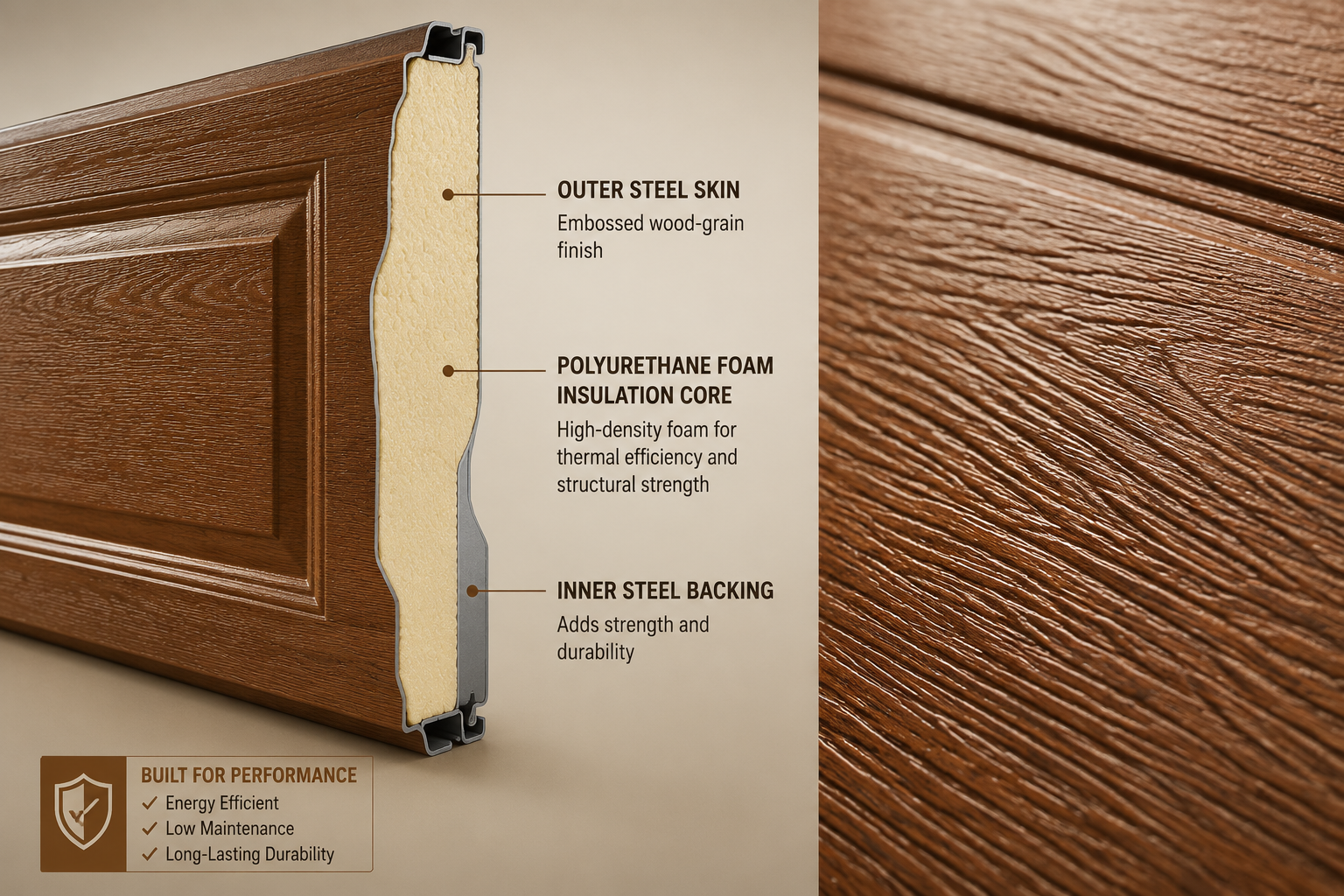
- Steel with embossed wood-grain skin: A galvanized or galvannealed steel shell is stamped with a wood-grain texture, then finished with a factory-applied paint or faux-stain coating. The interior is typically filled with polyurethane foam insulation for thermal performance.
- Composite overlay on steel: A steel base door is fitted with composite face panels, often made from a blend of wood fiber and polymer resin. This adds texture depth and a more tactile wood-like feel compared to plain embossed steel.
- Fiberglass with wood-grain texture: Less common but available, fiberglass doors can be molded with realistic grain patterns and are particularly resistant to rust and corrosion.
The steel-core construction is what gives most faux wood doors their durability advantage. The wood-grain appearance is a surface treatment, not a structural element, which means the door’s strength and weather resistance come from the metal or composite base rather than from any organic material.
How Much Cheaper Are Fake Wood Garage Doors Compared to Real Wood
Faux wood garage doors are generally 30 to 60 percent less expensive than comparable real wood doors, though the exact gap depends heavily on door size, brand, and customization level. A standard two-car steel faux wood door with insulation typically ranges from roughly $1,200 to $3,500 installed, while a custom real wood door in a similar size can run from $3,000 to $8,000 or more, depending on wood species and design complexity.
Cost factors that affect the comparison:
- Wood species: Cedar and redwood are popular for real wood doors and carry a premium over pine or hemlock. Exotic species push costs even higher.
- Custom sizing and design: Real wood doors are often custom-built, adding labor and material costs that factory-produced faux wood doors avoid.
- Insulation: Faux wood steel doors with polyurethane foam cores can achieve high R-values through added insulation. Real wood has some inherent insulating value, but still benefits from added insulation in cold climates.
- Long-term cost: Real wood requires staining or sealing every two to three years, which adds $300 to $700 per service in most Canadian and U.S. markets. Over a ten-year period, maintenance costs can narrow the gap between the two options considerably.
For homeowners working with a defined budget, faux wood is the clear winner on upfront cost. For those building a high-end custom home where the garage door is a design centerpiece, the premium for real wood may be justified. For help understanding what goes into a door quote, see this guide on how to read a garage door quote.
Do Faux Wood Garage Doors Look Realistic from the Street
At typical street distance (15 to 30 feet), a high-quality faux wood garage door is very difficult to distinguish from real wood. Modern embossing technology creates deep, varied grain patterns that replicate the look of cedar, oak, or walnut convincingly. The difference becomes more apparent on close inspection, where the uniformity of a stamped pattern and the flatness of a factory finish reveal the door’s true construction.
What affects realism:
- Grain depth and variation: Better faux wood doors use multi-step embossing to create grain lines that vary in depth and width, mimicking the natural irregularity of real wood. Budget options often have shallower, more repetitive patterns.
- Finish quality: A two-tone or hand-wiped faux stain finish adds visual complexity that plain single-color paint cannot match. Clopay’s Canyon Ridge line and similar premium products use this technique to add shadow and highlight to the grain.
- Panel design: Doors with raised overlays or recessed panels create physical shadow lines that enhance the wood illusion, especially in raking light conditions.
- Color accuracy: Warm, varied tones that shift slightly across the surface (as real wood does) look far more convincing than a flat, uniform color.
In 2026, several major brands have introduced new wood-grain plank colors specifically designed to increase realism. Haas Door, for example, debuted Black Oak Plank and Natural Plank finishes at the International Builders’ Show, reflecting ongoing investment in making faux wood visuals more convincing. Clopay’s HGTV Dream Home 2026 feature door was a Canyon Ridge Chevron model with a stained faux wood composite face, chosen specifically for its ability to deliver wood warmth at a showcase level.
Which Material Lasts Longer: Wood or Faux Wood Garage Doors
Faux wood garage doors, particularly steel-core models, generally outlast real wood doors in most residential climates when maintenance is compared on equal terms. A well-maintained steel faux wood door can last 20 to 30 years. Real wood doors, if properly and consistently maintained, can also last decades, but the consequences of neglecting maintenance are far more severe: rot, warping, and structural failure can develop within a few years of missed refinishing cycles.
Durability comparison at a glance:
| Factor | Faux Wood (Steel/Composite) | Real Wood |
|---|---|---|
| Lifespan (well-maintained) | 20-30 years | 15-30 years |
| Moisture resistance | High | Low to moderate |
| Pest resistance | High | Low (especially untreated wood) |
| Dent resistance | Moderate (steel dents) | High (wood resists denting) |
| Repairability | Limited (panel replacement) | Good (sanding, refinishing) |
| Maintenance frequency | Low | High (every 2-3 years) |
| UV/fade resistance | Moderate to high | Low without regular sealing |
Real wood has one genuine durability advantage: it does not dent from impact the way steel-skin faux wood doors can. A steel door hit by a basketball, bicycle, or minor vehicle contact may show a permanent dent, while real wood absorbs similar impacts without permanent deformation and can be sanded smooth. For dented panels on either door type, garage door panel replacement is often the most practical solution.
Can I Paint or Stain a Faux Wood Garage Door to Match My House
Most faux wood garage doors can be repainted, but they cannot be stained in the traditional sense. Staining requires an absorbent wood surface to penetrate and bond with the grain. Steel and composite surfaces are non-porous, so a conventional wood stain will not adhere or produce the same effect. Some composite overlay doors accept special exterior stains designed for non-wood surfaces, but results vary by product.
Finishing options for faux wood doors:
- Repainting: Most steel and composite faux wood doors can be repainted with a high-quality exterior latex or oil-based paint after proper cleaning and priming. This changes the color but not the grain texture.
- Factory finish touch-up kits: Many manufacturers offer color-matched touch-up paint for chips and scratches, which is the most reliable way to maintain the original appearance.
- Faux stain coatings: Some specialty exterior coatings are marketed for use on metal surfaces and can create a semi-transparent, wood-tone effect over an embossed grain. Results depend heavily on surface preparation and product quality.
- Full wrap: Vinyl wraps designed for garage doors can completely change the color and even add a faux wood pattern to a plain door.
Real wood doors, by contrast, can be stained, restained in a different color, or painted at any time, giving homeowners far more flexibility to update the look without replacing the door. This is one area where real wood holds a clear advantage for those who like to refresh their home’s exterior periodically.
What Maintenance Does a Wood Look Garage Door Need Each Year
Annual maintenance for a faux wood garage door is straightforward and requires no specialized skills. The door itself needs very little attention compared to real wood, but the mechanical components, springs, cables, and rollers require regular service regardless of door material.
Annual maintenance checklist for faux wood garage doors:
- Wash the door surface with mild soap and water to remove road salt, dirt, and organic debris. This prevents surface staining and protects the finish.
- Inspect the finish for chips, scratches, or areas where the coating has worn through to bare steel. Touch up promptly to prevent rust.
- Check weatherstripping along the bottom and sides. Replace if cracked or compressed flat.
- Lubricate all moving parts: springs, rollers, hinges, and tracks. A silicone or lithium-based lubricant works best in Ontario’s climate. See this guide on the best garage door lubricant for Ontario’s climate for product-specific advice.
- Test the balance: Disconnect the opener and manually lift the door halfway. It should stay in place without assistance. If it drops or rises, the springs need adjustment.
- Inspect hardware for loose bolts, worn cables, and damaged rollers.
For real wood doors, add to this list: inspect for soft spots indicating rot, check caulking around panels and trim, and plan for a full stain or sealant application every two to three years. A professional garage door tune-up covers most of the mechanical checks and is worth scheduling annually for either door type.
Are Faux Wood Garage Doors Good for Humid or Extreme Weather Climates
Faux wood garage doors are generally better suited to humid, wet, or temperature-extreme climates than real wood doors. Steel and composite materials do not absorb moisture, which means they will not swell, warp, or rot when exposed to repeated wet-dry cycles. This makes them a strong choice for coastal areas, regions with heavy rainfall, or climates with significant freeze-thaw cycling, such as Ontario.
Climate performance breakdown:
- High humidity and rain: Steel faux wood doors resist moisture intrusion effectively. The main risk is rust at chips or scratches in the finish, which is why prompt touch-up is important.
- Freeze-thaw climates (e.g., Ontario, Quebec): Steel expands and contracts with temperature changes, but within normal residential ranges this does not cause structural problems. Real wood, by contrast, can swell in wet conditions and shrink in dry cold, leading to gaps, sticking, or finish cracking.
- Hot, dry climates: Both materials perform reasonably well, but real wood is more prone to cracking and finish degradation under intense UV exposure without regular sealing.
- Coastal salt air: Fiberglass faux wood doors are the best choice in salt-air environments because they do not rust. Steel faux wood doors require careful attention to finish integrity in these conditions.
For lakefront and waterfront properties in particular, material selection matters significantly. The considerations for Bronte garage door installation for lakefront homes illustrate how climate and exposure directly affect which door material performs best over time.
What Are the Top Brands That Make Convincing Wood Look Garage Doors
Several manufacturers produce faux wood garage doors that consistently receive high marks for realism, durability, and finish quality. The market in 2026 is competitive, with brands investing heavily in grain depth, color variation, and composite overlay technology.
Leading brands for wood look garage doors:
- Clopay: The Canyon Ridge collection uses composite overlays with multi-step stain finishes that are widely regarded as among the most realistic faux wood options available. The Clopay Canyon Ridge Chevron was featured in the HGTV Dream Home 2026, reinforcing its position at the premium end of the market.
- Haas Door: Known for its plank-style doors with deep wood-grain embossing. The 2026 introduction of Black Oak Plank and Natural Plank finishes shows active product development in this category.
- Wayne Dalton: Offers composite wood doors (Model 9700 series) that use a wood-fiber composite construction rather than steel, providing a surface that accepts stain more like real wood.
- Amarr: The Amarr Carriage Court and Heritage collections use embossed steel with carriage-house styling and wood-tone finishes, targeting traditional and craftsman home styles.
- Doorlink: A strong option in the mid-range segment with reliable embossed steel wood-grain doors at accessible price points.
When evaluating brands, ask specifically about grain depth, finish warranty, and whether composite overlays are included or available as an upgrade. A door that looks convincing in a showroom photograph may look flat or repetitive at full scale on an actual home. Requesting physical samples or visiting a showroom is worthwhile for any premium purchase. For custom garage door options in Oakville, a local installer can show actual installed examples in the area.
Do Wood Look Garage Doors Increase Home Value Like Real Wood Would
Both faux wood and real wood garage doors can meaningfully improve curb appeal and contribute to home resale value. The difference in value impact is smaller than many homeowners expect. Remodeling industry data consistently shows that garage door replacement is one of the highest-ROI exterior upgrades available, regardless of whether the door is real or faux wood, primarily because the garage door occupies a large portion of the home’s visible facade.
Where the value gap appears:
- In luxury or high-end custom home markets, buyers and appraisers may distinguish between a real wood custom door and a faux wood door, with real wood carrying a slight premium.
- In the broad mid-market, a high-quality faux wood door that complements the home’s architecture will typically produce the same buyer reaction and appraisal outcome as a real wood door of similar appearance.
- A worn, poorly maintained real wood door can actually hurt resale value more than a clean, well-chosen faux wood door, because visible rot, peeling finish, or warped panels signal deferred maintenance to buyers.
The practical takeaway: choose the door that looks best on your specific home and that you can maintain properly. A faux wood door kept in excellent condition will serve resale value better than a real wood door that has been neglected.
How Hard Is It to Install a Wood Look Garage Door Yourself
Installing a garage door is a moderately to highly complex project that carries real safety risks, primarily from the high-tension springs that counterbalance the door’s weight. For most homeowners, professional installation is the safer and often more cost-effective choice when accounting for tools, time, and the risk of injury or damage.
What DIY installation involves:
- Removing and disposing of the old door and hardware
- Installing the new door panels in sequence, starting from the bottom
- Attaching hinges, rollers, and track sections
- Installing and tensioning the torsion or extension springs (the highest-risk step)
- Connecting and programming the opener
- Adjusting the door balance, travel limits, and safety reversal
Torsion spring installation in particular requires specialized winding bars and knowledge of spring tension. Errors can result in the spring releasing violently, causing serious injury. Most professional installers strongly advise against DIY spring work. For professional garage door installation in Oakville, a certified technician handles all of these steps with the proper tools and warranty coverage.
If a homeowner has prior experience with garage door systems and is replacing a door of the same size and spring configuration, a guided DIY installation is more feasible. For new construction, non-standard sizes, or first-time replacements, professional installation is the right call.
What Common Mistakes Do Homeowners Make When Choosing Wood Look Garage Doors
Choosing a faux wood garage door based on a small photograph or online rendering is the single most common mistake. The scale of a garage door means that details visible at thumbnail size, such as grain pattern repetition or color flatness, become much more apparent on an installed door viewed from the street.
Other frequent mistakes:
- Choosing the wrong color tone: Warm wood tones look very different against a cool gray or white house than they do in a product photo. Always test a sample against your actual siding and trim in natural light.
- Ignoring insulation value: Many homeowners focus entirely on appearance and overlook R-value. In Ontario winters, a door with R-12 or higher insulation makes a measurable difference in garage temperature and energy costs.
- Underestimating hardware impact: The handles, hinges, and decorative hardware on a faux wood carriage-house door significantly affect the final look. Cheap hardware undermines an otherwise high-quality door.
- Skipping the finish warranty review: Some faux wood finishes are warranted against fading and peeling for 10 years or more; others carry only a basic one-year warranty. This difference matters for long-term appearance.
- Buying a door that does not suit the home style: A rustic barn-plank faux wood door on a contemporary home, or a formal raised-panel design on a farmhouse, creates visual conflict that no amount of quality can fix. Match the door style to the architecture first, then choose the finish.
Are Faux Wood Garage Doors Better for Modern or Traditional Home Styles
Faux wood garage doors work well with both modern and traditional home styles, but the specific design within the faux wood category matters more than the material itself. The door’s panel layout, hardware, and color determine whether it reads as contemporary or classic.
Style matching guide:
- Traditional and craftsman homes: Raised-panel or carriage-house designs with warm walnut, cedar, or mahogany tones are the natural fit. Decorative strap hinges and ring pulls complete the look.
- Farmhouse and rustic styles: Horizontal plank designs with a weathered or natural wood-grain finish (such as Haas Door’s Natural Plank) align well with board-and-batten siding and metal roofing.
- Modern and contemporary homes: Flush or minimal-panel faux wood doors in darker tones (charcoal, espresso, or black oak) work well alongside clean lines and large windows. Mixing faux wood with glass inserts is a strong 2026 trend for design-conscious homeowners.
- Colonial and traditional: Multi-panel raised designs in lighter wood tones complement brick facades and symmetrical window arrangements.
The key principle: the door’s silhouette and panel geometry should echo the architectural language of the home. Material (faux vs. real wood) is secondary to getting the design right.
How Do Wood Look Garage Doors Handle Dents and Scratches Compared to Real Wood
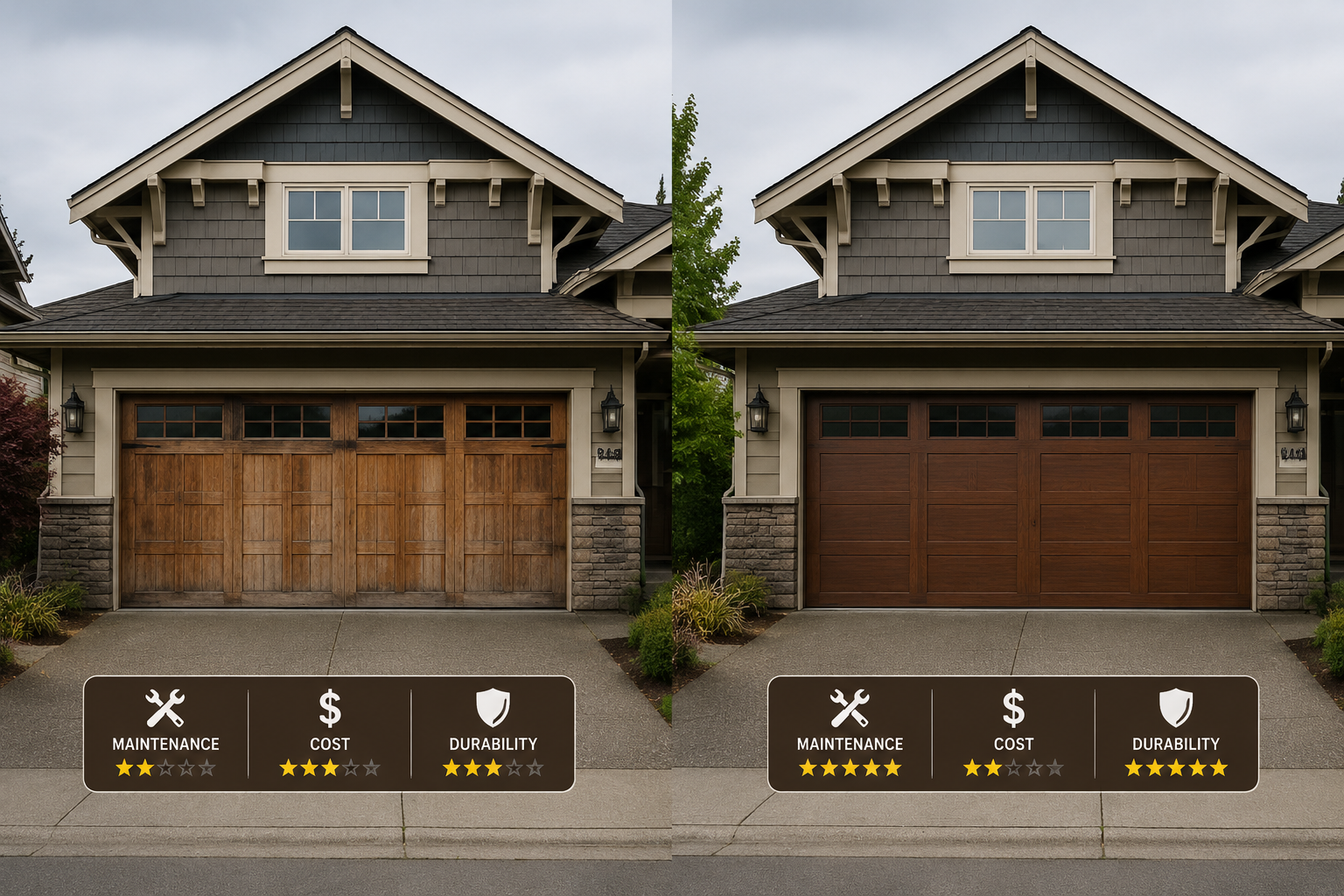
Steel faux wood doors are more vulnerable to denting than real wood, but they are more resistant to deep scratches. Real wood doors resist dents from impact because wood fibers compress and partially recover, but they are susceptible to gouges and surface scratches that expose raw wood to moisture.
Damage comparison:
- Dents: A steel faux wood door hit by a vehicle, bicycle, or heavy object will likely show a permanent dent. Real wood in the same scenario may show a compression mark that can often be sanded smooth.
- Scratches: Steel faux wood doors with a factory finish resist light scratches reasonably well, but deep scratches that breach the coating expose bare steel to rust. Real wood scratches more easily but can be sanded and refinished.
- Repair options: Dented steel panels are difficult to repair cosmetically; garage door panel replacement is often the most practical solution. Real wood panels can be repaired in place by a skilled carpenter.
- Long-term appearance: Real wood, when properly maintained, can look better with age because it can be fully refinished. Steel faux wood doors maintain their appearance well but cannot be restored to original condition after significant damage.
For homeowners in high-traffic areas, or those with young drivers or active households, the dent vulnerability of steel faux wood doors is worth considering. Composite overlay doors offer slightly better dent resistance than plain steel-skin models because the overlay adds thickness and rigidity to the panel face.
FAQ
What is the most realistic-looking faux wood garage door available in 2026? Clopay’s Canyon Ridge collection with composite overlays and multi-step stain finishes is widely considered the most realistic option currently available. Wayne Dalton’s composite wood doors also accept actual stain, making them difficult to distinguish from real wood at close range.
Can a faux wood garage door be repainted if I change my house color? Yes. Most steel and composite faux wood doors can be repainted with a high-quality exterior paint after proper cleaning and priming. The original embossed grain texture is preserved under the new paint, so the wood-look appearance remains.
How long does a faux wood garage door finish typically last before fading? Premium factory finishes on steel faux wood doors typically carry 10-year fade and peel warranties. Actual performance depends on sun exposure and climate, but most quality doors maintain acceptable color for 10 to 15 years before refinishing is considered.
Is real wood worth the extra cost for a high-end home? For luxury custom homes where material authenticity is a design priority, real wood can be worth the premium. Custom wood door makers emphasize “material honesty” and the unique aging characteristics of real wood as values that faux alternatives cannot fully replicate. For most homes, however, a premium faux wood door achieves the same visual result at lower cost.
Do faux wood garage doors require any special cleaning products? No. Mild dish soap and water applied with a soft cloth or low-pressure hose is sufficient. Avoid abrasive cleaners or high-pressure washing, which can damage the finish. Rinse thoroughly to remove soap residue.
Will a faux wood garage door warp in Ontario winters? Steel and composite faux wood doors do not warp from moisture or temperature changes the way real wood does. Extreme cold can cause minor panel contraction, but this does not cause structural warping. Real wood doors are significantly more susceptible to seasonal movement in Ontario’s climate.
How do I know if my faux wood garage door needs a new spring? Signs include the door feeling unusually heavy when lifted manually, the door not staying in place when released at the halfway point, or visible gaps in the spring coil. For more detail, see this guide on broken garage door spring warning signs.
Can I add windows to a faux wood garage door? Yes. Most manufacturers offer window inserts as a factory option or upgrade. Windows are typically installed in the top panel section and come in a range of shapes and glass styles to complement the door’s design.
Are composite faux wood doors better than embossed steel faux wood doors? Composite overlay doors generally look more realistic and are more repairable than plain embossed steel, but they cost more. For homeowners who prioritize appearance and are willing to pay a moderate premium, composite is the better choice. For budget-conscious buyers, quality embossed steel doors offer strong value.
What should I do if my faux wood garage door gets a large dent? Minor dents in steel doors are very difficult to repair invisibly. The most practical solution for a significant dent is replacing the affected panel rather than attempting to fill or reshape the steel. Contact a local installer to assess whether a panel replacement is feasible for your specific door model.
Conclusion
The comparison between wood look garage doors and real wood comes down to a straightforward trade-off: faux wood wins on cost, durability, and low maintenance, while real wood wins on authenticity, repairability, and the ability to be refinished over decades. For the majority of homeowners, especially those in climates with significant moisture, temperature swings, or freeze-thaw cycles, faux wood is the more practical and cost-effective choice without meaningful sacrifice in curb appeal.
Actionable next steps:
- Assess your climate and exposure. If your garage faces north, receives heavy rain, or sits near water, faux wood is the safer material choice.
- Set a realistic budget. Include installation, hardware, and a ten-year maintenance estimate when comparing total cost of ownership between faux and real wood.
- Request physical samples. View grain and color samples against your actual siding in daylight before committing to a finish.
- Match the door style to your home’s architecture. Panel design and hardware matter more than material for achieving the right look.
- Book a professional installation. For safety and warranty coverage, professional installation is worth the cost. Explore garage door installation options with a qualified local provider.
- Schedule annual maintenance. Regardless of material, a yearly tune-up keeps the door operating safely and extends its lifespan.
Whether the choice is a high-end composite faux wood door or a custom cedar original, the right garage door is the one that fits the home, the climate, and the owner’s willingness to maintain it.