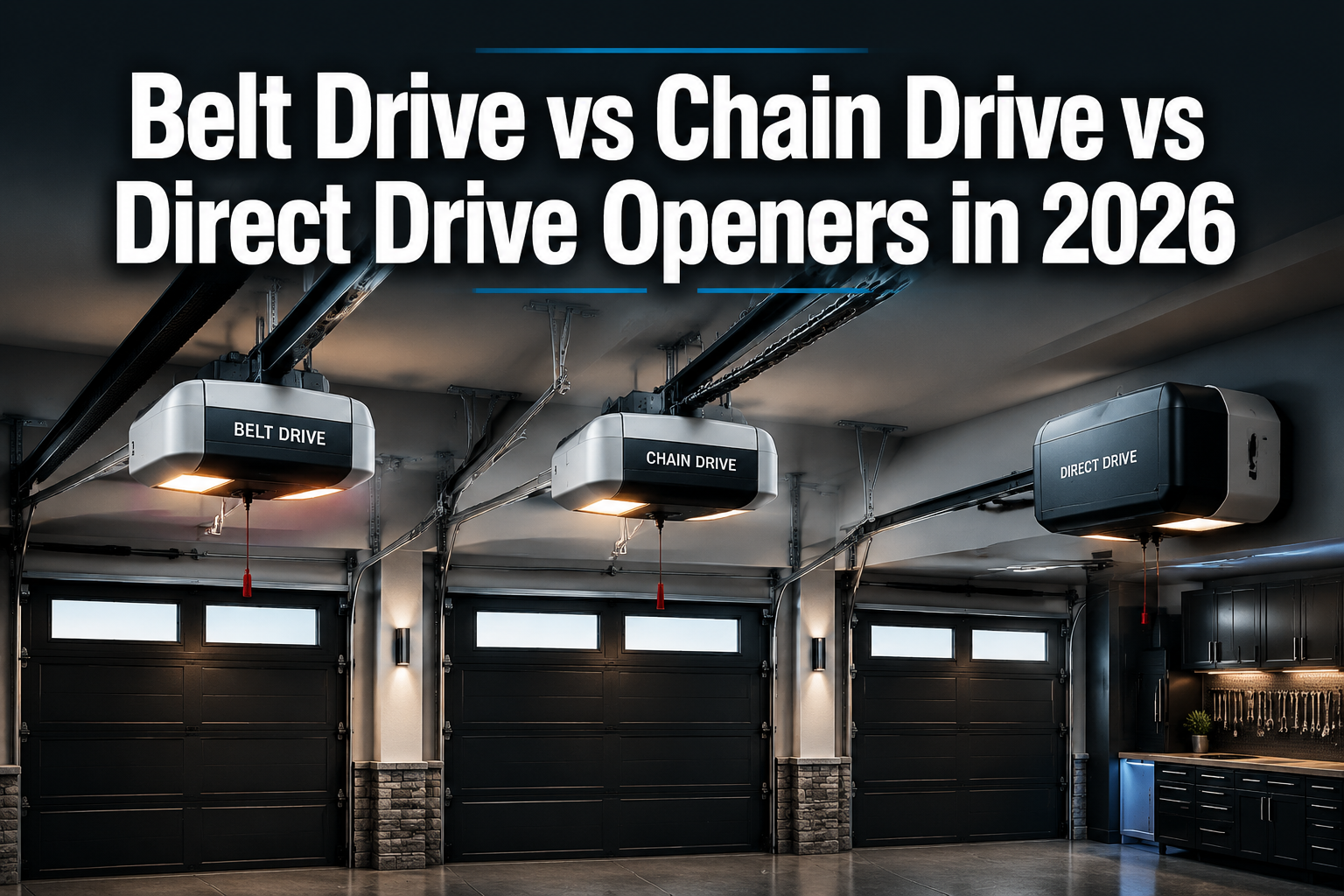
Last updated: June 12, 2026
Quick Answer
Belt drive openers are the quietest and best choice for attached garages where bedrooms sit above or beside the garage. Chain drive openers cost less upfront and handle heavy doors well, making them the practical pick for detached garages on a tight budget. Direct drive openers offer the fewest moving parts and the smoothest operation, but come at a higher price point that suits high-use households willing to pay for long-term simplicity.
Key Takeaways
- Belt drive openers are significantly quieter than chain drives and are the top recommendation for attached garages in 2026.
- Chain drive openers remain the most affordable option upfront, but 2026 steel tariff changes are beginning to narrow the price gap with belt drives.
- Direct drive openers have only one moving part (the motor itself), which translates to minimal maintenance and class-leading smoothness.
- Noise specialists note that belt and direct drive openers generally operate below 60 dB, while chain drives typically run louder (Guse-Hahn Door, 2025).
- Smart connectivity is now standard across all three drive types, not just premium belt or direct drive models, according to a June 2026 market analysis.
- In April 2026, Chamberlain/LiftMaster raised its Section 232 tariff surcharge on residential openers and rails from 6% to 12.5%, affecting retail prices for all drive types.
- Chain drives handle heavy wooden or oversized doors better than belt drives due to the metal chain’s resistance to slip under load.
- Direct drive and wall-mount openers free up ceiling space, which is valuable in garages with high-lift or low-clearance door configurations.
- DIY installation is feasible for belt and chain drive openers; direct drive units are also DIY-friendly but require careful rail alignment.
- There is no single “best” drive type — the right choice depends on door weight, garage attachment, noise tolerance, and budget.
What Is the Difference Between Belt Drive and Chain Drive Garage Door Openers?
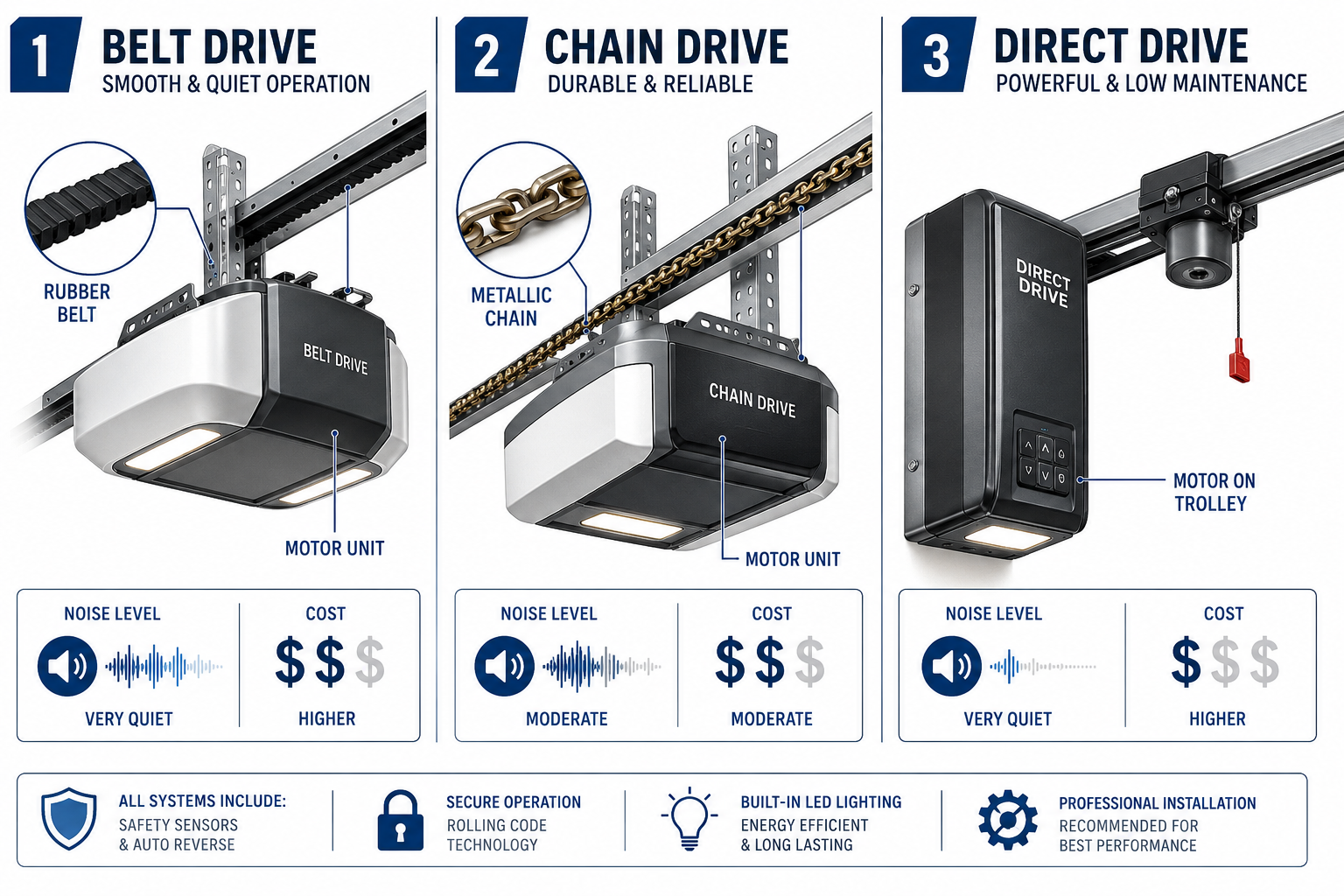
Belt drive and chain drive openers work on the same basic principle: a motor drives a looped mechanism along a rail to push or pull the trolley that moves the door. The key difference is what that loop is made of.
Chain drive openers use a metal chain, similar to a bicycle chain, to move the trolley. The chain is durable, inexpensive to manufacture, and handles heavy loads reliably. The trade-off is noise: the metal-on-metal contact creates vibration and rattling that travels through the garage structure.
Belt drive openers replace the metal chain with a reinforced rubber or polyurethane belt. The belt absorbs vibration rather than transmitting it, which is why belt drives are noticeably quieter. The belt is slightly more expensive to produce, which is reflected in the unit price.
Direct drive openers take a different approach entirely. Instead of a stationary motor driving a belt or chain, the motor itself travels along the rail as the single moving part. This eliminates the belt and chain mechanism altogether, reducing vibration to a minimum and cutting down on the number of components that can wear out.
| Feature | Chain Drive | Belt Drive | Direct Drive |
|---|---|---|---|
| Drive mechanism | Metal chain | Rubber/poly belt | Motor on trolley |
| Noise level | Higher (65+ dB typical) | Lower (below 60 dB) | Lowest |
| Upfront cost | Lowest | Mid-range | Highest |
| Maintenance needs | Moderate (chain lube) | Low | Very low |
| Heavy door support | Excellent | Good | Good |
| Moving parts | Several | Several | One |
| DIY-friendly | Yes | Yes | Yes (with care) |
Which Garage Door Opener Type Is Quietest in 2026, and How Do Belt Drives Compare to Chain Drives in Noise Levels?
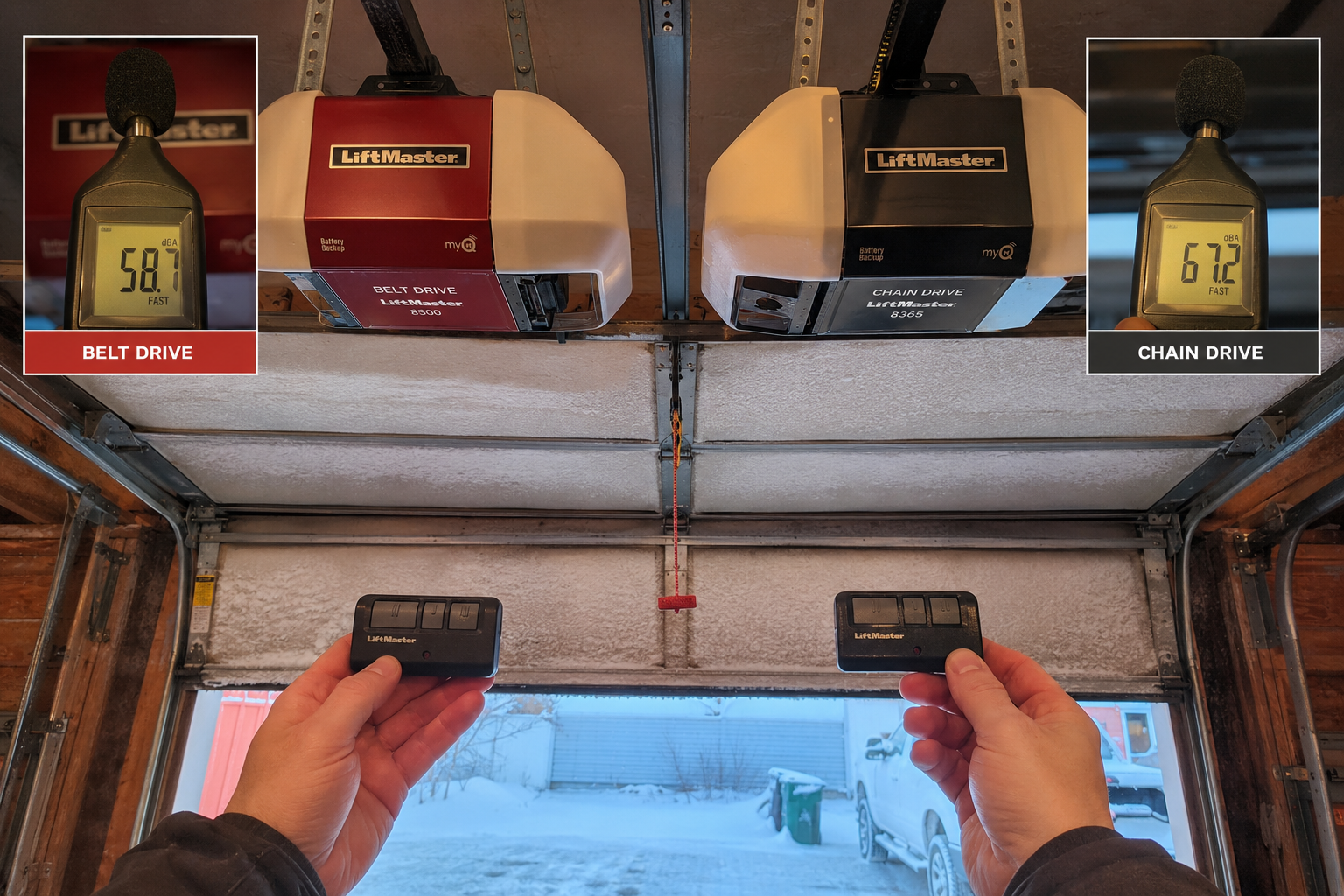
Direct drive openers are the quietest option available in 2026, followed closely by belt drive openers. Both typically operate below 60 dB, which is roughly the volume of a normal conversation. Chain drive openers are louder, often exceeding 65 dB, and the vibration can resonate through walls and ceilings in attached garages (Guse-Hahn Door, 2025).
The noise difference between belt and chain drive is meaningful in practice. A belt drive uses a reinforced belt and vibration-isolation mounts to dampen sound at the source. A chain drive transmits mechanical vibration directly through the rail and into the garage frame. In a detached garage, this distinction matters less. In an attached garage where a bedroom sits above or beside the garage, it can mean the difference between waking a sleeping household at 6 a.m. and not.
Modern DC-motor chain drives are quieter than older AC models, which has slightly narrowed the gap with belt drives (A1 Garage, 2026). But the gap has not closed entirely. For noise-sensitive environments, belt or direct drive remains the clear recommendation.
“Prioritize belt or direct drive when bedrooms sit above or beside the garage.” — Garage Door Doctor, February 2026
How Much Do Belt Drive Garage Door Openers Typically Cost in 2026?
Belt drive openers typically cost $50 to $100 more than comparable chain drive units before installation. In 2026, a mid-range belt drive opener (unit only) runs roughly $200 to $350 CAD at retail, while a comparable chain drive unit starts around $150 to $250 CAD. Direct drive openers sit at the top of the range, often $300 to $500 CAD or more for the unit alone.
Installation adds $100 to $200 CAD in most Ontario markets, depending on whether old hardware needs to be removed and whether the ceiling requires additional blocking.
A note on 2026 pricing pressures: In April 2026, Chamberlain/LiftMaster notified dealers of a Section 232 tariff surcharge increase on residential openers and rails, raising the surcharge from 6% to 12.5% (FirstLine Garage, 2026). This stacks on top of previously announced surcharges and applies to both motors and rails. Separately, White House modifications to Section 232 metal tariffs in April 2026 now apply duties to the full customs value of aluminum, steel, and copper-containing products, not just the metal portion. Chain drive rail systems, being steel-heavy, are particularly exposed to this cost pressure.
A June 2026 cost guide notes that while chain drives still carry lower upfront costs, the price gap with belt drives may narrow further as steel-heavy chain systems absorb more tariff burden. Homeowners buying in late 2026 should request updated quotes rather than relying on prices from earlier in the year.
For a full breakdown of what goes into an opener installation quote, see How to Read a Garage Door Quote: 9 Line Items Explained.
Are Chain Drive Openers Becoming Obsolete?
Chain drive openers are not becoming obsolete in 2026, but their market position is narrowing. They remain the dominant choice for budget-conscious buyers, detached garages, and applications involving heavy or oversized doors. However, their share of the attached-garage market is declining as belt drive prices have become more accessible and as homeowners increasingly prioritize quiet operation for smart-home use at irregular hours (Forest Door, April 2026).
Smart connectivity has also blurred one of the historic advantages of premium openers. A June 2026 market analysis projects smart garage door opener systems growing at roughly 14.4% annually from 2026 to 2033, and notes that even mid-range chain drive units now include app connectivity and auto-close features. The old assumption that “smart” meant “belt or direct drive only” no longer holds.
Chain drives are still the right tool for specific jobs. They are not going away, but they are no longer the default recommendation for every installation.
Which Garage Door Opener Type Is Best for Heavy Wooden Doors?
Chain drive openers are the most reliable choice for heavy wooden or oversized doors. The metal chain resists slip under load in a way that rubber belts cannot fully match, making chain drives the preferred option when door weight exceeds roughly 300 lbs or when the door is a solid wood carriage-house style (Raynor Door Authority, January 2026).
Belt drives can handle standard steel and insulated doors without issue. Most residential belt drive openers are rated for doors up to 500 lbs, which covers the majority of modern steel and composite doors. However, for very heavy solid-wood doors, a chain drive or a high-capacity belt drive (look for units specifically rated for heavy doors) is the safer long-term choice.
Direct drive openers also perform well with standard-weight doors but are less commonly available in the heavy-duty configurations that chain drives offer.
Decision rule:
- Door weight under 300 lbs, standard steel or insulated: belt or direct drive works well.
- Door weight over 300 lbs, solid wood, or oversized: chain drive is the more reliable option.
- Uncertain about door weight: have a technician assess before purchasing an opener.
If you’re replacing springs at the same time as the opener, see Garage Door Spring Repair in Oakville, ON for guidance on matching spring tension to door weight.
Do Direct Drive Openers Work Well in Cold Climates?
Direct drive openers perform reliably in cold climates, including Canadian winters. Because the motor is the only moving part, there are fewer components that can stiffen, crack, or contract in freezing temperatures compared to belt or chain drive systems.
Belt drives can be affected by cold in one specific way: rubber and polyurethane belts can stiffen slightly in extreme cold (below -20°C), which may cause minor performance changes in unheated garages. This is rarely a functional problem for most Ontario homeowners, but it is worth noting for garages that are completely uninsulated and exposed to prolonged deep freezes.
Chain drives are generally cold-tolerant, though the chain and sprocket benefit from a lubricant that stays fluid at low temperatures. Using the wrong lubricant in winter can cause the chain to drag. For lubricant guidance specific to Ontario’s climate, see Best Garage Door Lubricant for Ontario Climate: Silicone vs Lithium.
Direct drive openers also tend to work well in garages with limited ceiling clearance because the wall-mount configuration keeps the ceiling rail area clear. This is a practical advantage in older Ontario homes where garage ceiling heights can be lower than modern builds.
What Maintenance Do Belt Drive Openers Need?
Belt drive openers require very little maintenance compared to chain drives. The belt itself does not need lubrication. Routine maintenance for a belt drive opener includes:
- Inspecting the belt annually for cracks, fraying, or signs of stretching. A worn belt can slip or break, causing the door to stop mid-travel.
- Checking belt tension every one to two years. A belt that is too loose will cause the door to jerk; one that is too tight puts stress on the motor and trolley bearings.
- Lubricating the rail and trolley carriage with a silicone-based lubricant once or twice a year. The belt itself should not be lubricated.
- Testing the auto-reverse and force settings every six months to ensure safety compliance.
- Inspecting the drive gear and sprocket inside the motor unit every few years, particularly on openers used more than four times daily.
Chain drive openers need all of the above plus regular chain lubrication (every six to twelve months) to prevent rust and reduce noise. This is the single biggest maintenance difference between the two types.
Direct drive openers have the simplest maintenance profile of all three: the motor unit is largely sealed, and there is no belt or chain to inspect or lubricate. Annual visual checks and trolley rail lubrication are typically sufficient.
For a full maintenance checklist, a Garage Door Tune Up covers all opener types and includes safety checks that are easy to miss in a DIY inspection.
Can a Homeowner Install a Belt Drive Opener Without a Professional?
Yes, most homeowners with basic mechanical skills can install a belt drive opener as a DIY project. The process involves assembling the rail, attaching the motor unit to the ceiling, connecting the belt, and wiring the wall button and safety sensors. Most manufacturers include detailed instructions, and video guides are widely available.
Realistic DIY considerations:
- Allow two to four hours for a first-time installation.
- A helper makes the job significantly easier when lifting the motor unit into position.
- Proper ceiling blocking is required if the mounting point does not fall on a joist. Skipping this step is a common mistake that leads to vibration noise and, in rare cases, the unit pulling loose over time.
- Safety sensor alignment is the step most often done incorrectly. Misaligned sensors cause the door to reverse immediately after closing.
Chain drive openers follow essentially the same installation process and are equally DIY-friendly. Direct drive (wall-mount) openers require careful rail alignment because the motor travels the full length of the rail, and any bow or misalignment in the rail causes operational problems.
When to call a professional instead:
- The existing springs are worn or mismatched (a new opener does not fix a spring problem).
- The garage has a high-lift or custom door configuration.
- The ceiling height is below standard (less than 7 feet of headroom).
- The electrical outlet near the opener location is not on a dedicated circuit.
For professional installation in the Oakville and surrounding area, Garage Door Opener Repair in Oakville, ON includes same-day service for both new installs and replacements.
Which Garage Door Opener Type Is Most Reliable Long-Term?
Direct drive openers have the strongest case for long-term reliability because they have only one moving part. Fewer moving parts means fewer points of failure. The motor unit on a direct drive opener does not wear a belt or chain; the motor itself is the trolley, so there is no separate drive component to replace (OC Garage Door Guys, 2025).
Belt drive openers are the second-most reliable option for typical residential use. The belt is the main wear component and can last ten to fifteen years under normal conditions. When it does fail, belt replacement is straightforward and less expensive than a full unit replacement.
Chain drive openers are mechanically durable but require more consistent maintenance to achieve long service life. A neglected chain will stretch, rust, and eventually skip teeth on the sprocket, which can cause erratic door movement or a complete failure. With proper lubrication and periodic tension adjustment, a chain drive opener can last fifteen years or more.
Reliability summary by use case:
- High-use household (4+ cycles per day): direct drive offers the best long-term value.
- Average household (2 to 4 cycles per day): belt or direct drive, with belt being the more widely available option.
- Budget-focused, lower-use household: chain drive with consistent maintenance is a reliable choice.
Are Direct Drive Openers Worth the Extra Money?
Direct drive openers are worth the premium for homeowners who prioritize quiet operation, minimal maintenance, and long-term reliability. The price premium over a mid-range belt drive is typically $100 to $200 CAD for the unit, which is modest over a ten to fifteen year ownership period.
The case for direct drive is strongest when:
- The garage is attached and noise is a significant concern.
- The household uses the garage door frequently (four or more times daily).
- The homeowner wants to minimize future service calls and maintenance tasks.
- Ceiling space is limited and a wall-mount configuration is preferred.
The case against direct drive is simpler: brand selection is narrower than for belt or chain drives, which can make finding replacement parts or a knowledgeable installer slightly harder in some markets. In Ontario, most experienced garage door technicians work with direct drive systems regularly, so this is less of a concern than it might be in smaller markets.
For homeowners also considering smart lock integration with their opener, see myQ Secure View 3-in-1 Smart Lock: Is It Worth It in 2026 for a compatible accessory that works across all three drive types.
What Are Common Problems With Chain Drive Garage Door Openers?
Chain drive openers are reliable but have a predictable set of failure points that homeowners should know.
Most common chain drive problems:
- Chain stretching over time: A stretched chain sags and can slap against the rail, creating a loud banging noise. The fix is adjusting the chain tension, which is a straightforward DIY task.
- Chain rust: In humid or unheated garages, the chain can develop surface rust that increases friction and noise. Regular lubrication prevents this; a heavily rusted chain usually needs replacement.
- Sprocket wear: The sprocket that drives the chain can wear down, especially on openers used frequently without proper lubrication. Worn sprockets cause the chain to skip and the door to jerk or stop unexpectedly.
- Vibration noise: Chain drives transmit mechanical vibration through the rail and into the garage structure. Anti-vibration mounts can reduce but not eliminate this.
- Opener reversal issues: Like all opener types, chain drives can develop problems with the force and limit settings over time, causing the door to reverse before fully closing or opening. This is often a sensor or adjustment issue rather than a chain problem specifically.
If the opener is reversing unexpectedly, see Why Your Garage Door Reverses Before Closing and How to Fix It for a step-by-step diagnosis.
Which Garage Door Opener Is Recommended for Attached Garages?
Belt drive and direct drive openers are the standard recommendation for attached garages. The core reason is noise: in an attached garage, the opener motor and drive mechanism share walls, floors, and ceilings with living spaces. Chain drive vibration transmits directly into the home structure, which is disruptive — especially during early morning or late-night use (Garage Door Doctor, February 2026).
The recommendation from multiple installer sources and the February 2026 Garage Door Doctor guide is consistent: if a bedroom, nursery, or home office is located above or beside the garage, a belt or direct drive opener is the right choice. The noise difference is noticeable from the first use.
For detached garages, the noise concern largely disappears, and chain drive becomes a reasonable option for budget-focused buyers or those with heavy doors.
A note on power outages in Ontario: Attached garage openers are also the most critical to have battery backup on, since a power outage can trap a car inside. For Ontario-specific guidance, see Battery Backup Garage Door Openers: Why Ontario Power Outages Matter.
Comparing Belt Drive vs Chain Drive vs Direct Drive Openers in 2026: A Full Decision Framework
The right opener in 2026 depends on four factors: garage attachment, door weight, noise tolerance, and budget. Here is a practical decision framework that covers the most common scenarios.
Choose a chain drive if:
- The garage is detached and noise is not a concern.
- The door is heavy (solid wood, oversized, or above 300 lbs).
- Budget is the primary constraint and maintenance is manageable.
- The home is a rental property or the opener is a short-term solution.
Choose a belt drive if:
- The garage is attached to the home.
- Quiet operation is a priority but the budget does not stretch to direct drive.
- The door is a standard steel, insulated, or composite panel door.
- A wide selection of brands and replacement parts is important.
Choose a direct drive if:
- Maximum quiet and minimum maintenance are the top priorities.
- The household uses the garage door four or more times daily.
- Ceiling space is limited and a wall-mount configuration is preferred.
- Long-term reliability matters more than upfront savings.
The 2026 tariff context: With Chamberlain/LiftMaster’s April 2026 surcharge increase and broader Section 232 tariff changes affecting steel-heavy components, chain drive systems may see proportionally larger price increases than belt or direct drive units over the remainder of 2026. Buyers comparing prices should request current quotes and ask dealers specifically whether surcharges are included in the listed price.
FAQ: Belt Drive vs Chain Drive vs Direct Drive Openers in 2026
Q: Is a belt drive opener really quieter than a chain drive? Yes. Belt drive openers use a rubber or polyurethane belt that absorbs vibration rather than transmitting it. Noise specialists note that belt and direct drive openers generally operate below 60 dB, while chain drives typically run louder. The difference is audible from inside the home, especially at night.
Q: How long does a belt drive opener last? A well-maintained belt drive opener typically lasts ten to fifteen years. The belt itself is the primary wear component and can be replaced without replacing the entire unit, extending the opener’s service life further.
Q: Can a chain drive opener be made quieter? Partially. Anti-vibration mounting pads, proper chain lubrication, and tension adjustment all reduce chain drive noise. However, the mechanical vibration of metal-on-metal contact cannot be fully eliminated. A chain drive in good condition is quieter than a neglected one, but it will always be louder than a belt or direct drive.
Q: What horsepower rating do I need for a heavy wooden door? For heavy wooden or solid-core doors, a 3/4 HP or 1 HP opener is generally recommended. Most standard steel doors work fine with 1/2 HP. Check the door weight against the opener’s rated capacity before purchasing.
Q: Are direct drive openers available from multiple brands? Direct drive openers are available from fewer brands than belt or chain drive units. Sommer is the most widely recognized direct drive brand in North America. LiftMaster and Chamberlain offer wall-mount models that use a similar concept. Selection is growing but remains narrower than belt or chain drive options.
Q: Do tariffs in 2026 affect which opener type I should buy? Tariffs are affecting pricing for all three types, but steel-heavy chain drive rail systems face proportionally higher exposure to the 2026 Section 232 tariff changes. The price gap between chain and belt drives may narrow. Request current dealer pricing rather than relying on older price comparisons.
Q: Is a direct drive opener harder to repair? Direct drive openers have fewer components, so there is less to go wrong. However, when the motor unit itself fails, replacement typically involves the entire motor assembly. Parts availability depends on the brand. For most Ontario homeowners, a qualified technician can source parts within a few days.
Q: Which opener type works best with smart home systems? All three drive types are available with smart connectivity in 2026. Smart features (app control, auto-close, alerts) are no longer limited to premium belt or direct drive models. A June 2026 market analysis notes that even mid-range chain drive units now include app connectivity as standard.
Q: What should I do if my opener fails unexpectedly? If the opener stops working suddenly, check the safety sensors, the wall button connection, and the force settings before assuming the motor has failed. For same-day diagnosis and repair in the Oakville area, Garage Door Opener Repair covers all opener types and drive systems.
Q: Is it worth upgrading from chain drive to belt drive? If the current chain drive is working but noisy, and the garage is attached to the home, upgrading to a belt drive is worth considering — especially if the existing unit is more than ten years old. The noise reduction is immediate and the long-term maintenance savings partially offset the upgrade cost.
Conclusion
The Belt Drive vs Chain Drive vs Direct Drive Openers in 2026 comparison comes down to matching the right tool to the specific situation rather than chasing a single “best” answer.
For most attached garages in Ontario: a belt drive opener is the practical sweet spot between cost and quiet operation. It is quieter than a chain drive, widely available, easy to service, and priced within reach of most budgets.
For detached garages or heavy doors: a chain drive remains a solid, cost-effective choice. Keep up with lubrication and tension checks, and it will serve reliably for many years.
For high-use households or premium builds: a direct drive opener delivers the quietest, lowest-maintenance experience available and is worth the additional investment when the garage is used frequently.
Actionable next steps:
- Identify whether the garage is attached or detached, and note whether any living spaces share walls or ceilings with the garage.
- Check the door weight or have a technician assess it before selecting an opener horsepower rating.
- Get current quotes from at least two dealers in 2026, and ask specifically whether the April 2026 tariff surcharges are included in the price.
- If the existing springs are worn, address them at the same time as the opener replacement — a new opener on failing springs will not perform correctly.
- Consider battery backup for any attached garage opener, particularly in Ontario where winter power outages are a real risk.
For professional guidance on which opener suits a specific door and garage configuration, contact Oakview Garage Doors for an assessment in the Oakville, Burlington, and Mississauga area.
References
- Garage Door Doctor. (February 2026). Belt drive vs. direct drive vs. chain drive openers. Retrieved from garagedoordoctor.com
- Raynor Door Authority. (January 2026). Chain drive vs. belt drive garage door openers: A comparative guide.
- OC Garage Door Guys. (2025). Garage door opener buying guide: Chain vs. belt vs. direct drive.
- Guse-Hahn Door. (2025). Quietest garage door openers: Decibel ratings and drive type comparison.
- A1 Garage. (2026). Garage door opener buyer’s guide: Chain, belt, and direct drive.
- FirstLine Garage. (April 2026). Chamberlain/LiftMaster Section 232 tariff surcharge dealer notice summary.
- Forest Door. (April 6, 2026). Belt and chain drive openers: 2026 buyer’s perspective.
- LinkedIn Market Intelligence. (June 2026). United States smart garage door opener systems: Market growth projections 2026–2033.