Last updated: June 11, 2026
Quick Answer: Ontario garage doors must comply with the 2024 Ontario Building Code (OBC), the Ontario Fire Code, and the Ontario Electrical Safety Code. Key requirements cover structural integrity, entrapment-protection sensors, egress rules, and electrical safety. Most cosmetic replacements don’t need a permit, but any work that changes the opening size, affects structure, or adds new electrical circuits does.
Key Takeaways
- The 2024 Ontario Building Code is now fully in force and represents the most extensive set of building code changes in Ontario since 1975, replacing the 2012 OBC.
- Photoelectric entrapment-protection sensors are a mandatory safety feature on all automatic garage door openers in Canada, including Ontario.
- Overhead garage doors cannot serve as required egress or exit doors under the 2024 OBC or the Ontario Fire Code.
- A building permit is generally required when enlarging or relocating a garage door opening, or when making structural changes to the surrounding wall.
- All new electrical work for garage door openers and associated circuits requires an Electrical Safety Authority (ESA) notification and inspection.
- Residential and commercial garage doors face different code requirements, with commercial doors subject to stricter fire-rating, wind-load, and accessibility provisions.
- Building permit applications and code compliance are enforced by local municipal building departments, not a single provincial agency.
- The Ontario Fire Code was updated January 1, 2026 to harmonize with the 2020 National Fire Code of Canada, introducing new language around exit doors in farm-building occupancies.
What Are the Basic Safety Codes for Garage Doors in Ontario?
Ontario garage doors are governed by three overlapping regulatory frameworks: the 2024 Ontario Building Code, the Ontario Fire Code (updated January 1, 2026), and the Ontario Electrical Safety Code. Together, these codes set minimum standards for structural performance, fire separation, entrapment protection, and electrical installation.
The 2024 OBC is the primary document. It applies to new construction and to alterations that trigger a permit. For attached garages in residential homes (Part 9 buildings up to 3 storeys and 600 m²), the Code addresses:
- Fire separation: An attached garage must be separated from the house interior by fire-rated assemblies. The door connecting the garage to the living space must meet specific fire-resistance ratings, typically a solid-core or fire-rated door with a self-closing device.
- Structural loads: Garage door frames and headers must be sized to carry the loads imposed by the door, including wind uplift and snow loads relevant to the local climate zone.
- Entrapment protection: All automatic garage door openers sold and installed in Canada must include photoelectric sensors or equivalent entrapment-protection devices that reverse or stop the door when an obstruction is detected.
- Egress: Overhead garage doors are not permitted as required egress or exit doors. The OBC and Fire Code both require that exit doors swing in the direction of travel. Overhead and sliding doors do not meet this requirement.
The Ontario Fire Code update that took effect January 1, 2026 harmonized provincial rules with the 2020 National Fire Code of Canada. One notable change affects farm-building occupancies: exit doors must swing in the direction of travel and cannot be overhead doors, a rule that codifies what was already standard practice in residential and commercial construction.
Are There Different Requirements for Residential vs. Commercial Garage Doors?
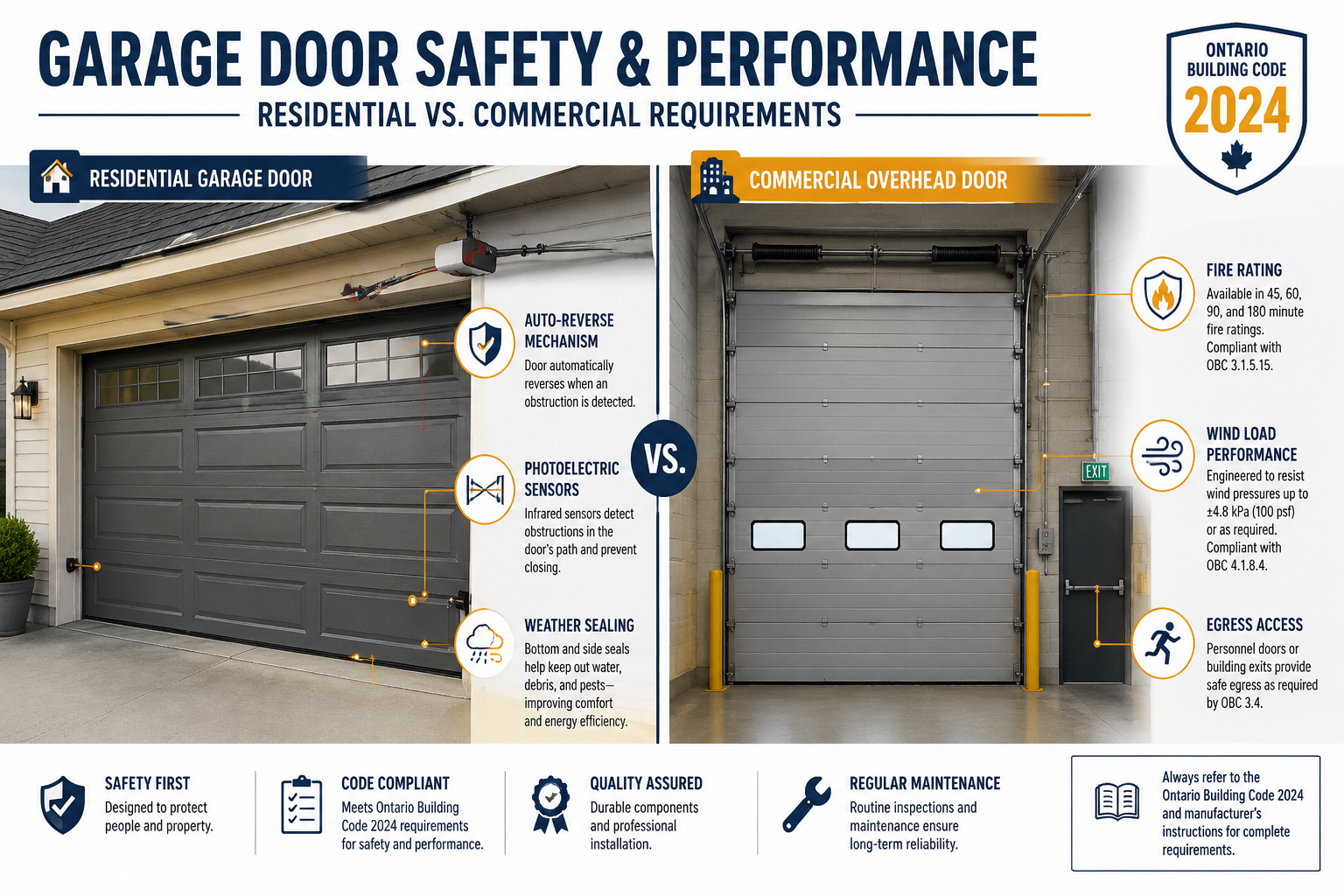
Yes, the requirements differ significantly. Residential garage doors in Part 9 buildings face baseline structural, fire-separation, and sensor requirements. Commercial and industrial overhead doors face a broader and stricter set of obligations.
Residential garage doors (single-family homes, townhouses, small multi-unit buildings) must meet:
- Minimum R-value insulation requirements where the garage is attached and conditioned
- Fire-rated separation from living space
- Entrapment-protection sensors on all automatic openers
- Header and frame sizing appropriate for the door weight and local wind/snow loads
Commercial and industrial overhead doors must also address:
- Fire ratings: Loading-bay and warehouse doors in fire-separated areas may need to be fire-rated assemblies, complete with fusible links or automatic closing mechanisms.
- Wind load compliance: Larger commercial doors must be engineered to resist wind pressures specific to the building’s location and exposure category.
- Accessibility: Where the overhead door is the primary entry point for employees or the public, accessibility provisions under the Accessibility for Ontarians with Disabilities Act (AODA) may apply to the surrounding pathway and controls.
- Egress: Commercial buildings must have compliant swinging egress doors independent of any overhead door, regardless of how large the overhead opening is.
Choose residential-grade requirements if: the garage is attached or detached from a single-family home or small residential building. Choose commercial-grade requirements if: the building is classified as industrial, commercial, or institutional, or if the overhead door exceeds standard residential dimensions (typically over 10 feet wide or 8 feet tall for a single door).
Do I Need a Permit to Replace My Existing Garage Door in Ontario?
Not always, but it depends on the scope of the work. A like-for-like replacement of an existing garage door, where the opening size stays the same and no structural changes are made, generally does not require a building permit in Ontario. However, all work must still comply with the Ontario Building Code regardless of whether a permit is pulled.
A building permit is required when:
- The garage door opening is enlarged, reduced, or relocated
- Structural elements such as the header, lintel, or surrounding wall framing are modified
- A new garage is being constructed or an existing one is being converted
- The project involves adding new electrical circuits for the opener or lighting
A permit is generally not required for:
- Replacing a door with one of the same size and type
- Swapping out an opener unit without changing wiring
- Cosmetic work such as painting or replacing panels without altering the frame
Even without a permit, the installation must meet code. If a contractor installs a door that doesn’t comply with the OBC and a problem arises later (a fire, a structural failure, an insurance claim), the absence of a permit and inspection can create serious liability for both the homeowner and the contractor.
For a clear breakdown of what line items in a garage door quote relate to permit-required work, see this guide on how to read a garage door quote.
What Happens If My Garage Door Doesn’t Meet Ontario Building Codes?
Non-compliant garage doors can trigger enforcement action, insurance complications, and safety risks. Ontario’s building code enforcement is handled at the municipal level by local building departments, and violations can result in orders to comply, stop-work orders, or mandatory remediation at the owner’s expense.
Specific consequences include:
- Order to comply: A building official who identifies a code violation can issue a formal order requiring the deficiency to be corrected within a set timeframe.
- Insurance denial: Many home insurance policies exclude coverage for damage arising from unpermitted or non-compliant work. A fire or injury linked to a non-code-compliant garage door could result in a denied claim.
- Resale complications: Home inspectors and real estate lawyers routinely flag unpermitted garage work. Buyers may demand remediation or price reductions.
- Personal liability: If a non-compliant door injures someone, the homeowner may face civil liability, particularly if the deficiency was known or should have been known.
The most common code violations found during inspections involve missing entrapment-protection sensors, inadequate fire separation between the garage and the house, and improperly sized headers above the door opening.
If a door is malfunctioning or showing signs of structural stress, addressing it quickly reduces both safety risk and code exposure. See 5 signs you need garage door repair for a practical checklist.
Which Garage Door Materials Are Most Recommended by Ontario Safety Standards?
Ontario’s building code does not mandate a specific material for garage doors, but it sets performance requirements that effectively favour certain materials over others. The door must resist the structural loads for its location, maintain the required fire separation where applicable, and perform reliably in Ontario’s climate conditions.
Steel: The most widely installed material in Ontario. Insulated steel doors offer good structural performance, reasonable R-values, and durability in freeze-thaw cycles. They can be factory-painted or finished to resist corrosion.
Aluminum: Lighter than steel and resistant to rust, but less rigid. Better suited to mild climates or contemporary architectural styles where large glass panels are incorporated. May require additional bracing in high-wind zones.
Fiberglass and composite: Resistant to denting and corrosion, but can become brittle in extreme cold. Less common in Ontario’s colder regions.
Wood: Aesthetically popular but requires consistent maintenance to prevent warping, rot, and swelling. Wood doors can meet structural requirements if properly constructed, but they demand more upkeep in Ontario’s humid summers and cold winters.
For attached garages, insulated steel is the most practical choice because it contributes to the thermal envelope of the home and holds up well through Ontario winters. For guidance on maintaining any door material through seasonal changes, the article on best garage door lubricant for Ontario’s climate covers product selection by temperature range.
How Much Does It Cost to Install a Code-Compliant Garage Door in Ontario?
A code-compliant garage door installation in Ontario typically ranges from $1,200 to $4,500 or more for a standard residential single or double door, depending on material, insulation level, opener type, and whether structural modifications are needed. These are general market estimates for 2026 based on contractor pricing in the Greater Toronto and Hamilton area; actual costs vary by municipality and project scope.
Typical cost breakdown:
| Component | Estimated Cost Range |
|---|---|
| Standard insulated steel door (single) | $800 – $1,800 |
| Standard insulated steel door (double) | $1,200 – $3,000 |
| Opener with entrapment sensors | $350 – $800 |
| Professional installation labour | $200 – $500 |
| Building permit (if required) | $100 – $400+ |
| ESA electrical inspection (if new circuit) | $100 – $250 |
| Header modification (if needed) | $300 – $1,500+ |
Costs rise when structural changes are involved, when a custom or wood door is selected, or when the existing opener wiring doesn’t meet current electrical code. For a detailed look at what drives spring replacement costs specifically, see garage door spring replacement cost in Oakville in 2026.
Common mistake: Homeowners sometimes choose the lowest-quoted door without verifying that the quote includes a code-compliant opener with sensors, proper header sizing, and ESA notification for electrical work. A quote that omits these items may look cheaper but creates compliance gaps.
What Are the Electrical Requirements for Modern Garage Door Systems?
Any new electrical work connected to a garage door system in Ontario must comply with the Ontario Electrical Safety Code and requires an ESA (Electrical Safety Authority) notification and inspection. This applies to new circuits, new outlets near the opener, and any wiring changes, even if the opener itself is a plug-in unit.
Key electrical requirements include:
- Dedicated circuit: Garage door openers should be connected to a properly rated circuit. While many plug-in openers run on a standard 15-amp circuit, the circuit must be properly grounded and protected.
- GFCI protection: Receptacles in garages must be ground-fault circuit-interrupter (GFCI) protected under the Ontario Electrical Safety Code, given the potential for moisture exposure.
- Lighting circuits: Hardwired lighting in garages must also comply with the Electrical Safety Code and may require a separate circuit depending on load.
- ESA notification: Any new wiring, including adding an outlet for an opener, requires the homeowner or licensed electrical contractor to notify the ESA and arrange an inspection.
- Battery backup systems: Openers with battery backup are not subject to additional code requirements beyond standard electrical rules, but the backup unit must be installed per the manufacturer’s instructions. For Ontario homeowners concerned about power outages, battery backup garage door openers are a practical addition that also supports code-compliant operation during grid failures.
Edge case: Smart garage door openers that connect to home Wi-Fi or integrate with smart-lock systems don’t face additional electrical code requirements beyond standard wiring rules, but their control systems must not interfere with the required entrapment-protection sensors.
Are Automatic Garage Doors Mandatory in New Ontario Construction?
No, automatic openers are not mandatory in new Ontario residential construction. The Ontario Building Code does not require a garage door to be motorized. However, if an automatic opener is installed, it must include entrapment-protection devices (photoelectric sensors or equivalent) as a mandatory safety feature.
In practice, most new homes built in Ontario include automatic openers because buyers expect them and builders include them as standard. The code requirement kicks in the moment an opener is installed, not at the point of construction.
For new construction specifically:
- The rough-in electrical for an opener (a ceiling outlet above the door) is standard practice and is often required by builders to meet buyer expectations, but it is not a code mandate.
- The garage structure itself must meet all OBC requirements for fire separation, structural loads, and egress, regardless of whether an opener is installed.
- If a builder installs an opener as part of the new home, all electrical work must comply with the Ontario Electrical Safety Code and receive ESA inspection.
What Safety Features Are Required for Garage Doors Near Schools or Public Spaces?
Garage doors adjacent to schools, community centres, or other public-access buildings face additional considerations beyond standard residential code. The core safety requirements remain the same (entrapment protection, structural integrity, fire separation where applicable), but accessibility and egress provisions become more prominent.
For garage doors in or adjacent to publicly accessible buildings:
- Accessibility: AODA requirements apply to the pathways, controls, and entry points associated with the door. Push-button controls must be accessible to wheelchair users, and visual or audible warnings may be required when a large door is in motion.
- Egress independence: The overhead door cannot substitute for a required exit. A compliant swinging exit door must be available independent of the overhead door’s operation.
- Signage and warnings: Commercial and institutional settings often require motion-warning signage and audible alerts when overhead doors operate in areas where pedestrians may be present.
- Wind load engineering: Larger doors on institutional buildings may require a professional engineer to certify wind load compliance, particularly in exposed locations.
Standard residential code does not address proximity to schools specifically. The additional requirements come from the building’s occupancy classification under the OBC and from AODA accessibility standards, both of which apply based on how the building is used, not its physical proximity to a school.
Who Checks and Enforces Garage Door Code Compliance in Ontario?
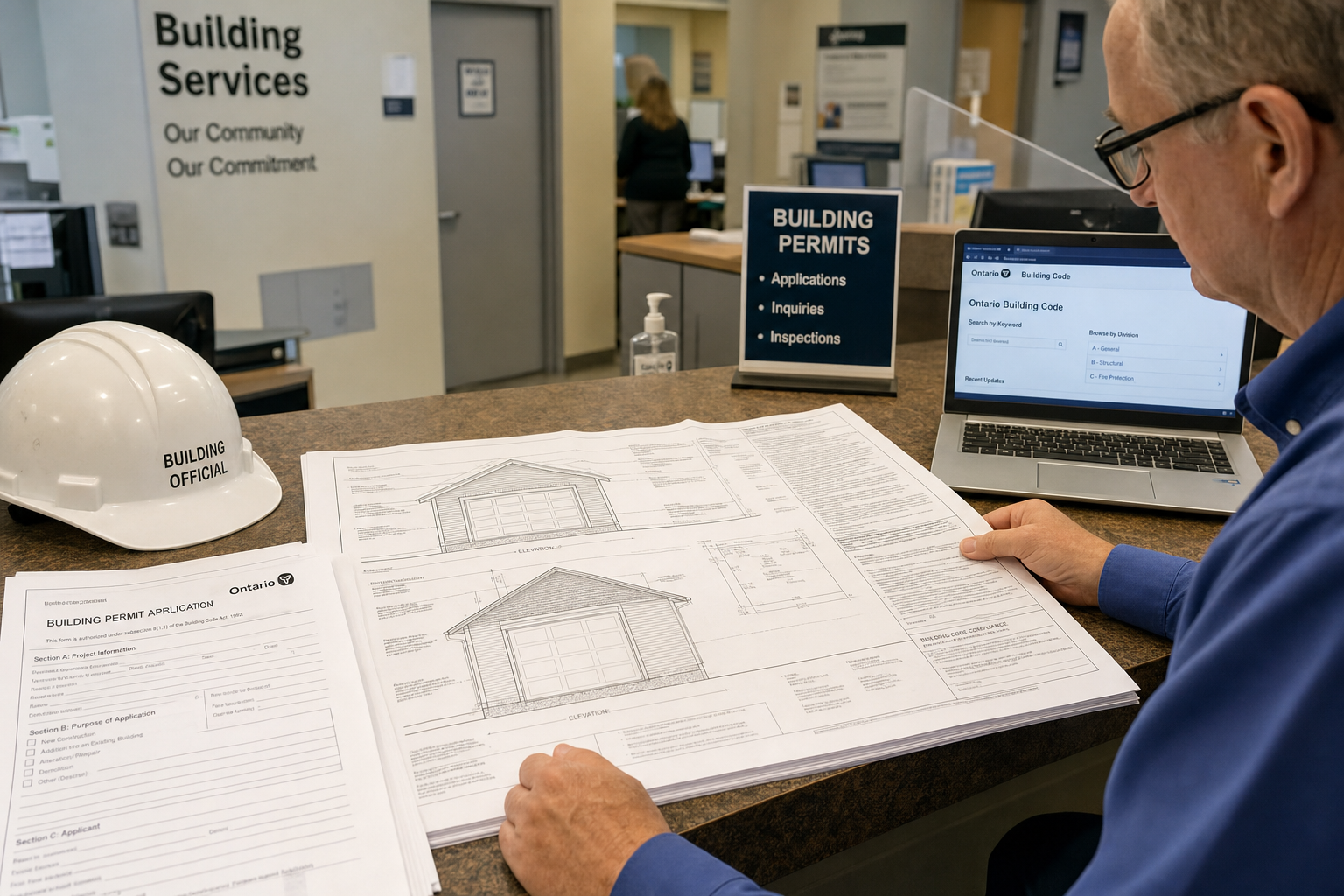
Code compliance for garage doors in Ontario is enforced primarily by municipal building departments. There is no single provincial agency that inspects individual garage doors. Enforcement happens through the permit and inspection process, and through complaints or incidents that trigger a building official’s review.
Key enforcement bodies:
- Municipal building departments: Issue permits, conduct inspections at key construction stages, and respond to complaints about non-compliant construction.
- Electrical Safety Authority (ESA): Inspects electrical work related to garage door openers, circuits, and outlets when a notification is filed. ESA can also investigate electrical hazards reported independently.
- Ontario Fire Marshal’s Office: Sets and enforces Fire Code requirements, including those related to exit doors and fire separation in garages. Enforcement at the property level is typically carried out by local fire departments.
- Technical Standards and Safety Authority (TSSA): Not directly involved in garage doors, but relevant if the garage connects to fuel-burning equipment or gas lines.
How inspections typically work:
- A building permit is issued by the municipality.
- The contractor or homeowner books inspections at required stages (framing, insulation, final).
- A building official attends and signs off if the work meets code.
- ESA conducts a separate electrical inspection if new wiring was involved.
- The permit is closed once all inspections are passed.
Without a permit, there is no scheduled inspection. Work may still be flagged if a neighbour complains, if the home is sold and a lawyer requests permit history, or if an incident occurs.
Common Mistakes Homeowners Make With Garage Door Installations
Several recurring errors appear in Ontario garage door projects, most of which create either safety risks or code compliance problems.
1. Skipping the permit when structural changes are involved. Enlarging a garage door opening without a permit is one of the most common violations. The header above the opening must be properly engineered for the new span, and without an inspection, undersized headers go undetected.
2. Installing an opener without entrapment sensors. Older or budget openers sometimes ship without functional photoelectric sensors. Installing one without sensors is a code violation and a serious safety hazard, particularly in homes with children.
3. Assuming the overhead door counts as an exit. Some homeowners believe a large garage door provides adequate emergency egress. It does not meet OBC or Fire Code requirements for an exit door, and relying on it as a primary escape route in a fire is dangerous.
4. Ignoring the fire-separation door between the garage and the house. Replacing the interior door between the garage and the living space with a standard hollow-core door removes a critical fire barrier. This door must be a solid-core or rated door with a self-closer.
5. Doing electrical work without ESA notification. Adding an outlet for a new opener or running a new circuit without notifying the ESA is a code violation. It also voids the electrical portion of home insurance coverage in many cases.
6. Choosing a door without considering Ontario’s climate loads. A door rated for mild climates may warp, bind, or fail structurally under Ontario’s freeze-thaw cycles and wind conditions. Insulated steel doors with proper weatherstripping are the most reliable choice for most Ontario locations.
If a door is already showing problems after installation, a garage door tune-up can identify whether the issue is mechanical or related to an installation deficiency.
How Often Do Garage Door Safety Standards Get Updated in Ontario?
Ontario’s building code has historically been updated in cycles of roughly 10 to 15 years, though the pace of change has accelerated. The 2024 OBC replaced the 2012 OBC after a 12-year gap, and it represents the most extensive revision since 1975. As of March 30, 2026, all Ontario Building Code exams are based on the 2024 Code, confirming that the transition is complete.
The Ontario Fire Code is updated more frequently, often in alignment with new editions of the National Fire Code of Canada. The January 1, 2026 update harmonized Ontario with the 2020 National Fire Code, and further updates are expected as new National Building Code editions are released.
Practical implications for homeowners:
- Code changes generally apply to new work, not to existing installations that were compliant when built. A garage door installed legally under the 2012 OBC is not automatically non-compliant under the 2024 OBC.
- When a renovation triggers a permit, the new work must meet the current code, even if the rest of the structure was built under an older edition.
- Manufacturers update their products to meet evolving standards, so doors and openers purchased from reputable suppliers are typically designed to meet current requirements.
Staying informed through the Ontario government’s Building Code portal or through a licensed contractor is the most reliable way to track changes that affect garage door projects.
Frequently Asked Questions
Does a detached garage need the same fire separation as an attached garage? No. Detached garages do not require fire-rated separation from the house because they are not connected. However, they must still meet structural, electrical, and occupancy requirements under the OBC, and any door openings must be properly framed and permitted if the opening is altered.
Can I install my own garage door opener in Ontario? Yes, homeowners can install their own openers. However, if the installation involves any new electrical wiring or a new circuit, an ESA notification is required and an inspection must be arranged. Plug-in openers on existing outlets typically don’t trigger this requirement, but the outlet itself must already be GFCI-protected and properly grounded.
Is there a minimum insulation requirement for garage doors in Ontario? The OBC does not set a universal minimum R-value for garage doors. However, if the garage is attached and the garage wall or ceiling forms part of the building’s thermal envelope, the overall assembly must meet energy efficiency requirements. In practice, insulated doors with an R-value of R-12 to R-18 are standard for attached garages in Ontario.
Are there wind load requirements for garage doors in Ontario? Yes. Garage doors must be designed and installed to resist wind loads appropriate to the building’s location and exposure. For most residential applications, standard manufacturer-rated doors meet these requirements. In high-exposure locations (near large open bodies of water, for example), additional bracing or engineered doors may be needed.
Can a garage door be used as the main entry to a basement apartment? No. An overhead garage door cannot serve as a required exit from a dwelling unit. Basement apartments must have at least one exit door that swings in the direction of travel and meets OBC egress requirements. This is a firm rule under both the OBC and the Ontario Fire Code.
What is the minimum door height for a residential garage door in Ontario? The OBC does not specify a minimum height for garage doors themselves (as opposed to egress doors). Standard residential garage doors are 7 feet tall for a single car and are sized to accommodate the vehicles they serve. The opening and surrounding structure must meet structural requirements regardless of height.
Do I need a permit to add windows to my existing garage door? Generally no, if the door itself is not being replaced and the structural integrity of the door is not affected. However, if the modification changes the door’s weight distribution significantly or requires frame alterations, it’s worth confirming with the local building department.
What happens if my garage door opener fails during a power outage? A failed opener during a power outage is a practical problem, not a code violation. However, all garage doors must have a manual release mechanism so the door can be operated by hand. This is a standard feature on all compliant openers. For homes where power outages are a concern, battery backup openers provide automatic operation without grid power.
Who is responsible for code compliance: the homeowner or the contractor? Both. The contractor is responsible for performing work that meets code. The homeowner is responsible for ensuring permits are obtained and for the condition of the property. If a contractor performs non-compliant work, the homeowner may still face enforcement action and must seek remedy from the contractor separately.
Are there specific requirements for garage doors in heritage buildings? Yes. Heritage properties in Ontario may be subject to additional restrictions under the Ontario Heritage Act, administered by local municipalities. Changes to the exterior appearance of a designated heritage property, including garage doors, may require heritage approval in addition to a standard building permit.
Conclusion
Garage door code compliance in Ontario in 2026 is more structured than many homeowners realize. The 2024 Ontario Building Code, the updated Fire Code, and the Ontario Electrical Safety Code together create a clear framework covering structural performance, fire separation, entrapment protection, egress, and electrical safety. The most important practical rules are: overhead doors cannot serve as required exits, automatic openers must have entrapment sensors, any structural changes to the opening require a permit, and new electrical work requires ESA notification.
Actionable next steps:
- Confirm your project scope. Determine whether your planned work changes the opening size, affects structure, or adds new electrical circuits. If yes, contact your local municipal building department before starting.
- Verify your existing door’s compliance. Check that your opener has functional photoelectric sensors, that the interior door between the garage and house is a rated fire door with a self-closer, and that all outlets in the garage are GFCI-protected.
- Hire qualified contractors. Use licensed contractors for structural work and licensed or ESA-registered electricians for any wiring. Ask for proof of ESA notification on electrical work.
- Keep records. Retain copies of permits, inspection sign-offs, and ESA certificates. These documents protect you at resale and in any insurance claim.
- Stay current. Check the Ontario government’s Building Code portal for updates, particularly as new National Building Code editions are adopted.
For professional installation or repair work in the Oakville, Burlington, Mississauga, or Hamilton areas, Oakview Garage Doors provides code-compliant installation with proper permitting guidance included.