Last updated: June 10, 2026
Quick Answer: At 11pm on a weeknight in Burlington, Ontario, a homeowner’s torsion spring snapped mid-cycle, trapping a vehicle inside a fully closed garage. A certified technician arrived within the hour, replaced both torsion springs, verified all safety systems, and restored full operation before midnight. The total repair time was under 45 minutes. This case study: emergency spring repair in Burlington at 11pm walks through every step of that call, the costs involved, the safety decisions made, and what homeowners can do to avoid the same situation.
Key Takeaways
- A broken garage door spring is one of the most common reasons for late-night emergency service calls in Burlington and across the Greater Hamilton-Burlington area.
- Torsion springs are the most common type on modern residential doors; when one snaps, the door typically becomes immovable without manual intervention.
- Emergency garage door spring repair in Burlington generally costs between $300 and $600 CAD after hours, depending on spring type, door size, and dispatch timing.
- DIY spring repair at any hour is genuinely dangerous. Ophthalmology case reports document open-globe eye injuries (ruptured eyeballs) from springs that released at high velocity during amateur repairs.
- Both springs should be replaced at the same time, even if only one has broken, because the second spring is typically at the same wear stage.
- Ontario’s 2026 Fire Code now requires carbon monoxide alarms on every level of a home with an attached garage, which is relevant safety context for any late-night garage service call.
- Signs of imminent spring failure include visible gaps in the spring coil, slow or uneven door movement, and a loud bang from the garage area.
- Springs typically last 10,000 cycles (roughly 7 to 10 years for an average household). High-cycle springs rated at 25,000 or 50,000 cycles are available as upgrades.
- Reputable technicians should carry liability insurance, be able to name their supplier for parts, and explain the repair clearly before starting work.
- Ignoring a broken spring can lead to a door dropping suddenly, cable failure, opener motor burnout, and a compromised security perimeter.
What Exactly Are Garage Door Springs and Why Do They Break
Garage door springs are the mechanical counterbalance system that offsets the weight of the door panel, which typically ranges from 130 to 400 pounds on a residential double door. Without functioning springs, the opener motor and any manual lifting force would have to carry that full weight alone.
Springs break primarily because of metal fatigue. Every time the door opens and closes, the spring completes one cycle. Most standard residential springs are rated for approximately 10,000 cycles. At two cycles per day, that translates to roughly 13 to 14 years. At four or five cycles per day (common in households where the garage is the main entry point), the same spring may fail in six to seven years.
Other contributing factors include:
- Rust and corrosion, which weakens the metal and increases friction between coils
- Improper tension setting during the original installation
- Extreme temperature swings, which cause the metal to expand and contract repeatedly (more on this below)
- Lack of lubrication, which accelerates wear at the coil contact points
When a spring snaps, it typically does so with a loud bang that many homeowners describe as sounding like a gunshot. That’s exactly what happened in this Burlington case: the homeowner heard the snap from inside the house at 10:47pm and found the door completely unresponsive.
For a deeper look at the warning signs that precede a spring failure, see this guide to broken garage door spring warning signs.
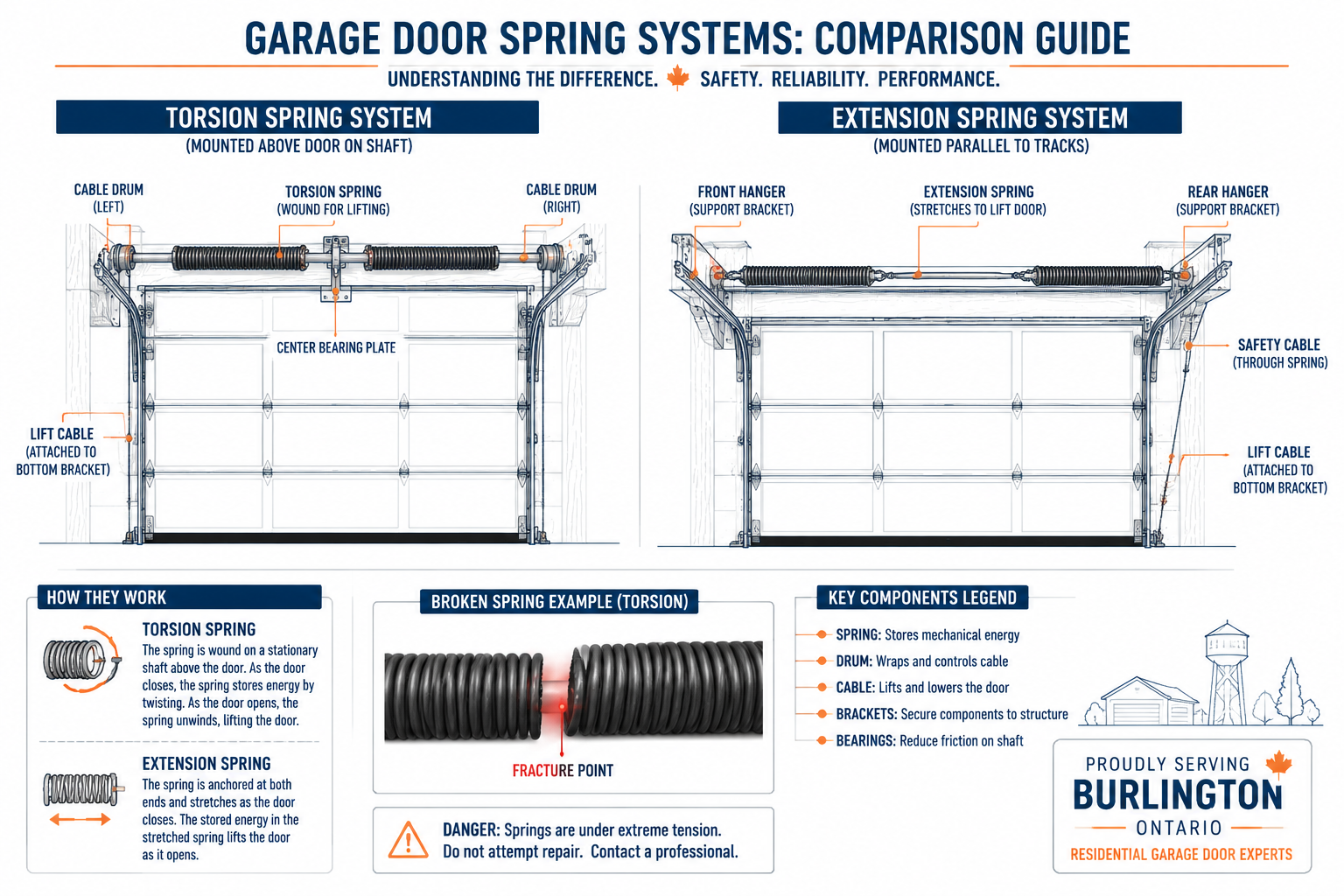
What Is the Difference Between Torsion and Extension Springs
Torsion springs and extension springs are both counterbalance systems, but they work differently and carry different risk profiles during failure and repair.
Torsion springs are mounted horizontally above the door opening on a steel shaft. When the door closes, the spring winds up and stores energy as torque. When the door opens, that stored torque unwinds and lifts the door. Most modern residential doors in Burlington and across Ontario use torsion springs because they are more durable, provide smoother operation, and are considered safer to service (though still dangerous without proper training).
Extension springs run parallel to the horizontal tracks on either side of the door. They stretch (extend) when the door closes and contract when it opens. They are more common on older installations and lighter doors. Extension springs require safety cables threaded through the center of each spring; without these cables, a broken spring can become a high-velocity projectile.
| Feature | Torsion Spring | Extension Spring |
|---|---|---|
| Location | Above door on horizontal shaft | Along side tracks |
| Common on | Modern residential doors | Older or lighter doors |
| Typical lifespan | 10,000–25,000 cycles | 10,000 cycles |
| Failure risk | Stays on shaft when broken | Can fly off without safety cable |
| Replacement complexity | Higher (requires winding bars) | Moderate |
| Cost to replace | Generally higher | Generally lower |
In this Burlington emergency case, the door used a standard double torsion spring system. One spring had snapped completely; the second showed visible coil separation when the technician inspected it under work lights. Both were replaced.
Can a Broken Spring Cause My Garage Door to Fall or Get Stuck
Yes, and both outcomes are genuinely dangerous. A broken spring is the single most common reason a garage door becomes stuck in the closed position, and it is also a leading cause of sudden door drops.
When a torsion spring breaks, the door loses its counterbalance. The opener motor is not designed to lift the full door weight unassisted, so it either refuses to operate or strains and stalls. In this Burlington case, the door was stuck fully closed with the homeowner’s vehicle inside. The only way to open the door manually was to disengage the opener and lift with significant physical effort, which is not safe to attempt alone on a heavy door without spring tension.
The door-drop risk is most acute when:
- A spring breaks while the door is partially open
- Someone forces the door open manually without understanding the spring is broken
- The opener is run repeatedly against a broken spring, causing cable slack
A door that drops unexpectedly can cause serious injury, damage a vehicle, or trap a person underneath. This is why the standard professional advice is to leave the door in whatever position it is in when the spring breaks, call for emergency service, and not attempt to force it.
For related safety context, see the garage door cable replacement guide, since cable failures often follow spring failures when the door is forced.
What Are Common Signs My Garage Door Spring Is About to Fail
Most spring failures don’t happen without warning. The door usually gives several signals in the weeks or days before the spring snaps.
Signs to watch for:
- A visible gap in the spring coil: A torsion spring that has partially failed will show a clear separation between coils, usually near the center of the spring.
- The door moves slower than usual: If the door takes noticeably longer to open or seems to struggle, the spring tension is likely reduced.
- Uneven movement: One side of the door rises faster than the other, suggesting one spring (on a two-spring system) is weaker than the other.
- The door feels heavier when lifted manually: Disconnect the opener and try lifting the door by hand. A properly balanced door should lift smoothly with one hand and stay in place at waist height. If it drops, the spring tension is off.
- Squeaking or grinding sounds: These often indicate rust or insufficient lubrication between coils.
- The opener strains or reverses: If the opener motor sounds like it’s working hard or the door reverses immediately after starting to open, the spring may be losing tension.
In the Burlington case, the homeowner later recalled that the door had been “a little slow” for about two weeks before the snap. That’s a classic early warning sign.
For a full breakdown of these signals, the 5 critical signs you need immediate garage door repair article covers each one in detail.
How Long Do Typical Garage Door Springs Last Before Needing Replacement
Standard residential torsion springs are rated for approximately 10,000 cycles. One cycle equals one full open-and-close sequence. At two cycles per day, that’s roughly 14 years. At four cycles per day, closer to seven years.
High-cycle springs, which are available as upgrades from most reputable technicians, are rated at 25,000 or 50,000 cycles. These cost more upfront but reduce the frequency of replacement and are worth considering for households that use the garage as a primary entry point.
Factors that shorten spring life in Burlington’s climate specifically include:
- Cold winters that cause metal contraction and make springs more brittle
- Road salt and humidity that accelerate rust on uncoated springs
- Lack of annual lubrication (a silicone or lithium-based lubricant applied to the coils twice a year can meaningfully extend spring life)
The springs in this Burlington case were original to the door installation, approximately nine years old, and had never been lubricated or inspected. That timeline is consistent with a standard 10,000-cycle spring reaching the end of its service life.
Can Temperature or Weather Affect Garage Door Spring Performance
Yes, significantly. Cold temperatures make metal more brittle and reduce the elasticity of the spring coil, which is why spring failures spike during Ontario winters and in the early spring when temperatures fluctuate sharply between day and night.
Burlington sits on Lake Ontario, which moderates temperatures somewhat compared to inland areas, but the city still experiences hard freezes, freeze-thaw cycles, and high humidity levels that accelerate corrosion. Springs that are already near the end of their cycle life are most vulnerable to cold-weather failure.
Practical steps to reduce weather-related spring failure:
- Apply a garage door lubricant rated for cold temperatures (silicone spray is generally preferred over WD-40, which can attract dust and gum up coils). For Ontario-specific product guidance, see this comparison of garage door lubricants for Ontario’s climate.
- Keep the garage temperature above freezing if possible, particularly if the door is used frequently in winter.
- Schedule an annual inspection before the onset of cold weather, ideally in October or November.
The 11pm Burlington call in this case study occurred in late January, which is peak season for spring failures across the region.
Are Garage Door Spring Repairs Dangerous to Do Myself
Garage door spring repair is one of the most hazardous home repair tasks a person can attempt without professional training. The danger is not theoretical.
Medical literature documents cases of open-globe injuries (where the eyeball itself is ruptured) caused by springs that released suddenly during amateur repair attempts. Springs store enormous mechanical energy, and when that energy releases in an uncontrolled way, the spring or its hardware can travel at high velocity. At 11pm, with poor lighting, fatigue, and no professional tools, the risk is compounded significantly.
Specific hazards include:
- Uncontrolled door drop: If the spring is partially wound and slips during repair, the door can drop suddenly with full weight.
- Flying hardware: A torsion spring that releases from the shaft can strike a person with enough force to cause severe injury.
- Winding bar slip: Torsion spring winding requires steel winding bars inserted into the spring cone. If a bar slips, the spring can spin and strike the person holding it.
- Cable snap: Cables that are slack due to a broken spring can snap back when tension is restored incorrectly.
The industry consensus, reflected in safety guidance from technicians and product manufacturers alike, is clear: do not attempt spring repair without professional training and proper tools. This applies at any hour, but especially at 11pm when the homeowner is likely tired and working alone.
If the door is stuck and you need to access the garage while waiting for a technician, the safest approach is to use the emergency release cord on the opener (the red cord hanging from the trolley) and then lift the door manually with assistance, keeping hands and feet clear of the door’s path. Do not leave the door open and unattended if it won’t stay up on its own.
How Much Does an Emergency Garage Door Spring Repair Cost After Hours
Emergency garage door spring repair in Burlington typically costs between $300 and $600 CAD for a standard residential torsion spring replacement, with after-hours surcharges pushing the total toward the upper end of that range for late-night calls.
Cost factors include:
- Spring type and size: Torsion springs for heavier or wider doors cost more than standard single-car door springs.
- Number of springs: Most professionals recommend replacing both springs simultaneously on a two-spring system. The labor cost is the same whether one or two springs are replaced, so replacing both at once is more economical long-term.
- After-hours surcharge: Emergency dispatch fees for calls after 9pm or 10pm typically add $75 to $150 CAD to the base repair cost.
- Upgrade options: High-cycle springs (25,000 or 50,000 cycles) cost more upfront but reduce future replacement frequency.
- Cable or hardware replacement: If the technician finds worn cables or damaged hardware during the repair, those add to the total.
In this Burlington case, the final invoice covered two standard torsion springs, a cable check (no replacement needed), and an after-hours dispatch fee. The total was within the $400 to $500 CAD range.
For a detailed breakdown of what goes into a repair quote, the garage door spring replacement cost guide for 2026 provides line-item context.
Who Handles Emergency Garage Door Repairs in Burlington at Night
Several garage door service companies in the Burlington and Greater Hamilton area advertise 24/7 emergency availability, but the quality and response time vary considerably. For this case study, the homeowner contacted a provider that dispatched a technician within approximately 50 minutes of the call.
When choosing an emergency provider at 11pm, the key questions to ask before confirming the call are:
- Is the technician who is coming licensed and insured?
- Will the quote be provided before work begins?
- Is there a written after-hours surcharge policy?
- Does the company carry the parts needed for a same-night repair, or will they need to return the next day?
For Burlington homeowners, Oakview Garage Doors’ Burlington repair service covers the area with same-day and emergency response. Emergency coverage also extends to nearby communities through emergency garage door repair in Hamilton and emergency repair in Oakville.
What Credentials Should I Look for in a Garage Door Repair Technician
A qualified garage door technician should be able to demonstrate several things before starting work on a spring repair.
Minimum expectations:
- Liability insurance: The technician or their company should carry general liability insurance. Ask for confirmation before work begins.
- Manufacturer parts: Ask where the springs come from. Reputable technicians use springs from established manufacturers with documented cycle ratings, not unbranded bulk hardware.
- Clear pre-work explanation: A professional will explain what they found, what they recommend, and why, before touching any hardware.
- Proper tools: Torsion spring replacement requires steel winding bars of the correct size. A technician using improvised tools (screwdrivers, rebar) is a red flag.
- Safety equipment: Eye protection and gloves should be standard. A technician working without them at 11pm is cutting corners.
In Ontario, there is no single provincial license specific to garage door technicians, but many reputable companies belong to industry associations and require technicians to complete manufacturer training programs. Asking about training background is reasonable and a good technician will answer without hesitation.
Red flags to watch for:
- A quote given over the phone without seeing the door
- Pressure to approve additional work without explanation
- No written invoice or receipt
- Cash-only payment with no documentation
What Happens If I Ignore a Broken Garage Door Spring
Ignoring a broken spring creates a cascade of secondary problems that become progressively more expensive and dangerous.
Short-term consequences (days to weeks):
- The opener motor runs against the full door weight, which it is not designed to do. This causes overheating and can burn out the motor within a short period of use.
- Cables that are slack due to lost spring tension can slip off their drums, creating a separate cable failure.
- The door may drop suddenly if someone attempts to open it manually.
Medium-term consequences (weeks to months):
- Continued operation with a broken spring puts stress on rollers, hinges, and the door sections themselves, leading to bent tracks or cracked panels.
- A door that cannot close properly (or that closes unevenly) creates a security gap and a potential weather-sealing failure.
Safety and compliance considerations:
Ontario’s 2026 Fire Code requires carbon monoxide alarms on every level of a home with an attached garage. A garage door that cannot close fully compromises the fire separation between the garage and the living space, which is a compliance issue beyond just the mechanical inconvenience.
The bottom line: a spring repair that costs $400 to $500 CAD today can easily become a $1,500 to $2,500 repair if the opener motor, cables, and panels are all damaged through delayed action.
Are Emergency Garage Door Spring Repairs Covered by Homeowners Insurance
In most cases, standard homeowners insurance does not cover garage door spring replacement because springs are considered a maintenance item subject to normal wear and tear. Insurance policies generally exclude mechanical breakdown from routine use.
There are exceptions worth checking:
- Sudden accidental damage: If the spring failure was caused by a covered peril (for example, a vehicle impact that damaged the spring mechanism), the repair might fall under the property damage portion of a policy.
- Extended warranty or home service plans: Some home warranty products cover garage door mechanical components. Review the policy language carefully, as coverage varies significantly between providers.
- Consequential damage: If a dropped door caused by the spring failure damaged a vehicle or another structure, that damage may be claimable under the relevant policy (auto insurance for the vehicle, homeowners for the structure).
The practical advice is to call the insurance provider to confirm coverage before assuming either way. For this Burlington case, the repair was paid out of pocket as a standard maintenance expense.
A Closer Look at the Case Study: Emergency Spring Repair in Burlington at 11pm
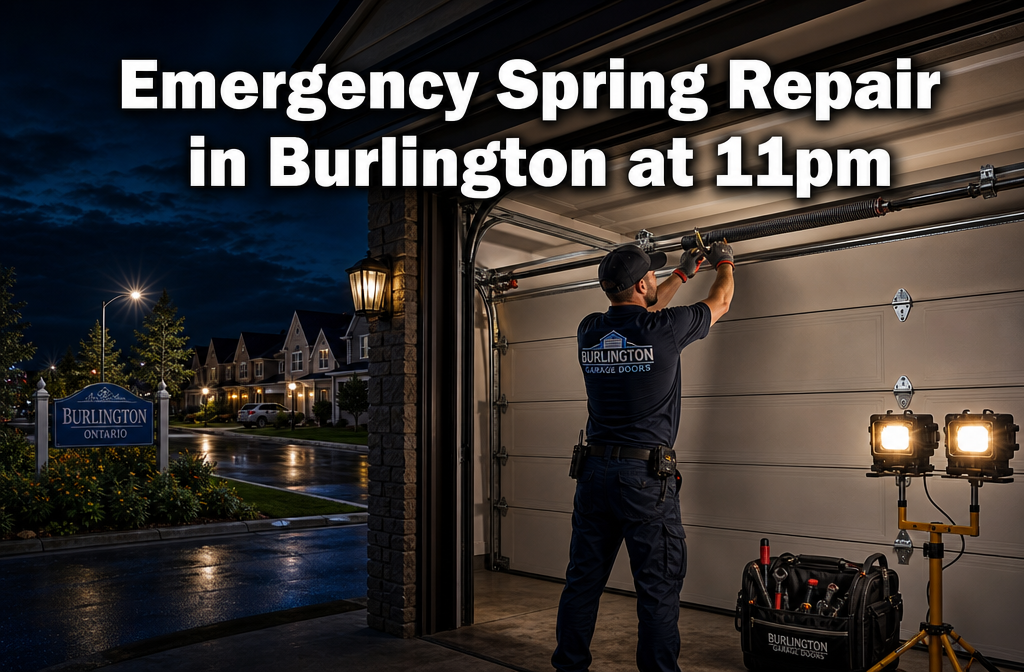
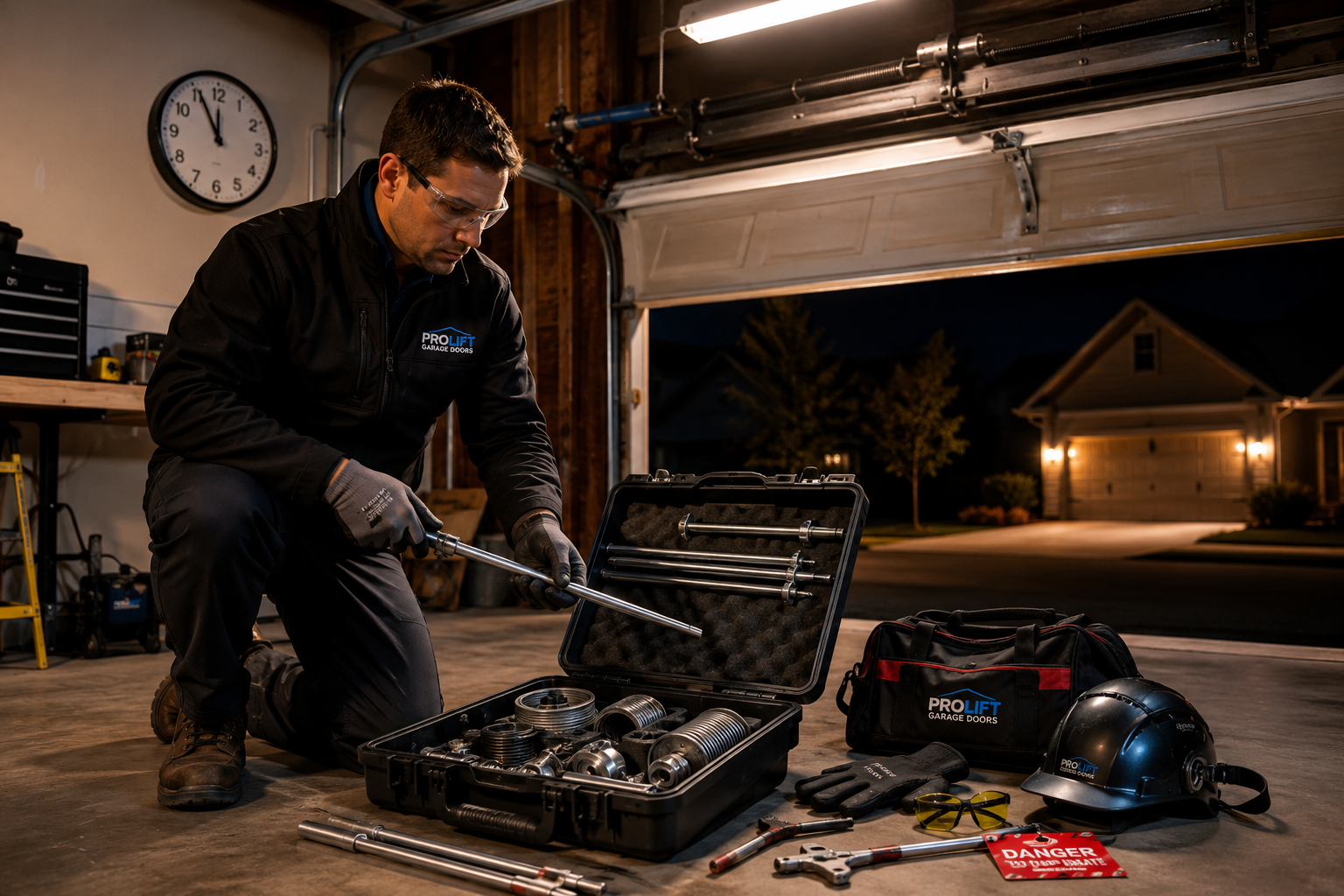
This section reconstructs the full timeline of the Burlington call to illustrate how a professional emergency spring repair actually unfolds.
10:47pm: The homeowner hears a loud bang from the garage. The garage door opener activates but the door does not move. The homeowner correctly does not attempt to force the door.
10:52pm: Call placed to an emergency garage door service. The dispatcher confirms a technician is available and provides an estimated arrival window of 45 to 60 minutes. An after-hours surcharge is disclosed on the call.
11:38pm: Technician arrives with a fully stocked service vehicle. Work lights are set up inside the garage.
11:40pm: Initial inspection confirms one torsion spring has snapped completely. The second spring shows a visible gap in the coils indicating it is near failure. The technician recommends replacing both springs and explains the reasoning. The homeowner approves.
11:42pm: The opener is disconnected and the door is manually secured. The technician uses proper winding bars to release residual tension from the intact (but failing) spring before removal.
11:55pm: Both old springs are removed. New springs of the same specification (with a high-cycle upgrade offered and accepted) are installed on the shaft.
12:08am: Springs are wound to the correct tension using the door weight and track measurements. The technician verifies balance by disconnecting the opener and checking that the door stays in place at waist height.
12:12am: Opener is reconnected and tested through five full cycles. Auto-reverse safety feature is tested. Cables are inspected and confirmed in good condition.
12:15am: Carbon monoxide alarm in the garage is noted by the technician as part of a post-repair safety check, consistent with 2026 Fire Code requirements for attached garages in Ontario.
12:18am: Invoice issued, payment processed. Total time from technician arrival to completion: 40 minutes.
The homeowner’s vehicle was accessible, the garage was secured, and no secondary damage occurred. This outcome is typical of a well-executed emergency spring repair when the homeowner calls promptly and does not attempt DIY intervention.
For context on how similar emergency calls are handled in neighboring communities, see the emergency garage door repair service overview and the garage door spring repair service page.
FAQ
Q: Can I drive my car out if the garage door spring is broken? A: Possibly, but not safely alone. A door with a broken spring can be lifted manually, but it requires significant force and a second person to hold it open. The door will not stay up on its own without spring tension. Attempting this alone risks the door dropping on the vehicle or on a person. Wait for a technician unless there is a genuine emergency requiring immediate vehicle access.
Q: How long does an emergency spring repair take? A: Most professional torsion spring replacements take 30 to 60 minutes once the technician is on site. The full timeline from call to completion, including dispatch, is typically 1.5 to 2.5 hours for a late-night call in Burlington.
Q: Should I replace one spring or both at the same time? A: Both springs should be replaced simultaneously on a two-spring system. When one spring fails, the second is typically at the same wear stage and will fail shortly after. Replacing both at one service call saves a second dispatch fee and prevents a repeat emergency.
Q: Is it safe to use the garage door opener after a spring breaks? A: No. Running the opener against a broken spring puts excessive strain on the motor and can cause cable slack or door drop. Disconnect the opener and leave the door in its current position until a technician arrives.
Q: What is a high-cycle spring and is it worth the upgrade? A: High-cycle springs are rated for 25,000 or 50,000 cycles instead of the standard 10,000. They cost more upfront (typically an additional $50 to $150 CAD per spring) but last two to five times longer. They are worth considering for households that use the garage as a primary entry point, cycling the door four or more times per day.
Q: Why did my spring break in winter? A: Cold temperatures make metal more brittle and reduce spring elasticity. Springs that are already near the end of their cycle life are most likely to snap during a cold snap or freeze-thaw cycle. Burlington’s winters, with temperatures that can drop below -15C, are a common trigger for spring failures.
Q: Can I lubricate the springs myself to extend their life? A: Yes. Applying a silicone-based spray lubricant to the spring coils twice a year (spring and fall) reduces friction and slows rust formation. Avoid WD-40 for this purpose, as it can attract dust and gum up the coils over time.
Q: What should I do immediately after a spring breaks at night? A: Leave the door in its current position. Do not run the opener. Do not attempt to lift the door alone. Call an emergency garage door service. If the door is partially open and cannot be safely secured, stay out of the path of the door until a technician arrives.
Q: Does the age of my house affect which type of spring I have? A: Generally yes. Homes built before the mid-1990s are more likely to have extension springs. Homes built after that period typically have torsion springs. However, previous repairs or replacements may have changed the original configuration.
Q: How do I find a reputable emergency technician at 11pm? A: Search for companies with verifiable reviews on Google or HomeStars, confirm they carry liability insurance before the technician arrives, and ask for a written quote before work begins. Avoid companies that quote a very low price over the phone and then add charges on site.
Q: Is a garage door tune-up worth doing after a spring replacement? A: Yes. A spring replacement is a good opportunity to have the entire door system inspected and adjusted. A garage door tune-up covers lubrication, hardware tightening, balance testing, and opener force adjustment, all of which contribute to longer component life.
Q: Can a broken spring affect my garage door opener? A: Yes. Running an opener against a broken spring (where the door doesn’t move) puts the motor under extreme load. Repeated attempts can overheat and burn out the opener motor. If you suspect a broken spring, disconnect the opener immediately.
Conclusion
The case study: emergency spring repair in Burlington at 11pm illustrates several practical realities that every garage door owner should understand before a failure happens.
First, spring failures are predictable. The warning signs (slow movement, visible coil gaps, a door that feels heavier than usual) appear weeks before the snap. Annual inspections and twice-yearly lubrication catch most failures before they become midnight emergencies.
Second, the repair itself is not a DIY task. The combination of stored mechanical energy, heavy door weight, and precision winding requirements makes spring replacement genuinely hazardous without proper training and tools. The documented medical consequences of amateur spring repair are severe enough to make professional service the only reasonable choice.
Third, acting quickly when a spring breaks prevents secondary damage. A $400 to $500 CAD repair called in promptly stays a $400 to $500 CAD repair. Delayed action turns it into a motor replacement, cable replacement, and potentially a panel repair on top.
Actionable next steps for Burlington homeowners:
- Inspect your springs visually today. Look for rust, visible gaps between coils, or uneven coil spacing.
- Test door balance by disconnecting the opener and lifting the door manually. It should stay at waist height without assistance.
- Lubricate the springs with a silicone-based spray if it has not been done in the past six months.
- Schedule an annual inspection with a certified technician, ideally before winter.
- Save an emergency garage door service number in your phone before you need it. At 11pm, you don’t want to be searching for a reputable provider.
- Verify that your carbon monoxide alarms meet Ontario’s 2026 Fire Code requirements for attached garages.
For emergency service in Burlington and the surrounding area, the Oakview Garage Doors Burlington repair page is a direct starting point. For broader emergency coverage across the region, the full emergency repair service covers same-day and after-hours calls.