Last updated: July 12, 2026
Quick Answer
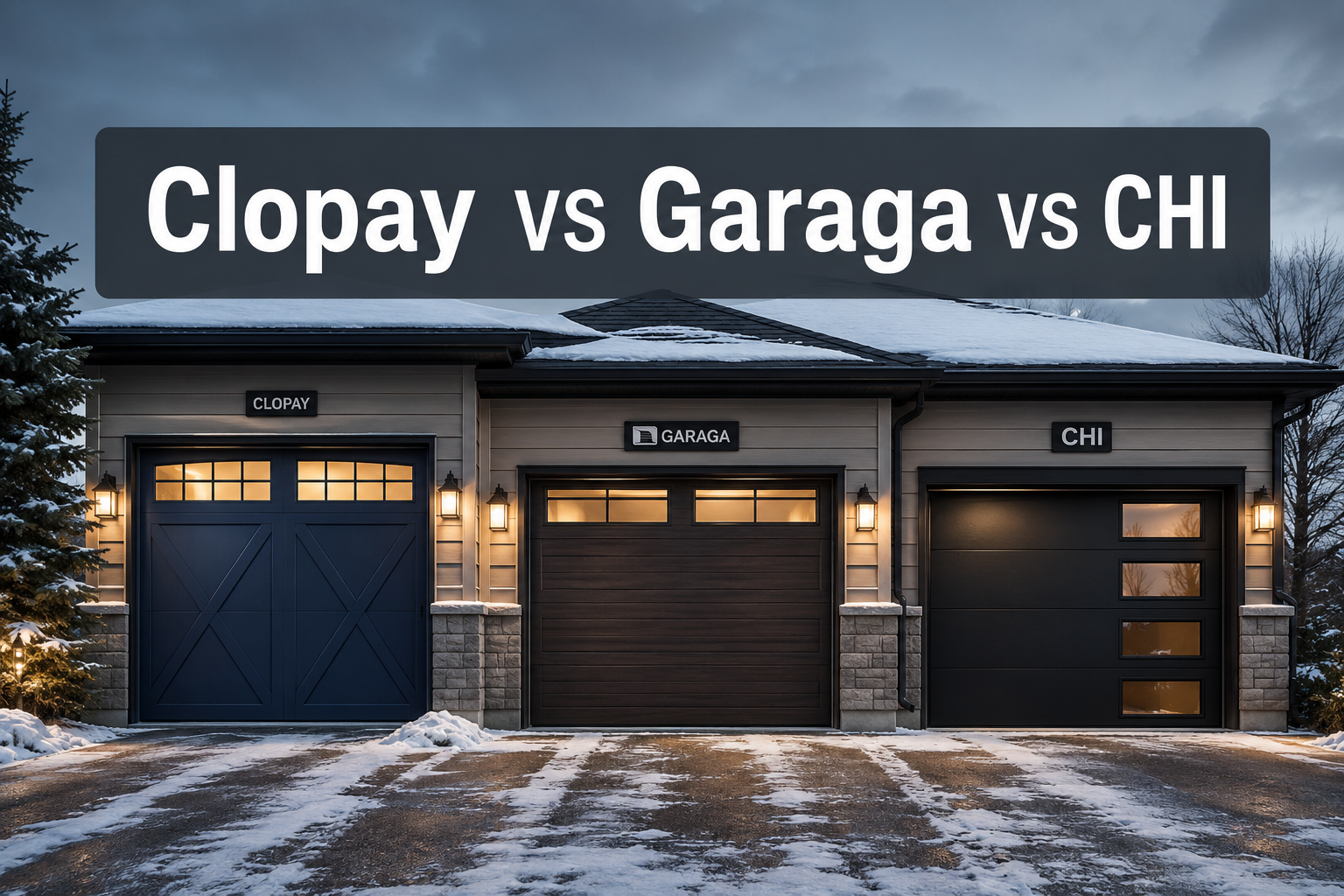
For most Ontario homeowners choosing between Clopay, Garaga, and CHI, the short answer is: Garaga leads on cold-climate insulation, Clopay leads on design variety, and CHI offers a strong mid-range value with solid customization options. The right brand depends on whether your priority is thermal performance, curb appeal, or budget. This Clopay vs Garaga vs CHI garage door brand comparison for Ontario breaks down exactly where each brand wins and where it falls short.
Key Takeaways
- Garaga is a Canadian-manufactured brand engineered specifically for cold climates, making it the strongest choice for Ontario winters and attached garages.
- Clopay offers the widest range of styles, finishes, and window options in North America, and is the go-to brand when curb appeal is the primary goal.
- CHI (Carriage House Industries) uses Nucor sustainable steel and offers three insulation levels, positioning it as a reliable mid-range option with dealer-supported customization.
- Clopay raised prices in March 2026, and CHI followed with a 6% residential sectional door increase in April 2026, so quotes obtained before those dates may no longer be accurate.
- Installed prices in Ontario typically range from roughly $1,800 to $2,500 for a standard insulated double door, with premium brands and custom sizes pushing costs higher.
- Garaga’s warranty is among the strongest in Canada, covering the door section, hardware, and finish with clearly defined terms.
- Same-day installation is rarely available for any of these three brands because doors are typically ordered to specification; stock door programs exist but are limited.
- The cheapest option that still delivers acceptable quality for Ontario conditions is a builder-grade CHI or a mid-tier Clopay steel door with polystyrene insulation.
- Door sizing in Ontario is almost always standard (8×7, 9×7, 16×7, or 16×8 feet for residential), but measuring the rough opening before ordering is essential to avoid costly re-orders.
- All three brands are available through local Ontario dealers; national brand recognition does not guarantee local service quality, so vetting the installer matters as much as the brand.
What Is the Difference Between Clopay and Garaga Garage Doors?
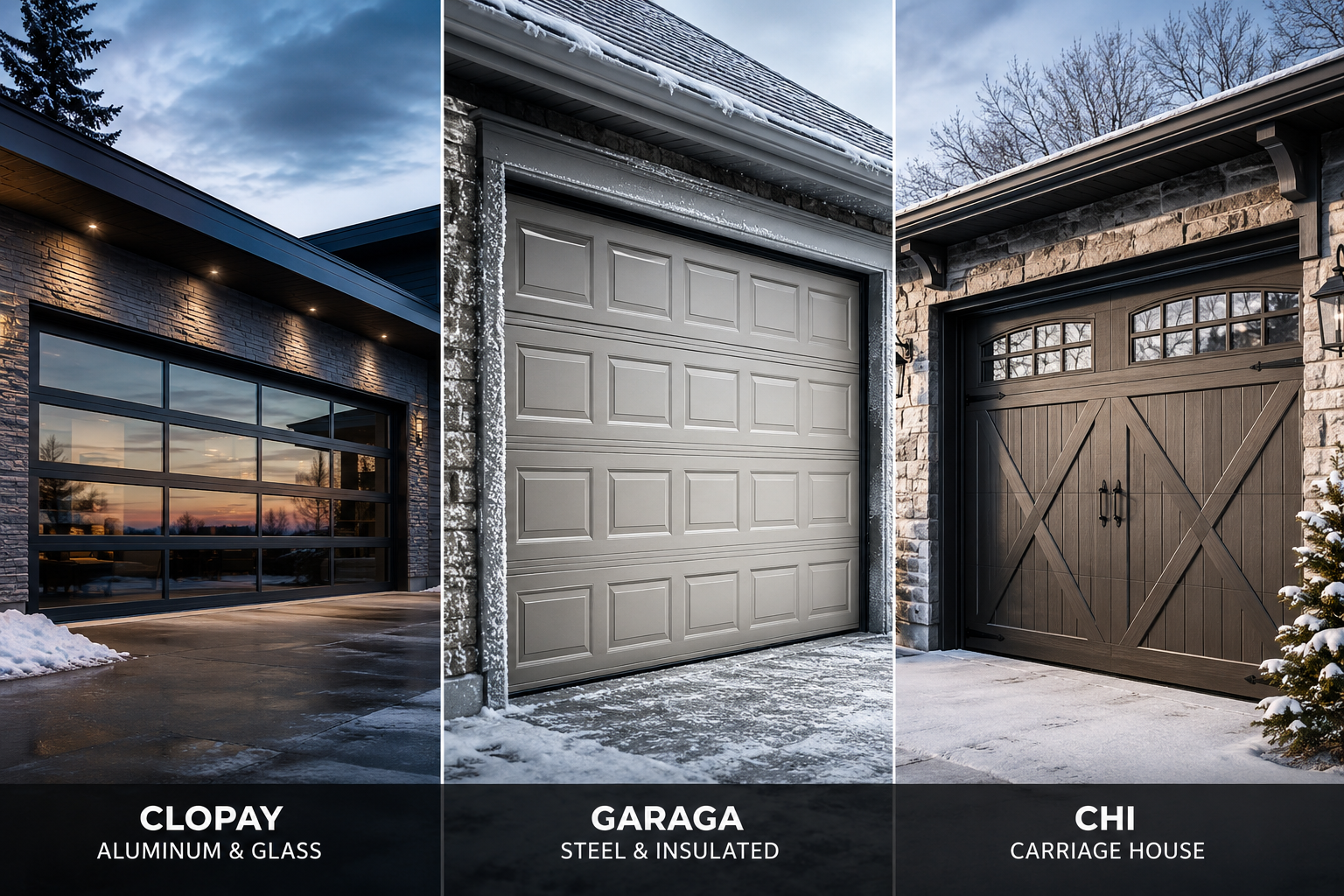
Clopay is a US-headquartered manufacturer with the broadest product catalog in North America, while Garaga is a Quebec-based Canadian company that builds its doors specifically for the Canadian climate. The two brands serve different primary needs: Clopay for design flexibility, Garaga for thermal and structural performance.
Clopay strengths:
- Largest style library in North America, covering everything from traditional raised-panel steel to the Avante aluminum-and-glass line
- Strong design tools including colour matching and window customization
- In 2026, Clopay launched its C-Power platform with Click-to-Conceal switchable glass panels on the Avante door, which won Best of IBS at the 2026 International Builders’ Show, a clear signal the brand is investing in smart-home and luxury design features
- Available through a wide dealer network across Ontario
Garaga strengths:
- Manufactured in Canada (Saint-Georges, Quebec), which means shorter supply chains and doors engineered for Canadian temperature swings
- Double-skin steel construction with thermal break is standard on many models, not an upgrade
- Quieter operation due to heavier gauge steel and tighter tolerances
- Consistently recommended by Ontario installers for attached garages where heat loss matters
The key difference in practical terms: If a homeowner in Oakville wants a door that looks stunning and matches a specific architectural style, Clopay is the easier choice. If a homeowner in Barrie or Ottawa wants the lowest possible heat loss through the garage wall, Garaga is the stronger pick. For a detailed look at installation options in the Oakville area, see garage door installation in Oakville.
Which Garage Door Brand Is Best for Ontario Winters?
Garaga is the best-performing brand for Ontario winters. Ontario installers consistently rank it as the top cold-climate choice because of its insulated double-skin panels, thermal break design, and tight weathersealing. An insulated Garaga door on an attached garage measurably reduces heat loss compared to a single-skin or polystyrene-only door.
Why insulation matters more in Ontario than most buyers expect:
- Ontario temperatures regularly drop to -20°C or lower in January and February
- An attached garage shares at least one wall with the living space; a poorly insulated door acts like a large thermal hole
- Polyurethane foam-injected doors (Garaga’s standard on most residential lines) have a higher R-value than polystyrene-backed doors at the same thickness
- Thermal breaks in the frame prevent cold bridging at the edges, which is where most heat escapes in cheaper doors
Clopay also offers well-insulated options, including polyurethane-injected doors in its Coachman and Canyon Ridge lines. CHI offers polystyrene and polyurethane options depending on the model. Neither matches Garaga’s reputation among Ontario-based installers for cold-climate performance, but both are acceptable if the garage is detached or if budget is a constraint.
Choose Garaga if: the garage is attached, the home is in a colder Ontario region (Ottawa, Barrie, Hamilton, or north of the GTA), or the homeowner plans to heat the garage space.
Choose Clopay or CHI if: the garage is detached, the home is in a milder urban microclimate, or design and price are higher priorities than maximum insulation.
Keeping a well-insulated door performing at its best also requires proper lubrication. See the guide to best garage door lubricant for Ontario’s climate for product recommendations that hold up in freeze-thaw conditions.
How Much Does a Clopay Garage Door Cost Installed in Ontario?
Installed costs for a Clopay door in Ontario in 2026 typically fall between $1,800 and $3,500 for a standard double door, depending on the model, insulation level, and installer. Entry-level steel models (Clopay 4050 series or equivalent) sit at the lower end; the Avante glass line and Canyon Ridge carriage-house models push toward $4,000 or more installed.
Key cost factors:
- Model line: Basic raised-panel steel is the cheapest; full-view glass and wood-look composite are the most expensive
- Insulation level: Non-insulated doors cost less upfront but cost more in energy over time; polyurethane-injected doors carry a $200 to $500 premium over polystyrene
- Size: A 16×8 double door costs more than a 16×7; custom widths add further cost
- Hardware and opener: Springs, cables, and opener are often quoted separately; always ask for a fully installed price
Clopay raised its dealer pricing in March 2026, so quotes from late 2025 or early 2026 may no longer reflect current costs. When reviewing a quote, it helps to understand every line item. The guide on how to read a garage door quote explains what each charge covers and where to push back.
Garaga and CHI installed costs are broadly similar to Clopay at comparable insulation levels. Garaga tends to price slightly higher than entry-level Clopay but is competitive with Clopay’s mid-tier lines. CHI often comes in slightly below Garaga for equivalent insulation specs.
Garaga vs CHI Garage Door: Which Is More Reliable?
Both Garaga and CHI are reliable brands with strong dealer networks, but they are built for slightly different buyers. Garaga prioritizes structural rigidity and thermal performance; CHI prioritizes customization flexibility and steel sourcing transparency.
Garaga reliability factors:
- Heavy-gauge double-skin steel resists denting better than single-skin panels
- Tight manufacturing tolerances reduce the chance of misalignment over time
- Canadian manufacturing means quality control is subject to Canadian standards
- Long-term finish durability is strong, with baked-on paint holding up well against Ontario road salt and humidity
CHI reliability factors:
- CHI uses Nucor sustainable steel, which is a domestic US source with consistent metallurgical standards
- Three insulation options (non-insulated, polystyrene, polyurethane) let buyers match the door to their actual use case rather than over-specifying
- Dealer-supported customization means the door is configured to the opening rather than forced to fit
- CHI has not reported widespread systemic product failures; common issues (see the CHI problems section below) are typically installation-related rather than manufacturing defects
The reliability verdict: For Ontario homeowners who want a door that holds up through 20 years of freeze-thaw cycles with minimal maintenance, Garaga has a slight edge. CHI is a strong second choice and the better option when the buyer wants more control over panel style and colour without paying Garaga’s premium.
Do Clopay Garage Doors Work in Cold Weather?
Yes, Clopay doors work in cold weather, but performance varies significantly by model. Clopay’s polyurethane-insulated lines (such as the Coachman and Canyon Ridge series) perform well in Ontario winters. The brand’s entry-level polystyrene-backed doors are adequate for detached garages but are not the best choice for attached garages in colder Ontario regions.
Clopay’s 2026 product focus has been on design innovation (the C-Power switchable glass platform, Bridgeport inlay doors, and Canyon Ridge updates) rather than cold-climate engineering. That is not a criticism, but it signals where the brand’s priorities lie.
Practical cold-weather tips for Clopay owners:
- Specify polyurethane insulation, not polystyrene, when ordering for an attached garage
- Confirm the weatherstripping package includes a bottom seal rated for cold climates
- Lubricate all hinges, rollers, and springs before winter with a product designed for low temperatures
If a Clopay door is already installed and showing cold-weather problems (slow operation, opener strain, or seal failure), those are usually maintenance issues rather than brand defects. A garage door tune-up before winter typically resolves most of them.
What Is Included in Garaga’s Warranty Coverage?
Garaga offers one of the more comprehensive warranties in the Canadian residential garage door market. Coverage generally includes:
- Lifetime warranty on the door section (steel panels) against manufacturing defects
- Limited warranty on hardware components including springs, hinges, and rollers (typically 1 to 3 years depending on the component)
- Finish warranty covering paint and finish against peeling, cracking, or fading for a defined period (typically 10 years on factory-applied finishes)
- Weatherstripping is typically covered for 1 year
Important warranty conditions to understand:
- Warranty is voided if the door is installed by an uncertified installer in some cases; always confirm with the local dealer
- Normal wear on springs is not covered under most warranty terms; springs are a wear item
- Damage from impact (backing a vehicle into the door) is not covered
For comparison, Clopay and CHI offer broadly similar warranty structures: lifetime on steel sections, limited terms on hardware and finish. Garaga’s advantage is that its warranty is administered through Canadian dealers who are familiar with Canadian conditions, which can make claims faster to resolve.
If springs or cables fail outside the warranty period, understanding replacement costs ahead of time is useful. See the guide on garage door spring replacement cost in Oakville for current pricing benchmarks.
Common CHI Garage Door Problems
CHI doors are generally well-built, but a few recurring issues show up in installer feedback and homeowner reports. Most are preventable with proper installation and maintenance.
Most common CHI issues:
Panel alignment drift – CHI’s wide range of panel configurations means that improperly set track spacing during installation can cause panels to bind or rub. This is an installation issue, not a manufacturing defect, but it is more common with CHI because of the variety of panel profiles available.
Bottom seal wear in cold climates – Some CHI models use a T-style bottom seal that can stiffen and crack in extreme cold. Replacing it with a bulb-style seal rated for -40°C resolves the problem.
Paint chipping on lower panels – The bottom panels of any steel door take the most abuse from road salt, gravel, and snow blower discharge. CHI’s finish is durable but not immune. Touching up chips promptly prevents rust.
Opener compatibility – CHI doors are compatible with all major opener brands, but very heavy CHI models (full-view glass, for example) may require a higher-horsepower opener than the installer initially quotes. Confirm the opener spec matches the door weight.
Spring tension after first winter – All steel doors, including CHI, can settle slightly after the first winter due to temperature-related metal contraction. A spring tension adjustment after the first season is normal and typically inexpensive.
If any of these issues appear after installation, most are resolved with a service call rather than a door replacement. For urgent issues, same-day garage door repair in Mississauga and similar services cover most of the GTA.
Which Brand Has the Best Customer Service in Ontario?
Customer service quality in Ontario depends more on the local dealer than on the brand itself. All three brands (Clopay, Garaga, and CHI) sell through authorized dealer networks, and the dealer is the primary point of contact for installation, warranty claims, and service calls. A strong local Garaga dealer will outperform a weak Clopay dealer every time.
That said, there are structural differences worth noting:
- Garaga has a tightly controlled Canadian dealer network. Because Garaga is a Canadian company, its dealer relationships tend to be closer and warranty claims are processed domestically, which reduces delays.
- Clopay has the largest dealer network in North America, which means more options but also more variability in service quality. Clopay’s brand standards require dealers to meet installation and service benchmarks, but enforcement varies by region.
- CHI operates similarly to Clopay with a broad dealer network and a quote-and-configure model. Service quality is dealer-dependent.
How to evaluate a dealer before buying:
- Ask how long they have been an authorized dealer for that brand
- Ask whether they carry service parts in stock or order them on demand
- Check Google reviews specifically for post-installation service, not just installation quality
- Ask whether the installer who quotes the job is the same person who installs it
Can You Get Clopay Doors Installed Same Day in Ontario?
In most cases, no. Clopay, Garaga, and CHI doors are built to order based on the specific opening dimensions, colour, insulation level, and hardware configuration the homeowner selects. Lead times in Ontario typically range from 2 to 6 weeks depending on the model, the dealer’s order volume, and supply chain conditions.
Some dealers maintain a small inventory of the most common configurations (white raised-panel steel, standard sizes, polystyrene insulation) that can be installed within a day or two. These are the exception, not the rule.
When same-day or next-day service is possible:
- The opening is a standard size (16×7 or 9×7 feet)
- The buyer accepts a stock colour (white or beige)
- The dealer happens to have that exact configuration in inventory
If the garage door has failed completely and the home is unsecured, a temporary repair or a stock door may be the fastest solution. For urgent situations, emergency garage door repair in Oakville and similar services can often address the immediate safety issue while a custom door is on order.
Is Garaga Made in Canada or Imported?
Garaga is made in Canada. The company manufactures its residential and commercial garage doors at its facility in Saint-Georges, Quebec. This is one of Garaga’s most significant selling points for Ontario buyers: the doors are designed, tested, and built for Canadian climate conditions, not adapted from a US or overseas product.
Canadian manufacturing also means:
- Shorter shipping distances from factory to Ontario dealer, which reduces lead times compared to US-manufactured brands
- Quality control under Canadian manufacturing standards
- No currency conversion risk on the base product cost (though steel commodity prices still fluctuate)
- Warranty claims are handled within Canada
Clopay is manufactured in the United States (Troy, Ohio is its primary facility). CHI is also US-manufactured. Both brands are widely distributed in Canada and perform well, but neither has the same “built for Canada” design mandate that Garaga operates under.
CHI vs Clopay: Which Lasts Longer?
Both CHI and Clopay residential steel doors have comparable lifespans when properly installed and maintained, typically 20 to 30 years for the door section itself. Springs, cables, and rollers are wear items that need replacement every 7 to 15 years regardless of brand.
Factors that affect longevity more than brand:
- Insulation type: Polyurethane-injected doors are structurally stiffer than polystyrene-backed doors, which reduces panel flex and cracking over time
- Finish maintenance: Touching up paint chips prevents rust; this matters more in Ontario where road salt is heavy
- Spring and cable maintenance: Worn springs put extra stress on panels and tracks; replacing them on schedule protects the door structure
- Opener quality: An underpowered opener strains the door on every cycle; matching opener horsepower to door weight extends the life of both
CHI’s use of Nucor steel is a positive indicator for long-term durability. Clopay’s steel sourcing is not as publicly detailed, but the brand’s market longevity suggests consistent quality control.
Edge case: Clopay’s Canyon Ridge composite carriage-house doors use a different material (composite overlay on steel) that can be more vulnerable to delamination in extreme freeze-thaw cycles if the installation is not perfectly sealed. This is a known edge case, not a widespread defect, but it is worth asking the dealer about if considering that specific line.
For panel-level damage that does not require full door replacement, garage door panel replacement is often a cost-effective repair option that extends the door’s overall life.
What Size Garage Door Do I Need?
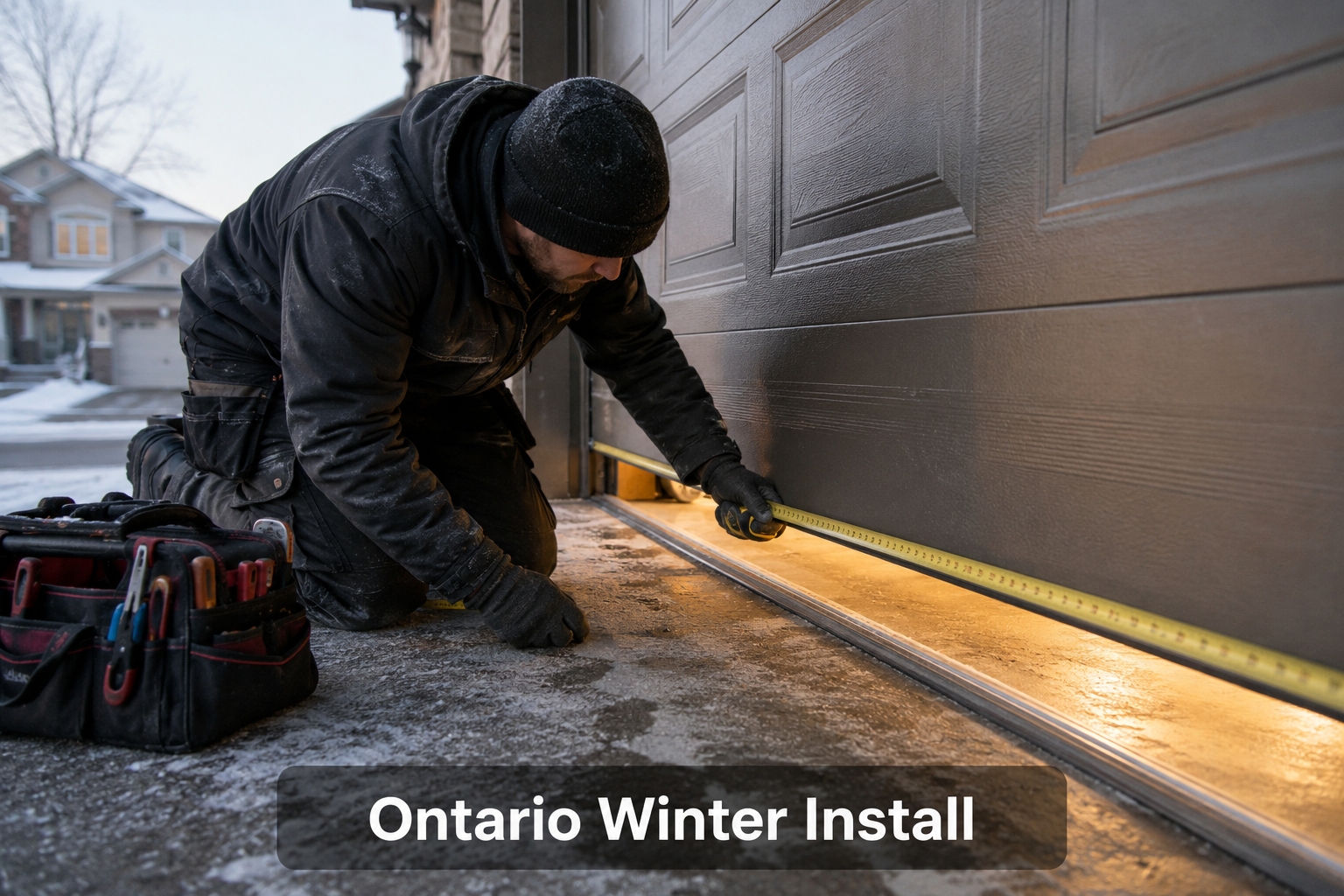
The correct garage door size is determined by the rough opening in the garage wall, not by the vehicle size. Standard residential sizes in Ontario are 8×7, 9×7, or 10×7 feet for single-car openings, and 16×7 or 16×8 feet for double-car openings. The door ordered should match the rough opening exactly.
How to measure:
- Measure the width of the rough opening at its widest point (from framing stud to framing stud)
- Measure the height from the floor to the top of the opening
- Measure the headroom (space between the top of the opening and the ceiling), a minimum of 10 to 12 inches is needed for standard track; low-headroom track is available for tighter spaces
- Measure the side room on each side (minimum 3.75 inches for standard track hardware)
- Measure the depth of the garage (minimum 18 inches behind the door for the opener and track)
If the rough opening is a non-standard size, all three brands (Clopay, Garaga, and CHI) offer custom sizing, but lead times and costs increase. It is almost always cheaper to adjust the rough opening during a renovation than to order a custom-size door.
Common mistake: Ordering a door based on the old door’s size rather than the actual rough opening. Old doors are sometimes undersized for the opening, meaning a standard replacement may fit better than a like-for-like replacement.
Are Expensive Garage Doors Worth It in Ontario?
For an attached garage in Ontario, a higher-quality insulated door is worth the premium. For a detached garage used only for storage, the calculus is different.
When the premium is worth it:
- The garage is attached and shares a wall with living space; a well-insulated door reduces heating costs and improves comfort
- The home is in a colder Ontario region where temperature swings are extreme
- The door is highly visible from the street; curb appeal directly affects resale value
- The homeowner plans to stay in the home for 10 or more years, allowing time to recoup the investment in energy savings and reduced maintenance
When a mid-range door is sufficient:
- The garage is detached and unheated
- The homeowner is selling the home within 2 to 3 years and needs a presentable but cost-effective replacement
- The existing door is structurally sound and only needs panel replacement rather than full replacement
A case study of an insulated door replacement in West Oak Trails found that upgrading from a builder-grade single-skin door to a polyurethane-insulated double-skin door made a measurable difference in garage temperature during winter months. See the full case study on insulated door replacement in West Oak Trails for specifics.
For custom or premium door options in the Oakville area, the guide on custom garage doors in Oakville outlines when the upgrade cost is justified.
What Is the Cheapest Garage Door Brand in Ontario That Still Has Good Quality?
For Ontario homeowners who need a cost-effective door that still performs adequately, a mid-tier CHI steel door with polystyrene insulation or an entry-level Clopay steel door (such as the 4050 series equivalent) are the most commonly recommended options. Both are available through Ontario dealers in the $1,500 to $2,200 installed range for a standard double door.
What “good quality” means at the budget end:
- Double-skin steel construction (not single-skin) to resist denting
- At least polystyrene insulation (R-6 or better) for an attached garage
- Galvanized bottom bracket and hardware to resist rust
- A bottom seal rated for cold temperatures
What to avoid at the budget end:
- Non-insulated doors for attached garages (the energy cost over time exceeds the upfront savings)
- Doors with painted (not baked-on) finishes, which chip and rust faster in Ontario conditions
- Dealers who quote an unusually low price by omitting the opener, hardware, or disposal of the old door from the quote
Garaga does not compete strongly at the entry-level price point; the brand’s value is in its mid-to-upper tier. Clopay’s entry-level steel doors are a reasonable budget choice. CHI’s base polystyrene models are the most competitive on pure price while still meeting acceptable quality standards for Ontario use.
Clopay vs Garaga vs CHI Brand Comparison Summary for Ontario
The table below summarizes where each brand leads for Ontario buyers.
| Factor | Clopay | Garaga | CHI |
|---|---|---|---|
| Cold-climate performance | Good (polyurethane lines) | Best in class | Good (polyurethane option) |
| Design variety | Widest in North America | Strong, Canadian-focused | Good, dealer-configured |
| Entry-level price | Competitive | Mid-to-premium | Most competitive |
| Made in Canada | No (USA) | Yes (Quebec) | No (USA) |
| Warranty strength | Strong | Strong, Canadian-administered | Strong |
| Best for | Curb appeal, design | Attached garages, cold regions | Budget-conscious buyers |
FAQ: Clopay vs Garaga vs CHI Garage Door Brand Comparison for Ontario
Q: Is Garaga better than Clopay for an Ontario home? Garaga is better for cold-climate insulation and attached garages. Clopay is better for design variety and curb appeal. For most Ontario homeowners with attached garages, Garaga is the stronger functional choice; for those prioritizing aesthetics, Clopay wins.
Q: Does CHI make good garage doors for Canadian winters? Yes, CHI makes acceptable doors for Canadian winters when the polyurethane insulation option is selected. The polystyrene option is adequate for detached garages but is not ideal for attached garages in colder Ontario regions.
Q: How long does a Garaga garage door last? A properly installed and maintained Garaga door section typically lasts 25 to 30 years or more. Springs and cables are wear items that need replacement every 7 to 15 years regardless of brand.
Q: Can I buy a Clopay door directly without a dealer? No. Clopay, Garaga, and CHI all sell exclusively through authorized dealer networks. There is no direct-to-consumer purchase option. The dealer handles measurement, ordering, installation, and warranty service.
Q: What R-value should a garage door have in Ontario? For an attached garage in Ontario, a minimum of R-12 is recommended; R-16 or higher is better for colder regions. Polyurethane-injected doors typically achieve R-12 to R-18 depending on panel thickness.
Q: Are Clopay’s 2026 switchable glass doors available in Ontario? Clopay’s Avante door with C-Power switchable glass panels was announced for Spring 2026 availability. Ontario availability depends on the local dealer’s ordering status; contact an authorized Clopay dealer to confirm current lead times and pricing.
Q: Which brand is easiest to get repaired in Ontario? All three brands have dealer networks in Ontario, but Garaga’s Canadian-administered network can make parts sourcing faster. For any brand, the quality of the local dealer matters more than the brand itself when it comes to repair response times.
Q: Do garage door prices include installation in Ontario? Not always. Some dealers quote the door price separately from labour, opener, hardware, and old door disposal. Always ask for a fully installed price that includes all components. The guide on how to read a garage door quote explains each line item.
Q: Is a battery backup opener worth adding to any of these doors? Yes, particularly in Ontario where ice storms and winter power outages are common. A battery backup opener works with any of the three door brands. See the full breakdown of battery backup garage door openers for Ontario power outages.
Q: What is the most common mistake when buying a garage door in Ontario? Choosing based on price alone and skipping insulation. The upfront savings on a non-insulated or polystyrene-only door for an attached garage are typically offset by higher heating costs and more frequent maintenance within 5 to 7 years.
Conclusion
The Clopay vs Garaga vs CHI garage door brand comparison for Ontario comes down to three clear decision paths. Choose Garaga if the garage is attached, the home is in a colder Ontario region, and thermal performance is the top priority. Choose Clopay if curb appeal, design variety, or smart-home features (including the new C-Power switchable glass platform) are the primary goals. Choose CHI if budget is the main constraint and the buyer still wants a reliable, customizable door with solid insulation options.
Actionable next steps:
- Measure the rough opening (width, height, headroom, and side room) before contacting any dealer.
- Decide whether the garage is attached or detached, then set insulation as a minimum spec accordingly.
- Get at least two quotes from local Ontario dealers, and ask for a fully installed price that includes hardware, opener, and old door disposal.
- Ask each dealer specifically about lead times in 2026, since both Clopay and CHI implemented price increases earlier this year and supply chain conditions continue to shift.
- Verify the dealer’s warranty claim process before signing, not after.
For homeowners in the Oakville, Burlington, Mississauga, or Hamilton areas, Oakview Garage Doors installs all three brands and can provide a current, itemized quote based on the specific opening and use case.