Last updated: June 27, 2026
Quick Answer
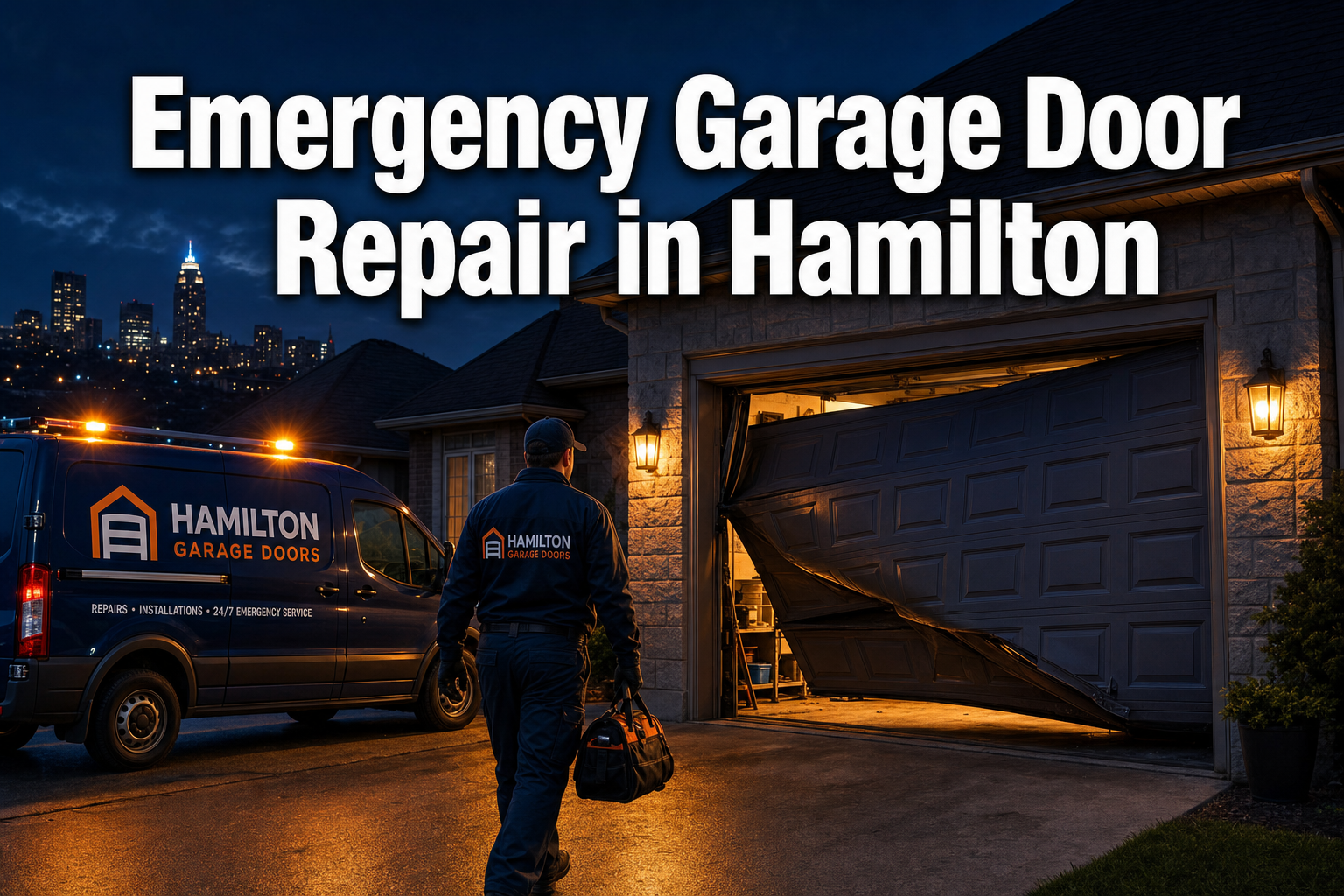
Not every garage door problem is a true emergency, but some situations — a broken torsion spring, a door stuck open overnight, or a door knocked off its tracks — create immediate safety and security risks that justify a same-day or after-hours call. Emergency garage door repair in Hamilton: what qualifies and who to call comes down to three factors: whether your home is unsecured, whether someone is trapped or at risk of injury, and whether the door is structurally unsafe to leave unattended. Reputable Hamilton-area companies offer 24/7 emergency response for exactly these scenarios.
Key Takeaways
- A true garage door emergency involves blocked access, an unsecured home, a safety hazard, or a structurally compromised door — not just inconvenience.
- Broken torsion springs, doors off their tracks, and doors stuck in the open position all qualify as emergencies.
- Emergency repair in Hamilton typically costs more than a standard service call — expect a premium for after-hours or weekend response.
- Never attempt to fix a broken spring, reattach a cable, or force an off-track door back into place yourself; these tasks carry a serious risk of injury.
- Ontario’s 2024 Building Code (in effect since January 1, 2025) and UL 325/CSA standards require auto-reverse and photo-eye sensors on all modern openers — a technician may refuse to restore a non-compliant opener.
- Basic troubleshooting (checking power, remote batteries, and sensor alignment) can resolve some “non-opening” issues without a service call.
- Hamilton homeowners should distinguish between 24/7 emergency dispatch and same-day service — these are not the same offering.
- Response times for genuine emergencies in Hamilton typically range from one to four hours depending on time of day and technician availability.
- Always ask for a written quote before work begins, even on an emergency call.
- If a vehicle impact or storm has damaged the surrounding structure, the repair may require a building permit under Ontario’s updated code.
What Counts as an Emergency Garage Door Repair
A garage door problem qualifies as an emergency when it creates an immediate safety risk, leaves your home unsecured, or prevents necessary access that cannot wait until regular business hours. Three conditions generally define a true emergency: the door cannot be closed and secured, someone is physically trapped or at risk of injury, or a structural component has failed in a way that makes the door dangerous to operate or leave in place.
Common situations that qualify:
- Broken torsion or extension spring: The door cannot be safely lifted manually, and the broken spring itself poses a whip-and-snap injury hazard.
- Door stuck in the open position: Your home is exposed to weather, theft, and intruders.
- Door off its tracks: A door hanging at an angle can fall, and the cables and springs are under abnormal tension.
- Snapped or frayed cable: The door may drop suddenly without warning.
- Vehicle impact damage: A car striking the door can bend panels, buckle the frame, and compromise the structural separation between the garage and living space — a fire and safety concern under Ontario building standards.
- Door that won’t open when a vehicle is inside: You’re blocked in or out and cannot get to work, a medical appointment, or an emergency of your own.
Situations that do not typically qualify as emergencies:
- A single panel with a cosmetic dent
- A slow or noisy door that still opens and closes fully
- A remote that needs reprogramming
- A weather seal that is worn but intact
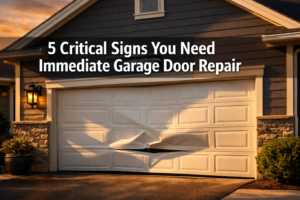
If you’re unsure whether your situation crosses the line, reviewing 5 critical signs you need immediate garage door repair can help you decide quickly.
Is a Broken Garage Door Spring an Emergency
Yes, a broken garage door spring is almost always an emergency. Torsion springs sit above the door and store enormous mechanical energy — when one snaps, the door typically becomes impossible to lift manually (it may weigh 150 to 400 lbs without spring assistance), and the broken spring itself can cause serious injury if touched or if the other spring fails while someone is nearby.
Why it’s urgent:
- A single-spring system leaves the door completely inoperable.
- On a two-spring system, the remaining spring is now carrying double the load and is at elevated risk of snapping.
- Attempting to operate the opener with a broken spring can burn out the motor and damage the opener’s drive mechanism.
- The broken spring creates a whip hazard — sharp metal under residual tension.
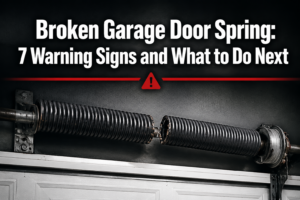
For a detailed breakdown of warning signs before a spring fully fails, see broken garage door spring: 7 warning signs and what to do next.
Edge case: If the spring breaks but the door is already in the closed position and you have another entry point into your home, you may be able to wait until morning for a same-day appointment rather than paying an after-hours premium — as long as the door is fully closed and secured. If the door is stuck open or partially open, call immediately.
Garage Door Stuck and Won’t Open: What Should You Do
If your garage door won’t open, start with basic troubleshooting before calling for emergency service. Many “non-opening” issues are electrical or sensor-related, not mechanical failures.
Step-by-step checks (safe for homeowners):
- Confirm the opener is plugged in and the outlet has power — check the breaker if needed.
- Replace the remote batteries and try again.
- Try the wall-mounted button inside the garage; if that works, the remote or its frequency is the issue.
- Inspect the photo-eye sensors near the floor on both sides of the door. Under Ontario’s building code requirements (aligned with UL 325 standards), these sensors must sit no higher than about 6 inches (15 cm) above the floor. If one sensor’s indicator light is off or blinking, gently wipe the lens and check for obstructions.
- Check whether the manual disconnect cord (usually a red rope hanging from the opener rail) has been pulled — this disengages the door from the opener.
- Look for obvious obstructions in the tracks.
If none of these resolve the issue, and especially if you hear a loud bang, see a visibly broken spring, or notice the door is crooked, stop and call a professional. Do not attempt to force the door open manually if a spring or cable has failed.
Garage Door Off Track: Safety Concerns and What to Do
A garage door that has come off its tracks is a genuine emergency. The door is structurally unstable, the cables and springs are under uneven tension, and the door can fall suddenly — potentially injuring anyone nearby or damaging a vehicle.
Immediate steps:
- Do not attempt to operate the door with the opener.
- Do not try to push or pull the door back onto the tracks yourself.
- If the door is partially open, do not walk under it.
- Disconnect the opener using the manual release cord only if the door is in the fully closed position; otherwise, leave it alone.
- Keep children and pets away from the area.
- Call an emergency technician.
An off-track door is frequently caused by a broken cable, a bent track, a roller that has worn out, or an impact. All of these require professional diagnosis because the fix involves re-tensioning cables and springs — tasks that carry a high injury risk without proper tools and training.
When Should You Call Emergency vs. Regular Garage Door Repair
The distinction matters financially. Emergency or after-hours calls in Hamilton carry a service premium — sometimes 1.5 to 2 times the standard rate — so it’s worth being honest about whether the situation truly cannot wait.
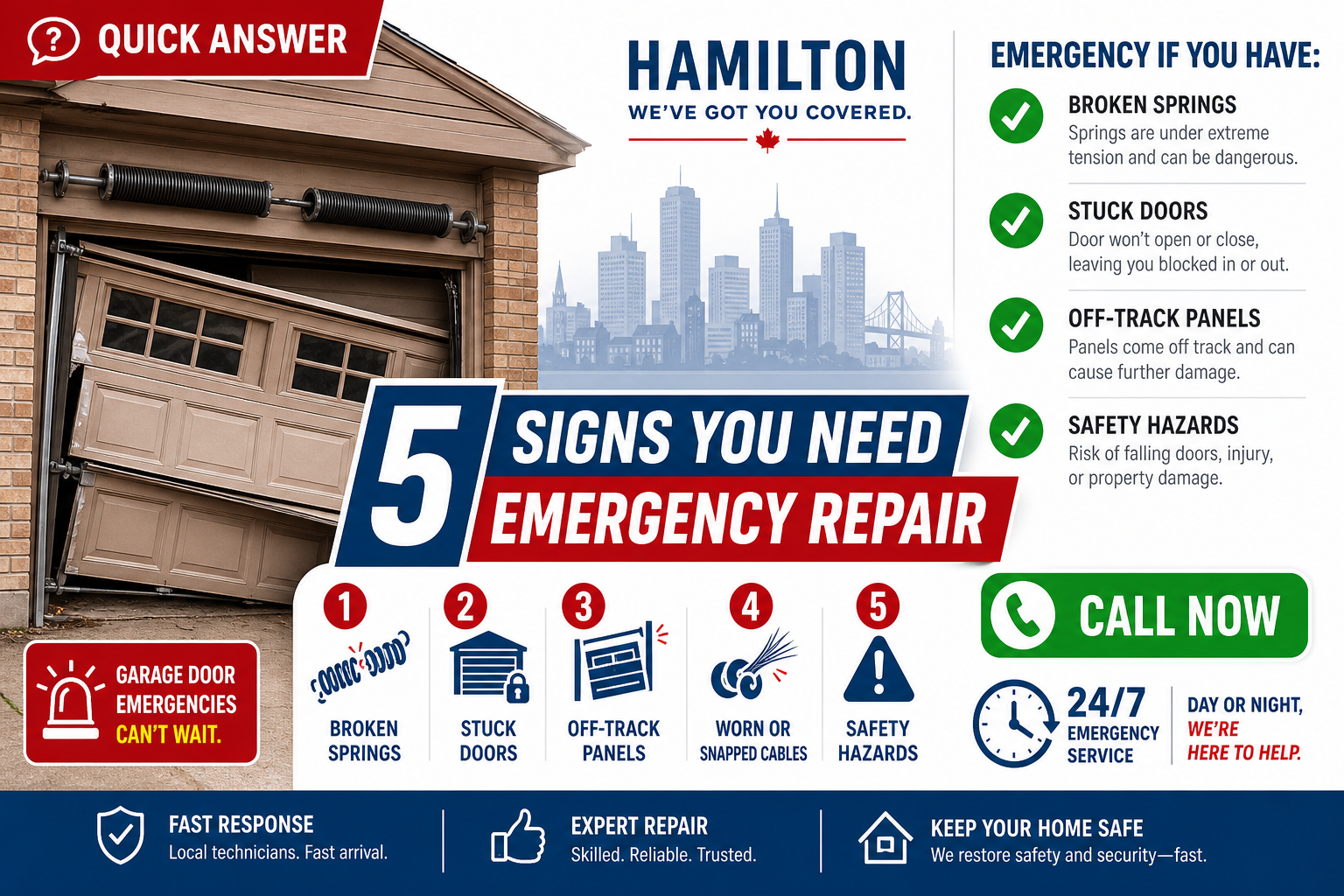
Call emergency (24/7) service when:
- The door is stuck open and your home is unsecured
- Someone is trapped inside or outside
- A spring or cable has visibly snapped
- The door is off its tracks and hanging at an angle
- A vehicle has struck the door
- The door is making loud grinding or banging noises and has stopped moving mid-cycle
Book a same-day or next-day appointment when:
- The door is closed and secured but won’t open
- The opener is malfunctioning but the door can be operated manually
- There is cosmetic damage only
- The door is slow or noisy but fully functional
- A sensor needs realignment during daylight hours
“Reserve 24/7 call-outs for blocked access, security exposure, or active safety hazards. Use regular hours for anything that can wait safely overnight.”
This distinction is also relevant if you’re comparing services across the region. Similar guidance applies to emergency garage door repair in Mississauga and emergency garage door repair in Oakville, where the same emergency-vs-same-day framework applies.
Can You Repair a Garage Door Yourself, or Do You Need a Professional
For minor issues — lubricating hinges, replacing a remote battery, realigning a sensor, or tightening loose bolts — DIY is reasonable. For anything involving springs, cables, or an off-track door, professional repair is strongly recommended.
Why springs and cables are not DIY tasks:
Torsion springs store significant mechanical energy. Industry safety sources and personal-injury legal commentary note that an estimated 20,000 to 30,000 people are injured in garage door accidents per year in North America, with defective or improperly handled springs frequently implicated. A Canadian public-health study using the CHIRPP hospital database recorded 622 garage-door-related injuries in Canadian hospitals between 1990 and 2005 — a figure that underscores the persistent injury risk even when the total number seems modest.
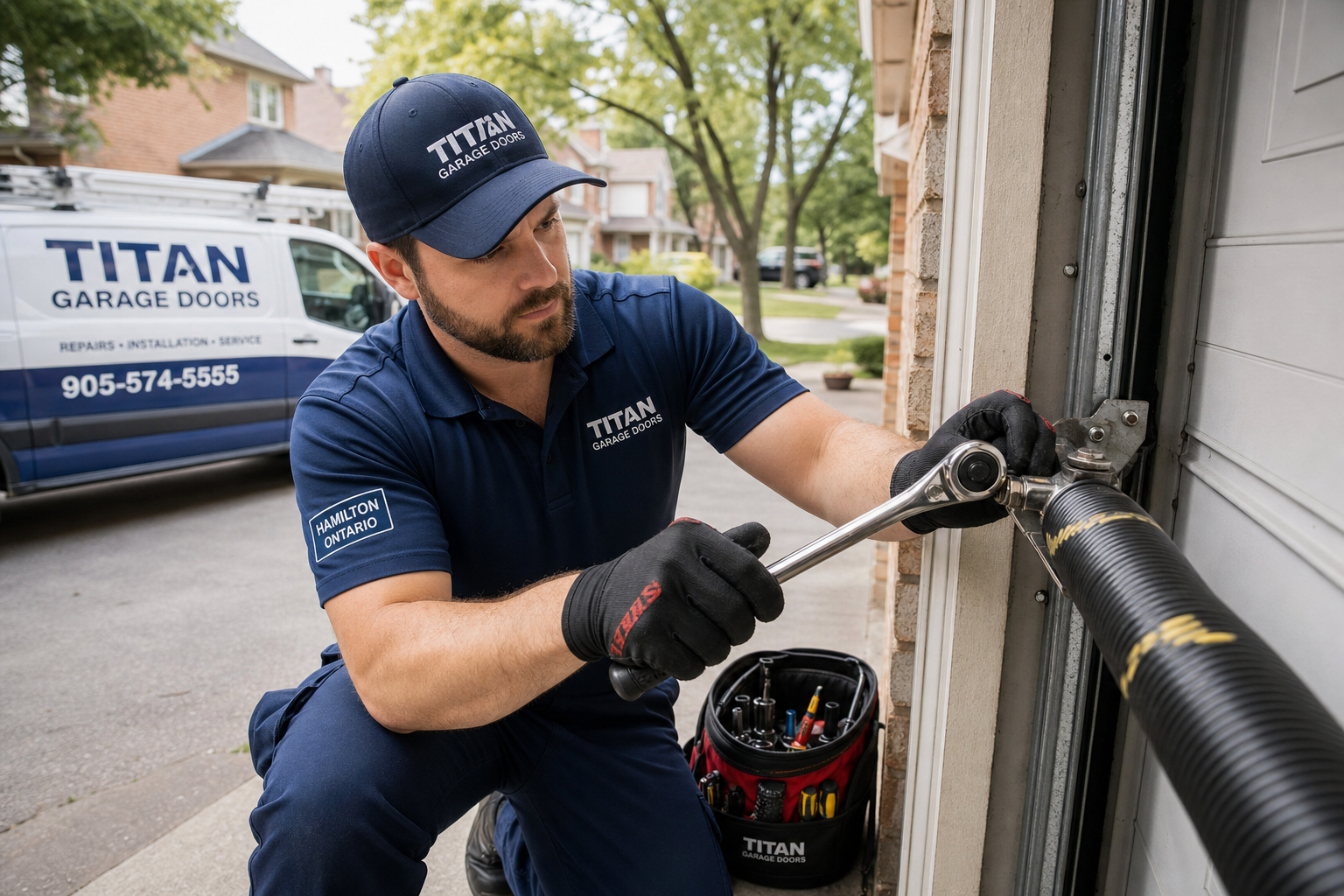
A professional technician has the winding bars, torque knowledge, and safety protocols to handle these components. Attempting to wind or replace a torsion spring without the right tools can result in the spring releasing suddenly, causing severe lacerations or broken bones.
What homeowners can safely do:
- Lubricate tracks, rollers, and hinges with an appropriate lubricant (see guidance on the best garage door lubricant for Ontario’s climate)
- Replace remote batteries
- Clean and realign photo-eye sensors
- Test the auto-reverse function monthly by placing a 2×4 flat on the floor under the door
What requires a professional:
- Spring replacement or adjustment
- Cable replacement
- Track realignment after an off-track event
- Opener replacement or major repair
- Any repair following a vehicle impact or storm damage
Garage Door Making Weird Noises: Is It Dangerous
Unusual noises are not always dangerous, but some sounds signal an imminent failure that warrants urgent attention. The key is identifying what type of noise you’re hearing.
| Sound | Likely Cause | Urgency |
|---|---|---|
| Loud bang or pop | Spring snapping | Emergency — stop using the door |
| Grinding or scraping | Worn rollers or misaligned track | Urgent — book same-day service |
| Squeaking or squealing | Dry hinges or rollers | Low — lubricate and monitor |
| Rattling | Loose hardware | Low — tighten bolts |
| Straining motor noise | Spring tension too low or broken | Urgent — stop using opener |
| Clicking | Chain/belt tension or worn gear | Moderate — book a service call |
A loud bang followed by the door dropping or becoming very heavy to lift almost always means a spring has broken. Treat this as an emergency. A grinding sound that worsens over several days is not an emergency but should be addressed before it becomes one — a worn roller can eventually cause the door to jump its track.
How Much Does Emergency Garage Door Repair Cost in Hamilton
Emergency garage door repair in Hamilton costs more than a standard service call, primarily because of after-hours labor premiums. Exact pricing varies by company, time of day, and the nature of the repair, but the following estimates reflect typical Hamilton-area market conditions in 2026.
Typical cost ranges (estimates based on market conditions; confirm with your technician):
- Standard service call (business hours): $80 to $150 diagnostic/trip fee, plus parts and labor
- After-hours emergency call fee: $150 to $250 additional premium on top of standard rates
- Torsion spring replacement (one spring): $200 to $350 including labor
- Torsion spring replacement (two springs): $300 to $500
- Cable replacement: $150 to $250 per cable
- Off-track repair (no structural damage): $150 to $300
- Opener replacement (mid-range unit, installed): $400 to $800
Factors that affect cost:
- Time of call (midnight vs. 7 a.m.)
- Day of week (weekends and holidays carry higher premiums)
- Door size and weight (double doors cost more to service)
- Parts availability (some older spring sizes or proprietary parts may require sourcing)
- Whether the opener needs to be brought up to code (auto-reverse, photo-eyes)
Always request a written quote before authorizing work, even in an emergency. Reputable companies will provide one. For a deeper look at how to interpret a service quote, see how to read a garage door quote: 9 line items explained.
Garage Door Emergency Repair Services Available 24/7 in Hamilton
Hamilton homeowners have access to several garage door companies that offer genuine 24/7 emergency dispatch, though it’s important to distinguish between companies that answer calls around the clock and those that only offer extended daytime hours.
What to look for in an emergency provider:
- Confirmed 24/7 dispatch (not just a voicemail)
- Technicians who carry common spring sizes and cables on their service vehicles
- Clear after-hours pricing disclosed before dispatch
- Licensed and insured technicians
- Familiarity with Ontario Building Code requirements, including UL 325 opener standards and photo-eye sensor rules
Questions to ask when you call:
- What is your after-hours service fee?
- How soon can a technician arrive?
- Do your technicians carry torsion springs for standard residential doors on their trucks?
- Are your technicians licensed and insured?
- Will you provide a written quote before starting work?
For Hamilton-specific emergency response, Oakview Garage Doors offers emergency garage door repair in Hamilton, ON with same-day and after-hours availability. Their technicians are familiar with the local residential market and carry common replacement parts for faster on-site resolution.
A note on code compliance: Ontario’s 2024 Building Code (effective January 1, 2025) and the referenced UL 325/CSA standards require that all modern automatic openers include auto-reverse and photo-eye sensors positioned no higher than 6 inches (15 cm) from the floor. If an emergency call reveals that your opener lacks these features — common on units installed before 1993 — a reputable technician may recommend disabling the opener and upgrading rather than simply restoring it to operation. This is not upselling; it reflects genuine safety and liability considerations.
How Long Does Emergency Garage Door Repair Usually Take
Most emergency garage door repairs in Hamilton take between 45 minutes and two hours on-site, once the technician arrives. The arrival window is typically one to four hours from the time of the call, depending on the time of day and technician availability.
Typical repair time by issue type:
- Spring replacement (one or two springs): 45 to 90 minutes
- Cable replacement: 30 to 60 minutes
- Off-track repair (no structural damage): 45 to 90 minutes
- Opener replacement: 60 to 120 minutes
- Track realignment: 30 to 60 minutes
What can extend repair time:
- Non-standard spring sizes that require sourcing
- Structural damage from a vehicle impact (may require a follow-up visit or a contractor)
- Older doors with proprietary hardware
- Multiple simultaneous failures (e.g., broken spring plus damaged cable)
If the technician determines that the damage involves the surrounding structure — the wall, header, or framing around the opening — the repair may need to be staged. A temporary security fix (boarding up or securing the door in place) may be done on the emergency call, with full structural repair scheduled separately and potentially subject to a building permit under Ontario’s updated code.
What Not to Do With a Broken Garage Door
Knowing what to avoid can prevent a bad situation from becoming worse — or dangerous.
Never do the following:
- Do not attempt to wind or replace a torsion spring yourself. The stored energy in a torsion spring is enough to cause severe injury or death if it releases suddenly.
- Do not operate the opener if a spring or cable has snapped. This can burn out the motor, damage the drive system, and cause the door to drop.
- Do not walk under a door that is off its tracks or hanging at an angle.
- Do not try to force an off-track door back into the tracks by hand. The cables are under tension and can snap.
- Do not bypass or tape over photo-eye sensors to get the door moving. These sensors exist to prevent the door from closing on a person, child, or pet. Disabling them creates a serious safety and legal liability.
- Do not ignore a door that reverses before closing — this is a sensor or limit-switch issue that can indicate the door is unsafe. See why your garage door reverses before closing and how to fix it for diagnostic guidance.
- Do not assume a “quick fix” is permanent. If a technician patches a broken cable or adjusts a bent track temporarily, schedule the full repair promptly.
Best Emergency Garage Door Repair Companies in Hamilton, Ontario, and Same-Day Service
The best emergency garage door repair companies in Hamilton combine fast dispatch, transparent pricing, and technicians who carry common parts on their vehicles. Same-day service and 24/7 emergency response are related but distinct: same-day service means a technician arrives within the current business day, while true emergency service means dispatch at any hour.
What separates a reliable company from a poor one:
- Technicians who quote in writing before starting work
- No pressure to replace parts that can be repaired
- Willingness to explain what failed and why
- Knowledge of Ontario code requirements (auto-reverse, photo-eyes, fire separation)
- Verifiable insurance and licensing
Red flags to avoid:
- Vague pricing over the phone with no written confirmation
- Pressure to replace the entire door when only a spring has failed
- Technicians who suggest bypassing safety sensors
- No physical address or verifiable business registration
For homeowners in surrounding areas, similar emergency services are available through garage door repair in Burlington and garage door repair in Milton, with comparable response time expectations.
FAQ
Q: Is a garage door stuck in the open position always an emergency? Yes. A door stuck open leaves your home unsecured and exposed to weather and intruders. This qualifies as an emergency regardless of the time of day.
Q: Can I manually open my garage door if the opener fails? Yes, if the spring is intact. Pull the red manual release cord to disconnect the door from the opener, then lift the door by hand. If the door feels extremely heavy or won’t stay up on its own, a spring may be broken — stop and call a professional.
Q: How do I know if my garage door opener is code-compliant in Ontario? Ontario’s building code (aligned with UL 325 standards) requires auto-reverse and photo-eye sensors on all automatic openers. Test the auto-reverse by placing a 2×4 flat on the floor under the door and pressing close — the door should reverse on contact. If it doesn’t, the opener is unsafe and should be serviced or replaced.
Q: Will my home insurance cover emergency garage door repair in Hamilton? It depends on the cause. Damage from a vehicle impact, storm, or vandalism is often covered under home insurance. Mechanical failure from normal wear is generally not. Check your policy and call your insurer before authorizing major repairs if the cause is an insured event.
Q: How much more does an after-hours emergency call cost compared to a daytime call? Expect to pay an additional $150 to $250 in after-hours premiums on top of standard parts and labor costs. Weekend and holiday rates are typically at the higher end of that range.
Q: Is it safe to park my car in the garage if the spring is broken? If the door is fully closed and secured, parking inside is generally safe as long as you do not try to open the door. If the door is partially open or off its tracks, do not park under it.
Q: How long do garage door springs typically last? Standard torsion springs are rated for approximately 10,000 cycles. At two cycles per day, that translates to roughly 13 to 14 years. High-cycle springs (rated at 20,000 or more cycles) last longer and are worth considering when replacing.
Q: Can a garage door be temporarily secured after an emergency if parts aren’t available? Yes. A technician can often secure a damaged door temporarily — using clamps, locking it in place, or boarding it — to restore security while parts are sourced. Ask about this option if the repair cannot be completed in one visit.
Q: Do I need a building permit for emergency garage door repair in Hamilton? Most like-for-like repairs (spring, cable, opener, track) do not require a permit. However, if the damage involves structural changes to the opening — enlarging it, replacing the header, or repairing fire-separation walls after a vehicle impact — a permit under Ontario’s 2024 Building Code may be required.
Q: What should I do if my garage door was hit by a car? Do not operate the door. Inspect the surrounding wall and framing for visible damage. Call an emergency technician and, if there is structural damage, contact your home insurer. The repair may involve both a garage door technician and a general contractor.
Q: How do I find a reputable emergency garage door company in Hamilton at 2 a.m.? Search for companies with verified Google reviews, a physical Hamilton-area address, and a phone number that connects to a live dispatcher (not just voicemail). Ask upfront about after-hours fees and technician arrival time before committing.
Q: Are garage door cable repairs also emergencies? A snapped cable is an emergency because it places the door under uneven tension and creates a drop risk. A fraying cable that still holds is urgent but may allow a same-day (rather than after-hours) appointment if the door is closed and secured.
Conclusion
Emergency garage door repair in Hamilton: what qualifies and who to call is not a complicated question once you know the criteria. A true emergency involves an unsecured home, a safety hazard, or a structural failure that cannot safely wait. Broken springs, off-track doors, snapped cables, and doors stuck open all meet that bar. Cosmetic damage, slow operation, and remote issues generally do not.
Actionable next steps:
- Right now: If your door is stuck open, off its tracks, or has a visibly broken spring, call an emergency technician. Do not attempt to operate the door or fix the spring yourself.
- Before an emergency happens: Test your door’s auto-reverse function monthly with a 2×4 on the floor. Confirm your photo-eye sensors are clean, aligned, and functioning. Lubricate moving parts twice a year.
- When booking a technician: Ask for written pricing before work starts, confirm they are insured, and ask whether your opener meets current Ontario safety standards.
- After the repair: Request documentation of what was replaced and why. If the technician identifies a code compliance issue with your opener, take it seriously — the liability exposure from a non-reversing door is significant.
For Hamilton homeowners who need immediate help, Oakview Garage Doors provides emergency garage door repair in Hamilton, ON with same-day and after-hours response. For a broader overview of emergency repair services across the region, see the garage door emergency repair service page.
References
- Canada Safety Council / CHIRPP database summary on garage door injuries in Canadian hospitals, 1990–2005. Referenced in industry safety commentary.
- Ontario Ministry of Municipal Affairs and Housing. Ontario Building Code, O. Reg. 332/12 (2024 Edition), effective January 1, 2025. ontario.ca
- UL 325: Standard for Door, Drapery, Gate, Louver, and Window Operators and Systems. Underwriters Laboratories. Referenced in Ontario garage door opener compliance guidance, 2026.
- Grand View Research / Allied Market Research. Garage and Overhead Door Market Size Report, 2026. Market estimate: approximately $8.02 billion USD globally, ~6% CAGR.
- Ontario garage door code compliance explainer, published May 2026. Covers UL 325, CSA standards, photo-eye placement, auto-reverse requirements, and fire separation rules for attached garages in GTA and surrounding municipalities.
- Personal injury and product liability legal commentary on garage door accidents in North America. Estimates of 20,000–30,000 annual injuries cited from legal and insurance industry sources.