Last updated: June 28, 2026
Quick Answer
Most garage door openers in Canada last between 10 and 15 years under normal residential use, though well-maintained units in mild climates can reach 20 years. The decision to repair or replace comes down to three factors: the opener’s age, the cost of the needed repair relative to a new unit, and whether the existing opener meets current Canadian safety standards. If repair costs exceed 50% of a new installed opener’s price, or if the unit is over 15 years old and failing repeatedly, replacement is almost always the better investment.
Key Takeaways
- The typical garage door opener lifespan in Canada is 10 to 15 years, with heavy-duty older models sometimes lasting 20 or more years but often lacking modern safety features.
- Cold Canadian winters, particularly in Ontario and the Prairie provinces, accelerate wear on motors, lubricants, and drive systems.
- The 50% rule is the standard industry heuristic: if a single repair costs more than half the price of a new installed opener, replace it.
- Installed replacement costs in Canada generally run between $300 and $900 CAD, depending on the opener type and labour rates in your area.
- Missing photo-eye safety sensors, failed auto-reverse tests, and repeated circuit board failures are the clearest signals to replace rather than repair.
- Belt-drive and DC motor openers tend to outlast chain-drive units and perform better in cold-weather conditions.
- Newer openers from brands like LiftMaster and Chamberlain offer battery backup, smartphone control, and quieter operation, features that justify replacement for many Canadian homeowners.
- Targeted repairs (sensors, remotes, gears, or backup batteries) are cost-effective when the opener is under 10 years old and the failure is isolated.
- Ontario’s building code references UL 325 and CSA safety standards, meaning older openers without compliant sensors may not meet current provincial expectations.
- A professional tune-up can extend opener life by two to three years if the unit is otherwise mechanically sound.
How Long Does a Garage Door Opener Last in Canada?
The average garage door opener lasts 10 to 15 years in Canada, though the actual lifespan varies based on drive type, usage frequency, maintenance habits, and local climate. Some heavy-duty units installed in the 1990s and early 2000s are still running, but they typically lack the safety features required under current Canadian standards.
Several factors determine where your opener lands in that range:
- Drive type: Belt-drive openers generally outlast chain-drive models because they produce less vibration and mechanical stress. Screw-drive units fall somewhere in between.
- Usage cycles: A household that opens and closes the garage door four to six times per day will wear through a motor faster than one that uses it twice daily.
- Maintenance: Annual lubrication, hardware tightening, and sensor alignment can add years to an opener’s life. See our guide on the best garage door lubricant for Ontario’s climate for product recommendations.
- Climate exposure: Garages that are uninsulated and unheated face greater thermal stress on motors and circuit boards during Canadian winters.
According to Don’s Garage Doors (May 2026), some older heavy-duty units can run 20 to 30 years, but they often lack modern safety features like photo-eye sensors and auto-reverse mechanisms that are now standard expectations under Ontario’s building code and UL 325/CSA safety guidelines.
Bottom line: Plan for a 10 to 15-year service life. If your opener is approaching that range and showing any symptoms of decline, start budgeting for replacement rather than waiting for a complete failure.
Does Cold Weather Affect Garage Door Opener Lifespan?
Yes, cold weather meaningfully shortens garage door opener lifespan in Canada, particularly for chain-drive models and older units without DC motors. Low temperatures thicken lubricants, stiffen metal components, and increase the load on the motor, which accelerates wear over time.
Specific cold-weather effects Canadian homeowners should know:
- Motor strain: When temperatures drop below -20°C, as they regularly do across much of Canada, motors work harder to move a door that has stiffened springs and frozen tracks. This added strain shortens motor life.
- Lubricant performance: Standard petroleum-based greases can congeal in extreme cold, reducing their effectiveness. Silicone-based lubricants perform better in Ontario winters.
- Circuit board sensitivity: Repeated freeze-thaw cycles can cause micro-cracking in circuit boards, leading to intermittent failures that are difficult to diagnose.
- Battery backup limitations: Standard lead-acid backup batteries lose significant capacity in cold weather. Lithium-based backup systems handle Canadian winters better.
For homeowners in Ontario’s colder regions, an insulated garage door paired with a DC motor belt-drive opener is the most practical combination for long-term reliability. If power outages during winter storms are a concern, our article on battery backup garage door openers and Ontario power outages covers the options in detail.
Signs Your Garage Door Opener Is Failing
Recognizing the warning signs early gives you time to make a planned repair or replacement decision rather than dealing with a breakdown at the worst possible moment. Most failing openers display at least two or three of the following symptoms before they quit entirely.
Mechanical and performance signs:
- The door moves slower than usual, especially in cold weather
- The opener strains, hesitates, or reverses unexpectedly mid-cycle
- The motor runs but the door does not move (stripped gears)
- Grinding, rattling, or vibrating sounds during operation that were not present before
- The door opens or closes partially and then stops
Electrical and safety signs:
- Remote or wall button works intermittently, even with fresh batteries
- The opener fails the safety reversal test (place a 2×4 flat on the floor under the door; it should reverse on contact)
- Photo-eye sensors are misaligned or the indicator lights are blinking in an error pattern
- The unit trips the circuit breaker or causes flickering lights
Age and obsolescence signs:
- The opener is more than 15 years old and lacks photo-eye sensors
- No rolling-code technology (older fixed-code openers are a security risk)
- Replacement parts are discontinued or unavailable
If you are seeing multiple signs from this list, read our breakdown of 5 critical signs you need immediate garage door repair for a more detailed diagnostic guide.
What Causes Garage Door Openers to Fail?
Garage door openers fail for a predictable set of reasons, most of which relate to mechanical wear, electrical component degradation, or an imbalance between the opener’s power rating and the door it is lifting.
Most common failure causes:
- Worn or stripped drive gears: Plastic drive gears are a deliberate weak point designed to fail before the motor does. Gear replacement is one of the most common and cost-effective repairs.
- Failed circuit board: Power surges, moisture infiltration, and age degrade the logic board. Circuit board replacement can cost $80 to $200 in parts alone, making it a borderline repair on older units.
- Motor burnout: Usually caused by a door that is out of balance, broken springs forcing the motor to carry the full door weight, or simply end-of-life wear. A burned motor almost always justifies replacement of the whole unit.
- Broken or worn torsion springs: The opener itself may be fine, but if the springs are broken, the motor is doing far more work than it should. Always address spring issues before assuming the opener has failed. Our garage door spring repair guide for Oakville explains the connection between spring health and opener longevity.
- Sensor failure or misalignment: Photo-eye sensors are sensitive to vibration, dirt, and physical bumps. Many “opener failures” are actually sensor issues that cost under $50 to fix.
- Electrical issues: Damaged wiring, loose connections, or a tripped GFCI outlet can mimic opener failure without any mechanical problem.
When Should You Repair vs Replace a Garage Door Opener?
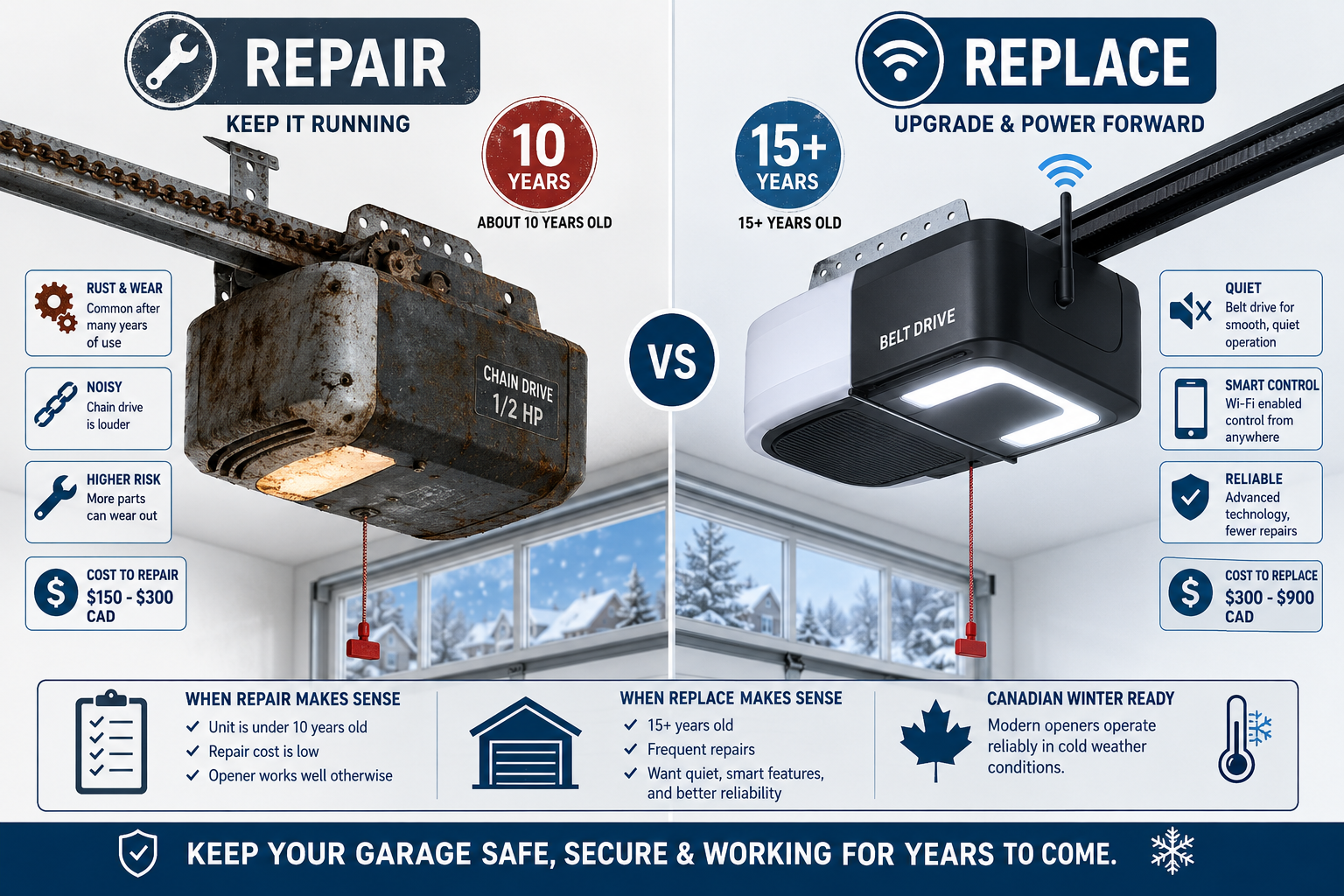
The repair-versus-replace decision for a garage door opener in Canada follows a clear framework based on age, repair cost, and safety compliance. Repairing makes sense when the unit is relatively young and the failure is isolated. Replacement makes sense when the unit is old, the repair is expensive, or the opener lacks modern safety features.
The 50% Rule
The most widely used industry benchmark is straightforward: if the cost of a single repair exceeds 50% of the installed price of a new opener, replace the unit. With installed replacement costs running roughly $300 to $900 CAD (more on that below), the repair threshold sits at approximately $150 to $450.
Age-Based Decision Framework
| Opener Age | Recommended Action |
|---|---|
| Under 5 years | Repair almost always; parts are available and under warranty |
| 5 to 10 years | Repair if the fix is isolated and costs under 50% of replacement |
| 10 to 15 years | Evaluate carefully; replacement is often the smarter long-term choice |
| Over 15 years | Replace, especially if lacking photo-eye sensors or auto-reverse |
Safety Compliance as a Non-Negotiable Factor
Ontario’s building code references UL 325 and CSA opener safety standards, which require photo-eye sensors mounted no higher than 6 inches from the floor and a functioning auto-reverse mechanism (Royal Garage Door Repairs, May 2026). If your opener predates these requirements and lacks these features, replacement is not optional from a safety standpoint, regardless of whether the motor still runs.
Choose repair if:
- The opener is under 10 years old
- The failure is a single, identifiable component (sensor, remote, gear)
- The repair cost is well under 50% of a new installed unit
- The opener already has photo-eye sensors and rolling-code security
Choose replacement if:
- The opener is 15 or more years old
- Repair costs approach or exceed the 50% threshold
- The unit lacks photo-eye sensors or auto-reverse
- You have upgraded to a heavier insulated door that exceeds the opener’s horsepower rating
- You want battery backup, smartphone control, or quieter operation
For professional assessment in the Oakville and Burlington area, Oakview’s garage door opener repair service can diagnose whether repair or replacement is the right call for your specific unit.
What Does It Cost to Repair or Replace a Garage Door Opener in Canada?
Repair costs for a garage door opener in Canada typically run between $80 and $350 CAD, depending on the component being replaced. Full installed replacement costs range from approximately $300 to $900 CAD, with premium smart openers at the higher end of that range.
Typical Repair Costs
| Repair Type | Estimated Cost (CAD) |
|---|---|
| Safety sensor replacement | $50 to $120 |
| Remote or keypad programming | $30 to $80 |
| Drive gear replacement | $100 to $200 |
| Circuit board replacement | $150 to $300 |
| Wiring repair | $80 to $150 |
| Battery backup replacement | $60 to $120 |
New Opener Installation Costs
Homewyse estimated installed opener replacement at USD $456 to $765 per unit as of January 2026, and HomeGuide puts the North American range at $300 to $900 USD installed. In Canadian dollars, accounting for exchange rates and regional labour costs, most Ontario homeowners should budget $400 to $1,000 CAD for a fully installed replacement, with the mid-range (belt-drive, Wi-Fi capable) sitting around $550 to $750 CAD installed.
Factors that push costs higher in Canada:
- Premium belt-drive or wall-mount openers
- Battery backup units (add $100 to $200 to the unit cost)
- Homes in remote areas with higher service call fees
- Older garages requiring wiring updates or header bracket modifications
For a broader view of what goes into a garage door service quote, our guide on how to read a garage door quote breaks down each line item.
Can You Repair an Old Garage Door Opener, or Is It Better to Replace?
Repairing an old garage door opener is possible in many cases, but whether it is worth doing depends on parts availability, the total repair cost, and what you are giving up by keeping the old unit. For openers under 10 years old, targeted repair is usually the right call. For units over 15 years old, repair often delays an inevitable replacement while costing money that could go toward a better unit.
When repair on an older unit makes sense:
- The failure is a sensor or remote, not the motor or circuit board
- Replacement parts are still available from the manufacturer
- The opener is a heavy-duty commercial-grade unit with a long expected service life
- Budget constraints make immediate replacement impractical
When repair on an older unit does not make sense:
- The motor or circuit board has failed (these are expensive repairs on aging units)
- Parts are discontinued or hard to source
- The opener lacks photo-eye sensors (a safety and code compliance issue)
- The door has been upgraded to a heavier insulated model that exceeds the opener’s rated capacity
A practical middle ground exists: sometimes only one component needs upgrading. If the motor and drive are healthy but the unit lacks battery backup, adding an aftermarket backup battery can extend usability without full replacement. Similarly, replacing just the safety sensors on an otherwise functional 12-year-old unit is a reasonable repair.
Best Garage Door Opener Brands for the Canadian Climate
The best garage door opener brands for Canadian conditions are those that offer DC motors (for smoother cold-weather starts), battery backup (for winter power outages), and robust build quality that handles thermal cycling. LiftMaster, Chamberlain, and Genie are the three brands most commonly recommended by Canadian garage door professionals.
Brand Overview
LiftMaster (Canada) LiftMaster’s Canadian product line emphasizes battery backup, myQ smartphone control, and quiet DC belt-drive operation. Their wall-mount models (such as the 8500W series) are well-suited to Canadian garages with limited ceiling space due to snow load trusses. LiftMaster positions battery backup and app control as standard features rather than upgrades, which reflects where the Canadian market is heading.
Chamberlain Chamberlain shares the same parent company as LiftMaster and offers similar technology at a slightly lower price point. Their belt-drive units with myQ integration are a strong mid-range choice for Ontario homeowners.
Genie Genie’s 2026 Signature Series includes a 1-1/4 HPc belt-drive unit with Wi-Fi, LED lighting, and battery backup. The higher horsepower rating makes it a good fit for heavier insulated doors, which are increasingly common in new Canadian construction.
Craftsman and Ryobi These are budget-friendly options available at major Canadian retailers. They are adequate for light residential use but generally lack the cold-weather durability and feature sets of LiftMaster or Genie at the premium tier.
What to Look for in a Canadian Climate
- DC motor (smoother starts in cold weather, less motor strain)
- Belt or jackshaft drive (quieter and lower vibration than chain drive)
- Battery backup with lithium or AGM battery (performs better in cold than standard lead-acid)
- Rolling-code or encrypted signal technology
- Horsepower rating matched to your door’s weight (heavier insulated doors need at least 1/2 HP, ideally 3/4 HP or more)
Metro Garage Doors’ April 2026 buyer’s guide notes that door weight, whether the garage is attached to the living space, and power-outage frequency should all factor into the opener selection, which often pushes Canadian buyers toward belt-drive or battery-backup units rather than basic chain-drive replacements.
What Warranty Comes with a New Garage Door Opener?
New garage door openers sold in Canada typically carry a motor warranty of 1 to lifetime (depending on the model), a parts warranty of 1 to 5 years, and a 1-year labour warranty through the installing dealer. Premium models from LiftMaster and Chamberlain often include lifetime motor warranties on their belt-drive units.
Typical warranty breakdown:
| Component | Standard Warranty | Premium Models |
|---|---|---|
| Motor | 1 to 5 years | Lifetime |
| Parts | 1 to 2 years | 5 years |
| Belt/Drive | 1 to 3 years | Lifetime |
| Labour (installer) | 90 days to 1 year | 1 year |
Important notes for Canadian buyers:
- Warranty coverage may differ between Canadian and US product SKUs, even for the same brand. Confirm Canadian warranty terms at purchase.
- Warranties are typically voided by DIY installation on models that require professional installation.
- Keep your installation receipt and product registration. Many manufacturers require registration within 30 days for lifetime warranty coverage to apply.
Can You Replace Just the Garage Door Opener Motor?
Replacing only the motor in a garage door opener is technically possible but rarely cost-effective. In most cases, the motor is not sold as a standalone part; instead, the entire opener head unit is replaced. Labour costs for motor-only replacement often approach or exceed the cost of a full new unit installation.
The exception is commercial-grade or high-end residential openers where the motor is a modular, serviceable component. For standard residential openers sold at Canadian home improvement retailers, the practical answer is: if the motor has failed, replace the whole opener.
What you can realistically replace as individual components:
- Drive gears and sprockets
- Circuit boards (if parts are available)
- Safety sensors
- Remotes and keypads
- Backup battery
- Drive belt or chain
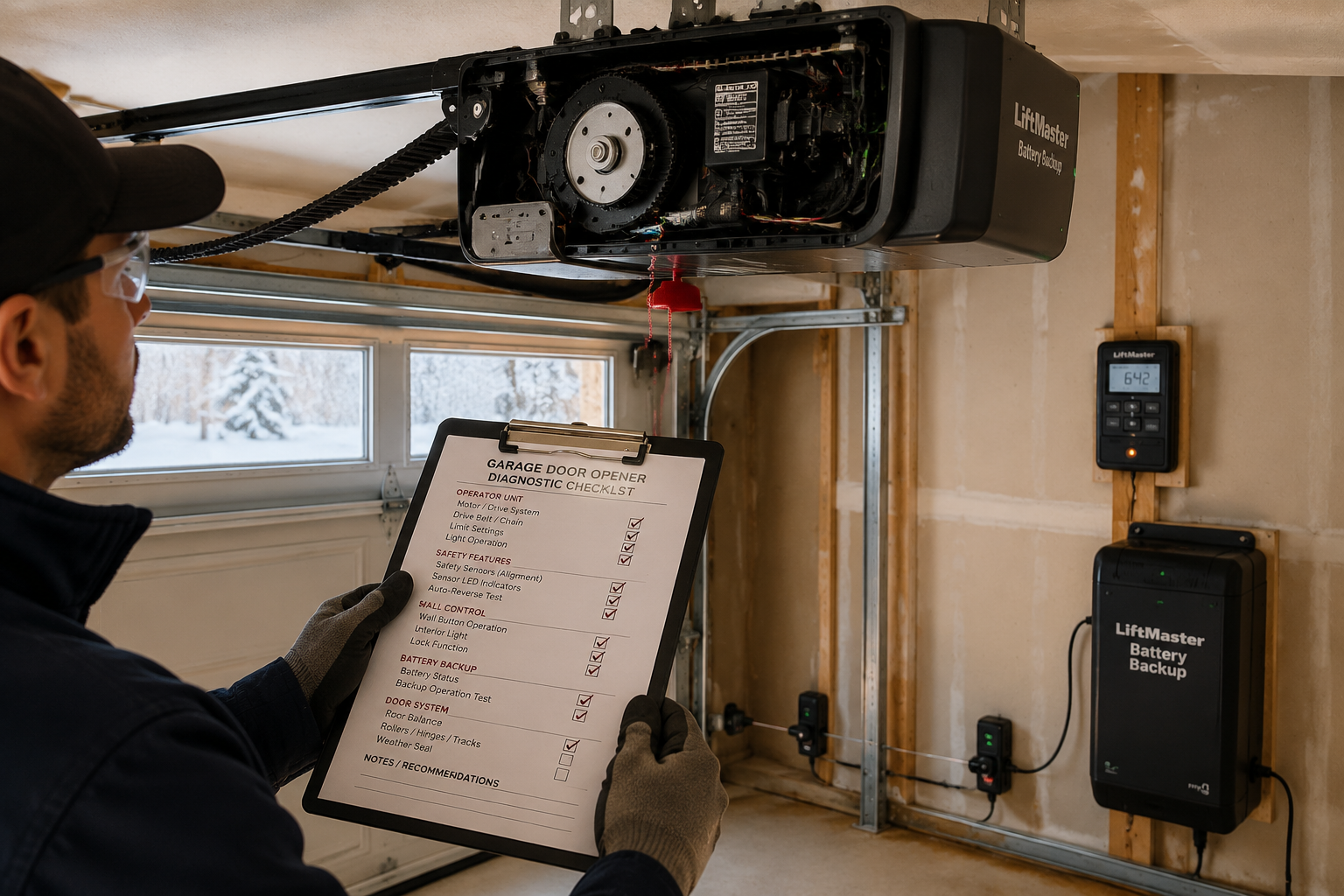
If you are unsure whether a component repair is viable for your specific model, a diagnostic visit from a qualified technician is the most efficient way to get a clear answer. Same-day garage door opener repair in Oakville is available for homeowners in the GTA West area who need a quick assessment.
Garage Door Opener Making Noise: When Should You Replace It?
A noisy garage door opener is not always a sign of imminent failure, but certain sounds do indicate that replacement is the better option over repair. The key is identifying what type of noise it is and how old the unit is.
Noise type and what it means:
| Noise | Likely Cause | Repair or Replace? |
|---|---|---|
| Grinding or crunching | Worn or stripped drive gears | Repair (gear replacement) if under 10 years old |
| Loud rattling | Loose hardware or worn chain | Tighten hardware; replace chain if worn |
| Vibration throughout operation | Motor bearing wear or imbalanced door | Diagnose; likely replace if over 12 years old |
| Squealing or screeching | Lack of lubrication or worn belt | Lubricate first; replace belt if damaged |
| Intermittent clicking with no movement | Circuit board or capacitor failure | Repair if under 10 years, replace if older |
| Constant loud operation (chain drive) | Normal for chain drive, not a fault | Consider upgrading to belt drive for noise reduction |
A chain-drive opener that has always been loud is not failing; it is just a chain drive. If noise is the primary complaint and the unit is otherwise functional, upgrading to a belt-drive opener is a legitimate reason to replace, even if the old unit could be kept running.
For issues where the door reverses unexpectedly or behaves erratically, our article on why your garage door reverses before closing covers the diagnostic steps in detail.
Frequently Asked Questions
How long should a garage door opener last in Canada? Most residential garage door openers in Canada last 10 to 15 years. Units with DC motors and belt drives tend to reach the higher end of that range. Cold-weather climates and high daily usage cycles shorten lifespan; regular maintenance extends it.
At what age should I replace my garage door opener? Plan to evaluate replacement at 10 years and strongly consider it at 15 years, especially if the unit is showing performance issues or lacks photo-eye safety sensors. An opener over 15 years old that requires a major repair should almost always be replaced rather than fixed.
What is the 50% rule for garage door openers? The 50% rule states that if a single repair costs more than half the price of a new installed opener, replacement is the better financial decision. With installed openers running $400 to $1,000 CAD in Ontario, the repair threshold is roughly $200 to $500.
Does cold weather shorten garage door opener life? Yes. Canadian winters increase motor strain, degrade lubricants, and stress circuit boards through freeze-thaw cycles. Insulated garages, DC motors, and silicone-based lubricants all help mitigate cold-weather wear.
What are the most reliable garage door opener brands in Canada? LiftMaster, Chamberlain, and Genie are consistently rated as the most reliable brands for Canadian conditions. LiftMaster’s Canadian line is particularly well-regarded for battery backup and smart-home integration.
Can I repair a garage door opener myself? Simple tasks like replacing batteries, reprogramming remotes, and cleaning or realigning sensors are safe DIY jobs. Replacing drive gears, circuit boards, or wiring should be done by a qualified technician to avoid injury and warranty issues.
How much does it cost to install a new garage door opener in Ontario? Expect to pay $400 to $1,000 CAD installed in Ontario in 2026, depending on the opener model, drive type, and whether any additional wiring or bracket work is needed. Mid-range belt-drive units with Wi-Fi typically land around $550 to $750 installed.
Do new garage door openers come with a warranty in Canada? Yes. Most new openers include a 1- to 5-year parts warranty, with lifetime motor warranties on premium belt-drive models from LiftMaster and Chamberlain. Confirm Canadian-specific warranty terms at purchase, as they can differ from US product listings.
Is a belt-drive opener worth the extra cost in Canada? For most Canadian homeowners, yes. Belt-drive openers are quieter, produce less vibration, and handle cold-weather starts more smoothly than chain-drive units. The price premium is typically $50 to $150 CAD over a comparable chain-drive model.
What happens if I keep using an opener without photo-eye sensors? Operating a garage door opener without functioning photo-eye sensors creates a serious safety risk, particularly for children and pets. It also puts the opener out of compliance with Ontario’s building code references to UL 325 and CSA safety standards. Sensors are inexpensive to add or replace and should be treated as non-negotiable.
When is an emergency garage door repair needed instead of a scheduled replacement? If the opener fails and the door is stuck open (a security risk) or stuck closed (trapping a vehicle), that is an emergency situation. Emergency garage door repair services in Oakville and the broader GTA area are available for same-day response in these situations.
Should I replace the opener when I replace the garage door? Not always, but it is worth evaluating. If you are upgrading to a heavier insulated door, your existing opener may lack the horsepower to handle it reliably. A new door installation is also a convenient time to upgrade the opener without paying a separate service call fee.
Conclusion
Understanding the garage door opener lifespan in Canada and knowing when to repair versus replace can save homeowners significant money and prevent safety issues before they become emergencies. The core decision framework is straightforward: use the 50% rule on repair costs, apply an age threshold of 10 to 15 years, and treat missing safety sensors as an automatic trigger for replacement regardless of cost.
Actionable next steps:
- Check your opener’s age. Find the manufacture date on the label inside the motor housing. If it is over 12 years old, schedule a professional inspection.
- Run the safety reversal test. Place a 2×4 flat on the floor under the door and trigger the close cycle. The door must reverse on contact. If it does not, stop using the opener until it is repaired or replaced.
- Get a repair estimate before deciding. A diagnostic visit will tell you exactly what component has failed and what it costs to fix. Compare that figure to 50% of a new installed opener’s price.
- Consider the upgrade value. If your current opener lacks battery backup, smartphone control, or a quiet belt drive, replacement offers tangible daily benefits beyond just fixing a problem.
- Budget proactively. If your opener is between 10 and 15 years old and running well, start budgeting $500 to $800 CAD for replacement in the next one to three years so a breakdown does not force a rushed decision.
For homeowners in Oakville, Burlington, Mississauga, and the surrounding GTA West area, professional assessment and same-day service are available through Oakview Garage Doors’ opener repair and replacement team.
References
- Don’s Garage Doors. (2026, May 5). How long garage door openers last and when to replace them. https://donsgaragedoors.com/how-long-garage-door-openers-last-when-to-replace/
- Royal Garage Door Repairs. (2026, May). Ontario garage door code commentary. https://royalgaragedoorrepairs.com/blog/ontario-garage-door-code/
- Forest Door. (2026, May 14). Signs it’s time to replace your garage door opener. https://www.forestdoor.com/blog/signs-time-replace-garage-door-opener/
- Metro Garage Doors. (2026, April). Garage door opener buyer’s guide. https://metrogaragedoors.ca/blog/garage-door-opener-buyers-guide/
- Homewyse. (2026, January). Cost to replace a garage door opener. https://www.homewyse.com/maintenance_costs/cost_to_replace_garage_opener.html
- HomeGuide. Garage door opener installation cost. https://homeguide.com/costs/garage-door-opener-installation-cost
- LiftMaster Canada. Garage door openers for homes. https://www.liftmaster.com/ca/for-homes/garage-door-openers
- Genie / The Home Depot. (2026). Genie Signature Series 1-1/4 HPc belt-drive opener with battery backup. https://www.homedepot.com/p/Genie-Signature-Series-1-1-4-HPc-Ultra-Quiet-Belt-Drive-Garage-Door-Opener-with-Battery-Backup-7055D
- Easy Open Door. When to replace your garage door opener. https://www.easyopendoor.com/when-replace-garage-opener/