Last updated: June 24, 2026
Quick Answer: R-value measures a garage door’s resistance to heat flow — the higher the number, the better the insulation. For most Ontario homeowners with an attached garage, a door rated between R-12 and R-16 hits the right balance of comfort, energy savings, and cost. Detached, unheated garages can work fine with R-6 or less, while heated workshops or converted spaces benefit from R-16 and above.
Key Takeaways
- R-value is a measure of thermal resistance; a higher R-value means less heat escapes through the door.
- Ontario’s climate makes insulation a practical necessity, not a luxury, for attached and heated garages.
- The R-12 to R-16 range is the most commonly recommended for attached garages in Ontario’s climate zones.
- Polyurethane foam cores outperform polystyrene (EPS) at the same stated R-value because of better adhesion and fewer air gaps.
- Panel-only R-value ratings can be misleading; look for whole-door or system R-value that accounts for seals and thermal breaks.
- DIY insulation kits add only about R-4 to R-8 and do not match the performance of a factory-insulated door.
- Ontario’s 2024 Building Code (in force January 1, 2025) tightened envelope insulation requirements, indirectly raising the bar for garage door performance.
- Unheated detached garages rarely need more than R-6 to R-9; spending more on insulation there delivers little return.
- U-value (the inverse of R-value) gives a more complete picture of real-world heat transfer across the whole door assembly.
What Is R-Value and Why Does It Matter for Garage Doors
R-value is a standardized measure of thermal resistance — specifically, how well a material resists the flow of heat from one side to the other. The higher the R-value, the slower heat moves through the material, and the better the insulation.
For garage doors, R-value matters because a standard double-car garage door covers roughly 128 square feet of your home’s exterior envelope. In an Ontario winter, an uninsulated door acts almost like an open window in terms of heat loss. Even a modest improvement in R-value can reduce the cold air that bleeds into an attached garage, which in turn reduces the load on any adjacent living spaces.
How R-value is measured: In the imperial system used in Canada and the U.S., R-value is expressed in units of ft²·°F·h/BTU. A higher number means more resistance. For context:
- A single-layer steel door with no insulation: approximately R-2 or less
- A basic polystyrene-backed door: R-6 to R-9
- A polyurethane-injected door: R-12 to R-18+
Garaga, one of Canada’s major garage door manufacturers, defines R-value as “resistance to heat flow” and recommends at least R-10 for attached garages in cold climates, R-12 or higher for heated garages, and R-16 or more when the space is used as a workshop or gym.
Garage Door R-Value Explained: Ontario’s Climate Zones and What They Demand
Ontario spans multiple climate zones, and the right R-value depends on where a home sits within the province. Southern Ontario cities like Oakville, Burlington, Mississauga, and Hamilton sit in a zone with average winter temperatures regularly dropping to -15°C or colder during cold snaps. Northern Ontario communities face even harsher conditions.
The practical implication: a door that performs adequately in Atlanta, Georgia is almost certainly undersized for a Halton Region winter.
Ontario climate context by region (general guidance):
| Region | Typical Winter Low | Suggested Minimum R-Value (Attached Garage) |
|---|---|---|
| Southern Ontario (GTA, Halton, Hamilton) | -15°C to -20°C | R-12 to R-16 |
| Central Ontario (Barrie, Peterborough) | -20°C to -25°C | R-14 to R-18 |
| Northern Ontario (Sudbury, Thunder Bay) | -25°C to -35°C | R-16 to R-20+ |
Ontario’s 2024 Building Code, which came into force on January 1, 2025, tightened insulation and energy provisions across the building envelope. While the code does not currently prescribe a specific minimum R-value for garage doors in the same way it does for walls or attics, the broader envelope tightening trend means that a poorly insulated door creates a weak link in an otherwise code-compliant home.
For homeowners planning a new garage door installation in Oakville or anywhere in the Greater Golden Horseshoe, choosing a door in the R-12 to R-16 range aligns with both current best practice and the direction of future code updates.
The Difference Between Polyurethane and Polystyrene Insulation
Not all insulated garage doors are equal, even at the same stated R-value. The type of insulation inside the door matters as much as the number on the spec sheet.
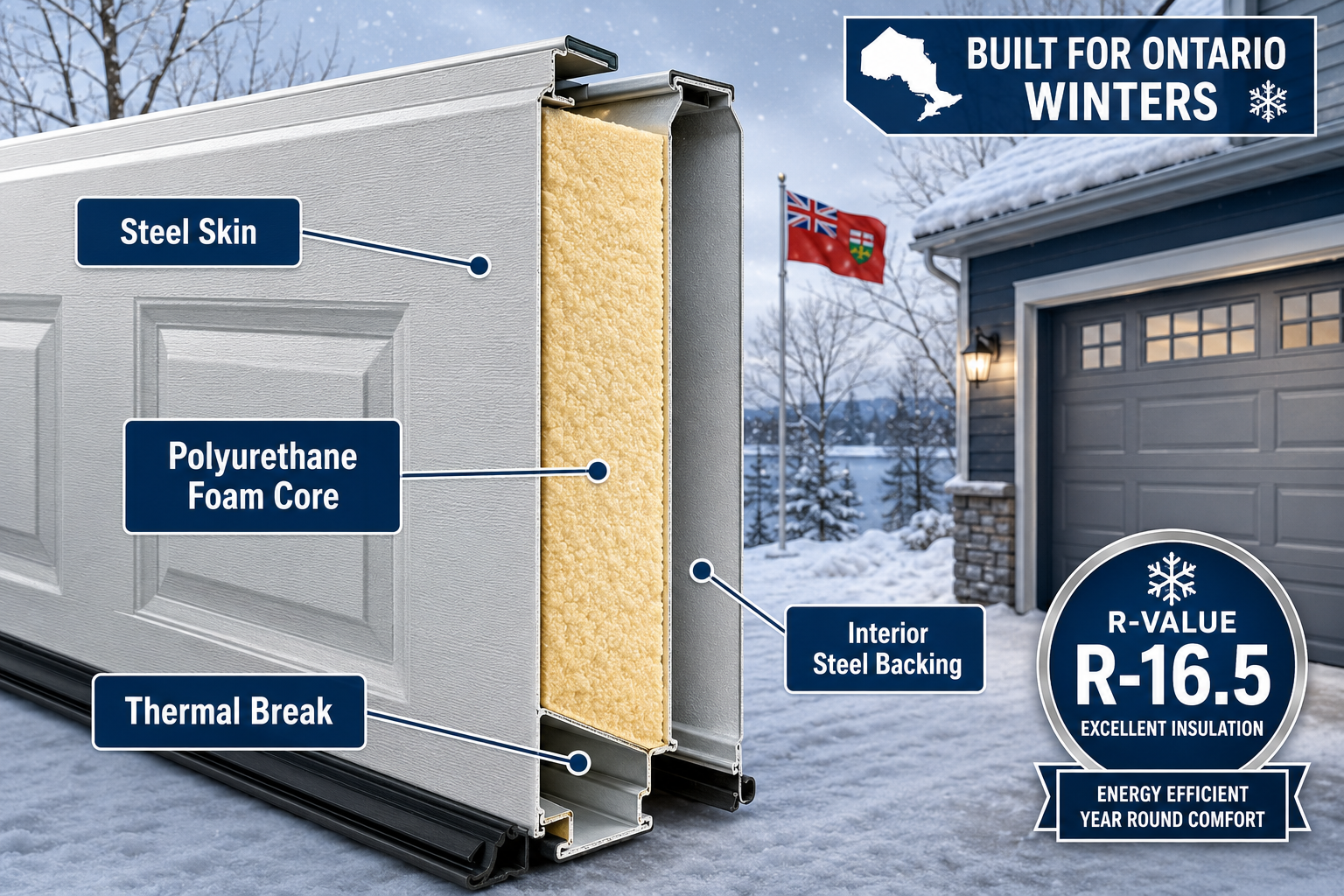
Polystyrene (EPS) panels are cut-to-fit foam boards inserted between the door’s steel skins. They’re less expensive to manufacture but leave small air gaps at the edges where the foam meets the frame. These gaps allow convective heat transfer that the R-value rating doesn’t fully capture.
Polyurethane foam is injected as a liquid and expands to fill the entire cavity, bonding to both steel skins. This creates a structurally stiffer panel with no air gaps. At the same nominal R-value, a polyurethane-insulated door typically outperforms a polystyrene door in real-world conditions.
Quick comparison:
| Feature | Polystyrene (EPS) | Polyurethane |
|---|---|---|
| Insulation method | Pre-cut boards inserted | Injected, expands to fill |
| Air gaps | Possible at edges | None (fully bonded) |
| Panel rigidity | Moderate | Higher |
| Typical R-value range | R-6 to R-12 | R-12 to R-18+ |
| Cost | Lower | Higher |
| Best for | Detached/unheated garages | Attached/heated garages |
Choose polyurethane if: the garage is attached to the home, used as a workspace, or located in Central or Northern Ontario. Choose polystyrene if: the garage is a detached, unheated structure and budget is the primary concern.
Panel R-Value vs. Whole-Door R-Value: A Critical Distinction
This is one of the most common points of confusion when shopping for an insulated door. The R-value printed on a door’s spec sheet almost always refers to the insulated panel section only — not the entire door assembly.
A door’s real-world thermal performance is affected by:
- Frame and edge seals: The perimeter weatherstripping and bottom seal can be significant sources of air infiltration.
- Thermal bridges: Metal hardware, hinges, and the door’s steel frame conduct heat even when the panel is well-insulated.
- Gaps and alignment: A door that doesn’t close squarely against its frame loses insulation value regardless of the panel rating.
A February 2026 article from RW Doors emphasizes that homeowners in cold Canadian climates should look at both R-value and U-value together. U-value measures the rate of heat transfer across the whole door assembly — it’s the inverse of R-value (U = 1/R). A door with a high panel R-value but poor seals can have a worse (higher) U-value than a door with a slightly lower panel R-value but excellent edge sealing and thermal breaks.
Practical tip: When comparing doors, ask the dealer for the whole-door or system R-value, not just the panel R-value. Some manufacturers publish both; others only advertise the panel figure. If only the panel figure is available, add one or two points of skepticism to any comparison.
For a full breakdown of what to look for when reviewing quotes, see this guide on how to read a garage door quote.
Garage Door R-Value Explained: Recommended Ranges for Ontario Homeowners
Based on manufacturer guidance, climate data, and the direction of Ontario’s building code, here are the R-value tiers that make practical sense for different garage types in 2026.
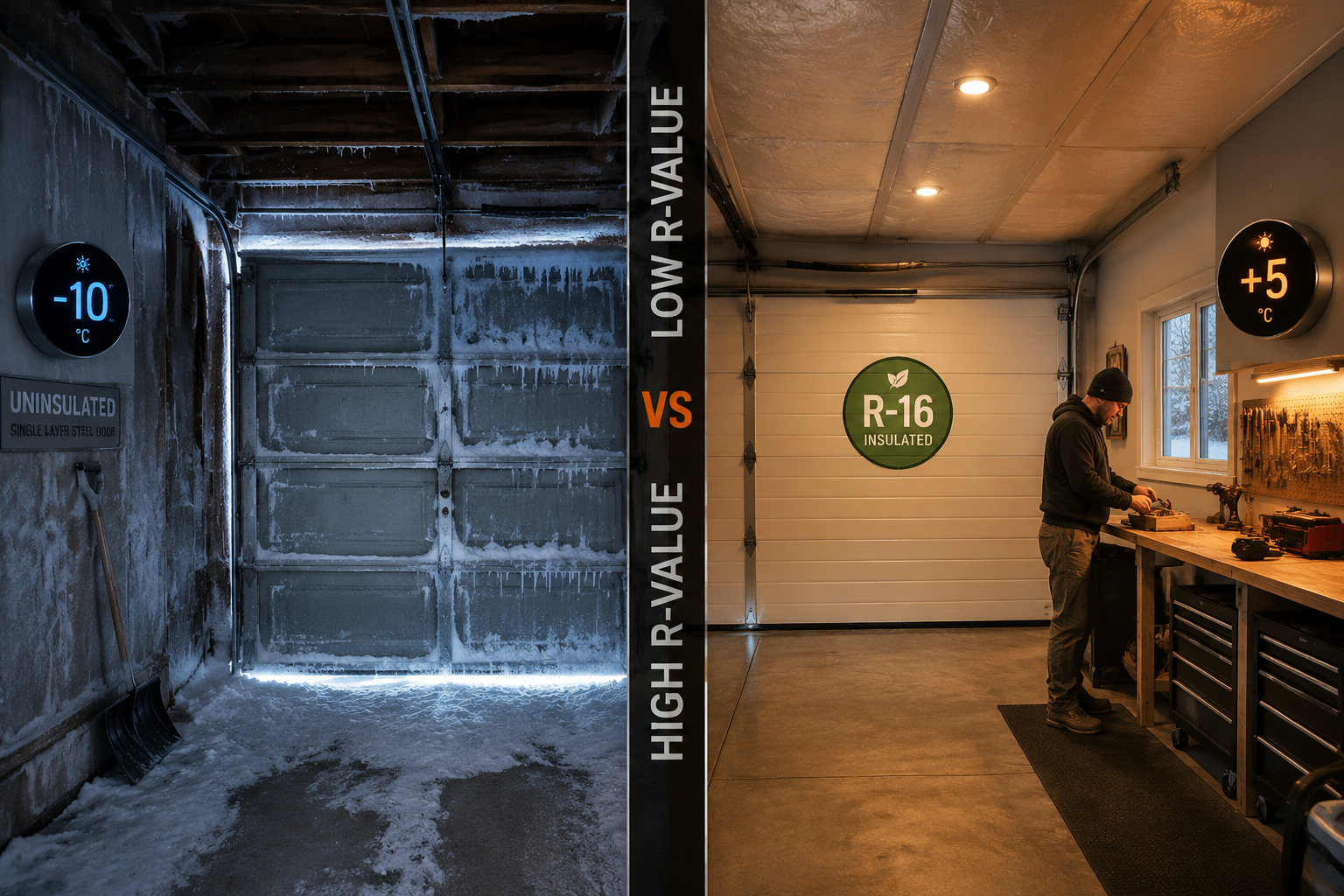
Tier 1 — R-0 to R-6: Detached, unheated garages A single or double-layer steel door with minimal or no insulation is acceptable here. Heat retention is not a goal, and the cost savings are real. This tier is not appropriate for any garage attached to a conditioned living space.
Tier 2 — R-6 to R-9: Attached, unheated garages This range provides a meaningful buffer against cold infiltration into the home. It’s the minimum worth considering for an attached garage, even if the garage itself is not actively heated.
Tier 3 — R-9 to R-13: Heated or conditioned garages For garages with a heater, mini-split, or in-floor heat, this range keeps the system from working harder than necessary. Most polyurethane-core doors in this range also offer good noise reduction.
Tier 4 — R-13 to R-16+: Workshops, home gyms, or net-zero homes When the garage functions as a living or working space, or when the home is pursuing net-zero or high-efficiency targets, R-16 and above is the appropriate choice. A May 2026 guide from Maple Garage Doors recommends the R-12 to R-16 range for most Ontario attached garages, noting that chasing the absolute highest R-value beyond R-18 delivers diminishing returns for most homeowners.
Common mistake: Buying a high-R door but neglecting weatherstripping. A door rated R-16 with deteriorated bottom seals or gaps at the sides performs far below its rated value. Always inspect and replace seals as part of any door upgrade. For related maintenance, a garage door tune-up typically includes seal inspection and can catch these issues early.
Do DIY Insulation Kits Work as a Substitute
DIY insulation kits are widely available at Ontario hardware stores and are often marketed as a budget-friendly way to improve an existing door’s thermal performance. They work — but with significant limitations.
Most DIY kits use cut-to-fit polystyrene or reflective foil panels that are attached to the interior face of existing door sections. According to a 2026 price guide from Royal Garage Door Repairs, typical DIY kits add approximately R-4 to R-8 to an existing door. They do not:
- Create a continuous, bonded insulation layer
- Eliminate thermal bridges at hinges and hardware
- Improve edge sealing or weatherstripping
- Add the structural rigidity of a factory-insulated panel
When a DIY kit makes sense: The garage is detached and unheated, the existing door is structurally sound, and the goal is modest temperature buffering rather than meaningful energy savings.
When a kit is not enough: The garage is attached to the home, the existing door is aging or misaligned, or the homeowner wants a meaningful reduction in heating costs. In these cases, a factory-insulated replacement door delivers better long-term value. A case study from West Oak Trails illustrates the real-world difference an insulated door replacement can make in an Ontario home.
How Much Does a Properly Insulated Garage Door Cost in Ontario
Cost is a real factor, and it’s worth being direct about the numbers available in 2026.
According to a GTA-focused price guide from Royal Garage Door Repairs, factory-insulated doors in the Greater Toronto Area start at approximately $1,350 plus HST installed for a standard 8×7 single door. Prices vary based on:
- Door size (single vs. double)
- Insulation type (polystyrene vs. polyurethane)
- Panel style and material (steel gauge, wood composite, aluminum)
- Hardware and window upgrades
- Installer rates in the specific municipality
A double-car polyurethane-insulated door in the R-12 to R-16 range, fully installed in the Oakville, Burlington, or Mississauga area, typically falls in the $2,200 to $3,800 range depending on style and specifications. Custom or carriage-style doors can exceed this.
RW Doors noted in their April 2026 trends article that high-performance insulated doors are now considered standard in Canada for attached garages, driven by rising energy costs and consumer comfort expectations. The premium over a non-insulated door has narrowed as production volumes have increased.
For homeowners in Oakville and surrounding areas considering an upgrade, exploring custom garage doors may also be worthwhile if aesthetics are a priority alongside thermal performance.
What Else Affects a Garage Door’s Thermal Performance Beyond R-Value
R-value is the most-cited number, but it’s not the only factor that determines how well a garage door insulates a home.
1. Weatherstripping and seals The bottom seal, top seal, and side seals (astragal) are the first line of defense against air infiltration. A worn or cracked seal can negate a significant portion of the door’s rated R-value. Seals should be inspected at least annually in Ontario’s climate.
2. Thermal breaks A thermal break is a non-conductive material placed between the door’s inner and outer steel skins at the edges. Without a thermal break, the metal frame conducts cold directly from outside to inside regardless of how well the panel is insulated.
3. Door fit and alignment A door that doesn’t sit squarely in its frame allows cold air to bypass insulation entirely. If a door has been damaged, has broken springs, or is simply aging, alignment issues can develop. For guidance on related mechanical issues, see broken garage door spring warning signs.
4. Number of steel layers Insulated doors come in two-layer (steel + foam) and three-layer (steel + foam + steel) configurations. Three-layer doors are more rigid, better insulated, and more resistant to denting. For attached garages in Ontario, three-layer construction is the better choice.
5. Garage ventilation and air sealing Even a well-insulated door won’t prevent cold infiltration if the garage has large gaps around pipes, electrical conduit, or the door between the garage and the home’s interior. The door is one piece of a larger air-sealing strategy.
Homeowners in lakefront communities like Bronte should also factor in wind exposure. A door with excellent R-value but poor seals can underperform significantly in high-wind conditions. The Bronte garage door installation guide covers these location-specific considerations in detail.
Garage Door R-Value Explained: How to Compare Doors When Shopping
When standing in a showroom or reviewing quotes, use this practical checklist to compare doors on thermal performance rather than just price or appearance.
Comparison checklist:
- Ask for the panel R-value AND the whole-door or system R-value if available
- Confirm whether insulation is polyurethane or polystyrene
- Check whether the door is two-layer or three-layer construction
- Ask about thermal breaks at the door edges
- Inspect or ask about the quality of the bottom seal and side weatherstripping
- Confirm the steel gauge (heavier gauge = more durable and typically better insulation retention over time)
- Compare warranty terms on both the door and the insulation specifically
Edge case to watch for: Some manufacturers advertise R-values measured using older or less stringent test standards. The DASMA (Door and Access Systems Manufacturers Association) test method 105 is the standard used by reputable North American manufacturers. Ask whether the R-value is DASMA 105-certified.
Also consider the long-term picture. A well-insulated door that is properly maintained will hold its performance for 20 to 30 years. Factoring in energy savings over that period often makes the higher upfront cost of a quality insulated door straightforward to justify.
FAQ
What R-value is recommended for an attached garage in Ontario? Most Ontario attached garages benefit from a door rated R-12 to R-16. Garaga recommends at least R-10 as a minimum for attached garages in cold climates, with R-12 or higher for heated spaces. The R-12 to R-16 range covers most Southern Ontario conditions well.
Is a higher R-value always better? Not necessarily. Beyond R-18, the marginal gain in thermal performance for most Ontario garages is small relative to the added cost. Climate zone, garage use, and overall envelope quality matter more than chasing the highest number available.
What is the difference between R-value and U-value for garage doors? R-value measures resistance to heat flow; U-value measures the rate of heat transfer. They are inverses of each other (U = 1/R). U-value accounts for the whole door assembly, making it a more realistic comparison metric than panel-only R-value when evaluating different doors.
Does an insulated garage door reduce noise? Yes. The foam core in an insulated door, particularly polyurethane, absorbs sound vibration. Homeowners with bedrooms above or adjacent to the garage often notice a meaningful reduction in noise from wind, rain, and street traffic after upgrading to an insulated door.
Can I add insulation to my existing garage door? DIY kits are available and add approximately R-4 to R-8. They are a reasonable option for detached, unheated garages but are not a substitute for a factory-insulated door in an attached or heated garage. Kits also add weight, which can stress the opener and springs.
Does Ontario’s building code require a specific R-value for garage doors? As of 2026, Ontario’s 2024 Building Code does not prescribe a specific minimum R-value for garage doors the way it does for walls or roofs. However, the code’s broader tightening of envelope insulation requirements means that a low-R garage door can create a compliance gap in new construction.
How long does a factory-insulated garage door last? A quality steel insulated door, properly maintained, typically lasts 20 to 30 years. The insulation itself does not degrade significantly over time if the door is not physically damaged. Regular lubrication and seal replacement extend both performance and lifespan. See the guide on best garage door lubricant for Ontario’s climate for maintenance specifics.
What is a thermal break in a garage door? A thermal break is a strip of non-conductive material placed between the inner and outer steel skins at the door’s edges. It prevents the metal frame from conducting cold directly through the door, which would otherwise bypass the insulated panel entirely.
Is polyurethane insulation worth the extra cost over polystyrene? For attached or heated garages in Ontario, yes. Polyurethane fills the entire cavity without air gaps, bonds to both steel skins for added rigidity, and delivers better real-world performance at the same nominal R-value. The price difference is modest relative to the door’s total cost.
What R-value should I choose for a garage converted to a gym or workshop? Garaga recommends R-16 or higher for garages used as workshops or gyms. At this level, a standard space heater or mini-split can maintain comfortable temperatures even during Ontario’s coldest weeks without excessive energy consumption.
Conclusion
Garage door R-value is not a marketing number to be ignored or blindly maximized. For Ontario homeowners, it’s a practical specification that directly affects comfort, energy costs, and the performance of the home’s thermal envelope.
The core guidance is straightforward: attached garages in Southern Ontario need at least R-12, with R-14 to R-16 being the better target for heated spaces or colder regions. Polyurethane foam cores outperform polystyrene at equivalent ratings. Three-layer door construction is worth the modest premium for any garage connected to a living space. And the panel R-value on the spec sheet is only part of the story — seals, thermal breaks, and door fit determine real-world performance.
Actionable next steps for Ontario homeowners in 2026:
- Identify your garage type (attached vs. detached, heated vs. unheated) and match it to the appropriate R-value tier.
- When requesting quotes, ask specifically for polyurethane-insulated, three-layer doors in the R-12 to R-16 range for attached garages.
- Ask dealers whether R-values are tested to DASMA 105 standards and whether whole-door figures are available.
- Inspect existing weatherstripping and bottom seals — even a high-R door underperforms with worn seals.
- If the existing door is aging or misaligned, factor in the full cost of a replacement versus the limited gains from a DIY insulation kit.
A well-chosen insulated garage door is one of the more cost-effective upgrades available to Ontario homeowners. The combination of comfort, noise reduction, and energy savings compounds over the 20 to 30-year life of the door, making the upfront investment straightforward to justify.
References
- Garaga. R-Value Recommendations for Garage Doors in Cold Climates. garaga.com. (n.d.)
- RW Doors. Modern Garage Door Trends. rwdoors.com. April 2026.
- RW Doors. R-Value vs U-Value for Garage Doors. rwdoors.com. February 2026.
- Maple Garage Doors. Winter 2026 Insulation Guide for Ontario Homeowners. maplegaragedoors.ca. May 2026.
- Ontario Ministry of Municipal Affairs and Housing. Ontario’s 2024 Building Code. ontario.ca. Filed April 10, 2024; in force January 1, 2025.
- Royal Garage Door Repairs. GTA Garage Door Price Guide 2026. royalgaragedoorrepairs.ca. 2026.
- Door Doctor. Garage Door Insulation R-Value Guide. doordoctor.ca. (n.d.)
- IECC 2024 Update Summary. International Energy Conservation Code Climate Zone Requirements. Industry article, May 2026.