Last updated: June 20, 2026
Quick Answer: Garage door warranties in Ontario typically combine three separate coverages: a manufacturer’s warranty on the door itself (ranging from 1 year to lifetime depending on the component and brand), an installer’s workmanship warranty (usually 1 to 3 years), and an opener warranty (often 1 to 5 years on parts, with some brands offering limited lifetime motor coverage). Understanding which warranty covers which component, and for how long, is the key to knowing what you can actually claim when something goes wrong.
Key Takeaways
- Garage door warranties in Ontario are not a single document but a stack of at least three separate coverages: manufacturer, installer, and opener.
- Steel door panels and rust-through are the most heavily protected components, with many brands offering lifetime coverage for original owners.
- Springs, cables, and hardware carry shorter terms, typically 1 to 5 years, because they are high-wear parts.
- Paint, finish, and fade warranties are conditional and often voided by failure to clean the door according to the manufacturer’s schedule.
- Ontario’s Consumer Protection Act implies a baseline quality warranty on installation services, even if the contractor’s written warranty is short.
- New home buyers in Ontario also have Tarion statutory coverage for garage doors and openers installed by the builder, within specific timelines.
- “Lifetime parts warranty with 90-day labour” is a common marketing phrase that is far less valuable than it sounds, because labour costs on big-ticket repairs often exceed parts costs.
- Keeping a maintenance log and service receipts is not optional; many warranties require proof of regular upkeep to remain valid.
- Replacement costs in Ontario range from roughly $2,000 to $12,000 per door, making warranty terms a significant factor in total cost of ownership.
- Always get the installer’s workmanship warranty in writing, separate from the manufacturer’s warranty card.
What Does a Garage Door Warranty in Ontario Actually Cover?
Most Ontario homeowners assume their garage door comes with one warranty. In practice, a complete warranty in Ontario: What Covers What and for How Long framework involves at least three distinct documents from different parties, each covering different components for different durations.
Here is how the layers break down:
1. Manufacturer’s Door Warranty Covers the door sections (panels), finish, insulation, and sometimes hardware like tracks and hinges. This is issued by the company that made the door, such as Garaga, Clopay, C.H.I., or Midland.
2. Installer’s Workmanship Warranty Covers the quality of the installation itself: alignment, balance, hardware fastening, and spring tension. This comes from the company or technician who installed the door, not the manufacturer.
3. Opener Warranty Covers the motor unit, logic board, and drive mechanism. This is issued by the opener manufacturer (LiftMaster, Chamberlain, Genie, etc.) and is separate from the door warranty.
A fourth layer applies to new homes: Tarion statutory coverage, which treats garage doors and builder-supplied openers as construction elements subject to Ontario’s new home warranty program.
“The most common warranty mistake Ontario homeowners make is assuming the manufacturer’s lifetime panel warranty also covers the labour to fix a broken spring. It does not. Springs are a separate component with a much shorter term, and labour is covered only by the installer’s warranty.”
How Long Do Manufacturer Warranties Last on Garage Doors in Ontario?
Manufacturer warranty lengths vary significantly by component and brand, but a consistent pattern has emerged across the major brands sold by Ontario dealers.
Steel Panels and Sections
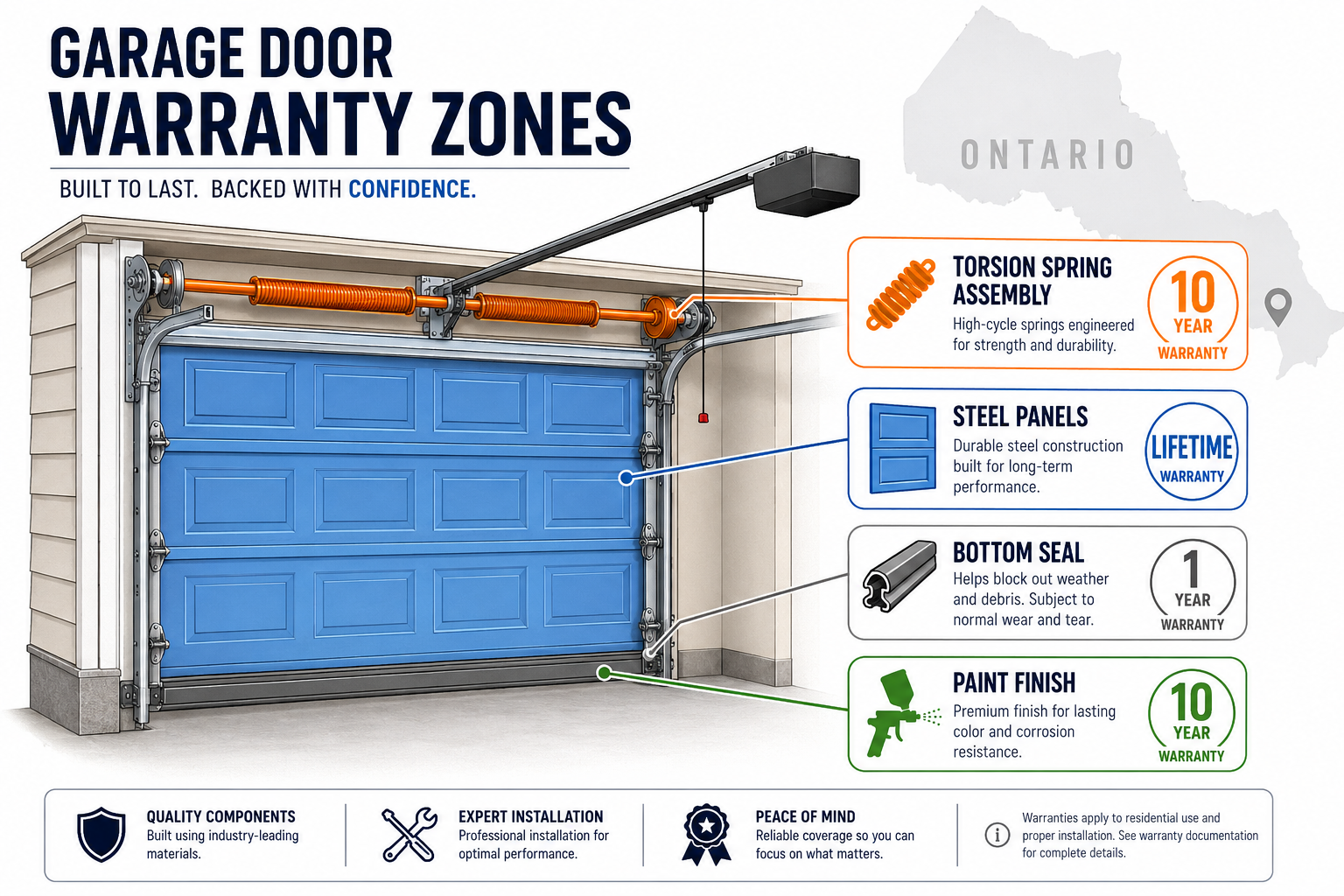
This is where the strongest coverage lives. Brands like Garaga (a Quebec manufacturer widely distributed across Ontario) offer a “Lifetime Limited” warranty on several residential insulated steel lines, including their Princeton, Cambridge, Eastman, Standard+, and H-Tech models, for as long as the original owner owns the door. Midland Garage Door similarly provides long-term section coverage “for as long as the original buyer owns the building” on many steel models.
Clopay and C.H.I., both North American brands commonly sold through Ontario dealers, offer limited lifetime coverage on key door sections and finishes for many insulated steel models, making them among the strongest residential warranties available in the market.
Important caveat: “Lifetime” means the lifetime of the original purchaser’s ownership, not the door’s physical lifespan. If the home is sold, the warranty typically does not transfer, or transfers with significantly reduced terms.
Insulation and Delamination
Midland’s warranty page (updated March 2026) confirms 10-year delamination protection on insulated doors. This covers the bonding between the steel skin and the foam core separating or bubbling.
Paint, Finish, and Fade
This is the shortest and most conditional category. Most brands offer 3 to 5 years on colour fade and finish defects, depending on the coating type. Midland’s finish warranty is shorter for “harsh environments,” and Ontario’s salt-heavy winters qualify as a harsh environment under many policy definitions. Garaga’s aluminum California full-vision doors carry only 1-year glass breakage coverage and 10-year coverage on sealed thermopane units, illustrating that not every product in a brand’s catalogue carries the same protection.
Springs, Cables, and Hardware
These are high-wear components. Manufacturer coverage for springs and cables typically runs 1 to 5 years. Some manufacturers exclude springs entirely from their standard warranty, treating them as consumable parts. If a spring breaks outside that window, the cost falls entirely on the homeowner. For current spring replacement pricing in Ontario, see how much garage door spring replacement costs in Oakville in 2026.
Summary Table: Typical Manufacturer Warranty Lengths by Component
| Component | Typical Coverage | Notes |
|---|---|---|
| Steel door panels (rust-through) | Lifetime (original owner) | Most major brands on insulated steel |
| Insulation / delamination | 10 years | Common across mid-to-premium lines |
| Paint / finish / fade | 3 to 5 years | Conditional; cleaning requirements apply |
| Springs and cables | 1 to 5 years | Some brands exclude entirely |
| Tracks and hardware | 1 to 3 years | Often bundled with installer warranty |
| Glass panels (thermopane) | 10 years (seal), 1 year (breakage) | Varies by product line |
What Does the Installer’s Workmanship Warranty Cover?
The installer’s workmanship warranty covers the quality of the installation itself, not the door components. It is issued by the company or technician who did the work.
Standard installer workmanship warranties in Ontario run 1 to 3 years. This covers problems like:
- Improper spring tension causing the door to slam or not balance correctly
- Misaligned tracks that cause binding or uneven wear
- Fasteners that were not properly secured
- Incorrect opener force settings that damage the door over time
What it does not cover: component failures that would have happened regardless of installation quality, cosmetic damage caused after installation, or problems from owner modifications.
Some Ontario repair companies now bundle longer labour coverage into specific repair jobs. For example, a London, Ontario repair company advertised bent track replacement at $240 to $350 CAD per side and full roller replacement at $180 to $260 CAD, explicitly stating that “all prices include parts, labour, and lifetime warranty” (pricing page, May 2026). This illustrates a trend where “lifetime” is being applied narrowly to a specific repair job rather than the entire door system.
Decision rule: If a contractor offers only a 90-day labour warranty, that is below the Ontario market standard. Ask for at least 1 year in writing. If they resist, treat it as a red flag.
For context on what a professional service visit should include, see this breakdown of what’s actually done during a garage door tune-up and what it costs.
What Does Ontario’s Consumer Protection Act Add to Your Warranty Rights?
Ontario’s Consumer Protection Act (CPA) provides a legal floor beneath any written warranty. Even if a contractor’s written warranty is short or poorly worded, the CPA implies that services must be of “reasonably acceptable quality.” Ambiguities in the contract are interpreted in favour of the consumer.
For garage door installations, this means:
- If workmanship is defective or unsafe, a court can find an implied quality warranty even without a written one.
- If the contractor’s warranty language is vague about what is covered, the interpretation favours the homeowner.
- This protection applies to residential renovation and home-improvement projects, which includes garage door installation and replacement.
This is not a substitute for a written warranty, but it does give Ontario homeowners legal standing when contractors try to walk away from obvious workmanship failures.
How Does Tarion Coverage Apply to Garage Doors in New Ontario Homes?
For buyers of new homes in Ontario, Tarion’s Construction Performance Guidelines (updated mid-2024) explicitly list garage doors and builder-supplied openers as elements covered under the statutory one-year “work and materials” warranty. This means a non-operational garage door or opener resulting from a construction defect is a valid Tarion claim within that first year.
For health and safety issues related to the Ontario Building Code, longer Tarion timelines may apply. For example, if a garage door fails in a way that creates a safety hazard directly tied to a code requirement, the two-year and seven-year Tarion coverage windows may be relevant.
Key point for new home buyers: Tarion coverage runs alongside the manufacturer’s warranty, not instead of it. If the door panel is defective, the manufacturer’s warranty applies. If the door was installed incorrectly by the builder, Tarion is the right channel.
What Voids a Garage Door Warranty in Ontario?
This is where most warranty disputes begin. Manufacturers and installers both maintain lists of actions that void coverage, and several are surprisingly easy to trigger accidentally.
Common warranty-voiding actions:
- Vehicle impact or physical damage. Any dent or bend from a car strike is excluded universally.
- Severe weather damage. Hail, flooding, and wind damage are typically excluded and redirected to home insurance.
- DIY modifications. Adding aftermarket hardware, changing spring tension, or modifying the opener wiring usually voids related coverage.
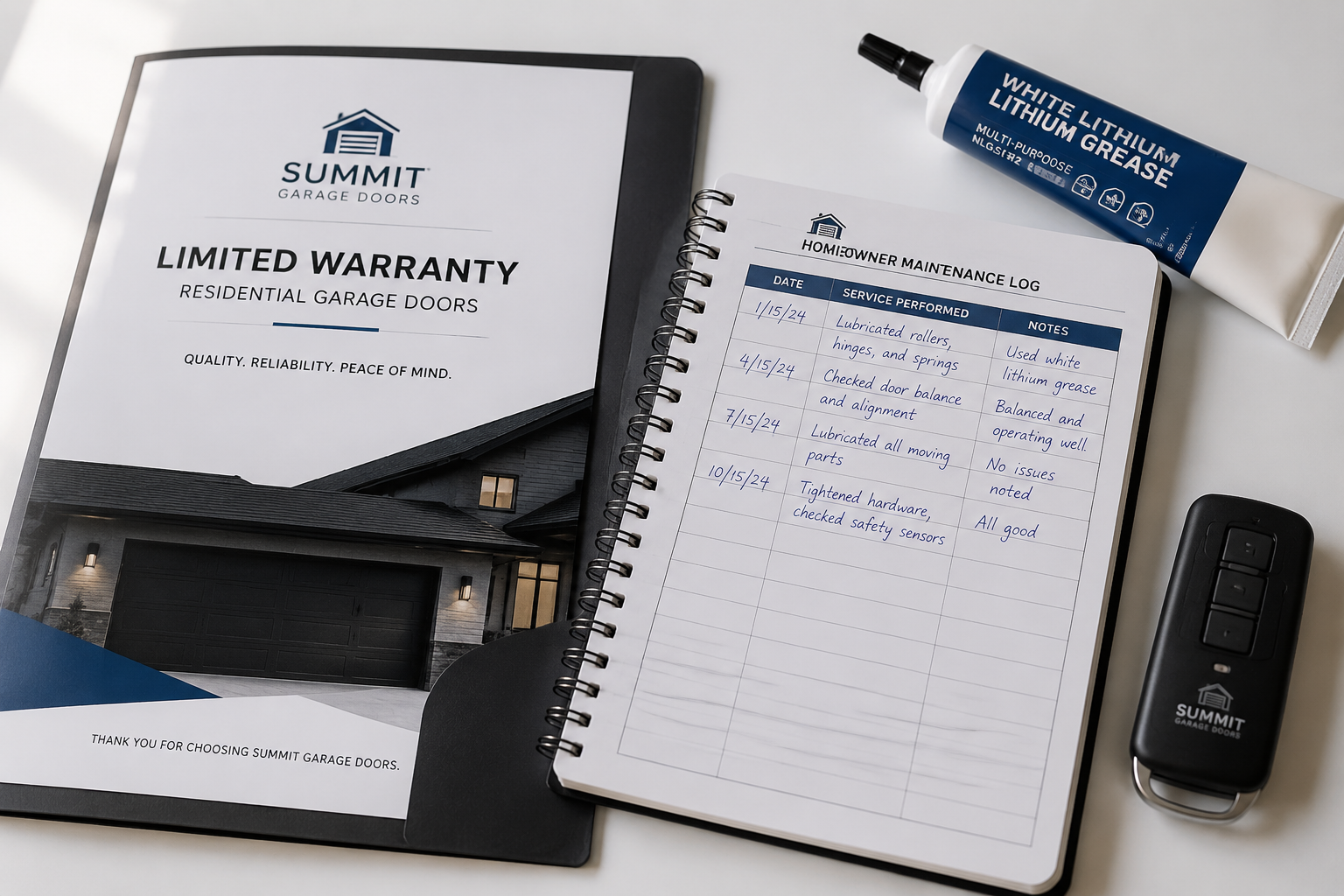
- Lack of maintenance. Many warranties require proof of regular lubrication and inspection. Skipping this gives manufacturers grounds to deny claims. Using the wrong lubricant can also void coverage; see the best garage door lubricant for Ontario’s climate for guidance on what to use.
- Improper installation. If the door was installed by someone other than an authorized dealer, manufacturer warranty coverage may be reduced or voided entirely.
- High-cycle applications. Midland’s warranty grants lifetime section coverage but only 1-year coverage for “high cycle” applications. If a door is operated far more frequently than a standard residential door, shorter terms apply.
Practical step: Keep a maintenance log. Record every lubrication, inspection, and service visit with the date and technician’s name. This documentation is your primary defence if a warranty claim is disputed.
Is a “Lifetime Parts Warranty” as Good as It Sounds?
No. A lifetime parts warranty with a short labour warranty is a common marketing structure that often benefits the seller more than the buyer.
Here is why: on high-cost repairs like torsion spring replacement or track replacement, labour often costs more than the parts. A lifetime parts warranty means the company will supply a new spring at no charge, but the homeowner still pays full labour rates to have it installed. If labour is covered for only 90 days, every repair after that window costs full price regardless of the parts warranty.
For reference, broken garage door spring warning signs and repair options illustrate how quickly spring-related labour costs add up.
What to look for instead: Multi-year or lifetime parts-and-labour coverage on specific components. Some Ontario installers now offer this on individual repair jobs, which is more valuable than a broad lifetime-parts-only offer.
How Do Opener Warranties Work Separately from Door Warranties?
Garage door opener warranties are entirely separate from the door warranty and are issued by the opener manufacturer.
Typical opener warranty terms:
- Motor unit: 1 to 5 years, with some brands (LiftMaster, Chamberlain) offering limited lifetime motor coverage on higher-end models.
- Logic board and electronics: 1 to 3 years.
- Drive belt or chain: 1 to 5 years depending on model.
- Accessories (remotes, keypads): Usually 1 year.
Opener warranties are voided by power surge damage (home insurance typically covers this), improper wiring, and unauthorized repairs. If the opener was supplied and installed by the builder in a new home, Tarion’s one-year work and materials coverage also applies.
For opener-specific service in Ontario, see garage door opener repair in Oakville for an example of what repair versus replacement decisions look like in practice.
What Should Ontario Homeowners Do Before Buying to Protect Warranty Rights?
Getting the right warranty starts before the purchase, not after something breaks.
Pre-purchase checklist:
- Ask for all three warranties in writing: manufacturer’s door warranty, installer’s workmanship warranty, and opener warranty. Do not accept verbal assurances.
- Confirm the installer is an authorized dealer. Buying a Garaga or Clopay door through an unauthorized installer often reduces or eliminates manufacturer coverage.
- Read the maintenance requirements. Every manufacturer’s warranty specifies cleaning frequency, lubrication type, and inspection intervals. Know these before you buy.
- Check the labour coverage term. If the installer offers less than 1 year on labour, negotiate or find another installer.
- Ask about transferability. If selling the home is a possibility, ask whether the warranty transfers and under what conditions.
- Understand the exclusions. Ask specifically about finish/fade exclusions for Ontario winters and high-cycle exclusions if the door will be used heavily.
- Get itemized quotes. Knowing what each component costs separately helps evaluate whether a bundled “lifetime” offer is genuinely valuable. A guide to reading a garage door quote line by line can help with this step.
FAQ: Garage Door Warranty in Ontario
Q: Does a garage door warranty transfer when a home is sold in Ontario? A: Most manufacturer warranties are non-transferable or transfer with significantly reduced terms. Always check the specific warranty document. The installer’s workmanship warranty typically does not transfer at all.
Q: What happens if my garage door was damaged in an Ontario ice storm? A: Weather damage is almost universally excluded from manufacturer and installer warranties. This type of damage falls under home insurance, not the product warranty.
Q: Can I install a garage door myself and still keep the warranty? A: In most cases, no. Major manufacturers require installation by an authorized dealer to maintain full warranty coverage. DIY installation typically voids or significantly reduces manufacturer coverage.
Q: How do I know if my garage door problem is a warranty issue or a maintenance issue? A: Warranty issues are defects in materials or workmanship present from the start. Maintenance issues develop over time from normal use. If a spring breaks after 8 years of regular use, that is wear and tear. If a panel delaminates after 2 years with no physical damage, that is likely a warranty defect.
Q: My builder installed the garage door. Who do I call for warranty service? A: For new homes in Ontario, start with Tarion if the issue arose within the first year. Tarion covers builder-installed garage doors and openers under the one-year work and materials warranty. For manufacturer defects, the builder’s supplier is the relevant party.
Q: Is a 90-day labour warranty standard in Ontario? A: No. The Ontario market standard for installer workmanship is 1 to 3 years. A 90-day labour warranty is below average and should prompt further negotiation before signing.
Q: Do I need to service my garage door regularly to keep the warranty valid? A: Yes. Most manufacturer warranties require documented regular maintenance, including lubrication and inspection. Failure to maintain the door gives manufacturers grounds to deny claims on the basis of neglect.
Q: What does “limited lifetime” mean on a garage door warranty? A: “Limited lifetime” means the warranty lasts for as long as the original purchaser owns the door or home, but it is limited by specific exclusions (weather, misuse, finish degradation, etc.). It is not unconditional coverage for the door’s entire physical lifespan.
Q: Are garage door cables covered under the manufacturer’s warranty? A: Sometimes, but usually only for 1 to 3 years. Cables are considered wear items and are often excluded from longer-term manufacturer coverage. For more on cable issues, see garage door cable replacement costs and safety risks.
Q: What if my garage door panel is dented but the door is still functional? A: Cosmetic damage from external causes (impact, weather) is excluded from manufacturer warranties. However, if the dent is from a manufacturing defect or shipping damage that was not visible at installation, it may be claimable. Document the issue immediately and contact the installer.
Q: Does the Ontario Consumer Protection Act help if my installer refuses a warranty claim? A: Yes. The CPA implies a warranty of reasonably acceptable quality on home improvement services. If a contractor refuses a legitimate workmanship claim and the written warranty is ambiguous, the CPA interpretation favours the consumer. Small Claims Court is a practical option for disputes under $35,000 CAD.
Q: How long should a well-maintained garage door last in Ontario? A: Industry estimates suggest 15 to 30 years for a quality door that is correctly installed and maintained. Ontario’s freeze-thaw cycles and road salt environment make regular maintenance especially important for reaching the upper end of that range.
Conclusion
Understanding garage door warranty coverage in Ontario comes down to one core principle: warranties are layered, not unified. The manufacturer covers the door components, the installer covers the workmanship, and the opener manufacturer covers the motor and electronics. Each layer has different durations, different exclusions, and different claims processes.
The most actionable steps for Ontario homeowners in 2026 are straightforward:
- Before buying: Get all three warranties in writing, confirm the installer is an authorized dealer, and read the maintenance requirements before signing anything.
- After installation: Start a maintenance log immediately. Record every lubrication, inspection, and service date. This documentation is your primary protection if a claim is ever disputed.
- When something breaks: Identify which layer of warranty applies before calling anyone. A panel defect goes to the manufacturer. An alignment problem goes to the installer. A motor failure goes to the opener brand. A new-home defect within year one goes through Tarion.
- If a claim is denied: Review the Consumer Protection Act protections. If the denial relies on vague warranty language or an implied maintenance failure, Ontario law interprets ambiguity in the consumer’s favour.
For homeowners in the Oakville, Burlington, Mississauga, and Milton areas, working with a local dealer who provides clear written warranties on both parts and labour is the most reliable way to avoid coverage gaps. If an issue arises that falls outside warranty terms, same-day garage door repair services are available across the region to address problems quickly before they escalate.
References
- Tarion Warranty Corporation. Construction Performance Guidelines. Updated mid-2024. https://www.tarion.com
- Government of Canada. Consumer rights and warranties guidance. Updated April 2025. https://www.canada.ca/en/consumer-protection
- Garaga Inc. Residential Garage Door Warranty Terms. Accessed 2026. https://www.garaga.com
- Midland Garage Door. Residential Warranty Page. Updated March 2026. https://www.midlandgaragedoor.com
- DuraServ. Understanding Garage Door Warranty Categories. Accessed 2025–2026. https://www.duraserv.com
- Ontario Ministry of Government and Consumer Services. Consumer Protection Act, 2002. https://www.ontario.ca/laws/statute/02c30