Last updated: June 15, 2026
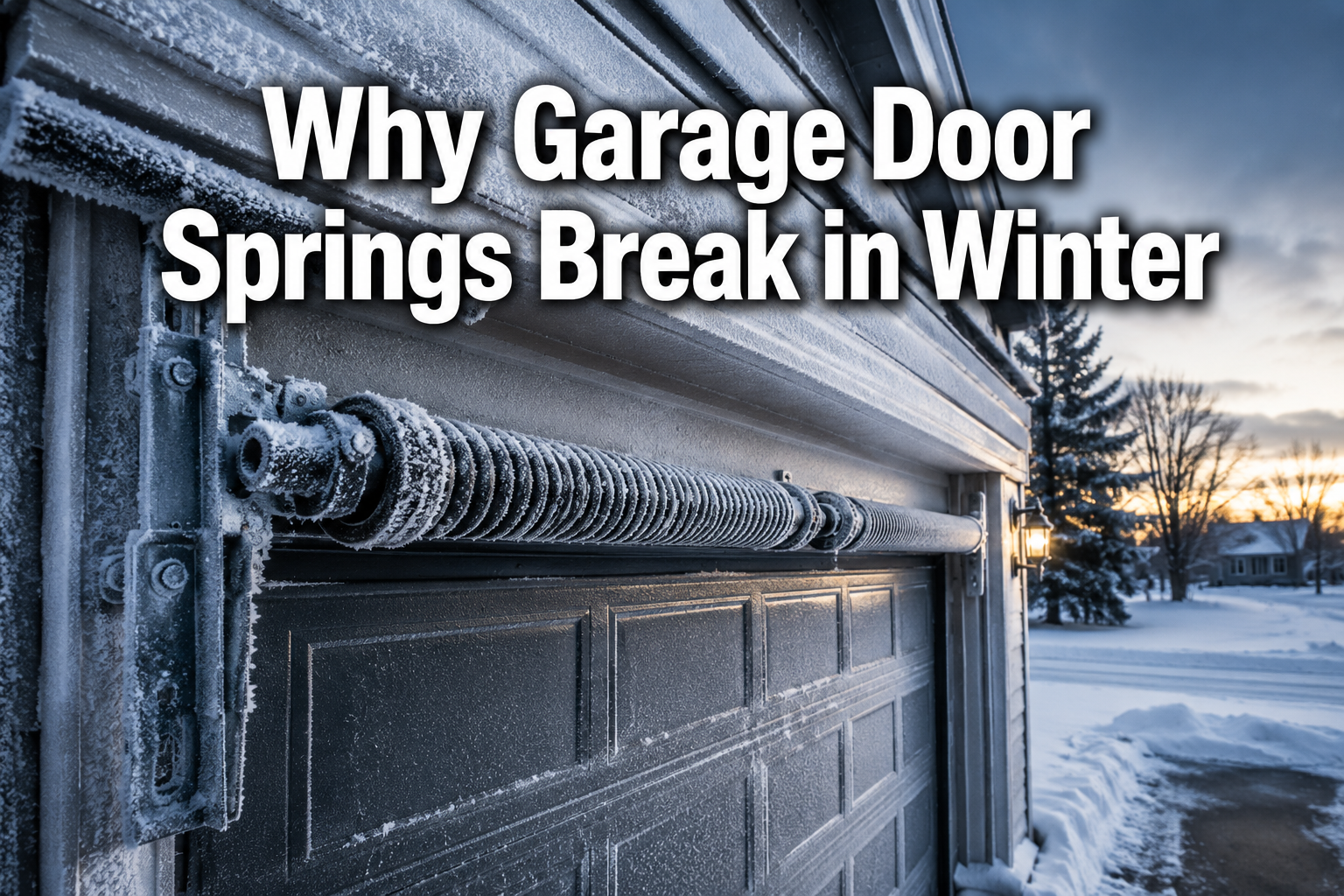
Quick Answer: Garage door springs break more often in winter because cold temperatures cause steel to contract and become more brittle, which dramatically increases stress on coils that are already worn, corroded, or poorly lubricated. Cold weather does not randomly destroy healthy springs — it accelerates failure in springs that were already close to the end of their service life. Homeowners can delay breakage by lubricating springs before the cold season, scheduling a fall inspection, and replacing springs that are showing visible wear before winter arrives.
Key Takeaways
- Steel springs contract in freezing temperatures, raising internal tension and making the metal more brittle — this is the core mechanical reason why garage door springs break in winter.
- Cold weather is a trigger, not a root cause. Rust, age, poor lubrication, and incorrect spring sizing are the actual culprits.
- Standard garage door springs are rated for roughly 10,000 cycles (about 7 to 10 years of average use). Springs near that limit are most vulnerable in winter.
- Torsion springs generally outperform extension springs in cold climates because of their design and mounting position.
- Lubricating springs with a silicone- or lithium-based spray before temperatures drop is one of the most effective low-cost prevention steps.
- Warning signs — loud banging, a door that feels suddenly heavy, visible gaps in the coil — should never be ignored in winter.
- Replacing both springs at the same time when one breaks saves money and reduces the risk of a second failure within months.
- Professional inspection in the fall is the single best way to catch a marginal spring before it snaps in January.
- High-cycle springs (rated 25,000+ cycles) are a worthwhile upgrade for homes with heavy garage door use in cold climates.
- Never attempt to repair or adjust a broken torsion spring yourself — the stored energy in the system is enough to cause serious injury.
How Cold Weather Affects Garage Door Spring Lifespan
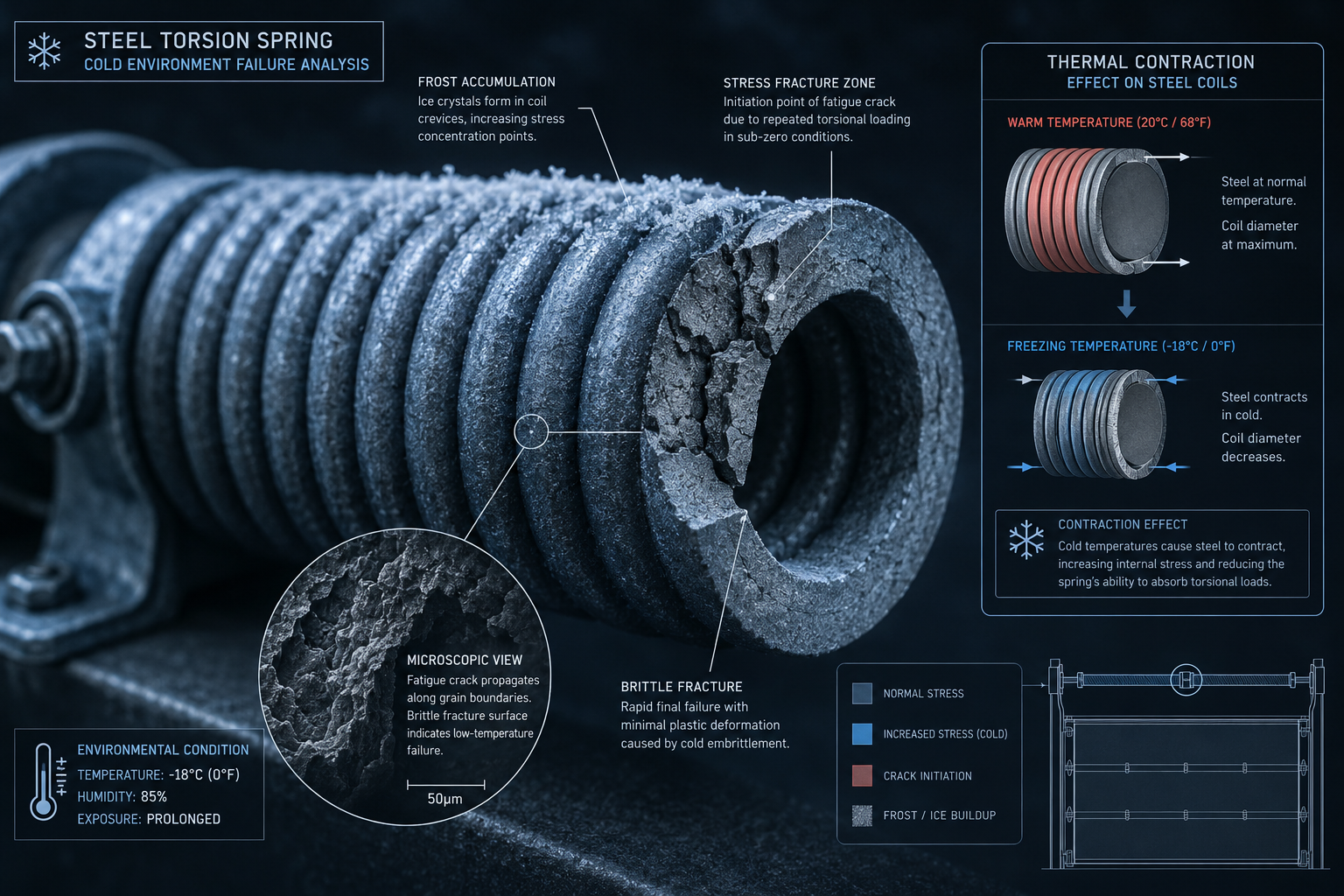
Cold weather shortens garage door spring lifespan by making steel more brittle and increasing the mechanical stress on every coil. When temperatures drop below freezing, steel contracts. In a tightly wound torsion spring, that contraction raises the internal tension the spring must carry just to hold the door in balance — before a single open or close cycle even begins.
The effect compounds over a full winter. Each time the door opens and closes, the spring flexes under higher-than-normal stress. If the spring is already worn from years of use, the added load from cold-induced contraction can push it past its breaking point. Industry technicians describe this as a “final stretch” scenario: the spring was already marginal, and winter is what finishes it.
Key factors that determine how much cold weather shortens spring life:
- Age of the spring: Springs within 1,000 to 2,000 cycles of their rated limit are far more vulnerable.
- Presence of rust or corrosion: Rust creates micro-fractures in the steel that spread faster in cold conditions.
- Lubrication status: Dry coils generate more friction heat during cycling, which accelerates fatigue.
- Garage insulation: An uninsulated garage sees wider temperature swings, which means more expansion-contraction cycles for the spring steel.
Are Metal Garage Door Springs More Brittle in Freezing Temperatures?
Yes. Steel becomes measurably more brittle at low temperatures, a well-documented property in materials science called ductile-to-brittle transition. For garage door springs, this means the steel can fracture under a stress load that it would have absorbed without breaking at room temperature.
This is not a minor effect. A spring coil that flexes safely at 20°C may crack at -15°C under the same load, especially if it has surface rust or manufacturing imperfections. The brittleness does not mean every spring will snap in the first cold snap — it means the margin for error shrinks considerably. Springs with rust, uneven coil spacing, or significant wear have almost no margin left when temperatures fall.
Common mistake: Homeowners often assume that because their springs survived last winter, they will survive this one too. Each season of use consumes more of the spring’s rated cycle count, so the risk is not constant — it grows every year.
What Causes Garage Door Springs to Snap in Winter
The direct cause of a spring snapping is metal fatigue reaching a failure point, but winter creates the conditions that make that failure happen sooner. Understanding the full chain of causes helps homeowners know where to intervene.
The failure chain typically looks like this:
- The spring accumulates wear through thousands of open-close cycles over years of use.
- Rust or corrosion develops on the coil surface, creating weak points in the steel.
- Inadequate lubrication increases friction and heat stress during each cycle.
- Cold temperatures arrive, causing the steel to contract and become more brittle.
- The combined stress of tension, brittleness, and existing fatigue exceeds the spring’s remaining strength.
- The spring snaps — often with a loud bang that sounds like a gunshot inside the garage.
Cold weather is the last domino, not the first. A well-maintained spring on a properly balanced door, with no rust and adequate lubrication, can survive many Ontario winters without issue. The springs that snap in January are almost always the ones that were already in trouble in October.
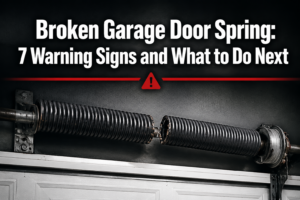
For a detailed breakdown of the warning signs that precede a snap, see this guide on broken garage door spring warning signs and what to do next.
Signs My Garage Door Spring Is About to Break
Several clear warning signs appear before a spring fails completely. Catching these early — especially heading into winter — can prevent an emergency breakdown on a cold morning.
Watch for these indicators:
- The door feels unusually heavy when you try to lift it manually. A properly balanced door should lift with minimal effort. Resistance means the spring is losing tension.
- Loud squeaking, grinding, or creaking during operation. This points to dry coils generating friction.
- Visible gaps in the spring coil. A stretched or partially failed coil will show uneven spacing between the coils.
- Rust or reddish discoloration on the spring surface.
- The door moves unevenly or jerks during opening or closing.
- The door reverses unexpectedly or the opener strains audibly. (If your opener is also struggling, it may be related — see our guide on garage door opener repair.)
- A loud bang from the garage even when the door wasn’t in use. This is often the sound of a spring snapping under resting tension.
If any of these signs appear, stop using the door and call a technician. Continued use after a spring has partially failed puts extra stress on the opener motor and cables, and can create a safety hazard if the door drops unexpectedly.
Difference Between Torsion and Extension Springs in Winter Performance
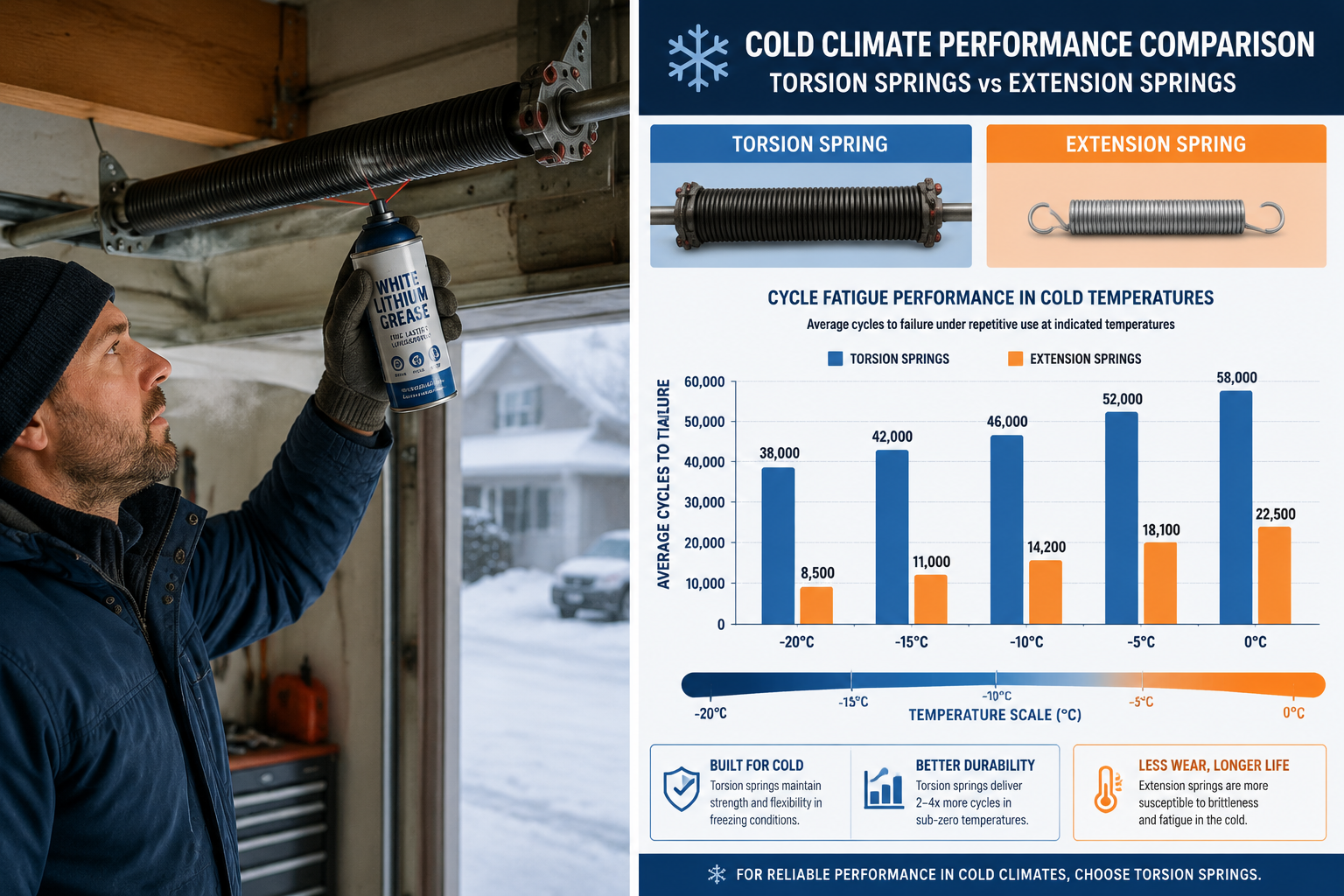
Torsion springs generally perform better than extension springs in cold climates, and understanding why helps homeowners make smarter decisions when it’s time to replace.
| Feature | Torsion Springs | Extension Springs |
|---|---|---|
| Mounting position | Above the door, horizontal | Along the sides of the door track |
| Cold weather exposure | Partially sheltered by door header | More exposed to temperature swings |
| Failure mode | Snaps in place (contained) | Can fly loose if safety cable is absent |
| Typical cycle rating | 10,000–25,000+ cycles | 10,000 cycles (standard) |
| Cost | Higher upfront | Lower upfront |
| Balance consistency | More consistent | Can drift over time |
| Best for cold climates | Yes | Less ideal |
Why torsion springs handle cold better: Their mounting position above the door header means they are slightly more sheltered from direct cold air exposure compared to extension springs, which run along the open sides of the track. More importantly, torsion springs distribute stress more evenly across the coil, which reduces the chance of a single stress concentration point failing in brittle conditions.
Extension spring edge case: If your garage uses extension springs and one breaks, the spring can become a projectile if no safety cable runs through the coil. This risk increases in winter when the metal is more brittle. Check that safety cables are present and intact before cold weather arrives.
Which Homes Are Most at Risk for Winter Garage Door Spring Failure
Not all homes carry the same risk. Several factors make some garages significantly more prone to spring failure in winter.
High-risk factors:
- Springs older than 7 years or past 8,000 cycles of use. The closer to the rated limit, the higher the risk.
- Uninsulated, unheated garages in cold climates like Ontario, where temperatures regularly drop below -10°C. Wider temperature swings mean more thermal stress cycles.
- Garages used more than twice daily. A household that opens the door 4 to 6 times per day accumulates cycles roughly twice as fast as average.
- Springs that have never been lubricated. Dry springs corrode faster and generate more heat stress.
- Doors with a history of balance problems. An unbalanced door puts uneven load on the springs, wearing one side faster.
- Homes in areas with high humidity or road salt exposure, which accelerates rust on spring coils.
Homes in Oakville, Burlington, Mississauga, and Hamilton that have attached garages with no insulation and older spring systems should treat fall inspection as a non-negotiable annual task. For homeowners in those areas, garage door spring repair services are available with same-day response during winter emergencies.
How Often Should You Lubricate Garage Door Springs in Winter
Springs should be lubricated at least twice a year — once in the fall before temperatures drop, and once in mid-winter if the garage is unheated and sees heavy use. In Ontario’s climate, a fall application in October or early November is the most important one.
Why timing matters: Lubricant applied before the cold season coats the coil surface before rust-promoting condensation from freeze-thaw cycles can form. Lubricant applied after rust has already started is less effective because it cannot penetrate existing corrosion.
What to use: Silicone-based spray or white lithium grease spray are the preferred options for garage door springs in cold climates. Both remain effective at low temperatures and do not attract grit the way petroleum-based oils do. For a full comparison of lubricant types suited to Ontario winters, see this guide on the best garage door lubricant for Ontario’s climate.
How to apply:
- Disconnect the opener and manually lower the door to relieve spring tension slightly.
- Apply lubricant directly to the coils of the torsion spring, working from one end to the other.
- Cycle the door manually two or three times to distribute the lubricant.
- Wipe away any excess that drips onto the door tracks (lubricated tracks cause the door to slip).
- Do not spray lubricant on the plastic rollers, nylon bearings, or rubber weather seal.
Common mistake: Using WD-40 on springs. WD-40 is a water displacer, not a long-term lubricant. It evaporates quickly and leaves the spring dry within weeks, especially in cold conditions.
Best Garage Door Springs for Cold Climates
The best springs for cold climates are high-cycle torsion springs, ideally rated for 25,000 cycles or more, made from oil-tempered steel with a galvanized or powder-coated finish to resist rust.
What to look for when selecting springs for a cold-climate garage:
- High cycle rating: Standard springs are rated for 10,000 cycles. High-cycle springs are available at 25,000, 50,000, or even higher. The higher rating reflects thicker, higher-quality steel that resists fatigue better in temperature extremes.
- Corrosion-resistant coating: Galvanized steel springs or springs with a powder-coat finish resist the rust that cold-climate condensation promotes.
- Correct sizing: A spring sized incorrectly for the door’s weight will wear faster regardless of its cycle rating. Always have a technician verify the spring specifications against the actual door weight.
- Oil-tempered steel: This manufacturing process produces steel with better flexibility and fatigue resistance compared to standard cold-drawn steel.
Tradeoff: High-cycle springs cost more upfront — sometimes 30 to 50 percent more than standard springs. For a garage that opens and closes four or more times daily, or for a household in a climate with harsh winters, the longer service life typically justifies the cost difference within a few years.
Average Cost to Replace Broken Garage Door Springs
Spring replacement in Canada typically ranges from $150 to $400 or more per spring for standard residential torsion springs, including parts and labor. High-cycle spring upgrades or complex installations cost more. One 2026 pricing estimate placed the cost band for a basic spring update at $319 to $562 per spring in the U.S. market, though Canadian pricing varies by region and labor rates.
For a detailed breakdown specific to the Oakville area, including what line items to expect on a quote, see how much garage door spring replacement costs in Oakville in 2026.
Factors that affect total cost:
- Single vs. paired replacement: Replacing both springs at once costs more upfront but is almost always recommended. When one spring fails, the other is typically close behind. Replacing them together avoids a second service call within months.
- Torsion vs. extension: Torsion spring replacement generally costs more than extension spring replacement due to the higher part cost and the skill required to safely manage the stored tension.
- Emergency vs. scheduled service: Emergency calls on weekends or in sub-zero temperatures typically carry a premium over scheduled weekday appointments.
- Spring grade: Upgrading to high-cycle springs adds to the parts cost but reduces long-term replacement frequency.
Decision rule: If the spring is less than 5 years old and broke due to a specific cause (such as a cable failure that put sudden load on the spring), a single replacement may be appropriate. If the spring is more than 7 years old, replace both.
Can You Fix a Broken Garage Door Spring Yourself
No — and this is not a conservative recommendation. Garage door torsion springs store a significant amount of mechanical energy under tension. When a spring is wound or unwound, that energy releases rapidly. A mistake during the process can cause the winding bar to fly loose, the spring to snap, or the door to drop suddenly. These scenarios have caused serious injuries.
Extension springs carry similar risks, particularly if the spring is not fully relieved of tension before removal.
What homeowners can safely do:
- Inspect the spring visually for rust, gaps, or visible damage.
- Lubricate the spring with the door in the closed position.
- Test the door’s manual balance (disconnect the opener, lift the door by hand to waist height, and let go — a balanced door stays in place).
- Call a technician if the door is out of balance or the spring shows damage.
What requires a professional:
- Removing or installing a torsion spring.
- Adjusting the tension on a torsion spring.
- Replacing extension springs on a door with significant weight.
- Any repair where the spring is visibly broken or partially separated.
For same-day professional service in the Oakville and surrounding area, garage door spring repair is available from trained technicians who carry the correct tools and replacement parts.
Common Mistakes Homeowners Make With Garage Door Springs in Cold Weather
Several recurring mistakes make winter spring failures more likely and more expensive to resolve.
Mistake 1: Skipping fall maintenance. The fall window — before temperatures drop consistently below freezing — is the best time to lubricate springs, check balance, and catch worn components. Many homeowners skip this step until something breaks.
Mistake 2: Continuing to use the door after it feels heavy. A door that suddenly requires more effort to open is signaling spring trouble. Continuing to use it puts extra load on the opener motor and cables, potentially causing a second component failure on top of the spring issue.
Mistake 3: Replacing only one spring. When springs are installed as a pair, they wear together. Replacing only the broken one leaves a worn spring in place that is likely to fail within the same season.
Mistake 4: Using the wrong lubricant. WD-40, petroleum-based oils, and grease products designed for other applications can damage nylon components, attract dirt, or freeze in low temperatures.
Mistake 5: Assuming a new door means new springs. If a used or older door was installed without replacing the springs, those springs carry the age and cycle count from their previous installation.
Mistake 6: Ignoring a tune-up. A professional garage door tune-up includes a balance check, hardware inspection, and lubrication — all of which directly reduce winter spring failure risk.
How to Tell If Your Garage Door Spring Needs Professional Inspection
A spring needs professional inspection when any of the following conditions apply. These are not situations to monitor over time — they warrant a call to a technician before the next cold snap.
Inspect immediately if:
- The door will not open at all, or opens only a few inches before stopping.
- There is a visible gap or separation in the spring coil.
- The door makes a loud bang or pop sound during operation or while the garage is not in use.
- The door drops faster than normal when closing.
- The opener motor runs but the door does not move, or moves very slowly.
- The door is visibly crooked or one side is higher than the other when partially open.
Schedule a non-emergency inspection if:
- The spring has visible surface rust covering more than a quarter of its length.
- The door feels noticeably heavier than it did six months ago.
- The spring is more than 7 years old and has never been replaced.
- The door has been making squeaking or grinding sounds for more than a few days.
If the spring has already snapped, do not attempt to use the door or the opener. A broken spring means the door is unsupported, and the opener is not designed to lift the full weight of the door without spring assistance. Using the opener in this condition can burn out the motor. For urgent situations, emergency garage door repair in Oakville is available with same-day response.
How to Delay Why Garage Door Springs Break in Winter: A Seasonal Checklist
The most effective prevention strategy combines fall preparation, mid-winter monitoring, and smart replacement decisions. Here is a practical checklist organized by timing.
October (before first freeze):
- Lubricate torsion or extension springs with silicone spray or white lithium grease.
- Test the door’s manual balance (disconnect opener, lift to waist height, release — door should hold position).
- Inspect springs visually for rust, uneven coil spacing, or visible wear.
- Check cables for fraying. (Broken cables often accompany or cause spring failures — see garage door cable replacement risks and costs.)
- Schedule a professional tune-up if the spring is more than 5 years old or showing any wear signs.
November through March (during cold season):
- Listen for changes in operating sound — new squeaking, grinding, or banging.
- Notice any change in how heavy the door feels when lifted manually.
- Keep the garage as insulated as practical to reduce temperature swing severity.
- Apply a second lubrication coat in January if the garage is unheated and sees daily use.
After winter:
- Inspect the spring for rust that developed over winter.
- Re-test door balance — cold-season stress can shift the balance even on springs that did not break.
- Note the spring’s age and cycle estimate, and plan replacement if it is approaching the 10,000-cycle mark.
FAQ
Why do garage door springs always seem to break in winter? Springs break in winter because cold temperatures make steel more brittle and increase internal tension through thermal contraction. Springs that are already near the end of their service life cannot handle the added stress. Healthy, well-maintained springs rarely fail from cold alone.
How long do garage door springs typically last? Standard residential garage door springs are rated for approximately 10,000 cycles, which translates to roughly 7 to 10 years for a household that opens and closes the door four times per day. High-cycle springs rated at 25,000 or more cycles are available and last significantly longer.
Is it safe to open my garage door if I think the spring is broken? No. If the spring is broken, the door is not properly supported. Using the opener to force the door open can damage the opener motor and create a safety hazard if the door drops unexpectedly. Disconnect the opener and call a technician.
Should I replace both springs if only one breaks? Yes, in almost all cases. Springs installed as a pair wear at the same rate. When one breaks, the other is typically close to failure. Replacing both at the same time avoids a second service call and keeps the door properly balanced.
What temperature is most dangerous for garage door springs? There is no single threshold, but temperatures below -10°C significantly increase the brittleness of steel. In Ontario, the January-February period — when overnight lows frequently drop to -15°C or below — is when most winter spring failures occur.
Can I lubricate my garage door spring myself? Yes. Lubricating the spring is a safe DIY task when the door is in the closed position and the opener is disconnected. Use silicone spray or white lithium grease. Do not use WD-40 or petroleum-based oils.
How much does emergency spring replacement cost in winter? Emergency or after-hours service typically carries a surcharge over standard rates. In the Oakville and Greater Toronto Area, expect to pay a premium of $50 to $100 or more for weekend or evening calls compared to scheduled weekday service.
Do high-cycle springs actually make a difference in cold climates? Yes. High-cycle springs use thicker, higher-quality steel that resists fatigue and brittleness better than standard springs. For garages in cold climates with heavy daily use, the upgrade cost is typically recovered through fewer replacements over the door’s lifetime.
Can a broken spring damage my garage door opener? Yes. If the door is operated without a functioning spring, the opener motor carries the full weight of the door rather than just guiding a balanced door. This can burn out the motor or strip the drive mechanism. Stop using the opener immediately if you suspect a spring has broken.
What is the difference between a torsion spring and an extension spring? A torsion spring mounts horizontally above the door and works by twisting. An extension spring mounts along the sides of the door track and works by stretching. Torsion springs generally last longer, handle cold climates better, and are safer when they break. Extension springs are less expensive but require safety cables to prevent them from becoming projectiles if they snap.
How do I know if my garage door is properly balanced? Disconnect the automatic opener by pulling the red release cord. Lift the door manually to about waist height and let go. A properly balanced door will stay in place or move only slightly. A door that drops or rises on its own is out of balance and needs professional adjustment.
What should I do immediately after a garage door spring breaks? Do not use the door or the opener. Keep vehicles inside or outside as they are until the spring is replaced. Call a licensed garage door technician for same-day service. If you are locked out of your vehicle, most technicians can manually release the door safely.
Conclusion
The reason why garage door springs break in winter comes down to a straightforward mechanical reality: cold temperatures make steel more brittle and increase internal spring tension, which pushes already-worn springs past their breaking point. Winter is the trigger, not the cause. Rust, age, poor lubrication, and missed maintenance are what put springs in a vulnerable position before the first freeze arrives.
The good news is that most winter spring failures are preventable with consistent, low-cost maintenance. Lubricating springs in October, testing door balance annually, and replacing springs that are approaching their rated cycle count before winter arrives will eliminate the majority of emergency breakdowns.
Actionable next steps for homeowners:
- Inspect your springs today for rust, uneven coil spacing, or visible wear.
- Apply silicone or lithium grease spray before temperatures drop below freezing.
- Test the door’s manual balance and call a technician if it fails the test.
- If your springs are more than 7 years old, schedule a professional inspection this fall.
- When replacing springs, ask about high-cycle options and always replace both springs at the same time.
- If a spring has already broken, stop using the door and arrange same-day repair.
Proactive maintenance costs a fraction of an emergency service call and avoids the frustration of a garage door that will not open on the coldest morning of the year.