Last updated: June 9, 2026
Quick Answer
A standard residential garage door opener is built to handle roughly 10,000 to 15,000 cycles over its lifetime, where one cycle equals one full open plus one full close. For a household that uses the garage door four times per day, that translates to approximately 7 to 10 years of service before the opener or its supporting components begin to wear out. Heavy use, poor maintenance, or an unbalanced door can shorten that lifespan considerably.
Key Takeaways
- One cycle equals one complete open-and-close sequence. Daily use of four cycles per day reaches 10,000 cycles in roughly 6.8 years.
- Most residential openers are rated for 10,000 to 15,000 cycles; premium and commercial units can exceed 100,000 cycles.
- The opener motor is rarely the first thing to fail. Springs, rollers, and cables wear out first and force the motor to work harder.
- Belt drive openers generally outlast chain drive models in residential settings because they produce less vibration and mechanical stress.
- Smart openers (Wi-Fi enabled) are not inherently more durable than traditional models, but they offer usage monitoring that can flag problems early.
- Horsepower above the minimum needed for your door weight does not significantly extend cycle life, but it does reduce motor strain.
- Standard torsion springs are rated at about 10,000 cycles; upgrading to high-cycle springs (20,000 to 100,000 cycles) is the single most effective way to extend the system’s overall lifespan.
- Industry guidance consistently puts residential opener lifespan at 10 to 15 years, with well-maintained units sometimes lasting 20 years.
- Replacement cost for a residential opener typically ranges from $300 to $700 installed, depending on drive type and features.
- Regular lubrication, annual tune-ups, and keeping the door balanced are the three most impactful maintenance habits.
How Many Times Can a Typical Garage Door Opener Open and Close Before Breaking
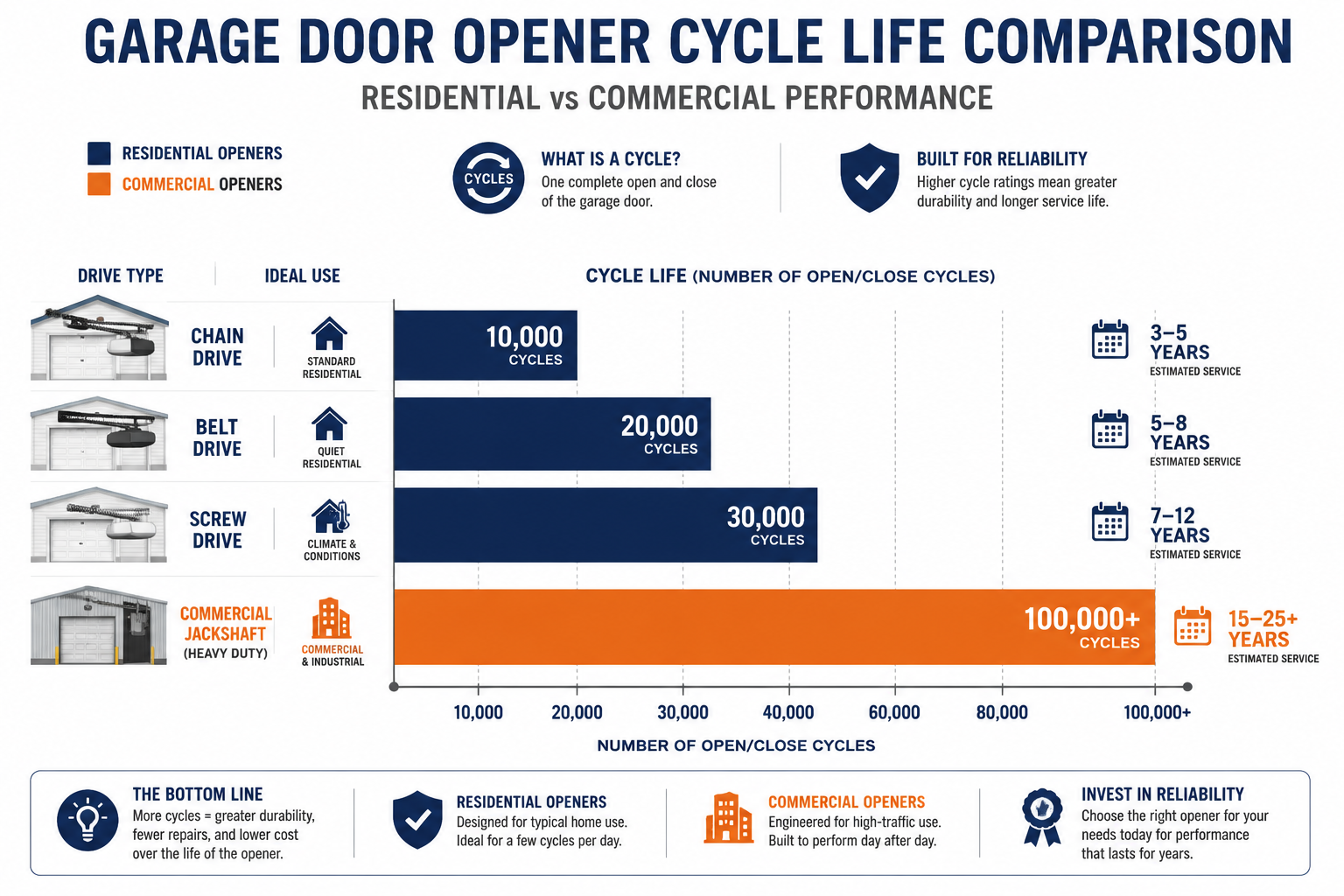
The honest answer: most residential garage door openers are designed to complete somewhere between 10,000 and 15,000 cycles before major components fail. A cycle is defined consistently across the industry as one full open movement followed by one full close movement. Some budget models may fall short of 10,000 cycles; high-end residential and light-commercial units can reach 20,000 or more.
To put those numbers in everyday terms:
| Daily Cycles | Years to Reach 10,000 | Years to Reach 15,000 |
|---|---|---|
| 2 (one trip in, one out) | 13.7 years | 20.5 years |
| 4 (typical household) | 6.8 years | 10.3 years |
| 6 (busy family, two cars) | 4.6 years | 6.8 years |
| 10 (home business / high traffic) | 2.7 years | 4.1 years |
These figures assume the door is properly balanced and maintained. A door that is out of balance, has worn springs, or runs on dry, corroded hardware will consume opener life much faster because the motor compensates for the extra resistance on every single cycle.
Common mistake: Many homeowners count only car trips, but every time a family member leaves and returns, that is two cycles. A household with two drivers making two trips each per day is already at eight cycles, not four.
What Affects the Cycle Life of a Garage Door Opener
Cycle life is determined by far more than the opener’s motor rating. The opener is only as durable as the system it operates.
Door balance is the single biggest variable. A properly balanced door should hold its position when lifted halfway by hand and released. If it falls or rises on its own, the springs are not doing their job and the opener motor is absorbing that load on every cycle. Over time, this accelerates wear on the drive gear, motor brushes, and circuit board.
Spring condition matters enormously. Standard torsion springs are rated at roughly 10,000 cycles. Extension springs typically fall in the 7,000 to 10,000 cycle range. When springs weaken before they fully break, the opener works harder without the homeowner noticing. Upgrading to high-cycle torsion springs (rated at 20,000, 30,000, or even 50,000 cycles) extends the life of the entire system, not just the springs. For more on spring replacement costs, see this guide on garage door spring replacement cost in Oakville.
Roller and track condition also affects how hard the opener works. Worn nylon rollers or dirty, bent tracks create friction that the motor must overcome on every cycle.
Climate plays a role too. In Ontario, freeze-thaw cycles can cause door seals to stick to the ground, putting sudden shock loads on the opener. Cold temperatures also thicken lubricants and stiffen metal components, increasing resistance at startup.
Duty cycle of the motor is a factor in cheaper models. Budget openers may use motors not rated for continuous or rapid repeat use, which causes heat buildup and faster wear.
Which Garage Door Opener Brands Last the Longest
No independent long-term cycle test data is publicly available that ranks residential opener brands by verified cycle count. However, industry technicians and installer guides consistently point to a few brands as durability leaders: Chamberlain, LiftMaster (also made by Chamberlain Group), Genie, and Craftsman for residential use. LiftMaster’s commercial and heavy-duty residential lines are frequently cited for longevity in high-use settings.
What actually separates durable brands from cheaper alternatives:
- Metal drive gears instead of plastic (plastic gears strip under load)
- Thermal protection circuits that shut the motor down before it overheats
- Robust limit-switch mechanisms that don’t drift over time
- Availability of replacement parts years after purchase
Choose a premium brand if: the garage is used more than six times per day, the door is heavy (solid wood or insulated steel), or the opener is expected to last beyond 10 years without major service.
Choose a mid-range brand if: the garage sees moderate use (two to four cycles per day) and the budget is limited, provided the door is well-balanced and maintained.
Belt Drive vs Chain Drive: Which Lasts Longer
Belt drive openers generally outlast chain drive models in residential settings because the rubber or polyurethane belt produces less vibration and places less mechanical stress on the drive gear and motor housing. Chain drives are mechanically simpler and easier to repair, but the metal-on-metal contact of the chain creates wear on the sprocket and rail over time, especially if lubrication is neglected.
Screw drive openers fall in the middle. They have fewer moving parts than chain drives, but the screw mechanism is sensitive to temperature changes and requires consistent lubrication to avoid premature wear.
Direct drive openers (where the motor travels along a stationary chain) are among the quietest and potentially longest-lasting residential options because the motor is the only moving part. However, they tend to cost more upfront.
| Drive Type | Typical Cycle Life | Noise Level | Maintenance Needs |
|---|---|---|---|
| Chain drive | 10,000 to 12,000 cycles | High | Moderate (lubrication) |
| Belt drive | 12,000 to 15,000+ cycles | Low | Low |
| Screw drive | 10,000 to 13,000 cycles | Medium | Higher (temperature sensitive) |
| Direct drive | 15,000+ cycles | Very low | Low |
For homeowners in Ontario who want a quieter, longer-lasting option, belt drive or direct drive systems are the practical choice. If budget is the primary concern, a well-maintained chain drive with quality springs will still deliver a decade of reliable service.
What Is the Average Cycle Life for Different Price Ranges
Price is a reasonable proxy for build quality, though it is not a perfect one.
Budget openers ($150 to $250 retail): These typically use plastic drive gears, lower-rated motors, and basic electronics. Expect 8,000 to 10,000 cycles under normal use. They are adequate for a single-car garage with light daily use.
Mid-range openers ($250 to $450 retail): Metal drive gears, better thermal protection, and more reliable limit switches. Expect 10,000 to 15,000 cycles. This is the sweet spot for most residential households.
Premium openers ($450 to $700+ retail): Heavy-duty motors, battery backup options, advanced diagnostics, and commercial-grade components in some models. Expect 15,000 to 20,000+ cycles. These make sense for busy households, heavy doors, or homeowners who want to minimize service calls.
Commercial openers ($700 to $2,000+): Rated for 50,000 to 100,000+ cycles. Designed for apartment complexes, parking facilities, or any setting with continuous high-volume use. Not necessary for residential applications.
How Commercial vs Residential Garage Door Openers Differ in Cycle Life
Commercial openers are engineered for a fundamentally different use case. A residential opener might see 4 to 10 cycles per day; a commercial operator in a parking garage or loading dock might handle 50 to 200 cycles per day.
Commercial units achieve their higher cycle ratings through:
- Industrial-grade motors with continuous-duty ratings
- Heavy-duty gearboxes with metal-on-metal tolerances
- Robust limit switches and safety sensors built for constant use
- Modular designs that allow component replacement without full unit swap-out
For a homeowner, buying a commercial opener is rarely cost-effective. The upfront cost is three to five times higher, and the cycle life advantage won’t be realized in a typical residential setting. A well-maintained mid-range residential opener will likely be replaced for reasons other than cycle exhaustion (technology obsolescence, storm damage, or a desire for smart features) before it reaches its mechanical limit.
Signs Your Garage Door Opener Is Reaching End of Its Cycle Life
Several warning signs indicate an opener is nearing the end of its useful life. Catching them early allows for planned replacement rather than an emergency repair call.
Mechanical warning signs:
- Grinding or straining sounds during operation, especially at startup
- The door moves slower than it used to, or hesitates mid-travel
- The opener runs but the door doesn’t move (stripped drive gear)
- Increased vibration felt through the ceiling mount
Electrical and electronic warning signs:
- Remote or keypad range has shortened noticeably
- The opener trips its thermal reset frequently
- Intermittent operation that clears up after the unit sits idle
- Error codes or flashing light sequences on the unit itself
Age-based warning signs:
- The unit is over 12 years old and lacks modern safety features (auto-reverse, photo-eye sensors)
- Replacement parts are no longer available from the manufacturer
- The unit predates current UL 325 safety standards
If the door itself is reversing unexpectedly before closing, that may point to sensor or limit issues rather than motor wear. See the detailed breakdown in this article on why your garage door reverses before closing.
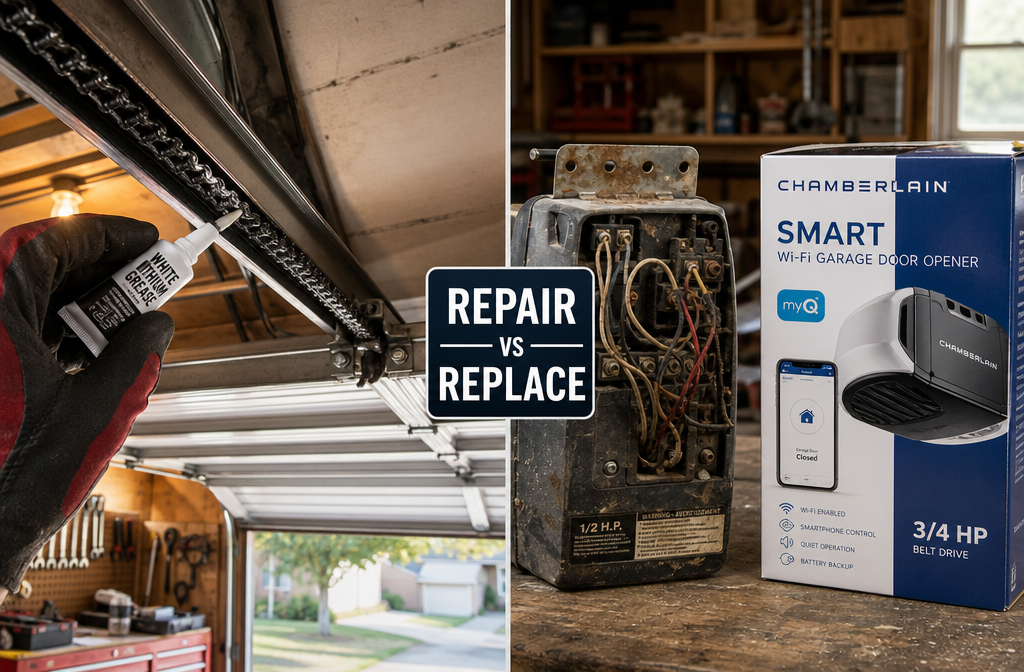
Can You Repair a Worn-Out Garage Door Opener or Does It Need Full Replacement
Many opener problems are repairable, but the decision depends on the age of the unit, the cost of the repair, and what parts are available.
Repair makes sense when:
- The unit is under 8 years old and the defective part (drive gear, capacitor, circuit board) costs less than 40% of a new opener installed
- The failure is a known, common part with good availability
- The motor itself is sound and the issue is in the drive mechanism or electronics
Replacement makes more sense when:
- The unit is over 10 to 12 years old and showing multiple wear signs
- Replacement parts are discontinued or hard to source
- The repair cost approaches or exceeds 50% of a new installation
- The unit lacks modern safety features that a new opener would include
For professional diagnosis in the Oakville and Burlington area, garage door opener repair services can assess whether a repair is economically sound or whether replacement is the better long-term value.
Edge case: A stripped plastic drive gear is one of the most common opener failures and is often repairable for $30 to $60 in parts. If the rest of the unit is sound, this repair is almost always worth doing.
Are Garage Door Openers With More Horsepower More Durable
Higher horsepower does not directly translate to more cycles, but it does reduce motor strain, which indirectly extends service life. A 1/2 HP opener working at 90% of its capacity on every cycle will wear out faster than a 3/4 HP opener working at 60% capacity on the same door.
General horsepower guidelines:
- 1/2 HP: Adequate for single-car doors up to 10 feet wide and standard steel construction
- 3/4 HP: Recommended for double-car doors, heavier insulated doors, or any door over 16 feet wide
- 1 HP and above: Heavy wooden doors, oversized doors, or light commercial applications
The practical takeaway: size the opener correctly for the door weight, and don’t underpower the system to save money upfront. An underpowered opener working near its limit on every cycle will reach the end of its life significantly faster than a properly sized unit.
What Voids the Warranty on a Garage Door Opener
Warranty terms vary by brand and model, but several actions consistently void coverage across major manufacturers.
Common warranty voiders:
- Installation by an uncertified person where professional installation is required by the warranty terms
- Use of the opener with a door that is not properly balanced or maintained
- Modification of the unit’s wiring, programming, or mechanical components
- Use in a commercial or multi-family setting when the unit is rated for residential use only
- Physical damage from power surges, flooding, or improper voltage supply
- Purchasing through unauthorized resellers (some brands, including Chamberlain, tie warranty terms to purchase channel)
Chamberlain’s support guidance notes that warranty terms vary by purchase channel and model, and that service labor is generally not covered. This means even a warranty claim may leave the homeowner paying for the technician’s time.
Practical implication: Keep the original purchase receipt, register the product within the required window (usually 30 to 60 days), and have the unit installed by a qualified technician if the warranty requires it. A professional garage door tune-up that documents door balance and spring condition can also serve as useful records if a warranty dispute arises.
How Much Does It Cost to Replace a Worn-Out Garage Door Opener
Replacement costs in 2026 for a residential garage door opener, including parts and professional installation, typically fall in the following ranges:
| Opener Type | Unit Cost (Retail) | Installed Cost (Estimate) |
|---|---|---|
| Budget chain drive | $150 to $250 | $300 to $450 |
| Mid-range belt drive | $250 to $400 | $400 to $600 |
| Premium smart opener | $350 to $600 | $500 to $750 |
| Battery backup model | $400 to $650 | $550 to $800 |
These are estimates for the Ontario market and will vary based on the installer, the complexity of the installation, and whether additional work (new wiring, bracket reinforcement, spring replacement) is needed at the same time.
Cost-saving tip: If the springs are also near end of life, replacing them at the same time as the opener saves a second service call fee. Combining opener replacement with spring replacement is a common and cost-effective approach.
For homeowners considering a new door alongside a new opener, garage door installation options are worth reviewing to understand the full system cost.
Maintenance Tips to Extend Your Garage Door Opener’s Lifespan
Consistent maintenance is the most reliable way to get the maximum number of cycles from a garage door opener. Most of the work focuses on the door itself, not the opener motor.
Annual maintenance checklist:
- Test door balance: Disconnect the opener, lift the door to waist height, and release it. It should stay in place. If it moves, the springs need adjustment.
- Lubricate moving parts: Apply a silicone or white lithium grease to the torsion spring, rollers, hinges, and rail (not the belt or screw). Avoid WD-40, which displaces lubrication rather than providing it. For guidance on the right product for Ontario’s climate, see this article on best garage door lubricant for Ontario.
- Inspect rollers: Nylon rollers should be replaced every 5 to 7 years. Worn rollers increase friction and strain the opener.
- Check and tighten hardware: Vibration loosens bolts and brackets over time. A loose mounting bracket transfers stress unevenly to the opener.
- Test auto-reverse: Place a 2×4 flat on the ground under the door. The door should reverse immediately on contact. If it doesn’t, adjust the force settings or call a technician.
- Clean the photo-eye sensors: Dust and spider webs on the safety sensors cause false reversals and repeated cycle attempts that waste opener life.
- Inspect the drive mechanism: Look for worn or cracked belts, stretched chains, or damaged screw threads.
How often: Full inspection annually, lubrication every six months (more frequently in Ontario winters when cold thickens grease and stresses components).
Are Smart Garage Door Openers More Reliable Than Traditional Models
Smart openers are not inherently more mechanically durable than traditional models. The motor, drive mechanism, and cycle life ratings are comparable across equivalent price points. What smart openers add is visibility and control, not extra cycles.
Parks Associates reported in March 2026 that smart garage door opener ownership reached 11% of U.S. internet households, reflecting gradual adoption as garage access gets folded into broader home security systems. The appeal is practical: remote monitoring, open/close alerts, and integration with voice assistants and smart locks.
Where smart openers genuinely help with longevity:
- Usage logs can reveal abnormal cycle patterns (a door being opened repeatedly due to a faulty remote or a child pressing the button repeatedly)
- Alerts for incomplete close cycles can catch sensor or spring issues before they become full failures
- Some models track motor performance metrics that can signal wear before a breakdown occurs
Where they don’t help:
- The added electronics (Wi-Fi module, app integration) introduce more components that can fail, particularly if firmware updates are discontinued
- Smart features require a stable Wi-Fi connection and ongoing app support from the manufacturer
Choose a smart opener if: remote monitoring, access logs, or smart home integration matter to you. For Ontario homeowners who lose power during ice storms, a battery backup smart opener combines both benefits. See why battery backup garage door openers matter during Ontario power outages.
Stick with a traditional opener if: simplicity and lower upfront cost are the priority and remote access is not needed.
Conclusion
Understanding garage door opener cycle life comes down to a few practical realities. Most residential openers are built for 10,000 to 15,000 cycles, which translates to roughly 7 to 15 years depending on daily use. But the motor rarely fails in isolation. Springs, rollers, and door balance determine how hard the opener works on every single cycle, and neglecting those components shortens opener life faster than heavy use alone.
Actionable next steps:
- Calculate your household’s approximate daily cycle count and estimate where your current opener sits in its lifespan.
- Test your door balance today. Disconnect the opener and check whether the door holds position at mid-height. If it doesn’t, schedule a spring adjustment before the opener absorbs more unnecessary strain.
- Schedule an annual tune-up that covers lubrication, hardware tightening, and sensor testing. Catching a worn roller or a weakening spring early is far cheaper than an emergency opener replacement.
- If your opener is over 10 years old and showing warning signs, get a replacement quote now rather than waiting for a failure. Planning the replacement on your schedule is less expensive and less stressful than an emergency call.
- When replacing, match the horsepower to the door weight, choose belt drive for quieter and longer-lasting operation, and consider high-cycle springs at the same time to protect the new opener investment.
For professional assessment or same-day opener repair in the Oakville, Burlington, and Hamilton area, garage door opener repair services are available to diagnose whether repair or replacement is the right call for your specific situation.
Frequently Asked Questions
What counts as one cycle for a garage door opener? One cycle is one complete open movement followed by one complete close movement. A door that opens and closes once to let a car out and once more to let it back in has completed two cycles.
How many cycles per day does a typical household use? Most households average three to six cycles per day. A two-driver household where each person leaves and returns once accounts for four cycles minimum. Households with teenagers, deliveries, or frequent garage access can easily reach eight to ten cycles per day.
Do garage door opener cycle ratings include the springs? No. Opener cycle ratings refer to the motor and drive mechanism. Springs have their own separate cycle ratings, typically 10,000 cycles for standard torsion springs. Both ratings apply simultaneously, so the component that fails first determines when service is needed.
Is it worth buying high-cycle torsion springs? For households using the garage more than four times per day, high-cycle springs (20,000 to 50,000 cycles) are worth the extra cost because they outlast the opener and reduce the risk of a sudden spring failure. For low-use households, standard springs may outlast the opener anyway.
Does cold weather reduce garage door opener cycle life? Yes, indirectly. Cold temperatures in Ontario winters cause lubricants to thicken, door seals to stick to the ground, and metal components to contract. Each of these increases resistance on startup, which puts extra load on the motor. Regular lubrication with a cold-rated product reduces this effect.
What is the average lifespan of a garage door opener in years? Industry guidance consistently puts residential opener lifespan at 10 to 15 years, with well-maintained units sometimes reaching 20 years. Units in high-use households or those attached to poorly maintained doors may need replacement in 7 to 8 years.
Can a garage door opener be repaired instead of replaced? Yes, many failures are repairable. Stripped drive gears, failed capacitors, and worn limit switches are common, serviceable problems. Replacement makes more sense when the unit is over 10 years old, parts are unavailable, or the repair cost approaches 50% of a new installed unit.
Does a heavier door shorten opener life? Yes, if the opener is underpowered for the door. A correctly sized opener on a heavy door will last as long as a smaller opener on a lighter door. The key is matching horsepower to door weight so the motor is not consistently running near its load limit.
Do smart openers last as long as traditional openers? Mechanically, yes. The motor and drive components are comparable at equivalent price points. Smart openers add electronics that can fail independently, but they also provide monitoring features that can catch problems early and potentially extend system life through better maintenance awareness.
What is the most common reason a garage door opener fails before its rated cycle life? An unbalanced door caused by worn or broken springs. When springs fail to carry the door’s weight, the opener motor compensates on every cycle, accelerating wear on the drive gear, motor, and electronics far ahead of the rated cycle count.
How do I know if my opener is near the end of its life? Key signs include grinding or straining sounds at startup, slower-than-normal door movement, intermittent operation, shortened remote range, and an age of over 10 to 12 years. If multiple signs appear together, replacement planning is warranted.
Is it safe to use an old garage door opener past its cycle life? An opener that is mechanically worn but still operating is not necessarily dangerous on its own, but it may lack modern auto-reverse and photo-eye safety features required by current safety standards. Openers manufactured before 1993 lack the entrapment protection required by UL 325, and those units should be replaced regardless of cycle count.