Last updated: June 5, 2026
Quick Answer: Hamilton garage door installation typically costs between $900 and $3,500 for a standard residential door, depending on door size, material, insulation level, and the specific neighbourhood. Hamilton’s humid-continental climate, freeze-thaw cycles, and the microclimatic differences created by the Niagara Escarpment make material selection and insulation rating more important here than in many other Ontario cities. Choosing the right door for your neighbourhood’s conditions can extend the door’s lifespan by several years and reduce heating costs noticeably.
Key Takeaways
- Hamilton garage door installation costs range from roughly $900 for a basic single steel door to $3,500 or more for a large, insulated double door with a new opener.
- The Niagara Escarpment divides Hamilton into distinct microclimates: Mountain and Ancaster neighbourhoods above the escarpment run colder and windier, while lakeshore areas like Stoney Creek experience milder but wetter, more humid conditions.
- Freeze-thaw cycles, not just deep cold, are the primary climate threat to garage door hardware, seals, and bottom weatherstripping in Hamilton.
- Insulated steel doors (R-12 to R-16) are the most practical choice for most Hamilton homes, balancing cost, durability, and energy performance.
- Spring is peak installation season in Hamilton; booking in late winter often secures better availability and sometimes better pricing.
- All new garage door installations in Ontario must comply with the Ontario Building Code, which may require a permit depending on the scope of work.
- Powder-coated tracks, corrosion-resistant hardware, and quality bottom seals are not optional extras in Hamilton’s climate — they are baseline requirements for a door that will last.
- Getting at least two itemized quotes and understanding what each line item covers is the single most effective way to avoid overpaying.

Why Hamilton’s Climate Makes Garage Door Installation More Demanding
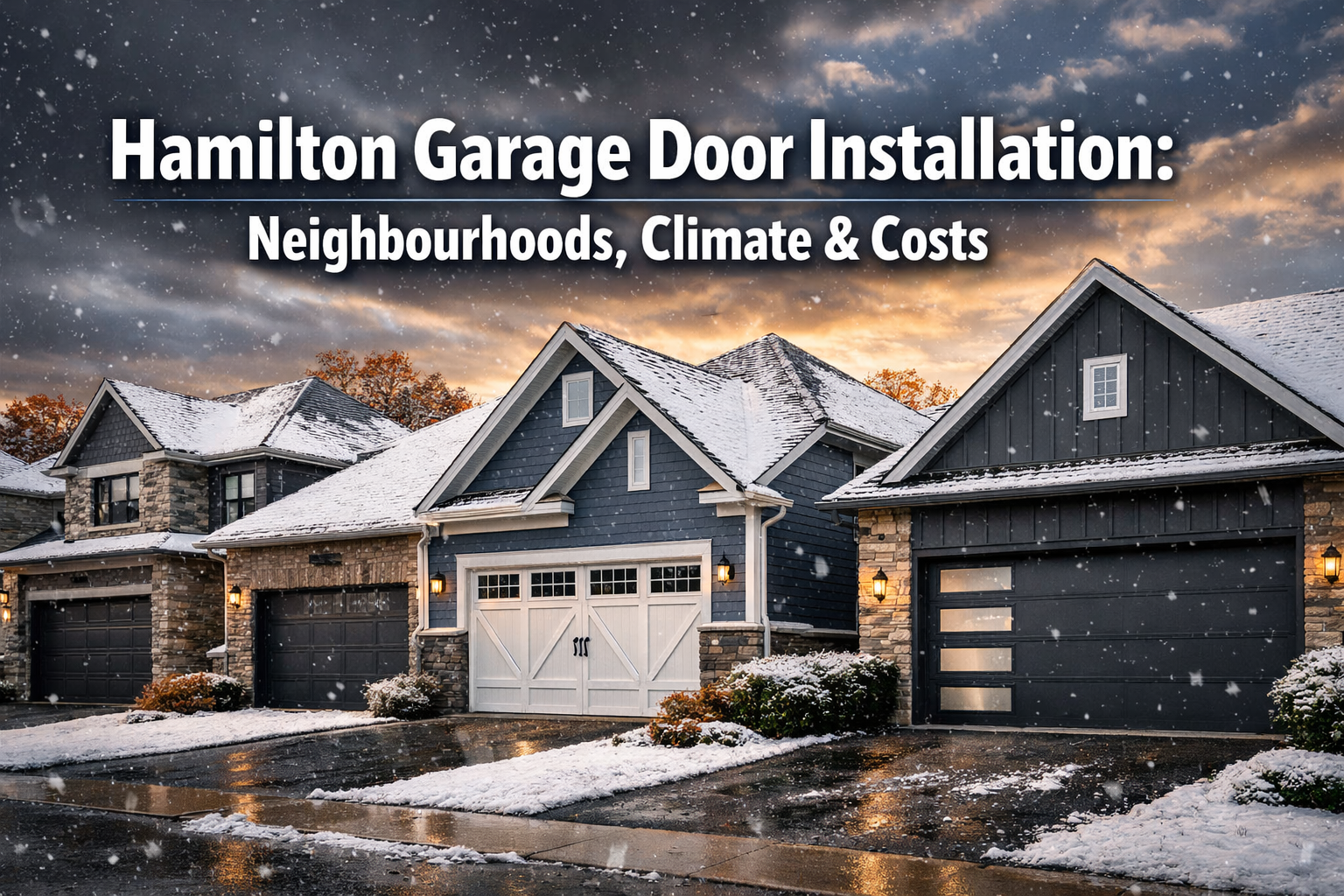
Hamilton sits at the western end of Lake Ontario in a humid-continental climate zone, close to the Dfb/Dfa boundary. That means warm, humid summers and winters that bring freezing temperatures, snow, and — critically — frequent freeze-thaw cycles rather than a single sustained deep freeze. For anyone planning Hamilton garage door installation, these conditions are the starting point for every material and hardware decision.
What makes Hamilton’s climate particularly hard on garage doors:
- Freeze-thaw cycles: Temperatures regularly swing above and below 0°C in late autumn, winter, and early spring. Each cycle stresses seals, bottom weatherstripping, and panel joints. Water that seeps into gaps freezes, expands, and widens cracks over time.
- Humidity and moisture: Proximity to Lake Ontario keeps humidity elevated year-round. Moisture accelerates rust on unpainted or poorly coated steel tracks, springs, and hinges. Wooden door panels can delaminate or swell if not properly sealed.
- Wind exposure: Hamilton’s geography channels wind, particularly in elevated areas. Wind load matters for panel rigidity and track mounting.
- Summer heat: Panels and tracks expand in summer heat. Doors without adequate thermal breaks can bind or warp.
The Great Lakes climate pattern also means winters are trending toward more precipitation falling as rain rather than snow, and more intense rain events overall. This shifts the emphasis from pure snow-load capacity toward water drainage, corrosion resistance, and robust bottom seals.
For ongoing maintenance after installation, using the best garage door lubricant for Ontario’s climate is one of the most cost-effective ways to extend hardware life through Hamilton’s seasonal extremes.
How Hamilton’s Neighbourhoods Affect Installation Choices
Not every Hamilton neighbourhood has the same installation requirements. The Niagara Escarpment running through the city creates genuine microclimatic differences that affect door specifications.
Above the Escarpment (Mountain, Ancaster, Dundas):
- Shorter frost-free periods and lower average January temperatures than the lower city.
- More wind exposure, particularly on the brow of the Escarpment.
- Recommended: Higher R-value insulation (R-16 or above), heavier-duty torsion springs rated for colder operating temperatures, and reinforced panel bracing.
- Ancaster’s mix of older heritage homes and newer subdivisions also means installation teams need to handle non-standard rough opening sizes more frequently.
Below the Escarpment and Lakeshore (Stoney Creek, Waterdown, lower city):
- Milder average temperatures but higher humidity and more rain events.
- Corrosion is a greater concern than extreme cold.
- Recommended: Powder-coated or galvanized hardware, moisture-resistant panel finishes, and high-quality bottom seals rated for wet conditions.
- Stoney Creek’s proximity to the lake also means salt air exposure in some areas, which accelerates metal corrosion.
Older urban core neighbourhoods (Kirkendall, Durand, Crown Point):
- Many homes have older garages with non-standard rough openings, low headroom, or structural quirks.
- Installation often requires custom sizing or low-headroom hardware kits.
- Permit requirements are more likely to apply when structural changes are needed.
New suburban developments (Binbrook, Waterdown, Meadowlands):
- Standard rough openings and modern framing make installation more straightforward.
- Builders often pre-install basic doors; upgrades to insulated or carriage-style doors are common at the time of first resale or renovation.
For homeowners in the broader region, the considerations for Bronte garage door installation in lakefront homes offer a useful parallel, since moisture and corrosion management apply equally to Hamilton’s lakeshore areas.
What Does Hamilton Garage Door Installation Actually Cost in 2026?
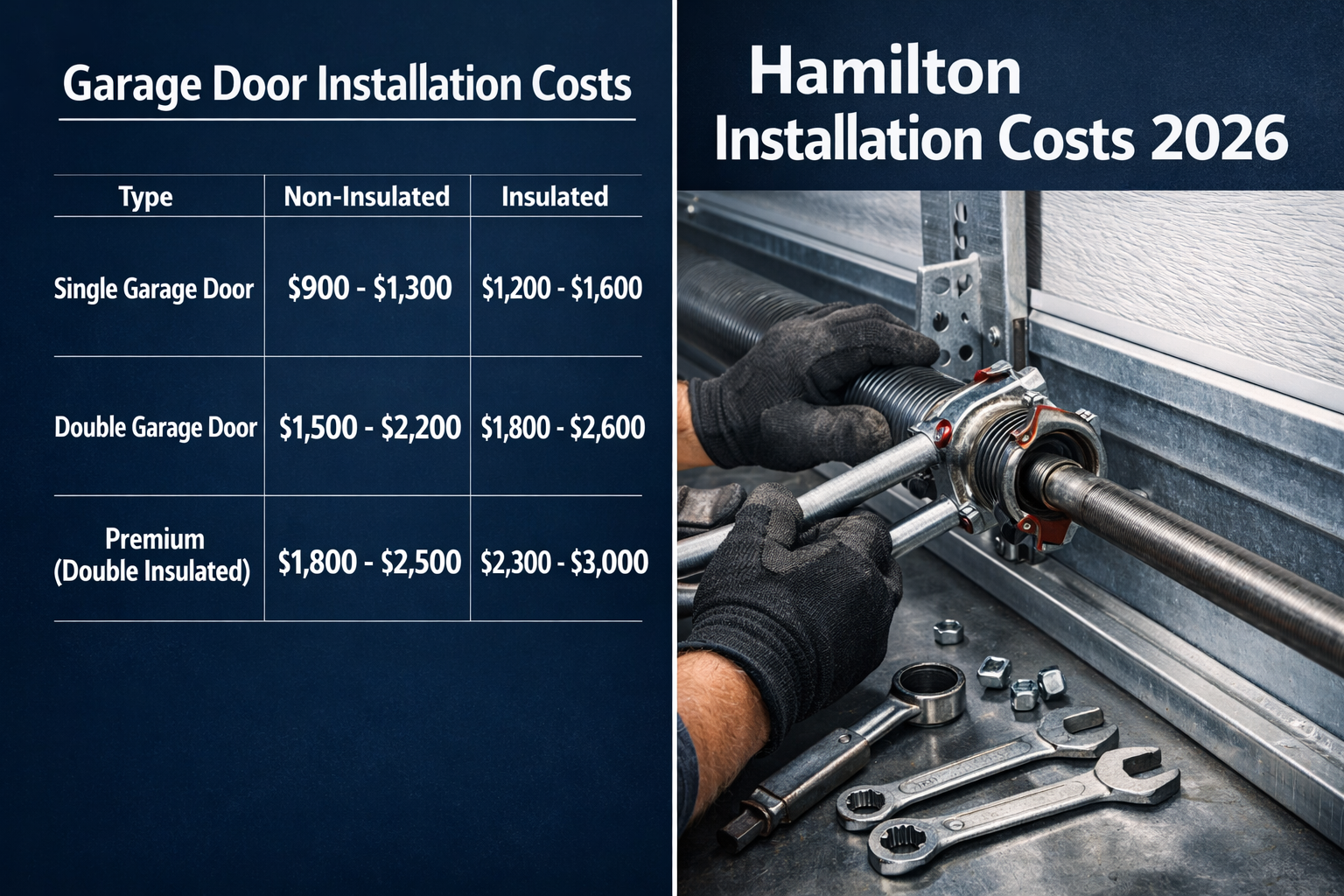
Hamilton garage door installation costs in 2026 range from approximately $900 to $3,500 for most residential projects, with the final number driven by door size, material, insulation level, opener choice, and any structural or framing work required.
Typical cost ranges by door type:
| Door Type | Single Door (approx.) | Double Door (approx.) |
|---|---|---|
| Basic non-insulated steel | $900 – $1,300 | $1,400 – $1,900 |
| Insulated steel (R-12 to R-16) | $1,200 – $1,800 | $1,800 – $2,600 |
| Carriage-style steel | $1,500 – $2,200 | $2,200 – $3,200 |
| Wood or wood composite | $2,000 – $3,000 | $2,800 – $3,500+ |
| Aluminum/glass accent panels | $1,800 – $2,800 | $2,600 – $3,500+ |
These are estimates based on current Southern Ontario market conditions as of mid-2026. Final pricing depends on specific product, installer, and site conditions.
What drives costs up:
- Low-headroom or side-room hardware kits for older garages
- Framing repairs or rough opening modifications
- Adding a new opener or upgrading to a smart/battery-backup opener
- Premium finishes, custom colours, or decorative hardware
- Disposal fees for the old door
What keeps costs lower:
- Standard 9×7 or 16×7 rough openings in good condition
- Retaining the existing opener if it is compatible and in good working order
- Choosing a mid-range insulated steel door over wood or custom options
When reviewing quotes, it helps to understand each line item. A detailed breakdown of what to look for is covered in this guide on how to read a garage door quote.
Spring pricing note: Major retailers and local installers in Hamilton run promotional pricing in late May and early June, which aligns with peak spring demand. Booking in late winter or early spring can sometimes secure a better price and more flexible scheduling before the rush.
Which Door Materials Work Best in Hamilton’s Climate?
For most Hamilton homeowners, insulated steel is the practical first choice. It handles freeze-thaw cycles well, resists moisture better than wood, and offers good R-values without the maintenance demands of natural wood.
Material comparison for Hamilton conditions:
Steel (insulated, 24-gauge or heavier)
- Best all-round choice for Hamilton’s climate
- Resists denting better than thinner gauges
- Polyurethane foam core (R-12 to R-18) reduces heat loss and panel flex in cold
- Requires powder-coat or quality paint finish to resist moisture and salt air
- Choose: if you want low maintenance and reliable performance
Wood and wood composite
- Attractive, traditional look popular in Ancaster and older Hamilton neighbourhoods
- Requires annual sealing and repainting to prevent swelling, rot, and delamination
- Bottom sections are most vulnerable to meltwater pooling — a genuine problem in Hamilton winters
- Choose: if aesthetics are the priority and you are committed to regular maintenance
Aluminum with glass panels
- Modern aesthetic, lightweight
- Prone to denting and less thermally efficient unless thermally broken frames are used
- Not ideal for above-escarpment areas with higher wind exposure
- Choose: if the garage is detached and not climate-controlled, or for a contemporary home design
Fiberglass
- Resists corrosion and moisture well
- Can crack in very cold temperatures, which is a real risk in Hamilton winters above the escarpment
- Choose: in mild lakeshore locations where aesthetics matter and cold extremes are less frequent
For a full professional installation service overview, the garage door installation page at Oakview Garage Doors covers product options and what to expect from the installation process.
What Insulation Rating Do Hamilton Homes Actually Need?
The right insulation rating (R-value) depends on whether the garage is attached or detached, conditioned or unconditioned, and where in Hamilton the home is located.
Practical R-value guidance for Hamilton:
- Attached, conditioned garage (heated or sharing a wall with living space): R-16 or higher. This reduces heat transfer through the door meaningfully and protects the door’s mechanical components from the worst cold.
- Attached, unconditioned garage: R-12 to R-16. Even without active heating, insulation reduces temperature swings that stress springs, seals, and openers.
- Detached garage: R-6 to R-12 is adequate for most detached garages unless the space is used as a workshop or living area.
- Above the Escarpment (Mountain, Ancaster): Err toward the higher end of each range given colder average temperatures and greater wind exposure.
A common mistake is choosing a door based on R-value alone. Panel construction matters as much as the rated R-value. A door with a continuous polyurethane foam core between two steel skins performs better in real conditions than a door with polystyrene inserts and exposed air gaps at the edges.
How Does the Installation Process Work in Hamilton?
A standard Hamilton garage door installation, from first contact to a working door, typically takes one to two weeks when parts are in stock, and one to three days for the physical installation itself.
Step-by-step process:
- Site assessment: The installer measures the rough opening, checks headroom and side room clearances, inspects the framing, and identifies any structural issues.
- Product selection and quote: Based on the site assessment, the installer recommends door options, opener compatibility, and any hardware upgrades needed for Hamilton’s climate conditions.
- Permit check: In Ontario, replacing a garage door in an existing opening generally does not require a permit. However, if the rough opening is being modified or structural framing is changed, a permit from the City of Hamilton may be required. Confirm this with your installer before work begins.
- Removal of old door: The existing door, springs, and hardware are removed and disposed of (confirm disposal is included in the quote).
- Track and hardware installation: New tracks, torsion spring assembly, and mounting hardware are installed. In Hamilton’s climate, powder-coated or galvanized components are the standard for corrosion resistance.
- Panel installation: Door panels are assembled from the bottom up, with each section connected and aligned.
- Spring tensioning and balance check: Springs are tensioned and the door is tested for balance. An unbalanced door strains the opener and wears hardware faster.
- Opener connection and programming: If a new opener is being installed, it is mounted, connected, and programmed. Safety reversal sensors are tested.
- Weatherstripping and seals: Bottom seal, side seals, and top seal are fitted. This step is critical in Hamilton’s climate — a poor bottom seal allows cold air, water, and ice to enter.
- Final inspection and walkthrough: The installer demonstrates manual release, explains maintenance requirements, and confirms warranty terms.
If an emergency arises during or after installation, emergency garage door repair in Hamilton is available for urgent issues.
What Maintenance Does a New Hamilton Garage Door Need?
A new garage door installed in Hamilton requires biannual maintenance at minimum to perform reliably through the city’s seasonal extremes.
Maintenance schedule for Hamilton conditions:
Before winter (October/November):
- Lubricate torsion springs, hinges, rollers, and tracks with a silicone or lithium-based lubricant rated for cold temperatures
- Inspect and replace bottom weatherstripping if cracked or compressed
- Test manual release operation
- Clear any debris from the threshold that could freeze under the door
- Test the opener’s safety reversal function
After winter (March/April):
- Inspect hardware for rust, corrosion, or wear caused by freeze-thaw cycles
- Check panel joints and seals for gaps created by thermal expansion and contraction
- Re-lubricate all moving parts
- Inspect the bottom seal for ice damage
Annually:
- Perform a full door balance test (disconnect the opener and lift the door manually to waist height — it should stay in place)
- Check cable condition for fraying or corrosion
- Inspect torsion spring for signs of wear or cracking
A professional garage door tune-up once a year covers most of these items systematically and catches problems before they become expensive repairs.
How to Choose a Reliable Hamilton Garage Door Installer
Hamilton has a competitive local market for garage door installation, with multiple regional and national providers active in 2026. The key is not finding the cheapest quote — it is finding an installer whose quote covers everything and whose work will hold up through Hamilton’s seasonal demands.
What to look for:
- Itemized written quotes: Labour, materials, disposal, and any permit fees should be listed separately. Avoid quotes that bundle everything into a single number without breakdown.
- Local knowledge: An installer familiar with Hamilton’s neighbourhoods will know about low-headroom situations in older homes, escarpment wind loads, and the corrosion risks in lakeshore areas.
- Warranty terms: A quality installation should come with at least a one-year labour warranty and the manufacturer’s product warranty (typically five to ten years on panels, lifetime on springs for premium products).
- Licensed and insured: Confirm the installer carries liability insurance and, if applicable, WSIB coverage.
- References or reviews specific to Hamilton: Generic reviews are less useful than feedback from homeowners in similar neighbourhoods with similar climate exposure.
Red flags:
- Pressure to decide same-day without a written quote
- No mention of permit requirements when structural work is involved
- Quotes that exclude disposal of the old door
- Spring warranties shorter than five years on a new installation
FAQ: Hamilton Garage Door Installation
How long does a garage door installation take in Hamilton? Most standard residential installations in Hamilton take between four and eight hours for the physical work. Custom doors or installations requiring framing modifications may take longer, sometimes spanning two days.
Do I need a permit to replace my garage door in Hamilton? Replacing a door in an existing, unchanged rough opening generally does not require a permit in Hamilton. If the opening is being widened, framing is being altered, or the project is part of a larger renovation, a permit from the City of Hamilton is likely required. Always confirm with your installer and the city’s building department before work begins.
What is the best garage door material for Hamilton winters? Insulated steel with a continuous polyurethane foam core is the most practical choice for most Hamilton homes. It handles freeze-thaw cycles well, resists moisture, and requires less maintenance than wood. For above-escarpment locations, choose 24-gauge steel or heavier with an R-16 or higher rating.
How much does it cost to add a new opener during installation? Adding a belt-drive or chain-drive opener during a Hamilton garage door installation typically adds $300 to $600 to the project cost, depending on the opener model. Smart openers with battery backup add $150 to $300 more. Installing the opener at the same time as the door is more cost-effective than adding it later.
Why is my new garage door not sealing at the bottom in winter? This is usually a threshold or bottom seal issue. In Hamilton’s climate, the ground near the garage threshold can heave slightly from frost, creating gaps. A rubber threshold seal installed on the floor (not just on the door) solves most cases. If the door itself is not level, the tracks may need adjustment.
How often should I lubricate a garage door in Hamilton? Twice a year is the minimum: once before winter and once after. Given Hamilton’s humidity and freeze-thaw cycles, more frequent lubrication of springs and rollers (every three to four months) is reasonable for heavily used doors.
Can I install a garage door myself in Hamilton? Replacing panels or a complete door is technically possible as a DIY project, but torsion spring installation is genuinely dangerous and should be handled by a professional. Springs store significant energy under tension and can cause serious injury if mishandled. Most Hamilton installers advise against DIY spring work under any circumstances.
What R-value do I need for an attached garage in Hamilton? R-12 is the practical minimum for an attached garage in Hamilton. R-16 is a better choice if the garage shares a wall with living space or if the home is above the Escarpment where temperatures run colder. Higher R-values beyond R-18 offer diminishing returns for most residential applications.
How do I know if my garage door needs replacement rather than repair? If the door has significant panel damage, the torsion spring has broken more than once in a few years, the door is more than 20 years old and showing rust or structural weakness, or the cost of repairs approaches 50% of a new door’s cost, replacement is usually the better investment. See 5 signs you need garage door repair for a detailed checklist.
Does Hamilton’s climate affect how long a garage door lasts? Yes. In Hamilton’s freeze-thaw environment, a door that is well-specified (correct gauge, insulation, hardware finish) and properly maintained can last 20 to 30 years. A poorly specified door — particularly one with inadequate bottom seals, thin steel, or untreated hardware — may show significant deterioration within seven to ten years.
Conclusion
Hamilton garage door installation is not a one-size-fits-all project. The city’s position at the base of the Niagara Escarpment creates real microclimatic differences between neighbourhoods, and the region’s freeze-thaw cycles, humidity, and seasonal temperature swings put genuine demands on door materials, hardware, and seals.
Actionable next steps for Hamilton homeowners:
- Identify your neighbourhood’s specific conditions — above or below the Escarpment, lakeshore proximity, and garage attachment type — before selecting a door specification.
- Set a realistic budget using the cost ranges in this guide, and factor in opener replacement and disposal fees from the start.
- Request at least two itemized written quotes from installers with demonstrated Hamilton-area experience.
- Prioritize insulation and hardware quality over cosmetic upgrades if budget requires trade-offs. An R-16 insulated steel door with powder-coated hardware will outperform a decorative wood door with basic hardware in Hamilton’s climate every time.
- Schedule biannual maintenance from the first year of installation. The cost of a professional garage door tune-up is a fraction of the cost of a premature spring or opener replacement.
- Confirm permit requirements with the City of Hamilton before any structural work begins.
A well-chosen, properly installed garage door in Hamilton will deliver reliable performance for decades. The upfront investment in the right specification — matched to your neighbourhood’s conditions — pays back through lower heating costs, fewer repairs, and a door that operates smoothly through whatever Hamilton’s climate delivers.