Last updated: July 3, 2026
Quick Answer
Ontario’s building code does not contain a standalone clause that lists sensor specifications for garage doors. Instead, the Ontario Building Code (O. Reg. 332/12, as amended) requires that automatic garage door operators be listed and labeled to the binational standard CAN/UL 325. That standard mandates two independent entrapment-protection systems on every automatic residential garage door opener: a primary force-sensing auto-reverse mechanism and a secondary non-contact device, almost always a photo-eye (infrared beam) sensor. In practice, any automatic opener installed in an Ontario home must include functioning photo-eye sensors to be code-compliant, and a missing or bypassed sensor is treated by building officials as a life-safety defect.
Key Takeaways
- Ontario’s garage door sensor requirements flow through CAN/UL 325, a binational Canadian-American standard that the Ontario Building Code adopts by reference.
- Every automatic garage door opener manufactured and sold since January 1, 1993 must include both a primary auto-reverse (force-sensing) mechanism and a secondary non-contact entrapment device such as a photo-eye beam.
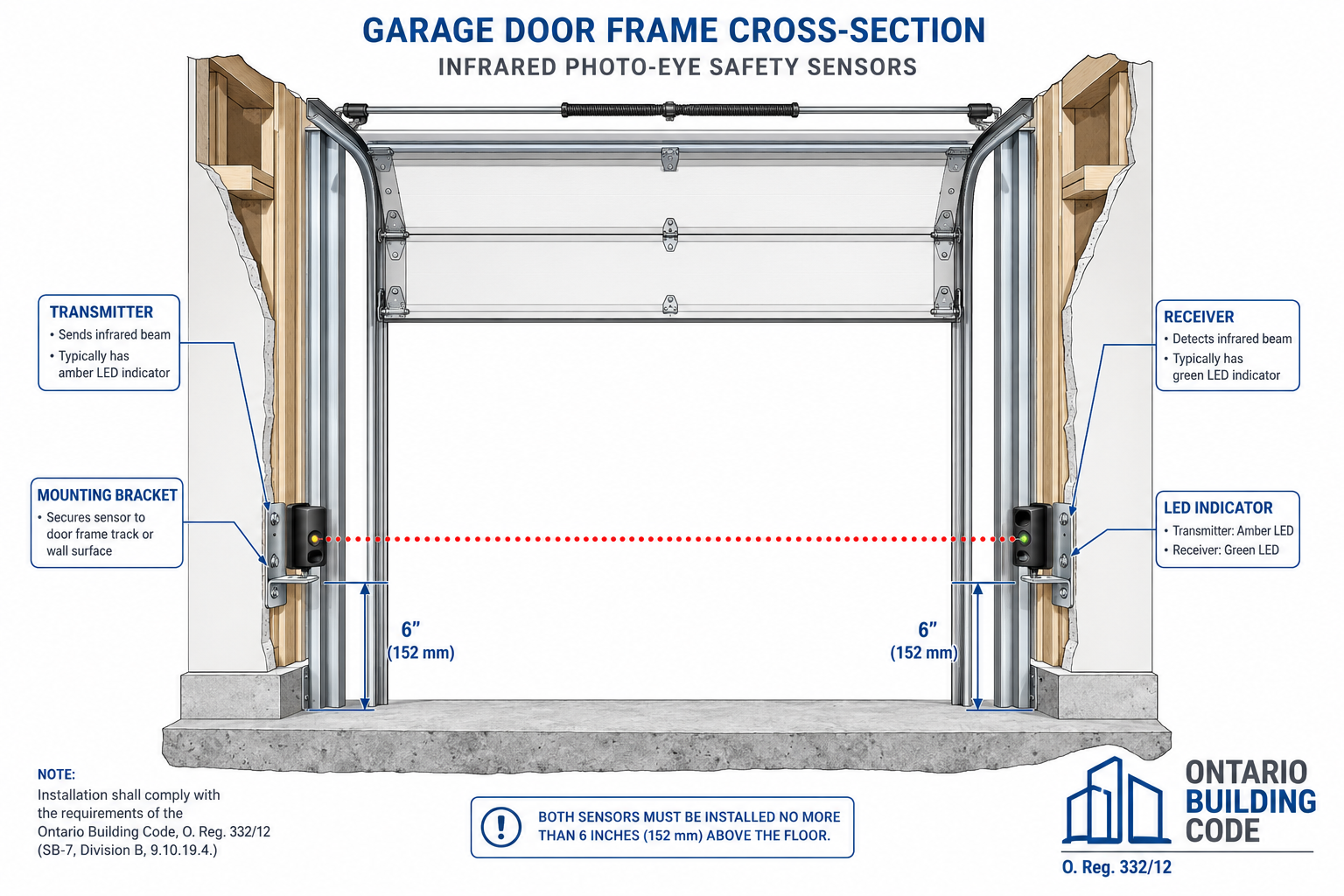
- Photo-eye sensors must be mounted no higher than 6 inches (approximately 15 cm) above the garage floor, one sensor on each side of the door opening.
- GTA-area building departments treat a non-functioning or bypassed sensor as a life-safety defect, not a minor code deviation.
- Older garage doors (pre-1993 openers) are not automatically exempt from sensor requirements if the opener is replaced or if a permit triggers a code review.
- Photo-eye sensors are not the same as motion detectors; they serve a specific entrapment-prevention function.
- Sensors do not expire on a fixed schedule, but they can degrade, misalign, or fail, and should be tested monthly.
- The 2024 Building Code amendments (O. Reg. 163/24, effective January 1, 2025) did not introduce new garage-door-specific sensor clauses beyond the existing CAN/UL 325 reference.
- Bypassing sensors to avoid nuisance trips is not a compliant solution; the correct fix is realignment or replacement.
- Replacement sensor kits typically cost $30 to $80 for parts, with professional installation in Ontario running $80 to $150 in labour.
What Is the Ontario Building Code Requirement for Garage Door Safety Sensors
The Ontario Building Code does not publish a dedicated “garage door sensor” section with millimetre-by-millimetre specifications. What it does is require that automatic garage door operators be installed in accordance with recognized product safety standards, specifically CAN/UL 325 (also written as ANSI/CAN/UL 325), which is a National Standard of Canada recognized by both Canadian and American certification bodies.
CAN/UL 325 is where the actual sensor requirements live. The standard requires that every automatic residential garage door operator include:
- Primary entrapment protection: A force-sensing auto-reverse that stops and reverses the door if it contacts an obstruction during closing.
- Secondary entrapment protection: A non-contact device, typically a photo-eye infrared beam, that detects an obstruction in the door’s path before contact occurs.
Both systems must be present and functional. An opener that has only one of the two does not meet the standard, and therefore does not meet the Ontario Building Code.
Building officials in the GTA, including Toronto, Mississauga, Brampton, Oakville, and Vaughan, enforce this during inspections by verifying that the installed opener carries a CAN/UL 325 listing mark. If the opener is listed but the sensors have been removed or disabled, inspectors treat that as a life-safety defect requiring immediate correction.
The 2024 update: O. Reg. 163/24 (the 2024 Building Code) took effect January 1, 2025 and amended O. Reg. 332/12 in several areas, including housing density, radon readiness, and carbon-monoxide alarms. It did not introduce new garage-door-specific sensor language. The CAN/UL 325 reference framework remains the governing mechanism.
Are Garage Door Safety Sensors Required by Law in Ontario
Yes, for any garage door with an automatic electric opener. The legal pathway is: Ontario Building Code requires CAN/UL 325-listed operators, and CAN/UL 325 mandates photo-eye sensors as a condition of listing. There is no legal route to install an automatic opener in an Ontario home without entrapment-protection sensors.
A few important distinctions:
- Manual garage doors (no electric opener) are not subject to the sensor requirement because there is no automatic operator to govern.
- Pre-1993 openers may still be in service in older Ontario homes. These predate the mandatory sensor requirement. However, if the opener is replaced, the new unit must comply with current CAN/UL 325 requirements, including sensors. A permit for renovation work that includes the garage may also trigger a code review of the opener.
- Commercial and industrial doors face additional layers of requirement under CAN/UL 325 for commercial operators, including the rule that any door operating automatically (via timer, loop detector, or remote) must have a safety device protecting the entrapment zone. Constant-pressure-to-close operation is the only permitted alternative to sensors in commercial settings, and that approach is not practical for typical residential use.
If you’re unsure whether your current opener is compliant, a garage door opener repair technician can verify the listing mark and sensor function during a service call.
How Do Garage Door Safety Sensors Work
Garage door safety sensors use an infrared beam to detect obstructions in the door’s closing path. One sensor (the transmitter) sends a continuous invisible infrared beam across the width of the garage door opening. The sensor on the opposite side (the receiver) detects that beam. When something breaks the beam, the receiver signals the opener’s control board to stop and reverse the door immediately.
The two-layer safety system works like this:
- Photo-eye (non-contact): Detects an obstruction before the door touches it. This is the sensor most homeowners are familiar with, mounted low on each side of the door track.
- Force-sensing auto-reverse (contact): If the door makes physical contact with an obstruction that didn’t break the beam (for example, a low-profile object), the opener’s motor detects the increased resistance and reverses.
Both layers must work together. The photo-eye catches most situations. The force-sensing system is the backup.
LED indicators on the sensors tell you the system status at a glance:
- Solid green or amber light on both sensors: beam is aligned and active.
- Blinking or no light: misalignment, obstruction, or wiring issue.
If your door reverses unexpectedly or refuses to close, the sensor system is likely the first place to check. For a detailed walkthrough of that specific problem, see why your garage door reverses before closing and how to fix it.
Garage Door Sensor Placement Requirements: Ontario Code and the Six-Inch Rule
Photo-eye sensors must be mounted no higher than 6 inches (approximately 15 cm) above the garage floor. This rule comes directly from CAN/UL 325 and has been in effect since January 1, 1993. The logic is straightforward: a sensor mounted higher than 6 inches could miss a small child, a pet, or a low object in the door’s path.
Placement checklist for compliant installation:
- One sensor on each side of the door opening (transmitter on one side, receiver on the other).
- Both sensors at the same height, no more than 6 inches above the finished floor.
- Sensors aimed directly at each other so the beam travels horizontally across the full width of the opening.
- Sensors mounted on the door track or a dedicated bracket, not on the door itself (the door moves; sensors must be stationary).
- Wiring secured and protected from physical damage.
Common placement mistake: Some homeowners or installers raise the sensors to 8 or 10 inches to avoid nuisance trips caused by leaves, snow, or debris. This is not compliant. The correct solution is to address the source of the nuisance (clear debris, check alignment, adjust sensitivity) rather than raise the sensors above the required maximum height.
Garage Door Sensor Cost and Installation Price in Ontario
Replacing or installing garage door safety sensors in Ontario is one of the more affordable garage door repairs. The cost depends on whether you’re replacing a failed sensor, installing sensors on an opener that somehow lacks them, or upgrading to a newer sensor system.
| Scenario | Parts Cost (CAD) | Labour Cost (CAD) | Total Estimate (CAD) |
|---|---|---|---|
| Replace one failed sensor (OEM match) | $30, $60 | $80, $120 | $110, $180 |
| Replace both sensors (pair kit) | $50, $80 | $80, $150 | $130, $230 |
| New sensor installation (opener retrofit) | $60, $100 | $100, $180 | $160, $280 |
| Full opener replacement (includes sensors) | $250, $600 | $150, $250 | $400, $850 |
These are estimates based on Ontario market pricing in 2026. Actual costs vary by brand, opener model compatibility, and whether the job involves any wiring repairs. A full garage door tune-up often includes a sensor alignment check at no extra charge, which can catch problems before they require a service call.
What Happens If Your Garage Door Sensors Aren’t Working
A garage door with non-functioning sensors presents two immediate problems: a safety risk and a code-compliance issue.
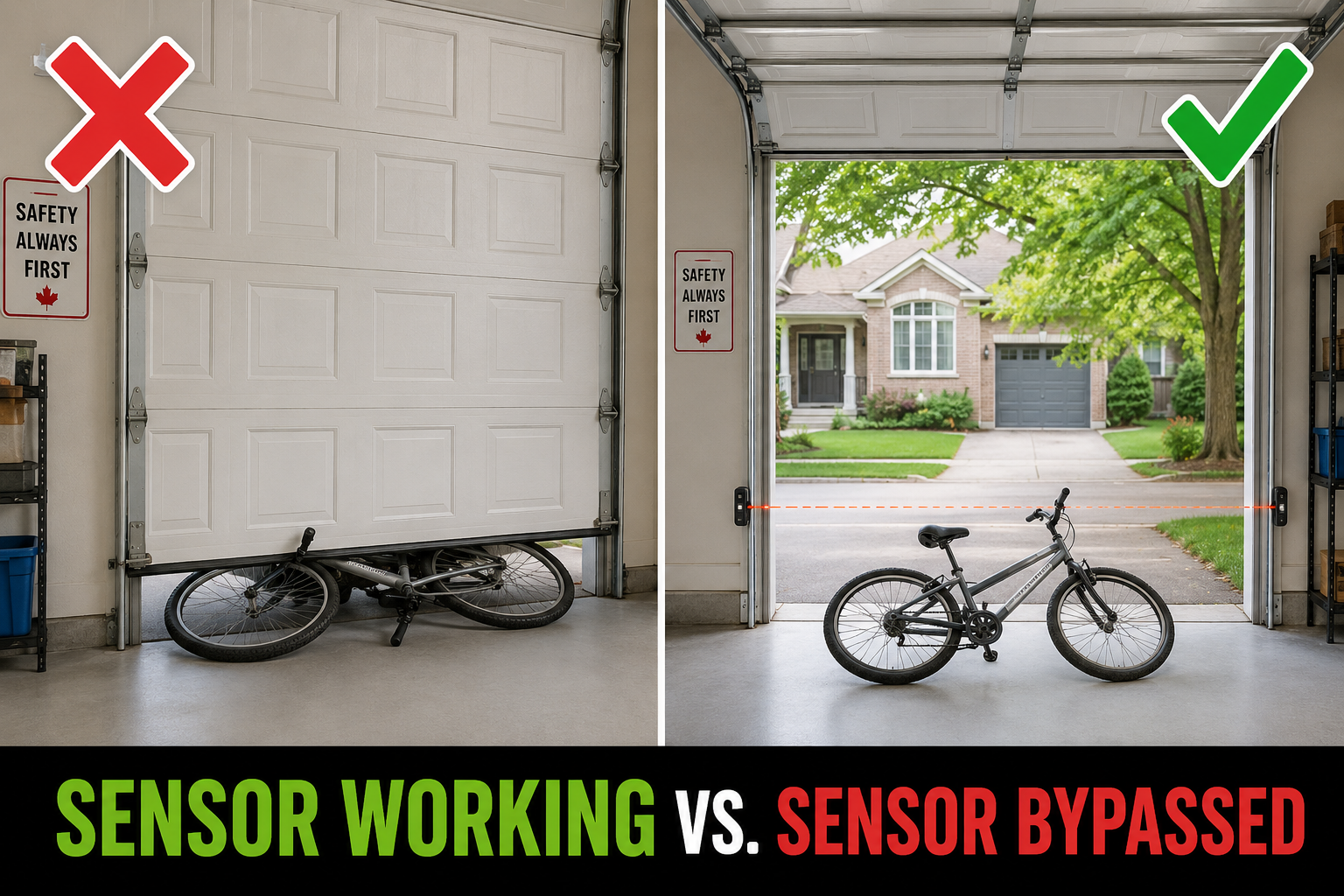
Safety risk: Without a working photo-eye, the door will not stop or reverse if a person, pet, or object is in its path during closing. The force-sensing auto-reverse is still present, but it only activates on contact, meaning the door must physically strike the obstruction before reversing. For a child or small pet, that contact alone can cause serious injury.
Code-compliance issue: Ontario building officials treat a bypassed or non-functional sensor as a life-safety defect. If you’re selling your home, a home inspector will flag missing or disabled sensors. If you’re pulling a permit for any renovation work that touches the garage, an inspector may require the sensor system to be brought into compliance before sign-off.
Practical consequences of non-functioning sensors:
- The opener may refuse to close the door at all (most modern openers default to this safe-failure mode when sensors are misaligned or disconnected).
- The door may close but only in “manual override” mode, which some openers allow by holding the wall button continuously.
- Insurance claims related to a garage door incident may be complicated if sensors were known to be non-functional.
If your door is behaving erratically, see our guide on 5 signs you need garage door repair to assess whether sensors are the root cause or a symptom of a larger issue.
Garage Door Safety Sensor vs. Motion Detector: What Is the Difference
These are two different devices that serve entirely different purposes, and confusing them is a common mistake.
Photo-eye safety sensor:
- Purpose: Entrapment prevention. Detects an obstruction in the door’s closing path.
- Location: Mounted 6 inches above the floor on both sides of the door opening.
- Function: Continuous infrared beam; triggers door reversal when beam is broken.
- Required by: CAN/UL 325 and Ontario Building Code.
Motion detector:
- Purpose: Security or convenience lighting. Detects movement in a defined area.
- Location: Typically mounted high on a wall or ceiling to cover a wide area.
- Function: Passive infrared (PIR) or microwave sensor; triggers lights, alarms, or smart-home automations.
- Required by: Not required by the Ontario Building Code for garage doors.
A motion detector cannot substitute for a photo-eye sensor. They operate on different principles, are mounted in different locations, and serve different functions. Some smart garage door systems integrate motion detection for security alerts, but this is in addition to, not instead of, the mandatory photo-eye sensors.
Can You Use Any Garage Door Sensor, or Does It Have to Match Your Opener
Sensors must be compatible with your specific opener model. This is not just a preference; it is a functional requirement.
Why compatibility matters:
- Sensors communicate with the opener’s control board using proprietary wiring and signal protocols. A sensor designed for a LiftMaster opener will not function correctly on a Chamberlain or Genie unit, even if the connector looks similar.
- Using an incompatible sensor may cause the opener to behave erratically, fail to detect obstructions, or refuse to operate at all.
- For CAN/UL 325 compliance, the sensor must be part of a listed system. Mixing components from different manufacturers can void the listing.
When you have options:
- OEM (original equipment manufacturer) sensors from the opener’s brand are always the safest choice.
- Some aftermarket sensor kits are certified for use with specific opener models. Check the packaging for compatibility lists and listing marks.
- Universal sensor kits exist but should be verified against your opener model before purchase.
When replacing sensors, bring the opener model number (usually on a label on the motor unit) to ensure you get the right replacement. If you’re unsure, a garage door opener repair technician can source the correct part and confirm compatibility.
Do I Need Safety Sensors on an Old Garage Door in Ontario
If the old garage door has an automatic electric opener, yes. The age of the door panels themselves is irrelevant. What matters is whether an automatic opener is present and whether that opener is CAN/UL 325-listed.
Scenarios and what they mean:
- Pre-1993 opener, still original: The opener predates the sensor requirement. It is technically operating under a “grandfathered” condition, but it poses a real safety risk. If you replace the opener for any reason, the new unit must include sensors. Many insurance providers and home inspectors will flag a pre-1993 opener as a safety concern regardless of code status.
- Post-1993 opener with sensors removed: Not compliant. Sensors were required at the time of manufacture and must be present and functional.
- Old door panels, new opener: The opener must meet current CAN/UL 325 requirements including sensors. The age of the door panels does not change this.
- Renovation permit that includes garage work: A building permit may trigger a code review of the entire garage, including the opener. An inspector can require sensor compliance as a condition of permit sign-off.
The practical advice for Ontario homeowners: if your opener is more than 15 to 20 years old, a garage door tune-up that includes a full safety inspection is a worthwhile starting point before deciding whether to repair or replace.
Garage Door Sensor Not Detecting Obstructions: How to Fix It
A sensor that fails to detect obstructions is either misaligned, dirty, damaged, or wired incorrectly. Start with the simplest cause and work toward the more complex.
Step-by-step troubleshooting:
- Check the LED indicators. Both sensors should show a solid light. A blinking light on the receiver side almost always means misalignment or an obstruction blocking the beam.
- Clear physical obstructions. Cobwebs, dirt, leaves, and even direct sunlight hitting the sensor lens can interfere with the beam. Wipe the lenses with a clean dry cloth.
- Check alignment. Sensors can be knocked out of alignment by a vehicle bumper, a kicked bracket, or vibration over time. Loosen the mounting bracket, aim the sensors directly at each other until both LEDs show solid, then retighten.
- Check the wiring. Loose or corroded wire connections at the sensor or at the opener’s terminal board are a common cause of intermittent failures. Inspect the full wire run for damage.
- Test with an obstruction. Place a cardboard box in the door’s path and attempt to close the door. The door should stop and reverse before touching the box. If it doesn’t, the sensor is not functioning correctly even if the LEDs appear normal.
- Replace the sensor. If alignment and cleaning don’t resolve the issue, the sensor itself may have failed. Sensor components can degrade from UV exposure, moisture, and physical damage.
When to call a professional: If you’ve completed steps 1 through 5 and the sensor still doesn’t detect obstructions, or if the wiring appears damaged, contact a technician. Operating a door with a known sensor failure is not a safe interim solution.
Do Garage Door Sensors Expire or Need Replacement
Sensors don’t have a printed expiry date, but they do degrade over time. Most photo-eye sensors have a practical service life of 10 to 15 years under normal conditions, though Ontario’s climate adds some stress factors.
Factors that shorten sensor lifespan:
- Freeze-thaw cycles that cause bracket movement and misalignment.
- Moisture infiltration into sensor housings (common in unheated garages).
- UV degradation of the lens and housing material.
- Physical impact from vehicles, bikes, or equipment stored in the garage.
- Corrosion on wire terminals from humidity or road salt tracked in by vehicles.
Signs a sensor needs replacement rather than adjustment:
- LED indicator is solid but the door still fails the obstruction test.
- LED flickers intermittently with no apparent cause.
- Sensor housing is cracked or the lens is yellowed and cloudy.
- Sensor has been physically struck and the housing is deformed.
Recommended maintenance schedule:
- Test the photo-eye beam monthly by placing an object in the door’s path.
- Wipe sensor lenses clean every three months.
- Inspect brackets and wiring annually, ideally as part of a full garage door tune-up.
What Triggers a Garage Door Sensor False Alarm
A “false alarm” in sensor terms means the door reverses or refuses to close even when there is no actual obstruction. This is frustrating, but it is the sensor system doing its job in response to something it perceives as a problem.
Common causes of false sensor trips:
- Misalignment: Even a few millimetres of shift in bracket position can cause the beam to miss the receiver. This is the most common cause.
- Dirty lenses: Dust, spider webs, and condensation on the sensor lens scatter the beam.
- Sunlight interference: Direct sunlight shining into the receiver sensor at certain times of day can overwhelm the infrared signal.
- Reflective surfaces: A shiny car bumper, a mirror, or metallic storage shelving near the sensor can reflect the beam in unexpected ways.
- Wiring issues: A loose wire at the terminal creates intermittent signal loss that the opener interprets as a broken beam.
- Nearby RF interference: Less common, but wireless sensors on some newer opener systems can be affected by other wireless devices.
What not to do: Do not raise the sensors above 6 inches to avoid nuisance trips. Do not bypass or disable sensors. Address the root cause instead.
What Are the Most Common Garage Door Sensor Mistakes Homeowners Make
Understanding these mistakes helps avoid both safety risks and unnecessary repair costs.
Mistake 1: Raising sensors above 6 inches to stop nuisance reversals. This is the single most dangerous mistake. It creates a gap at the bottom of the door’s path where a small child or pet could be struck without triggering the sensor.
Mistake 2: Bypassing sensors entirely. Some openers allow the door to close in “hold-to-close” mode when sensors are disconnected. Using this as a permanent workaround removes the secondary entrapment protection entirely and is not code-compliant.
Mistake 3: Assuming sensors are working because the door closes. A door can close even when sensors are misaligned, if the opener is in a degraded mode. Always test with a physical obstruction, not just by watching the door close normally.
Mistake 4: Using incompatible replacement sensors. As noted above, sensors must match the opener. Using a mismatched sensor may appear to work but may not trigger correctly under all conditions.
Mistake 5: Ignoring blinking LED indicators. A blinking light is the sensor telling you something is wrong. Ignoring it and using the door anyway is a safety risk.
Mistake 6: Skipping sensor checks after any impact. If a vehicle bumper, bicycle, or moving box clips a sensor bracket, check alignment immediately. Even a minor impact can shift the sensor enough to cause a failure.
Garage Door Safety Sensor Alternatives If You Don’t Have One
There is no true alternative to a photo-eye sensor for an automatically operating residential garage door in Ontario. CAN/UL 325 requires both primary force-sensing and secondary non-contact entrapment protection for listed operators. There is no approved substitute for the non-contact device in a standard automatic residential application.
The only permitted alternative under CAN/UL 325 is constant-pressure-to-close operation, where the user must hold a control continuously while the door moves. The door stops immediately if the button is released. This approach is used in some commercial applications where sensor maintenance is impractical, but it is not a practical solution for a home garage and most residential openers do not support this mode.
What this means in practice:
- If your opener lacks sensors and cannot be retrofitted (very rare with post-1993 openers), the opener itself needs to be replaced.
- If you are considering a new opener installation, verify that the unit includes sensors before purchase. All current residential openers sold in Canada are required to include them.
For homes in Oakville, Burlington, or surrounding areas, garage door installation services include opener selection guidance and ensure the installed system meets CAN/UL 325 requirements.
Frequently Asked Questions
Q: Does the Ontario Building Code specifically mention photo-eye sensors? A: Not by name. The OBC requires automatic garage door operators to be listed to CAN/UL 325, and that standard requires photo-eye sensors. The requirement is enforced through the standard, not through a standalone OBC clause.
Q: My garage door was built in 1988. Do I need to add sensors? A: If the opener is original and pre-1993, it predates the sensor mandate. However, if you replace the opener, the new unit must include sensors. A pre-1993 opener without sensors is a genuine safety risk regardless of its code status.
Q: Can I install sensors myself? A: Sensor replacement is a DIY-accessible task for homeowners comfortable with basic wiring. However, the installation must achieve correct alignment and height (no more than 6 inches above the floor), and the sensors must be compatible with the opener. If you’re unsure, professional installation ensures compliance and correct function.
Q: How do I know if my sensors are CAN/UL 325 compliant? A: Look for a listing mark (UL or cUL) on the opener’s motor unit. If the opener carries a current listing mark and the sensors are the original or OEM-matched replacement components, the system is compliant. The listing mark is on the motor housing, not on the sensors themselves.
Q: Will a home inspection flag missing sensors? A: Yes. Home inspectors in Ontario routinely test garage door safety features. A missing or non-functional sensor is typically noted as a safety defect in the inspection report and may affect sale negotiations.
Q: What if my sensors keep getting knocked out of alignment? A: The brackets may be loose, damaged, or mounted on a surface that flexes. Replacing the brackets with more robust hardware and ensuring they’re mounted to a solid structural surface (not just drywall) usually resolves chronic misalignment.
Q: Can I use smart sensors or wireless sensors instead of wired photo-eyes? A: Some newer opener systems use wireless sensors. These are acceptable as long as the complete system (opener plus sensors) carries a CAN/UL 325 listing. Do not mix wireless sensors from one brand with an opener from another unless compatibility is explicitly confirmed.
Q: Do sensors need to be replaced when I replace the garage door panels? A: Not necessarily. Replacing door panels does not affect the opener or sensors. However, if the door track geometry changes significantly, sensor alignment should be rechecked after the panel work is complete.
Q: Is there a fine for having non-compliant sensors in Ontario? A: The OBC does not set a specific fine for sensor non-compliance in existing homes. However, a building inspector can issue an order requiring correction, and non-compliance can affect home sales, insurance claims, and liability in the event of an injury.
Q: How long does sensor replacement take? A: A professional technician can replace a sensor pair in 30 to 60 minutes, including alignment and testing. DIY replacement takes longer the first time but is manageable for most homeowners.
Q: My door closes fine but the sensor light blinks. Should I be concerned? A: Yes. A blinking sensor light means the system is not operating correctly, even if the door appears to close normally. The door may be closing in a degraded or override mode. Address the sensor issue before continuing to use the door.
Q: Do garage door sensors work in extreme cold? A: Standard sensors are rated to operate in the temperature ranges typical of Ontario winters. However, ice buildup on sensor lenses, condensation, and bracket contraction in very cold weather can cause alignment issues. Inspect sensors after periods of extreme cold.
Conclusion
Garage door safety sensors are not optional equipment in Ontario. The province’s building code, through its adoption of CAN/UL 325, mandates that every automatic garage door opener include both a primary force-sensing auto-reverse and a secondary photo-eye infrared sensor. Those sensors must be mounted no higher than 6 inches above the floor, one on each side of the door opening, and they must be compatible with the specific opener in use.
The 2024 Building Code amendments did not change this framework. Ontario continues to rely on the CAN/UL 325 listing system as the mechanism for enforcing sensor requirements, and building officials across the GTA treat a missing or bypassed sensor as a life-safety defect.
Actionable next steps for Ontario homeowners:
- Test your sensors today. Place a cardboard box in the door’s path and attempt to close the door. It should stop and reverse before making contact.
- Check sensor height. Both sensors should be mounted at or below 6 inches above the floor. If they’re higher, have them repositioned.
- Look for the listing mark. Confirm your opener’s motor unit carries a UL or cUL listing mark. If it doesn’t, the opener may predate current requirements.
- Schedule an annual inspection. A garage door tune-up that includes a sensor check is the most cost-effective way to stay ahead of compliance and safety issues.
- Don’t bypass sensors as a shortcut. If nuisance trips are the problem, fix the alignment or replace the sensor. Raising or disabling sensors creates a real danger and a code violation.
For homeowners in Oakville, Burlington, Mississauga, and surrounding areas who need sensor replacement, opener repair, or a full compliance check, same-day garage door repair service is available to get your door back to safe, code-compliant operation.