Last updated: June 30, 2026
Quick Answer
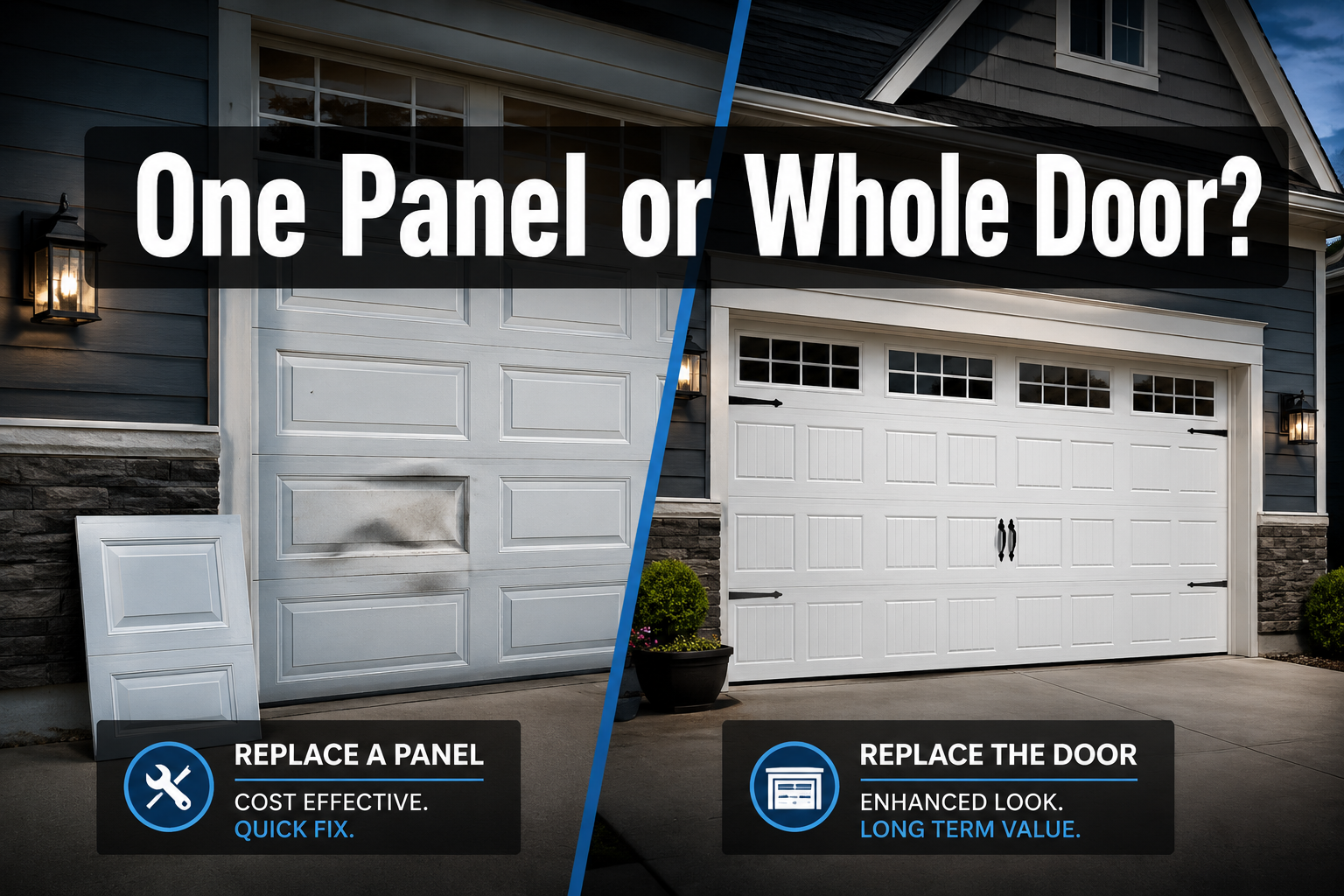
Replacing a single garage door panel costs $350–$900 and makes sense when damage is isolated, the door is under 10 years old, and the hardware is in good condition. Once three or more panels are damaged, or the door is over 15 years old, a full door replacement at $1,200–$2,500 almost always delivers better value. The decision comes down to panel count, door age, hardware condition, and whether a matching replacement panel is still available.
Key Takeaways
- A single damaged panel on a newer door is almost always worth replacing rather than buying a whole new door.
- Replacing three or more panels can cost $1,050–$2,700, which overlaps directly with full door replacement pricing.
- Doors older than 15 years often have discontinued panel styles, making a matching replacement impossible or prohibitively expensive.
- Minor dents on functional panels can sometimes be repaired cosmetically for $75–$150, avoiding panel replacement entirely.
- Hardware condition (springs, tracks, rollers) is as important as panel condition when making the panel vs. full door decision.
- In 2026, manufacturer price increases of 6–10% on residential doors and parts have pushed multi-panel repair costs closer to full replacement territory.
- A full new door is the better choice when the door is aging, hardware is worn, or you want improved insulation and security.
- Panel matching is one of the most common and overlooked problems in single-panel replacement projects.
What Is the Difference Between Replacing One Garage Door Panel vs the Whole Door
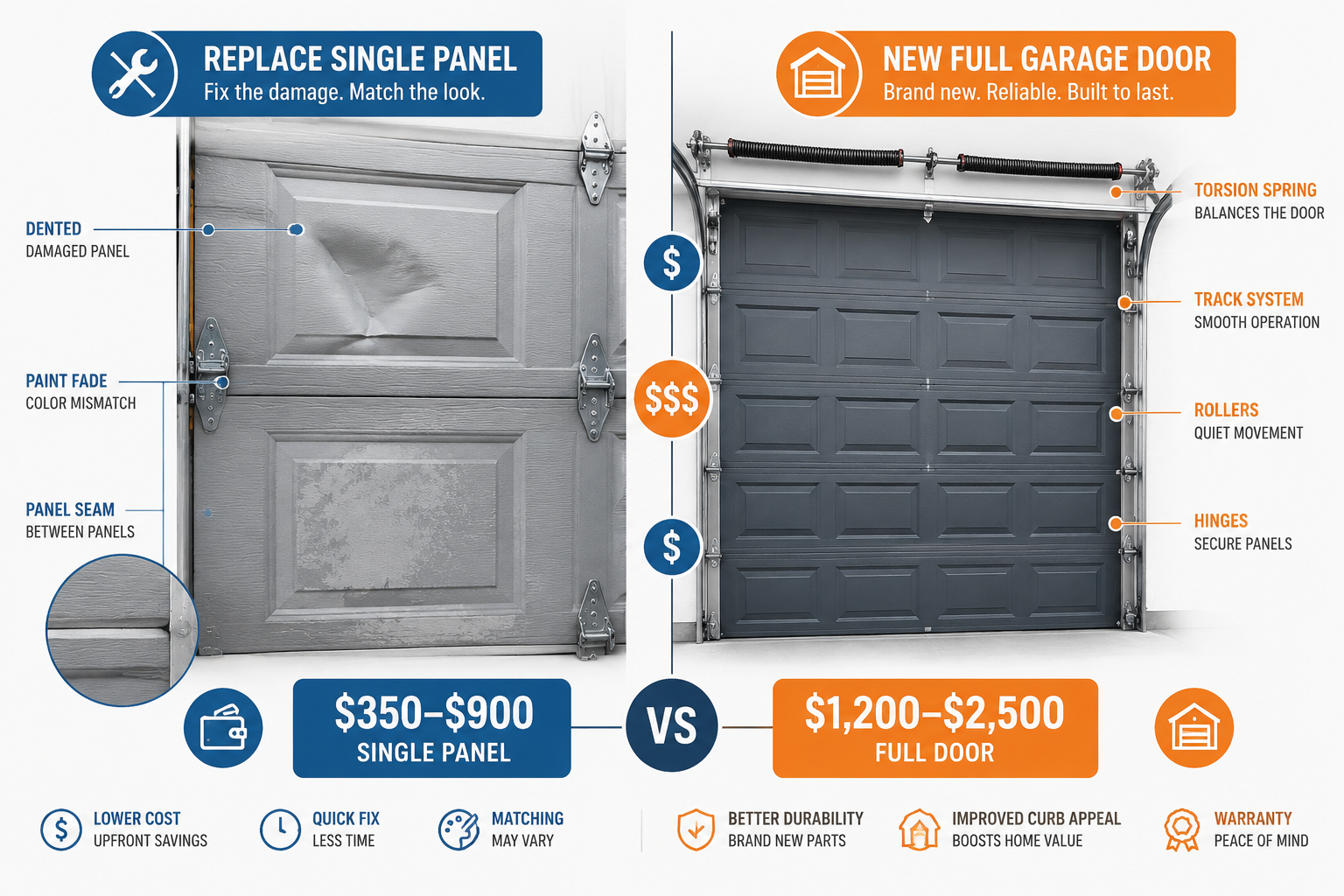
Garage Door Panel Replacement: When One Panel vs Whole Door Makes Sense starts with understanding what each option actually involves. Replacing one panel means removing a single damaged section and installing a matching replacement, leaving the rest of the door and all its hardware in place. Replacing the whole door means removing every panel, the track system, and often the opener hardware, then installing a complete new unit.
Single panel replacement:
- Targets one damaged section only
- Reuses existing tracks, springs, rollers, and opener
- Requires a panel that matches the existing door’s style, color, and profile
- Faster and less expensive in the short term
Full door replacement:
- Removes all panels and typically the entire frame hardware
- Provides a fresh start with new or upgraded components
- Eliminates matching concerns entirely
- Adds insulation, security, and aesthetic upgrades not possible with a partial fix
The key distinction is scope. Panel replacement is a repair strategy. Full door replacement is a renovation. Choosing between them depends on how much of the door is compromised and how much life the remaining components have left.
Can You Replace Just One Damaged Garage Door Panel
Yes, you can replace a single damaged garage door panel, but only under the right conditions. The replacement panel must match the existing door in style, profile, thickness, and color, and the door’s structural and mechanical components must still be in good working order.
Conditions that support single-panel replacement:
- Damage is limited to one section (a vehicle impact, a fallen object, localized rust)
- The door is less than 10 years old
- Springs, cables, tracks, and rollers are functioning normally
- The manufacturer still produces a matching panel, or one can be sourced from a supplier
Conditions that make single-panel replacement impractical:
- The door model has been discontinued
- The existing panels have faded significantly and a new panel will not match
- The damaged panel is structural (bottom section with weatherstripping, or a top section near the opener bracket)
- Hardware shows wear that will require separate repairs soon regardless
For garage door panel replacement in Oakville and surrounding areas, a technician will typically inspect panel availability before quoting a replacement, because sourcing a discontinued panel can make the job cost more than a new door.
How Much Does It Cost to Replace a Single Garage Door Panel
Most homeowners pay $350–$900 to replace a single sectional garage door panel, with an average around $550 when labor is included. Specialty materials, custom sizes, and premium insulated panels push costs toward the higher end of that range, sometimes reaching $1,200 per panel.
| Panel Type | Estimated Cost (Installed) |
|---|---|
| Standard steel panel | $350–$600 |
| Insulated steel panel | $500–$900 |
| Wood or wood-composite panel | $700–$1,200 |
| Aluminum or glass panel | $800–$1,500+ |
Labor typically accounts for $100–$200 of the total, depending on the complexity of the removal and whether the panel requires hardware adjustment during installation.
It is worth noting that 2026 has brought significant cost increases across the industry. One major manufacturer raised prices 6–10% on residential doors and parts in April 2026 alone, described as the third major price hike within roughly 60 days. These increases affect both panel parts and full door pricing, but they hit multi-panel repair jobs particularly hard because costs compound with each additional section.
For a broader look at how repair costs are structured, the guide on how to read a garage door quote breaks down the line items you should expect to see.
Is It Cheaper to Replace One Panel or Buy a New Garage Door
For a single damaged panel, replacing just that panel is almost always cheaper than buying a new door. The math changes quickly when multiple panels are involved.
Cost comparison by number of damaged panels:
- 1 panel: $350–$900 (panel replacement clearly wins)
- 2 panels: $700–$1,800 (panel replacement still usually wins)
- 3 panels: $1,050–$2,700 (costs overlap with full door replacement)
- 4+ panels: $1,400–$3,600+ (full door replacement typically costs less or delivers more value)
A full door replacement in 2026 generally runs $1,200–$2,500 for a standard residential sectional door, installed. When panel repair estimates approach or exceed $2,000, a new door becomes the smarter financial decision because it includes new hardware, a manufacturer warranty, and often better insulation.
When replacing three or more panels costs as much as a new door, the new door is the better investment. You get fresh hardware, a warranty, and no mismatched panels.
One exception applies to highly custom or architectural doors, where individual panels can cost $1,500 or more each. In those cases, even two or three panel replacements may still be cheaper than a full custom door replacement. For guidance on when custom doors are worth the premium, see custom garage doors in Oakville: when the premium is worth it.
When Should You Replace the Entire Garage Door Instead of One Panel
Replace the entire garage door when the door is over 15 years old, when multiple panels are damaged, or when the hardware (springs, tracks, cables) is significantly worn. Replacing panels on an aging system does not fix the underlying mechanical issues and often leads to repeated repairs within a short time.
Replace the whole door when:
- The door is 15+ years old and panels are discontinued
- Three or more panels are damaged or severely faded
- Springs, cables, or tracks are worn and will need replacement soon anyway
- The door lacks insulation and energy efficiency is a concern
- The frame or bottom rail is bent or structurally compromised
- You want to upgrade to a smart opener, better insulation, or a new design
Stick with panel replacement when:
- Damage is limited to one or two sections
- The door is under 10 years old
- Hardware is in good working condition
- A matching panel is readily available
Hardware condition is often the deciding factor that homeowners overlook. If springs are near the end of their service life, replacing panels without addressing the springs means a second service call is likely within 12–18 months. A technician who identifies worn springs during a panel assessment is giving you useful information, not upselling. For context on what spring replacement involves, see garage door spring repair in Oakville.
How Do I Know If My Garage Door Panel Is Repairable or Needs Replacement
A panel is repairable if the damage is cosmetic and the panel’s structure is still sound. It needs replacement if the panel is bent in a way that affects door alignment, if it has compromised the seal, or if it is cracked through the core material.
Signs the panel can be repaired (not replaced):
- Small to medium dents with no crease through the panel’s full depth
- Surface scratches or paint chips that do not expose bare metal to moisture
- Minor rust spots that have not eaten through the panel
Signs the panel needs replacement:
- Deep creases that prevent the panel from sitting flat
- Cracks in the panel skin that expose foam insulation or the panel core
- Warping that causes the panel to bind in the track
- Rust that has perforated the steel
Signs you may need a full door assessment:
- Multiple panels show damage simultaneously
- The door is noisy, uneven, or slow since the damage occurred
- The opener is straining more than usual
Minor dents on steel or aluminum panels can sometimes be repaired cosmetically for $75–$150 without replacing the panel at all. This is only practical when the panel’s function is unaffected and the goal is purely cosmetic. If you are unsure, a garage door repair inspection can clarify whether repair, panel replacement, or full door replacement is the right path.
What Causes Garage Door Panels to Get Damaged
Garage door panels are damaged most often by vehicle impacts, weather events, and long-term material degradation. Understanding the cause matters because some causes affect only the panel surface while others compromise the entire door system.
Common causes of panel damage:
- Vehicle impact: Backing into the door is the most common single-panel damage scenario. Usually affects one or two lower sections.
- Hail and storm debris: Can dent multiple panels simultaneously, which often tips the decision toward full replacement.
- Rust and corrosion: Affects steel panels in humid or coastal climates over time. Ontario’s freeze-thaw cycles accelerate this process.
- UV fading and warping: Particularly common with wood and lower-grade steel panels after years of sun exposure.
- Mechanical stress: Panels can crack or warp if springs or cables fail suddenly and the door drops unevenly.
- Falling objects: Tree branches, ladders, or stored items falling against the door from inside.
The cause of damage often signals whether the rest of the door is affected. A single vehicle impact typically leaves hardware intact. A storm that dents multiple panels may also have bent the track or stressed the springs, which changes the repair scope significantly.
Can a Dented Garage Door Panel Be Fixed Without Replacing It
Yes, minor dents on steel and aluminum panels can often be repaired without full panel replacement, typically for $75–$150. This approach works when the dent has not creased the panel deeply, has not broken the paint seal all the way through, and has not affected the panel’s ability to sit flat in the track.
When dent repair (without replacement) works:
- Shallow dents from minor impacts
- Dents on flat-panel or recessed-panel steel doors where the profile is simple
- Situations where function is fully intact and only appearance is the concern
When dent repair will not work:
- Deep creases that have permanently deformed the panel’s profile
- Damage that has cracked or separated the panel skin from the insulation core
- Rust that has developed at the dent site and spread beneath the paint
Dent repair is the most cost-effective option when it applies, but it is not always a lasting solution. A repaired dent on a steel panel may show a slight shadow or color difference after repainting, which matters if curb appeal is a priority.
What If My Garage Door Panels Do Not Match After Replacing One
Panel mismatch is one of the most common and frustrating outcomes of single-panel replacement. Even when the correct panel profile is sourced, color fading on the existing panels means a new panel will look noticeably brighter or different in finish.
Ways to address panel mismatch:
- Paint the entire door: After installing the new panel, repaint all panels to a uniform color. This adds $150–$400 to the project but produces a consistent result.
- Source a weathered or pre-finished panel: Some suppliers offer panels with finishes designed to approximate aged steel, though an exact match is rarely guaranteed.
- Accept the mismatch temporarily: If the door is 5–8 years old and will be replaced in a few years anyway, a slight color difference may be an acceptable trade-off.
- Replace the full door: If the existing panels are heavily faded or the style is dated, this is often the cleanest solution.
Mismatch risk increases significantly for doors over 10 years old. Manufacturers update their color lines and panel profiles regularly, so a panel ordered today may differ in gloss level, texture, or exact shade from panels installed a decade ago. A technician should flag this risk before the job begins, not after.
Do All Garage Door Panels Fit All Doors
No, garage door panels are not universal. Each panel is specific to a manufacturer, door model, panel height, and profile style. Installing a panel from a different manufacturer or model line will almost always result in alignment problems, gaps, or hardware incompatibility.
What determines panel compatibility:
- Manufacturer and model line: Panels from Brand A will not fit a door built by Brand B in most cases.
- Panel height: Common heights are 21 inches and 18 inches, but custom heights exist. A panel of the wrong height will throw off the entire door’s alignment.
- Profile style: Raised panel, flush panel, long-panel, and carriage-house profiles all have different geometries.
- Thickness and insulation rating: A 2-inch insulated panel cannot replace a 1-3/8-inch non-insulated panel in the same door without hardware adjustments.
This is why panel availability must be confirmed before committing to single-panel replacement. If the manufacturer has discontinued the model, the only compatible panels may come from salvage or resale, which introduces condition and warranty concerns.
Is It Worth Replacing Panels on an Old Garage Door
Replacing panels on a door over 15 years old is generally not worth it. Discontinued panel styles, color mismatch, aging hardware, and the likelihood of additional repairs within a short time frame all reduce the value of a partial fix on an old door.
The age-based decision rule:
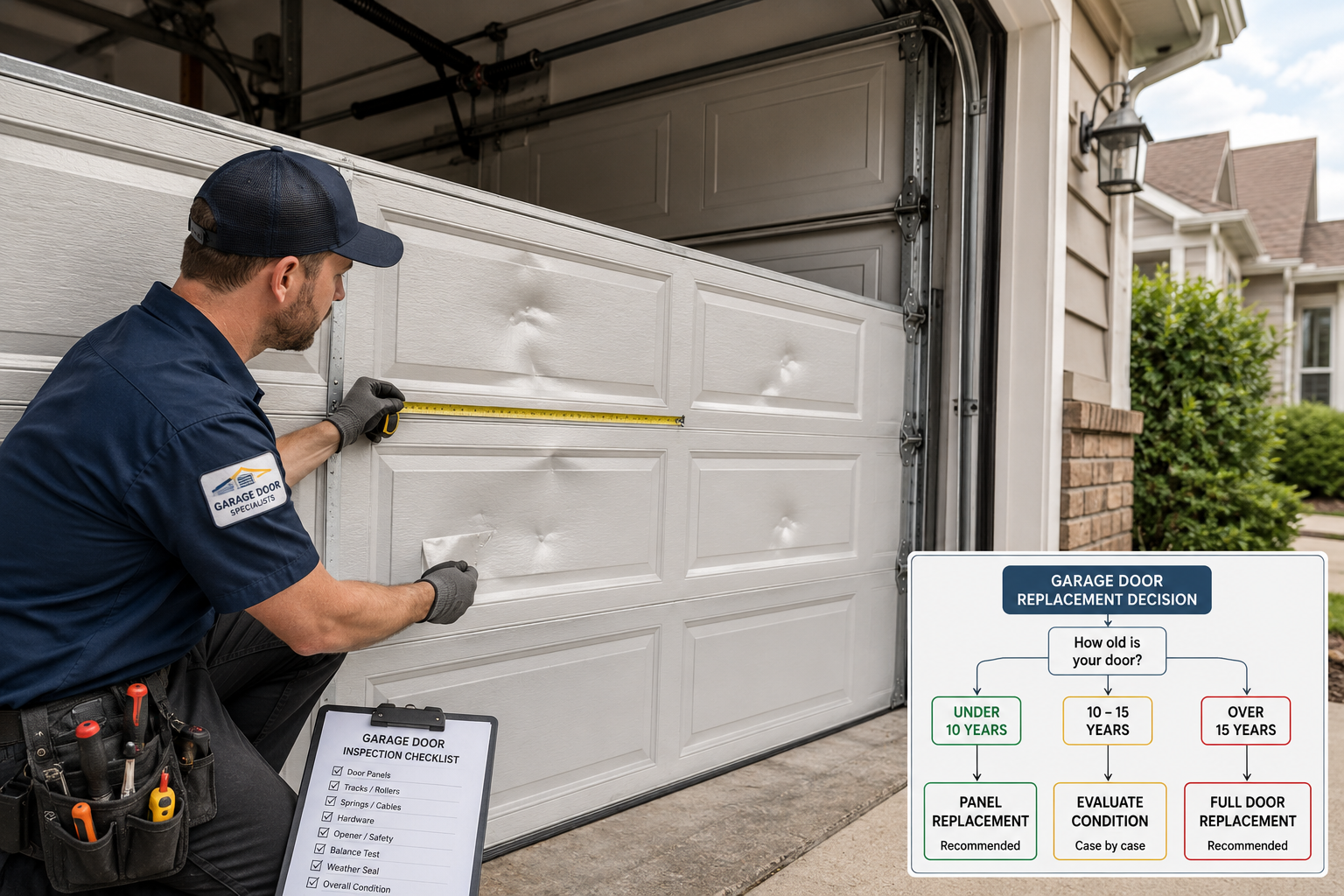
- Under 10 years old: Panel replacement is usually worth it if damage is isolated.
- 10–15 years old: Evaluate hardware condition carefully. If springs and tracks are original, a full replacement may be more economical.
- Over 15 years old: Full door replacement is almost always the better investment.
The reasoning is straightforward. A 15-year-old door has springs approaching or past their typical service life (most torsion springs are rated for 10,000–15,000 cycles). Replacing a panel on a door that will need spring replacement within a year means paying for two separate service calls instead of one comprehensive replacement. For a case study on how this plays out in practice, see the insulated door replacement in West Oak Trails.
What Is the Lifespan of a Garage Door Panel
The lifespan of a garage door panel depends on material, climate, and maintenance. Steel panels on a well-maintained door typically last 20–30 years before rust or structural fatigue becomes a serious issue. Wood panels last 15–20 years with regular painting and sealing. Aluminum panels resist rust but dent easily and may need replacement after a decade in high-traffic garages.
Estimated panel lifespan by material:
| Material | Typical Lifespan |
|---|---|
| Steel (non-insulated) | 20–25 years |
| Steel (insulated) | 20–30 years |
| Wood | 15–20 years (with maintenance) |
| Aluminum | 15–25 years |
| Fiberglass | 10–20 years |
Ontario’s climate accelerates wear on steel panels due to road salt exposure, freeze-thaw cycles, and temperature swings. Regular lubrication and annual inspections extend panel life significantly. For maintenance guidance specific to Ontario conditions, see best garage door lubricant for Ontario climate.
Should You Replace Panels Preventatively or Wait Until They Break
Wait until there is a clear reason to replace. Preventative panel replacement is rarely cost-effective because panels that are faded or mildly worn but still structurally sound do not need to be replaced. The exception is when one damaged panel is being replaced and adjacent panels show early signs of rust or cracking, in which case replacing two panels at once can save on labor costs.
Replace proactively only when:
- A panel shows active rust that is spreading toward adjacent sections
- A hairline crack is visible and the door operates in a high-cycle environment
- You are already replacing one panel and an adjacent panel is clearly near failure
Do not replace proactively when:
- Panels are faded but structurally intact
- The door is functioning normally with no alignment or sealing issues
- The cost of preventative replacement would approach full door replacement cost
If you notice early warning signs beyond the panels, such as unusual noise, slow operation, or the door reversing unexpectedly, those symptoms often point to hardware issues rather than panel issues. See 5 signs you need garage door repair for a broader diagnostic checklist.
How Long Does a Garage Door Panel Replacement Take
A single panel replacement typically takes 1–3 hours for a professional technician. More complex jobs involving panels near the top of the door, insulated panels that require hardware adjustment, or panels on heavy wood doors can take up to half a day.
Time estimates by job type:
- Single standard steel panel: 1–2 hours
- Single insulated or specialty panel: 2–3 hours
- Two panels on the same door: 2–4 hours
- Full door replacement: 4–8 hours depending on door size and hardware
Same-day service is often available for single-panel replacements when the panel is in stock. Custom or discontinued panels may require a lead time of several days to several weeks depending on the supplier. If the damage has left the door inoperable, emergency garage door repair can address immediate safety concerns while a replacement panel is sourced.
FAQ
Can I replace a garage door panel myself? Technically yes for a bottom panel, but it is not recommended. Panels near the top of the door involve spring tension and cable systems that are under significant mechanical load. Incorrect installation can cause alignment problems or injury. A professional replacement is safer and typically includes a workmanship warranty.
What happens if I ignore a damaged panel? A structurally compromised panel can worsen over time. Gaps allow moisture, pests, and cold air into the garage. A bent panel can bind in the track, strain the opener motor, and eventually cause the door to come off its track.
Will my homeowner’s insurance cover panel replacement? It depends on the cause. Damage from a vehicle impact or a named storm event may be covered under your home insurance policy, subject to your deductible. Gradual wear and rust are typically not covered. Check your policy or contact your insurer before paying out of pocket.
How do I find a matching replacement panel? Start with the door’s manufacturer and model number, usually found on a sticker inside the top panel or on the door’s frame. Contact the manufacturer directly or a local garage door dealer. If the model is discontinued, a dealer may be able to source a compatible panel from a distributor’s remaining stock.
Can I paint my garage door after replacing one panel to make it match? Yes, and this is often the best way to achieve a uniform appearance. Use a paint formulated for metal or the specific door material. Light sanding and a primer coat before painting will help the finish adhere and last longer.
Does replacing a panel void my garage door warranty? It can, if the replacement panel is not from the original manufacturer or if the work is done by an uncertified technician. Check your warranty terms before proceeding. Using an authorized dealer for both the part and the labor typically preserves warranty coverage.
Is a dented bottom panel more urgent to fix than a dented middle panel? Yes. The bottom panel contains the weatherstripping seal that keeps out water, pests, and cold air. Damage to the bottom panel affects the door’s ability to seal properly at ground level, which has immediate practical consequences beyond aesthetics.
How many cycles does a typical garage door panel handle? Panels themselves do not have a cycle rating the way springs do. They are passive structural components. Their lifespan is determined by material quality, climate exposure, and physical impacts rather than operational cycles.
What is the most cost-effective option when only one panel is slightly dented? If the dent is shallow and the panel is functional, a cosmetic dent repair for $75–$150 is the most cost-effective option. Full panel replacement is only necessary when the damage affects the door’s structure, seal, or operation.
Should I replace panels before selling my home? If the damage is visible from the street and affects curb appeal, yes. A visibly damaged garage door can reduce perceived home value. Whether to replace one panel or the full door depends on the door’s age and overall condition, using the same criteria outlined in this guide.
Conclusion
The decision in Garage Door Panel Replacement: When One Panel vs Whole Door Makes Sense comes down to four factors: how many panels are damaged, how old the door is, whether a matching panel is available, and what condition the hardware is in.
Actionable next steps:
- Assess the damage honestly. Count how many panels are affected and check whether the damage is cosmetic or structural.
- Check the door’s age. If it is under 10 years old, panel replacement is likely the right call. If it is over 15 years old, get a full replacement quote before committing to panel work.
- Confirm panel availability before agreeing to a quote. Ask the technician to verify that a matching panel exists before the job begins.
- Get both quotes. For any job involving two or more panels, ask for a panel replacement estimate and a full door replacement estimate side by side. The comparison often makes the decision obvious.
- Factor in hardware condition. If springs, cables, or tracks are near the end of their service life, include that cost in your comparison.
- Do not ignore minor damage. A small dent repaired for $100 today prevents a rusted-through panel replacement at $600 next year.
For homeowners in the Oakville and surrounding area, a professional assessment from Oakview Garage Doors will confirm whether panel replacement or full door replacement is the right investment for your specific door and situation.