Last updated: July 11, 2026
Quick Answer: As of mid-2026, Matter does not yet have an official device type specification for garage doors. The Connectivity Standards Alliance (CSA) continues to release new Matter spec versions, but no finalized garage door cluster has been published. A small number of third-party controllers are marketing themselves as Matter-compatible or “Matter-ready,” but true native Matter support for garage door openers is still in development, with broad availability likely 12 to 24 months away.
Key Takeaways
- Matter Protocol for Garage Doors: What’s Coming and When is one of the most-searched smart home questions in 2026, but the honest answer is that native support does not exist yet.
- The CSA’s Matter specification (versions 1.3 and 1.4) does not include a finalized garage door device cluster as of this writing.
- A few controllers (notably Third Reality and Aqara’s Dual Relay Module T2) offer workaround solutions that approximate Matter garage control through relay modules and hubs.
- The main bottleneck is the spec committee process, not manufacturer readiness, brands are designing for future upgrades now.
- Major garage door opener brands have not announced confirmed Matter-native product launches with firm dates.
- Matter’s core advantage for garage doors will be cross-platform control from Apple Home, Amazon Alexa, and Google Home without separate apps or bridges.
- Homeowners with existing Wi-Fi openers are not locked out, several retrofit paths are emerging.
- Security in Matter relies on end-to-end encryption and local processing, which is a genuine improvement over older cloud-dependent systems.
- Upgrading to a Matter garage opener will likely require a new opener unit or a certified add-on controller, not just a firmware update.
- Budget estimates for Matter-native garage openers range from roughly CAD $250 to $500 (opener only), based on current smart opener pricing trends, actual Matter pricing is not yet confirmed.
What Is Matter Protocol and How Does It Work with Garage Doors
Matter is an open-source smart home connectivity standard developed by the Connectivity Standards Alliance (CSA), a consortium that includes Apple, Amazon, Google, Samsung, and dozens of device manufacturers. It runs over Wi-Fi and Thread (a low-power mesh networking protocol), with Bluetooth used for device commissioning. The goal is simple: one standard so that any certified device works with any certified hub or voice assistant, without proprietary bridges.
For garage doors specifically, Matter would define a standardized “device type”, essentially a set of commands and attributes (open, close, position, obstruction status) that any Matter-certified hub can read and control. The problem is that this device type has not been finalized in the published spec. Without it, manufacturers cannot build a fully certified Matter garage door opener.
How the spec process works:
- The CSA publishes Matter specification versions on a rolling basis (1.0, 1.1, 1.2, 1.3, 1.4).
- Each version adds new device types, for example, version 1.2 added robot vacuums and refrigerators.
- Garage doors require their own cluster definition covering safety interlocks, position reporting, and obstruction detection.
- Until that cluster is ratified, any “Matter garage door” product is technically using a workaround device type (often a generic switch or contact sensor).
The practical result: products marketed as Matter-compatible for garage doors today are bridging the gap with relay modules and sensors, not true native Matter device types.
When Will Matter Garage Door Openers Be Available
No confirmed release date exists as of July 2026. Based on the CSA’s spec cadence and manufacturer signals, a realistic window for the first truly native Matter garage door openers is late 2026 to mid-2027, but this depends on when the CSA ratifies the garage door cluster.
What the timeline looks like:
- 2022-2024: Matter 1.0 through 1.2 launch; garage doors not included.
- 2025: Matter 1.3 and 1.4 released; still no finalized garage door device type in public documents.
- Early 2026: Third Reality releases a Matter-based smart garage controller, generating renewed interest. Aqara updates its Dual Relay Module T2 product page positioning it as a smart garage solution via Matter hub. ismartgate updates its platform to “Matter ready” status but stops short of native Matter.
- Mid-2026 (now): No major opener brand (Chamberlain/LiftMaster, Genie, Craftsman, Marantec) has announced a confirmed Matter-native product with a ship date.
- Late 2026 to 2027: Most likely window for first certified Matter garage door openers, assuming spec ratification happens in the next 6 to 12 months.
The spec-committee dependency is the real bottleneck here. Manufacturers are not waiting idly, they are designing hardware with Matter in mind, but they cannot ship a certified product until the standard exists.
Which Garage Door Brands Support Matter Protocol
No major garage door opener brand has shipped a fully Matter-certified product as of mid-2026. However, several third-party controller brands are positioning themselves ahead of the curve.
Current landscape by brand:
| Brand | Status (July 2026) | Approach |
|---|---|---|
| Third Reality | Matter-based controller available | Uses Matter generic switch workaround |
| Aqara (Dual Relay T2) | Matter via hub | Relay + contact sensor, hub-dependent |
| ismartgate | “Matter ready” | Multi-ecosystem; not Matter-native |
| Konnected | No Matter support yet | Awaiting official device type |
| Chamberlain / LiftMaster | No announcement | myQ ecosystem; future Matter unclear |
| Genie | No announcement | Aladdin Connect platform |
| Craftsman | No announcement | Shared platform with Chamberlain |
The Chamberlain/LiftMaster situation is worth noting separately. The myQ platform has faced criticism for restricting third-party integrations, which makes its Matter roadmap uncertain. Homeowners evaluating a new opener today should factor this into their decision. For a detailed look at current smart opener options, see this garage door opener repair and upgrade guide.
Do I Need a New Garage Door for Matter Compatibility
No, you almost certainly do not need a new garage door panel or door itself. Matter compatibility is entirely about the opener and controller electronics, not the door structure.
What you will likely need:
- A new opener unit if your current opener is more than 5 to 7 years old and lacks a data port or smart module slot.
- A certified Matter add-on controller if your opener supports third-party accessories (many belt and chain drive openers do).
- A Matter hub in most current workaround setups (Apple HomePod mini, Amazon Echo 4th gen, Google Nest Hub 2nd gen, or a dedicated Thread border router).
What you will not need:
- A new garage door (the door itself is mechanical and brand-agnostic).
- New tracks, springs, or cables.
- Any structural changes to the garage.
If your door itself needs attention before you invest in smart technology, it makes sense to address mechanical issues first. A garage door tune-up ensures the opener isn’t fighting a door that’s out of balance or binding on worn hardware.
Matter vs. Wi-Fi Garage Door Openers: Which Is Better
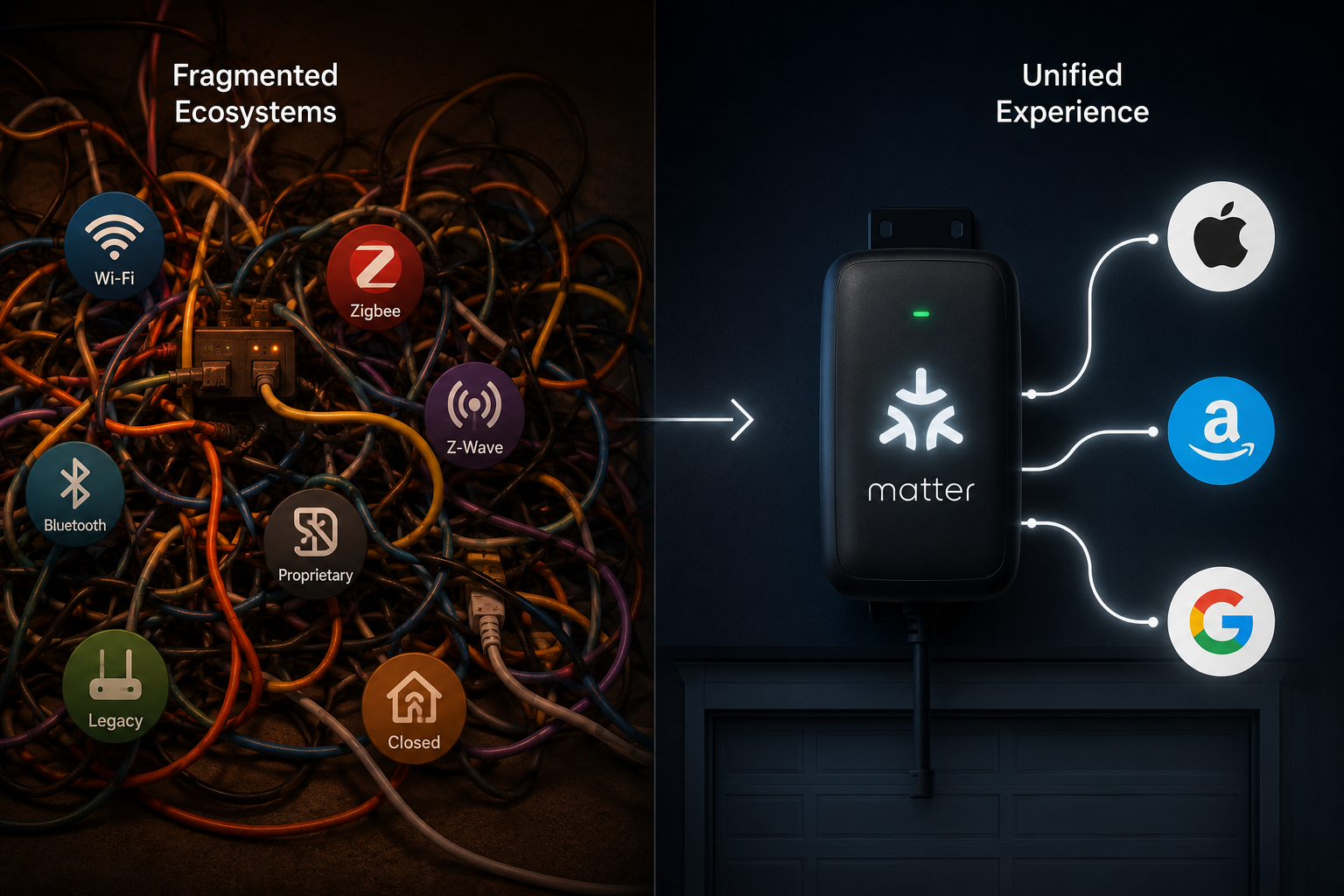
For most homeowners right now, a well-reviewed Wi-Fi opener is the more practical choice. Matter will be better in the long run, but the technology isn’t ready yet for garage doors specifically.
Wi-Fi openers today:
- Widely available from established brands.
- Work with Alexa, Google Home, or HomeKit, but often only one ecosystem per product.
- Depend on cloud servers; if the manufacturer shuts down or changes its API, functionality can break (the myQ situation in 2023-2024 is a cautionary example).
- Setup is generally straightforward.
Matter openers (when available):
- Will work natively with all major platforms simultaneously.
- Local processing means the opener works even if the manufacturer’s cloud goes offline.
- One app for commissioning, then control from any certified hub.
- Stronger, standardized security model.
Choose Wi-Fi now if: You need an opener today, your current ecosystem is locked in (e.g., you’re deep in the Apple Home ecosystem and HomeKit-compatible openers already work well for you), or you want proven reliability.
Wait for Matter if: You’re building a new home, doing a full smart home renovation, or your current opener still has several years of life left and you can afford to wait.
For homeowners weighing a full garage door installation alongside smart tech, timing the opener choice with Matter availability could save a second upgrade cost down the road.
How Much Will Matter Garage Door Openers Cost
Exact pricing is not confirmed because no major brand has announced a Matter-native garage opener with a retail price. Based on current smart opener pricing and the typical premium for new-standard devices at launch, here are reasonable estimates.
Estimated cost ranges (CAD, 2026 estimates based on current smart opener market):
- Matter-native opener unit: CAD $250 to $500 (comparable to current premium Wi-Fi openers at launch).
- Matter add-on controller (retrofit): CAD $80 to $150, based on current relay-style controllers like Third Reality’s offering.
- Hub (if not already owned): CAD $100 to $180 for a compatible smart hub.
- Professional installation: CAD $150 to $300 depending on complexity.
These are estimates based on market patterns, not confirmed prices. Early adopter pricing at launch often carries a 15 to 25 percent premium over the settled market price 12 months later.
For context on how to evaluate any smart garage upgrade quote, this guide on reading a garage door quote breaks down what each line item actually covers.
Can I Use Matter with My Existing Smart Home Setup
Yes, in most cases, Matter is specifically designed to work across Apple Home, Amazon Alexa, Google Home, and Samsung SmartThings simultaneously. If you already use one or more of these platforms, a Matter garage door device will integrate without a separate brand-specific app or bridge.
Requirements for your existing setup:
- At least one Matter-certified hub or border router (most current-generation smart speakers and displays qualify).
- A Wi-Fi network running 2.4 GHz or 5 GHz (Thread devices also need a Thread border router, which is built into recent Apple and Google hubs).
- iOS 16.2+ or Android with the Google Home app (version supporting Matter commissioning).
What changes:
- You commission the device once using a QR code scan.
- After commissioning, the device appears in all linked ecosystems automatically, no manual re-pairing.
- Automations you’ve built in one platform can trigger the garage door without cross-platform workarounds.
What doesn’t change:
- Your existing non-Matter smart devices keep working as-is.
- Matter is additive, not a replacement for your current setup.
What Are the Benefits of Matter for Garage Doors
The core benefit of Matter Protocol for Garage Doors is interoperability combined with local control. These two features address the two biggest pain points of current smart garage systems: ecosystem lock-in and cloud dependency.
Key benefits broken down:
- Cross-platform control: One opener works with Apple Home, Alexa, and Google Home simultaneously. No choosing sides.
- Local processing: Commands execute on your home network, not through a manufacturer’s cloud server. The opener responds even during internet outages.
- Standardized security: Matter uses certificate-based authentication and end-to-end encryption, which is a meaningful step up from older openers that used fixed rolling codes or basic Wi-Fi authentication.
- Future-proofing: A Matter-certified opener will remain compatible as the standard evolves, reducing the risk of a product becoming unsupported.
- Simplified setup: One commissioning process covers all platforms.
- Status reporting: The Matter spec for garage doors (when finalized) will include standardized obstruction detection and position reporting, making automations more reliable.
For homeowners who have already invested in battery backup systems, Matter’s local processing pairs well with that investment. A battery backup garage door opener that also runs Matter locally means the door stays smart and operable during both internet and power outages.
Matter Garage Door Security: How Safe Is It
Matter is more secure than most current proprietary smart garage systems. The standard uses device attestation (each device has a unique cryptographic certificate), mutual authentication between device and hub, and encrypted communication over the local network.
Security features in Matter:
- Device attestation: Every certified Matter device carries a manufacturer-issued certificate. Counterfeit or uncertified devices cannot join a Matter network.
- Encrypted local communication: Traffic between the opener and hub is encrypted, reducing the risk of interception on the local network.
- No mandatory cloud relay: Because commands process locally, there’s no cloud server that can be breached to access your garage.
- Access control: Multi-admin support means multiple platforms can control the device, but each requires explicit authorization.
Remaining considerations:
- The hub itself becomes a security-critical device. A compromised hub (weak password, unpatched firmware) remains a vulnerability regardless of Matter’s own security.
- Physical security of the garage door is unchanged, a Matter opener still uses the same mechanical components.
- Workaround solutions using relay modules (current “Matter-ish” products) may not carry the full Matter security model, since they’re not using a certified garage door device type.
Do All Smart Hubs Work with Matter Garage Doors and What Devices Do I Need
Not all hubs are equal for Matter, and garage doors specifically will require a hub that supports the finalized garage door device type once it’s published. Most current-generation hubs will receive this via firmware update.
Confirmed Matter-compatible hubs (as of 2026):
- Apple HomePod mini (2nd gen) and HomePod (2nd gen), also Thread border routers.
- Amazon Echo (4th gen and newer).
- Google Nest Hub (2nd gen) and Nest Hub Max.
- Samsung SmartThings Station and Hub v3.
- Apple TV 4K (3rd gen), doubles as a Thread border router.
What you need to control a Matter garage door:
- A Matter-certified garage door opener or controller (not yet widely available).
- One of the hubs listed above on your home network.
- A smartphone with the hub’s app for initial commissioning.
- A stable 2.4 GHz or 5 GHz Wi-Fi network (or Thread if the device uses it).
What you do not need:
- The opener brand’s proprietary app after initial setup.
- A separate bridge or hub specific to the opener brand.
- A subscription service (Matter itself has no subscription model).
Common Problems with Matter Garage Door Setup
Because native Matter garage door products don’t exist yet, the most common problems today come from workaround implementations. These are worth understanding before investing in a current “Matter-compatible” controller.
Problem 1: Device type mismatch Controllers using a generic switch or contact sensor device type in Matter may not expose all expected controls in your smart home app. You might see “on/off” instead of “open/close,” which can confuse automations.
Problem 2: Hub dependency for relay solutions Products like Aqara’s Dual Relay Module T2 require an Aqara hub to bridge into Matter. If the hub goes offline, Matter control is lost. This partially defeats the local-processing advantage.
Problem 3: Obstruction detection gaps Current relay-based solutions don’t always report obstruction status to the Matter network, meaning safety automations (like “don’t close if something is in the way”) may not work reliably.
Problem 4: Thread vs. Wi-Fi confusion Some Matter devices use Thread (a mesh protocol) rather than direct Wi-Fi. If your hub isn’t a Thread border router, Thread-based garage controllers won’t commission correctly.
Problem 5: Firmware update requirements Hubs frequently require firmware updates to support new Matter device types. If your hub’s manufacturer is slow to update, new devices may not be recognized.
For general opener troubleshooting unrelated to Matter, the garage door opener repair page covers the most common mechanical and electronic fault patterns.
Is a Matter Garage Door Worth Upgrading To
For most homeowners in mid-2026, waiting is the smarter move. The technology isn’t finalized, the product selection is thin, and the workaround solutions carry compromises that undercut Matter’s main advantages.
Upgrade now if:
- Your current opener is failing and needs replacement anyway.
- You’re installing a new opener as part of a larger renovation (consider a Matter-ready opener or a Wi-Fi opener you’re comfortable replacing in 2 to 3 years).
- You want to experiment with current relay-based solutions and understand their limitations.
Wait if:
- Your current opener works reliably.
- You want the full Matter experience (true cross-platform, local control, certified security).
- You prefer not to pay an early-adopter premium.
What to do in the meantime:
- Note your opener’s model and check whether the manufacturer has announced a Matter upgrade path.
- Ensure your smart hub is Matter-certified so you’re ready when products arrive.
- If your opener is aging, address mechanical maintenance now so it lasts until Matter products are available. A broken garage door spring or worn cables are worth fixing before layering smart tech on top of a mechanically unreliable door.
What Happens If Matter Loses Connection to the Garage Door
Matter’s local-first design means a loss of internet connectivity does not stop the opener from working, as long as your home network is up. However, if the hub itself goes offline or the local network fails, control through Matter apps will be interrupted.
Scenario breakdown:
- Internet goes down: Matter still works. Commands route through your local network to the hub to the opener. Voice assistants that require cloud processing (like some Alexa routines) may not function, but direct app control will.
- Hub goes offline: Matter control is lost until the hub restarts. The opener’s physical wall button and remote always work independently.
- Wi-Fi network fails: Same result as hub going offline for Wi-Fi-based Matter devices. Thread-based devices on a mesh network may maintain partial connectivity.
- Power outage: The opener itself loses power unless it has a battery backup. Matter connectivity is irrelevant if the opener motor has no power.
This is why pairing a Matter opener with a battery backup system makes practical sense. If the grid goes down, a battery-backed opener keeps the door functional, and Matter’s local processing means smart control can resume as soon as power is restored to the hub.
FAQ
Does Matter work with garage doors right now? Not in a fully certified, native way. As of July 2026, the Matter specification does not include a finalized garage door device type. Some controllers use workarounds (relay modules, generic switch device types) to approximate Matter control, but these are not true Matter garage door implementations.
What version of Matter will include garage doors? The CSA has not publicly confirmed which version number will include the garage door cluster. Based on the spec’s rolling release pattern, it is likely to appear in a version after 1.4, potentially in late 2026 or 2027.
Can I add Matter to my existing LiftMaster or Chamberlain opener? Not currently through official channels. Chamberlain’s myQ ecosystem has not announced a Matter bridge or firmware path. Third-party relay controllers may offer a workaround, but compatibility varies by opener model.
Will Matter garage door openers work without internet? Yes. Matter processes commands locally on your home network. As long as your hub and local network are running, the opener works without an active internet connection.
Do I need a subscription to use a Matter garage door opener? No. Matter itself has no subscription model. Individual manufacturer apps may offer optional paid features, but the core Matter control layer is subscription-free.
Is myQ compatible with Matter? As of mid-2026, myQ is not Matter-compatible. Chamberlain has restricted third-party API access, and no official Matter integration has been announced.
What is the difference between Matter and Thread for garage doors? Matter is the application-layer standard (the language devices speak). Thread is a network transport protocol (how data travels). A Matter garage door opener could use either Wi-Fi or Thread as its transport. Thread requires a border router (built into recent Apple and Google hubs) but offers lower latency and better mesh reliability.
Can I control a Matter garage door when I’m away from home? Yes, through remote access provided by your hub platform. Apple Home, Google Home, and Alexa all support remote access to Matter devices as long as your hub is online and connected to the internet.
Will my current smart home automations work with a Matter garage door? Yes, once a Matter garage door device is commissioned into your hub, it appears as a standard device in your automation platform. Existing automations (like “close garage at sunset”) can be updated to include it.
How long does Matter commissioning take for a garage door? For devices that follow the standard commissioning process, initial setup typically takes 2 to 5 minutes: scan a QR code, connect to the local network, and the device appears across all linked platforms.
Is a relay-based Matter garage controller safe to use? Relay-based controllers are generally safe for the door mechanism, but they don’t carry the full Matter security model since they use generic device types. For security-critical applications, waiting for a certified Matter garage door device type is advisable.
What should I do now to prepare for Matter garage doors? Ensure at least one Matter-certified hub is on your home network, keep your opener’s firmware updated, and address any mechanical issues with the door itself so it’s in good condition when you’re ready to upgrade.
Conclusion
The story of Matter Protocol for Garage Doors is essentially a story of a standard that’s almost there. The underlying technology is sound, the manufacturer interest is real, and the CSA’s spec process is moving forward, but the finalized garage door device type hasn’t landed yet, and that gap matters for anyone trying to make a purchase decision today.
Actionable next steps for homeowners in 2026:
- Audit your current opener. If it’s more than 7 years old or showing signs of wear, schedule a garage door tune-up to assess whether it’s worth maintaining until Matter products arrive.
- Check your hub. Verify that your smart home hub is Matter-certified. If not, the next hub purchase should be.
- Watch the CSA spec releases. When a garage door cluster appears in a published Matter spec version, certified products will follow within 6 to 12 months.
- Evaluate workaround solutions carefully. Products like Third Reality’s controller or Aqara’s relay module can work, but go in with clear expectations about their limitations versus true Matter.
- Don’t rush a replacement. If your current opener works, the best financial move is to wait for the first wave of certified Matter garage door openers, compare options, and upgrade once the standard is proven.
The foundation of a smart garage isn’t just the opener, it’s a mechanically sound door that the opener doesn’t have to fight. Addressing springs, cables, and balance issues now means the smart upgrade, when it comes, will actually work the way it’s supposed to.