Last updated: July 1, 2026
Quick Answer: Cold weather causes garage door keypads to fail primarily because alkaline batteries lose 30 to 50 percent of their effective capacity below freezing. After a cold snap, a battery that was already marginal simply cannot deliver enough voltage to power the keypad. In most cases, swapping in a fresh battery — ideally a lithium 9V — restores full function within minutes, no reprogramming required.
Key Takeaways
- Alkaline 9V batteries lose 30 to 50 percent of their effective capacity in sub-zero temperatures, which is the most common reason a garage door keypad stopped working after the cold snap.
- A keypad that “magically” works again when temperatures rise is a classic sign of a battery problem, not a broken unit.
- Lithium 9V batteries maintain voltage far better in cold climates and are the recommended upgrade for Ontario winters.
- Moisture and condensation can cause terminal corrosion inside the keypad housing; wiping contacts during a battery swap often restores reliable operation.
- If the keypad still fails after a fresh battery, check for lost programming, frozen door hardware, or internal corrosion before assuming the unit needs replacement.
- Keypads and remotes respond differently to cold because remotes sit inside a warmer car most of the time; a working remote paired with a dead keypad almost always points to the outdoor battery.
- Replacement keypads cost roughly $30 to $80 for the unit; professional installation and programming typically adds $50 to $100.
- Sealing the keypad housing with weatherstripping tape and keeping a spare lithium battery on hand are the two most effective prevention steps.
Why Does Cold Weather Affect Garage Door Keypads?
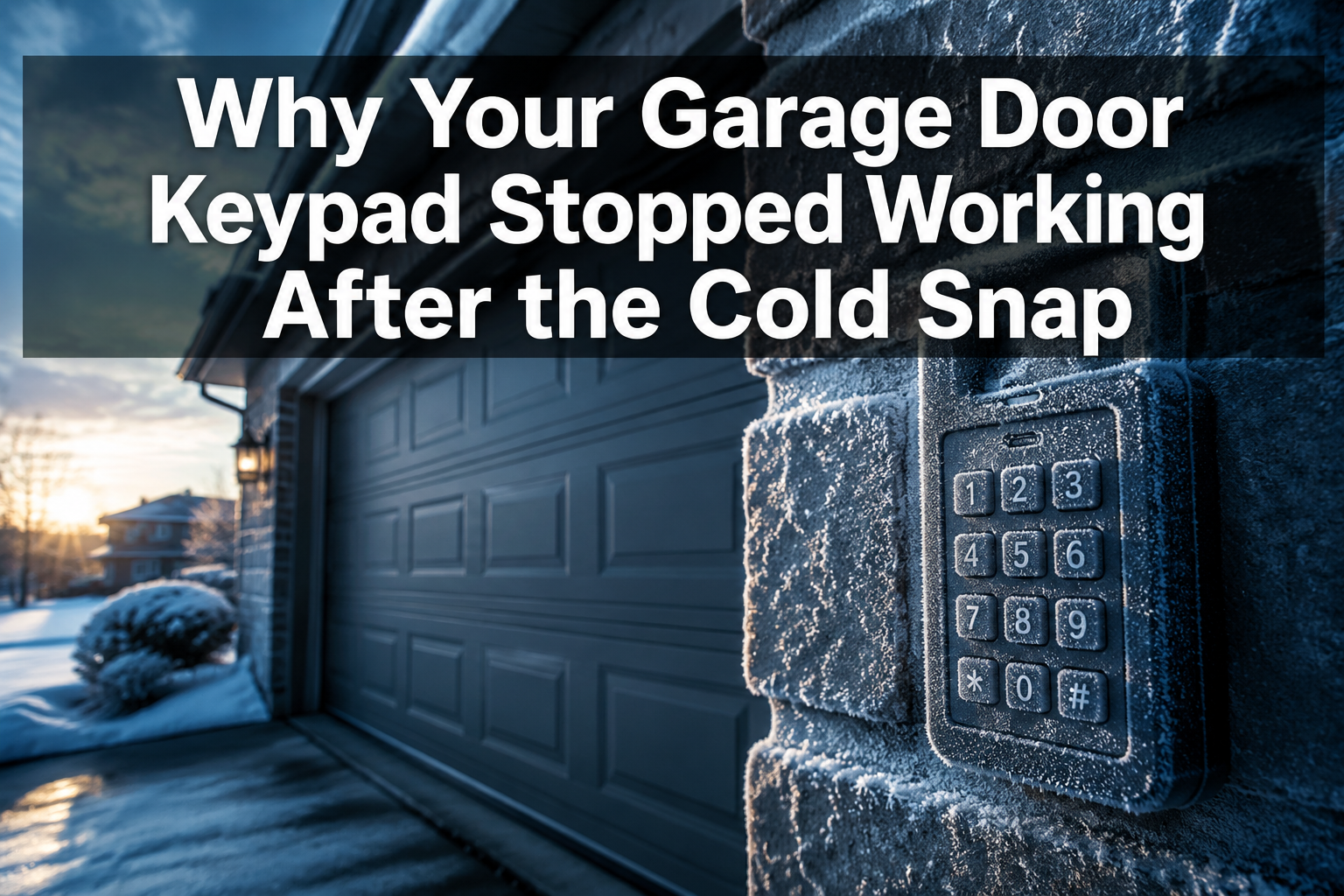
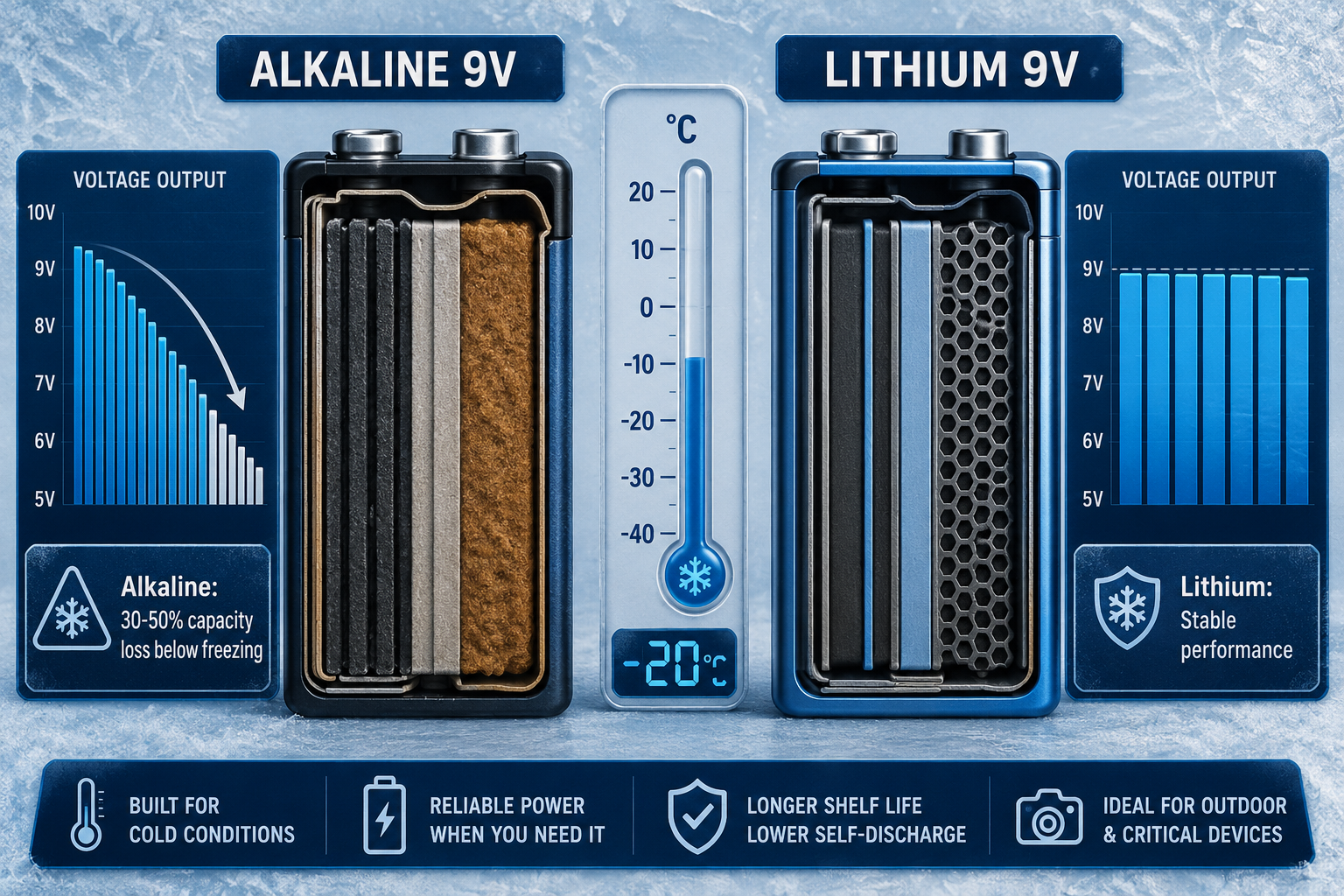
Cold weather affects garage door keypads because the electrochemical reaction inside a standard alkaline battery slows dramatically as temperature drops. Below 0°C (32°F), a 9V alkaline battery can lose 30 to 50 percent of its usable capacity. The keypad may still appear to have power — the display might flicker — but there is not enough sustained voltage to complete a signal to the opener.
Here is what happens at the component level:
- Battery chemistry slows: Alkaline batteries rely on a liquid electrolyte that thickens in the cold, reducing ion flow and voltage output.
- Plastic housing contracts: Minor contraction of the keypad casing can loosen internal contacts, making an already-weak battery connection intermittent.
- Moisture enters and freezes: Temperature swings cause condensation inside the housing. That moisture can freeze around the battery terminals, adding resistance or causing corrosion.
- Membrane keys stiffen: The rubber or silicone membrane under the keys becomes less responsive in extreme cold, requiring more force to register a press.
The result is a keypad that worked fine in October but goes completely silent after the first hard freeze of the season. The cold snap did not break the unit — it simply exposed a battery that was already running low.
Do Garage Door Keypads Stop Working in Cold? What Temperature Is the Threshold?
Yes, garage door keypads can and do stop working in cold weather, and the failure threshold is lower than most homeowners expect. Alkaline batteries begin losing meaningful capacity around 0°C (32°F) and can fail to power a keypad reliably at temperatures below -10°C (14°F). In Ontario winters, where temperatures regularly reach -15°C to -25°C, this is a very real risk.
Temperature reference guide for alkaline 9V batteries:
| Temperature | Approximate Usable Capacity |
|---|---|
| +20°C (68°F) | 100% (rated capacity) |
| 0°C (32°F) | 70 to 80% |
| -10°C (14°F) | 50 to 60% |
| -20°C (-4°F) | 30 to 40% |
| -30°C (-22°F) | Below 30% — likely failure |
Lithium 9V batteries maintain roughly 80 to 90 percent of their rated capacity even at -20°C, which is why technicians recommend them for any keypad mounted on an exterior wall in a cold climate.
Common mistake: Many homeowners replace the battery in autumn with a standard alkaline bought at a dollar store. That battery enters winter already at partial capacity from sitting on a shelf, then fails completely during the first serious cold snap.
Garage Door Keypad Not Responding in Winter: Is It Broken or Just Cold?
A keypad that is not responding in winter is far more likely to be suffering from a cold-related battery issue than a genuine hardware failure. The fastest way to tell the difference is to warm the keypad up.
Quick diagnostic test:
- Bring the keypad (or the whole exterior unit if it is removable) indoors for 20 to 30 minutes.
- If it works after warming up, the problem is the battery or cold-related contact issues — not a broken keypad.
- If it still does not work after warming, proceed to a battery swap and terminal cleaning.
Signs pointing to “just cold” rather than “actually broken”:
- The keypad worked fine before the cold snap with no other issues.
- The display flickers or lights up dimly but does not complete a command.
- A remote control still opens the door (confirming the opener itself is fine).
- The keypad resumes working on warmer days.
Signs pointing to a genuinely broken keypad:
- Visible cracks in the housing that have allowed water intrusion.
- Specific keys no longer register even after a fresh battery and cleaning.
- The unit is more than 7 to 10 years old and has had recurring issues.
- Green or white corrosion is severe and has spread to the circuit board.
If you are seeing any of the signs above alongside a cold snap, it may be time to look at garage door opener repair options rather than just a battery swap.
How to Fix a Frozen or Cold-Affected Garage Door Keypad: Step-by-Step
Fixing a garage door keypad that stopped working after the cold snap is usually a straightforward battery replacement. Follow these steps before calling a technician.
What you will need:
- A new 9V lithium battery (preferred) or fresh alkaline
- A small flathead or Phillips screwdriver
- A dry cloth or cotton swab
- Optionally: a can of electronics contact cleaner
Step-by-step fix:
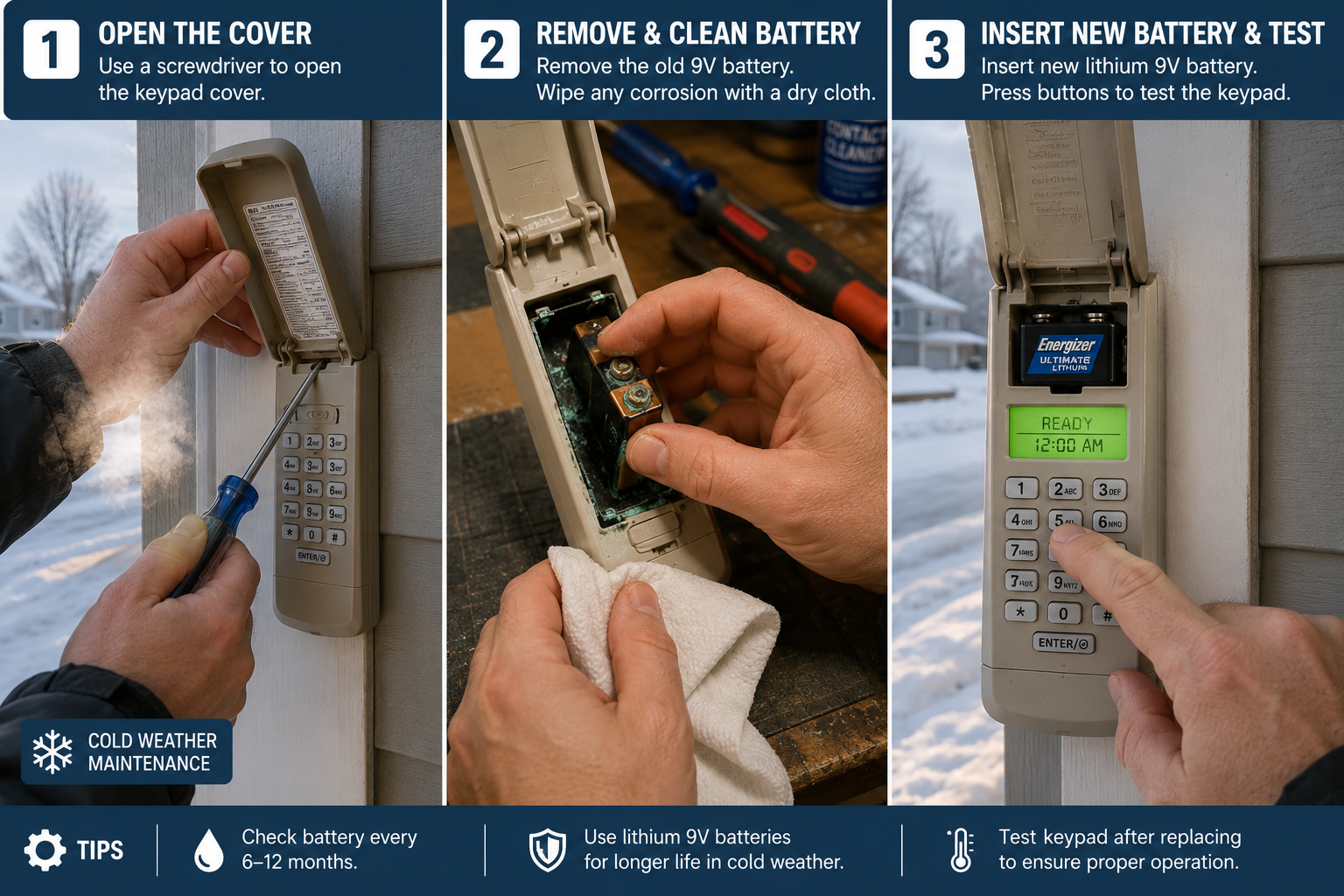
- Locate the battery compartment. On most keypads, it is behind a small panel on the back or bottom of the unit. Some models require a screwdriver; others snap open by hand.
- Remove the old battery. Note any white or green residue on the metal connector clips — this is corrosion.
- Clean the terminals. Wipe corrosion off the connector clips with a dry cloth or cotton swab. If corrosion is heavy, a small amount of electronics contact cleaner helps. Dry thoroughly before inserting a new battery.
- Insert the new 9V battery. A lithium battery is the better choice for an exterior keypad in a cold climate.
- Test the keypad. Enter your PIN. In most cases, the keypad will work immediately without reprogramming.
- Reprogram if needed. If the keypad does not respond after a fresh battery, the unit may have lost its learned code — especially if the battery was completely dead for an extended period. Follow the manufacturer’s programming steps or see the guide on keypad and remote programming for detailed instructions.
- Seal the housing. After confirming operation, check the gasket around the keypad cover. If it is cracked or missing, apply a thin bead of clear weatherstripping tape to reduce future moisture entry.
Edge case: If the door itself does not respond even after the keypad is confirmed working, the problem may be mechanical — frozen hardware, stiff springs, or a frozen bottom seal. This is a separate issue from the keypad and is covered in the section below.
Garage Door Keypad Battery Drain in Cold Weather: Why It Happens Faster Than You Think
Battery drain accelerates in cold weather for reasons that go beyond simple chemistry. An exterior keypad mounted on a north-facing wall or in a shaded area can sit at temperatures well below the ambient air temperature, especially overnight. That sustained cold draws down the battery even when the keypad is idle, because the unit’s standby circuitry still consumes a small amount of power continuously.
Factors that speed up cold-weather battery drain:
- Repeated failed attempts: When a cold battery cannot complete a signal, many homeowners press the keys multiple times. Each attempt draws current, depleting the battery faster.
- Backlit displays: Keypads with illuminated displays draw more power than basic unlit models, accelerating drain in cold conditions.
- Old or cheap batteries: Batteries stored in a warm warehouse and then placed in a cold keypad experience a rapid transition that accelerates capacity loss.
- Partial corrosion: Even minor terminal corrosion increases internal resistance, forcing the battery to work harder to deliver the same voltage.
For homeowners in the Oakville, Burlington, or Hamilton area — where temperatures can stay below -10°C for weeks at a time — keeping a spare lithium 9V battery in the house and replacing it every autumn is the single most effective maintenance step. You can also read more about how Ontario’s climate affects garage door components in the guide on best garage door lubricant for Ontario’s climate.
Garage Door Keypad Troubleshooting After Freezing: Beyond the Battery
Once a fresh battery is confirmed and the keypad still does not work, the troubleshooting process moves to a short list of secondary causes. Cold weather can expose underlying problems that were dormant during warmer months.
Secondary causes to check:
1. Lost programming If the battery was completely dead for more than a few days, some keypads lose their stored access code. The fix is reprogramming, which takes about five minutes. Consult your opener’s manual or the keypad and remote programming page for model-specific steps.
2. Frozen door hardware — not a keypad problem A keypad can send a perfect signal and the door still will not open if the hardware is frozen. Check for:
- Ice at the bottom seal bonding the door to the floor
- Thickened or frozen lubricant on the tracks and rollers
- A torsion spring that has snapped in the cold (a loud bang the previous night is a strong clue)
If the opener motor runs but the door does not move, the problem is mechanical. See the guide on broken garage door spring warning signs for next steps.
3. Internal corrosion on the circuit board Moisture that has been entering the keypad housing over multiple seasons can corrode the circuit board itself. Signs include:
- Visible green or white buildup beyond the battery terminals
- Intermittent operation that does not follow any temperature pattern
- Certain keys that never register regardless of battery condition
At this point, replacement is usually more cost-effective than repair.
4. Wiring issues (hardwired keypads) Some older or commercial-grade keypads connect to the opener via low-voltage wiring rather than a wireless signal. Cold temperatures can cause wire insulation to crack and connections to loosen at terminal blocks. If the unit is hardwired, check for loose or corroded wire connections at both the keypad and the opener head.
5. Opener receiver interference In rare cases, a cold snap can affect the opener’s radio receiver rather than the keypad itself. Test with the handheld remote. If the remote also fails, the issue is with the opener — not the keypad.
For issues that go beyond a battery swap, same-day garage door repair in Oakville can diagnose and resolve most cold-weather failures quickly.
Garage Door Keypad vs. Remote in Cold Weather: Which Handles Cold Better?
Remotes generally outperform exterior keypads in cold weather because they spend most of their time inside a warm vehicle or home. The battery in a remote is rarely exposed to sustained sub-zero temperatures, so it retains more of its capacity. An exterior keypad, by contrast, sits outside 24 hours a day and takes the full force of a cold snap.
Key differences:
| Factor | Exterior Keypad | Handheld Remote |
|---|---|---|
| Battery exposure to cold | Continuous, 24/7 | Minimal (stored indoors) |
| Battery type | 9V (alkaline or lithium) | CR2032 or AA (often alkaline) |
| Cold-weather failure rate | Higher | Lower |
| Moisture exposure | High (mounted outside) | Low |
| Convenience if battery fails | Must go outside to fix | Can replace indoors |
Practical takeaway: If the remote works but the keypad does not, the keypad battery is almost certainly the cause. If both fail at the same time, suspect the opener’s receiver or a power issue with the opener itself. For opener-specific problems, the garage door opener repair service covers both diagnosis and same-day repair.
How to Prevent Your Garage Door Keypad from Freezing or Failing in Winter
Preventing cold-weather keypad failures is straightforward and inexpensive. Most of the steps take less than 15 minutes and cost under $20.
Prevention checklist:
- Switch to lithium batteries before winter. Replace the 9V alkaline in the keypad each October with a lithium 9V. Lithium batteries hold their charge far better in cold and last longer overall.
- Inspect the housing seal. Check the gasket or foam seal around the keypad cover. Replace it if cracked or compressed. A tight seal keeps moisture out and reduces condensation inside the unit.
- Keep a spare battery indoors. Store a spare lithium 9V in the house so a failed keypad can be fixed in under five minutes without a trip to the hardware store.
- Clean terminals annually. During the autumn battery swap, wipe the connector clips with a dry cloth even if they look clean. Early-stage corrosion is often invisible to the naked eye.
- Consider a keypad cover or canopy. Small plastic covers that mount above the keypad block direct snow and ice accumulation. They are available at most hardware stores for under $15.
- Do not mount a new keypad in a fully exposed location. If replacing a unit, choose a position on the door jamb that has some overhang protection from the eave above.
These steps also apply to the broader category of cold-weather garage door maintenance. For a full seasonal checklist, the battery backup garage door openers guide covers related winter preparation topics.
Garage Door Keypad Reset After Cold Weather: When and How to Reprogram
A keypad reset is needed after cold weather when the unit has lost its stored access code — usually because the battery was completely dead for an extended period. Not every cold-weather failure requires reprogramming; a simple battery swap restores operation in most cases.
When reprogramming is needed:
- The keypad has a fresh battery but pressing the PIN produces no response from the opener.
- The keypad display lights up normally but the door does not move.
- The battery was dead for more than a few days before replacement.
General reprogramming steps (vary by brand):
- Locate the “Learn” button on the opener motor head (usually a colored button near the antenna wire).
- Press and release the Learn button — the indicator light will turn on for about 30 seconds.
- Within those 30 seconds, enter your desired PIN on the keypad and press the Enter or Send button.
- The opener light should flash or the motor should click, confirming the new code is stored.
- Test by entering the PIN from a normal distance.
For brand-specific steps covering LiftMaster, Chamberlain, Genie, and other common openers, the keypad and remote programming guide provides model-by-model instructions.
Note: If the keypad still does not respond after reprogramming with a fresh battery, the unit likely has internal damage and should be replaced.
Garage Door Keypad Replacement Cost vs. Repair: What Makes Sense in 2026?
In 2026, replacing a garage door keypad is almost always more cost-effective than repairing one. Keypads are low-cost commodity items, and the labor involved in diagnosing and repairing internal circuit damage typically exceeds the cost of a new unit.
Typical costs:
| Item | Estimated Cost (CAD) |
|---|---|
| Replacement 9V lithium battery | $8 to $15 |
| New universal keypad (DIY install) | $30 to $60 |
| Brand-specific OEM keypad | $50 to $100 |
| Professional keypad installation + programming | $50 to $100 labor |
| Full keypad replacement (parts + labor) | $100 to $200 total |
Choose repair (battery swap + cleaning) if:
- The keypad is less than 5 years old and has no visible cracks or heavy corrosion.
- All keys still register correctly after warming up.
- The failure started immediately after a cold snap with no prior issues.
Choose replacement if:
- The unit is more than 7 to 10 years old.
- Specific keys no longer register regardless of temperature or battery condition.
- The housing has visible cracks that have allowed water intrusion.
- Corrosion has spread beyond the battery terminals to the circuit board.
- Repeated battery swaps over multiple winters have only provided temporary fixes.
A new keypad is a minor expense relative to the convenience and security it provides. If you are also noticing other issues — a door that reverses unexpectedly, unusual noises, or slow response — it may be worth a broader inspection. The guide on 5 signs you need garage door repair now covers the indicators that warrant a professional visit.
FAQ: Garage Door Keypad Cold Weather Problems
Q: Why does my garage door keypad work in the afternoon but not in the morning? Morning temperatures are colder, which reduces battery voltage below the threshold needed to power the keypad. As the day warms up, the battery recovers enough capacity to function. This is a reliable sign the battery needs replacing.
Q: Can I use AA or AAA batteries in my garage door keypad? Most exterior keypads use a single 9V battery. Some newer models use two AA batteries. Check the battery compartment label or your owner’s manual — using the wrong battery type will prevent the unit from working at all.
Q: Does cold weather damage the keypad permanently? Cold alone rarely causes permanent damage. The risk is moisture: condensation that forms during temperature swings can cause corrosion over time. A keypad that has been exposed to moisture repeatedly over several winters may develop permanent circuit damage, but a single cold snap typically does not destroy a unit.
Q: My keypad has a fresh battery but still does not work. What next? Check whether the keypad has lost its programming and needs to be re-paired with the opener. Also confirm that the opener itself is working by testing with the handheld remote. If the remote works but the keypad does not after reprogramming, the keypad likely needs replacement.
Q: How often should I replace the battery in my exterior keypad? Replace it every 12 months as part of autumn maintenance, regardless of whether it appears to be failing. Using a lithium 9V battery extends the reliable service period, but an annual swap eliminates cold-weather surprises.
Q: Will my keypad lose its code if I replace the battery? Usually not. Most keypads retain their stored PIN during a quick battery swap. Code loss is more likely if the battery was completely dead for several days before replacement.
Q: My garage door opener runs but the door does not open. Is that a keypad problem? No. If the opener motor activates, the keypad signal is working. The problem is mechanical — likely a broken spring, frozen bottom seal, or obstruction. This requires a different repair approach than a keypad fix.
Q: Is a universal replacement keypad compatible with my opener? Most universal keypads are compatible with major brands including LiftMaster, Chamberlain, Genie, and Craftsman. Check the product’s compatibility list before purchasing. Brand-specific OEM keypads are always a safe choice but cost more.
Q: Can extreme cold damage the opener receiver and cause keypad-like symptoms? Yes, though it is uncommon. If both the keypad and the remote fail simultaneously after a cold snap, the opener’s receiver or logic board may be affected. This requires professional diagnosis.
Q: How do I know if my keypad has corrosion I cannot see? Open the battery compartment and look at the metal connector clips. Green or white powdery residue indicates corrosion. If the clips look clean but the unit still fails after a fresh battery, internal corrosion on the circuit board is possible and the unit should be replaced.
Q: Does a smart or Wi-Fi keypad handle cold better than a standard model? Smart keypads have more electronics and can be more sensitive to cold and moisture. However, models designed for exterior use have improved sealing. A smart keypad’s main advantage is remote monitoring and temporary code access, not cold-weather resilience.
Q: What if my keypad is hardwired rather than wireless? Hardwired keypads are not battery-dependent, but cold can crack wire insulation and loosen terminal connections. Check for loose wires at both the keypad and the opener head. If wiring looks intact, the keypad unit itself may need replacement.
Conclusion
Understanding why your garage door keypad stopped working after the cold snap comes down to one core fact: standard alkaline batteries lose a significant portion of their capacity in freezing temperatures, and a marginal battery that worked in October will often fail completely in January. The fix is almost always a fresh lithium 9V battery, a quick terminal cleaning, and occasionally a five-minute reprogramming session.
Actionable next steps:
- Replace the battery today with a lithium 9V if the keypad stopped working after a cold snap. Do not wait for warmer weather to confirm the diagnosis.
- Clean the terminals during the swap, even if they look fine. Early corrosion is invisible and adds resistance that shortens battery life.
- Reprogram if needed using the Learn button on the opener head. The process takes under five minutes for most brands.
- Inspect the housing seal and apply weatherstripping tape if the gasket is cracked or missing.
- Schedule a replacement if the unit is over 7 years old, has cracked housing, or has specific keys that no longer respond after a fresh battery.
- Call a professional if the door still does not operate after confirming the keypad is working — the issue may be a broken spring, frozen hardware, or an opener fault that needs expert attention.
For homeowners in Oakville, Burlington, Hamilton, and surrounding areas, cold-weather garage door issues are a routine part of winter. Most keypad failures are solved in under 10 minutes with a $10 battery. When the problem goes deeper, professional same-day service is available to get the door working safely before the next freeze.