Last updated: June 14, 2026
Quick Answer
A garage door off track in Oakville is a safety emergency that requires immediate action: disconnect the opener, do not attempt to run the door, and clear the area of people and vehicles. Minor roller misalignment on a door that is still largely in the track can sometimes be corrected by a careful homeowner, but any door that is hanging at an angle, has loose cables, or shows spring damage must be handled by a licensed technician. Same-day emergency repair services are available across Oakville and the surrounding area.
Key Takeaways
- A garage door that is visibly off track, hanging at an angle, or has loose cables is an automatic emergency — stop all use immediately and disconnect the opener.
- The most common causes in Oakville include impact damage, worn rollers, broken cables, loose hardware, and temperature-related track contraction during Ontario winters.
- DIY repair is only appropriate for very minor misalignment where the door is still largely seated in the track and no cables or springs are damaged.
- Emergency garage door repair in Oakville typically costs between $150 and $400 for a straightforward track realignment, with costs rising if cables, springs, or panels are also damaged.
- A misaligned track puts serious strain on the garage door opener motor and can cause permanent damage if the opener is run while the door is off track.
- Most standard homeowner insurance policies cover sudden accidental damage (such as a vehicle impact) but not wear-and-tear track failures.
- Older homes in Oakville — particularly those built before the 1990s — are more likely to have worn, undersized, or corroded track hardware that contributes to off-track events.
- The 2024 Ontario Building Code (in force since January 1, 2025) affects permit requirements for any repair that alters the door opening size or structural elements.
- Licensed Oakville technicians can typically complete a standard track repair in one to two hours.
- Annual maintenance, including lubrication and hardware checks, is the single most effective way to prevent off-track incidents.
How Do I Know If My Garage Door Is Completely Off Track
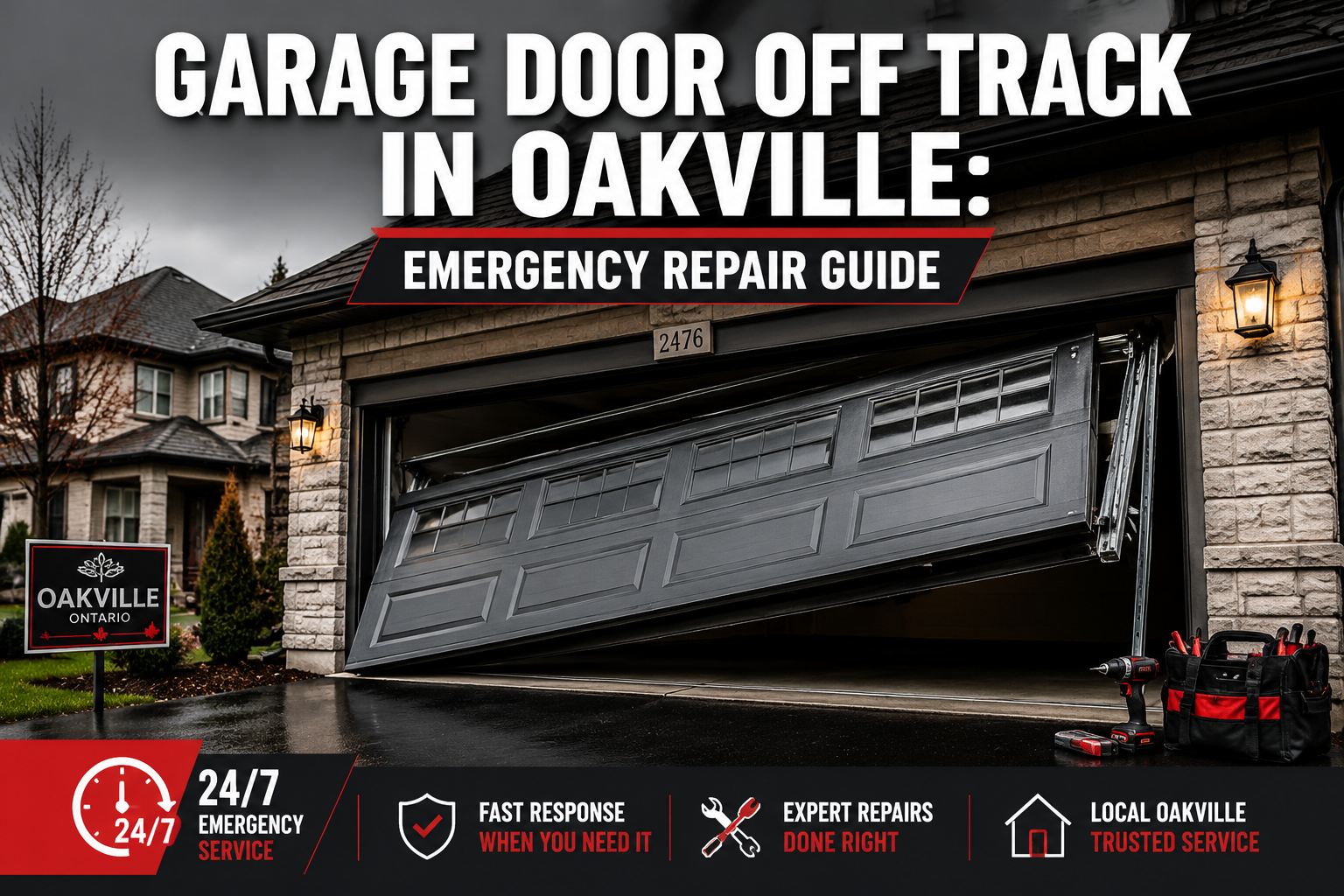
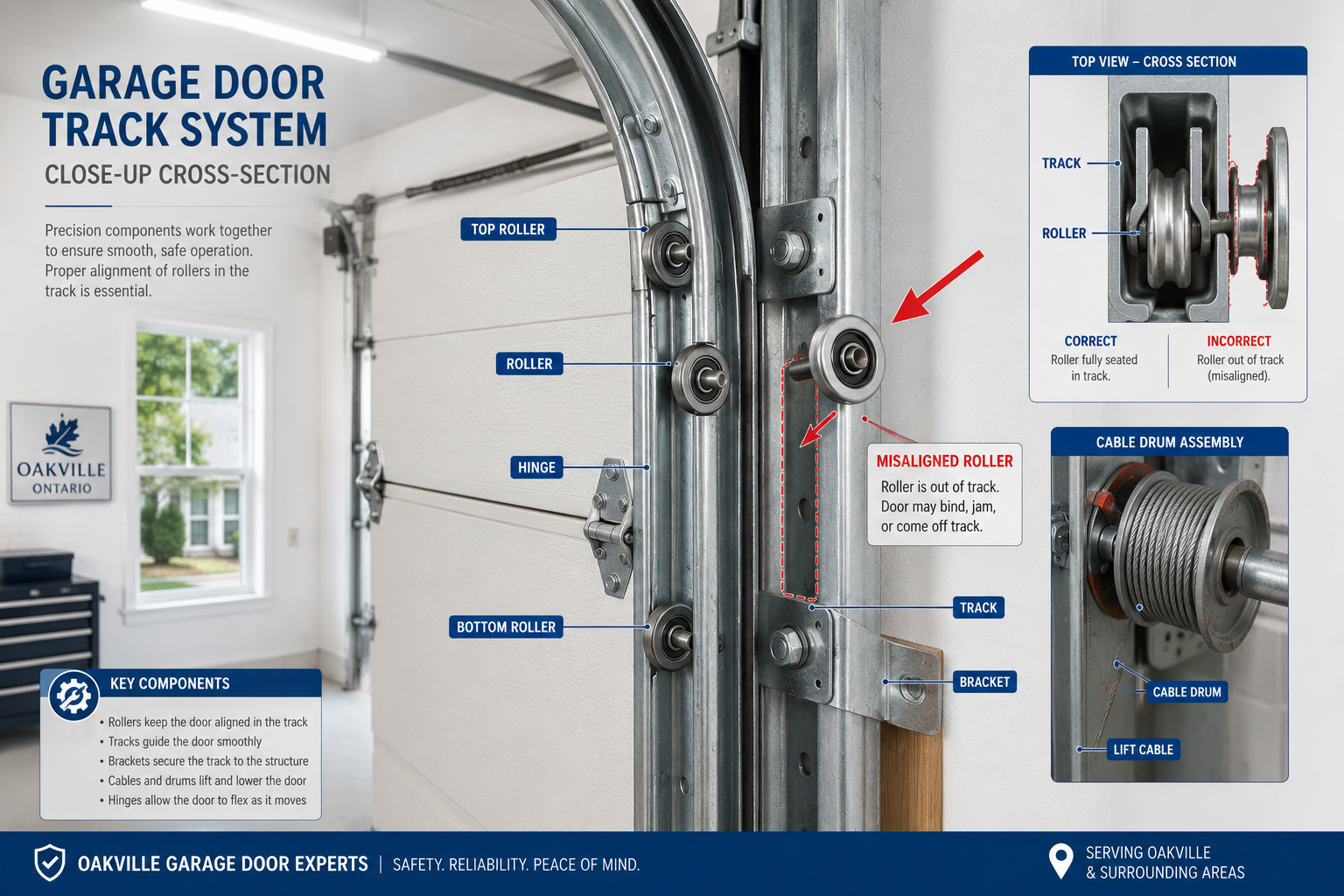
A garage door is off track when one or more rollers have left the track channel, causing the door to move unevenly, bind, or hang at an angle. You can confirm this by visually inspecting the rollers along both vertical tracks while the door is stationary and the opener is disconnected.
Signs your door is off track:
- The door moves unevenly or jerks during operation
- One side of the door is lower than the other
- You hear loud scraping, grinding, or popping sounds during movement
- The door stops partway and will not move further
- Rollers are visibly outside the track channel
- The door appears to lean or bow outward at one corner
- Cables are slack, looped, or lying on the floor
Signs it is a full emergency (stop all use immediately):
- The door is hanging at a noticeable angle
- Cables are visibly loose or detached
- The door moved while the opener was running and then stopped hard
- Any panel is bent or buckled near the track
If any of the emergency signs above are present, treat this as a serious hazard. Industry guidance from Barton Overhead Door (2026) classifies any door that is hanging at an angle or has loose cables as an “automatic emergency,” with the instruction to stop all use, cut power to the opener if it is safe to do so, and clear the area until a technician arrives.
For a broader checklist of warning signs that indicate urgent repair is needed, see 5 Signs You Need Garage Door Repair Near Me Now.
What Causes a Garage Door to Go Off Track in the First Place
The most common cause of an off-track garage door is physical impact — a vehicle bumping the door or a panel — but worn rollers, broken cables, loose hardware, and extreme temperature swings are nearly as frequent in the Oakville area.
Common causes, ranked by frequency in residential settings:
| Cause | How It Leads to Off-Track Event |
|---|---|
| Vehicle impact | Direct force knocks rollers out of track channel |
| Worn or broken rollers | Plastic or nylon rollers crack and slip out of track |
| Broken or frayed cable | One side loses tension; door drops unevenly |
| Loose track brackets | Track shifts inward or outward, roller loses guidance |
| Bent track section | Roller cannot pass the deformed section |
| Broken torsion or extension spring | Loss of counterbalance causes door to fall or jam |
| Debris in track | Object blocks roller path; door derails under force |
| Extreme cold (Ontario winters) | Metal tracks contract; clearance tightens and binds rollers |
Ontario’s climate adds a layer of risk that homeowners in warmer regions do not face. Steel tracks contract measurably in temperatures below -10°C, which can tighten the clearance around rollers and accelerate wear. Using the wrong lubricant — or no lubricant at all — compounds this. For guidance on the right products, see Best Garage Door Lubricant for Ontario Climate: Silicone vs Lithium.
A broken spring is one of the most dangerous underlying causes. If the door came off track at the same time you heard a loud bang, a spring failure is likely. See Broken Garage Door Spring: 7 Warning Signs and What to Do Next before attempting anything further.
Are Some Garage Door Track Issues More Serious Than Others
Yes. Track problems range from a single roller that has slipped slightly out of the channel (low risk, potentially DIY-able) to a door that is hanging by a cable with a broken spring (high risk, professional-only). The severity determines both the urgency and the appropriate response.
Severity tiers:
Tier 1 — Minor misalignment (lowest risk)
- One roller slightly out of the track
- Door still mostly level and moveable by hand
- No cable or spring damage visible
- Potentially correctable by a careful homeowner
Tier 2 — Moderate misalignment (moderate risk)
- Multiple rollers out of track
- Door noticeably uneven but not hanging freely
- Track bracket loose or slightly bent
- Professional repair strongly recommended
Tier 3 — Full derailment or structural damage (high risk)
- Door hanging at an angle or partially fallen
- Cables slack, looped, or detached
- Track visibly bent or pulled from wall
- Spring damage suspected or confirmed
- Professional-only; do not touch the door
A door in Tier 3 can fall without warning. The weight of a standard residential garage door ranges from approximately 130 to 350 pounds depending on material and insulation. Even a partial fall from that height is capable of causing serious injury.
Can I Fix a Garage Door Off Track by Myself or Do I Need a Pro
A homeowner can safely attempt a DIY fix only for Tier 1 situations: a single roller that has slipped slightly out of the track, where the door is still level, the opener is disconnected, and there is no cable or spring damage. Any situation beyond that requires a licensed technician.
When DIY is reasonable (Tier 1 only):
- Disconnect the opener by pulling the red emergency release cord.
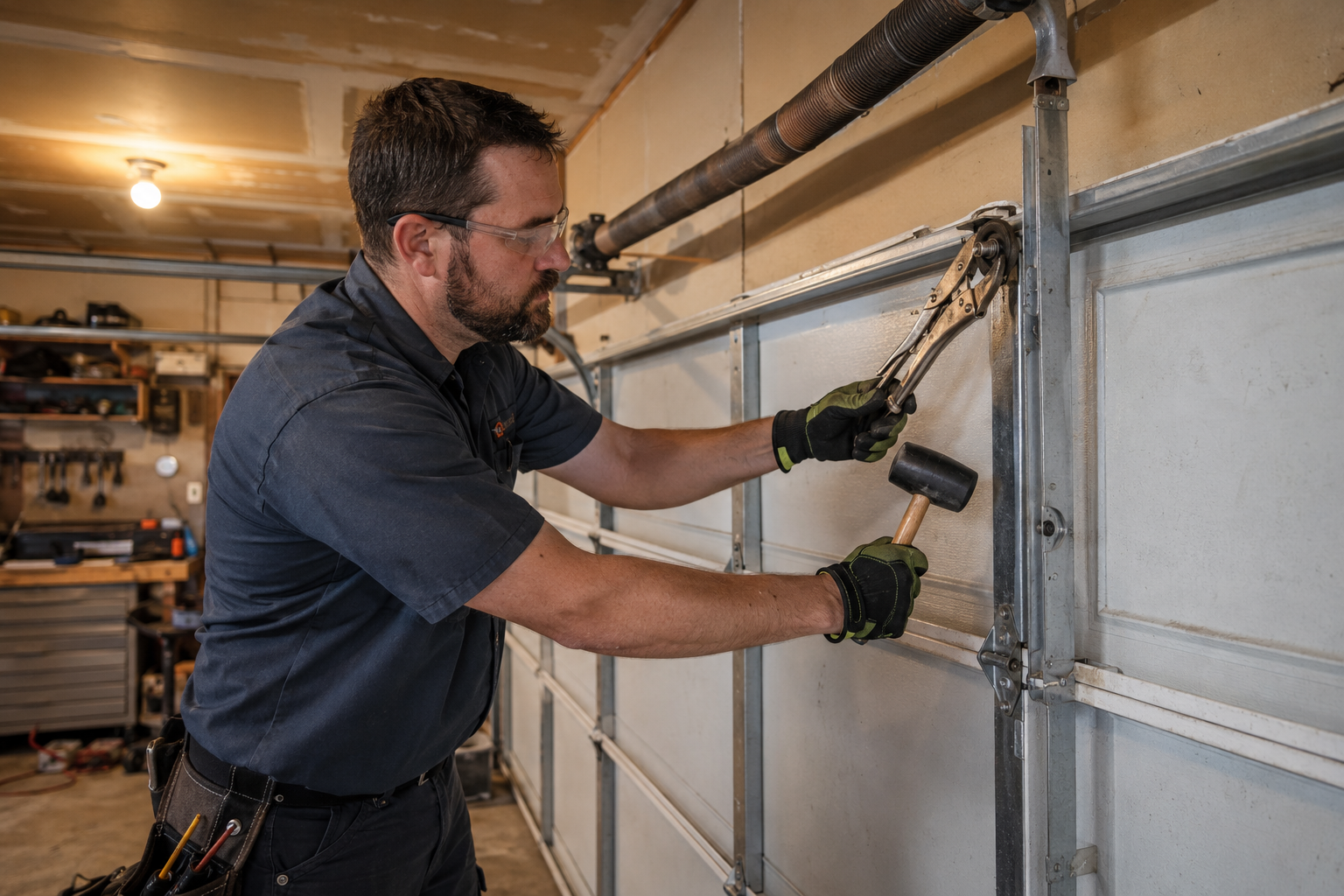
- Clamp locking pliers or a C-clamp to the track just below the lowest roller to prevent the door from dropping.
- Use pliers to gently widen the track lip at the point where the roller exited.
- Carefully guide the roller back into the track channel.
- Use pliers to re-form the track lip back to its original angle.
- Remove the clamp and manually test the door through its full range of motion.
- Reconnect the opener only after confirming smooth, level movement.
Stop and call a pro if:
- You see broken or frayed cables
- The door will not lift manually (suggests spring failure)
- The track is bent, cracked, or pulled from the wall
- More than one roller is out on the same side
- The door is not level after the roller is reseated
Multiple 2024-2026 expert guides from Cunningham Door, Barton Overhead Door, and Literally Garage Door all draw the same line: DIY is only appropriate for very minor misalignment. Any door that is not level, has visible cable issues, or appears likely to fall should be addressed only by a trained technician.
For professional same-day service in Oakville, Emergency Garage Door Repair in Oakville is available with rapid dispatch.
What Tools Do I Need to Realign a Garage Door Track
For a minor Tier 1 DIY realignment, the tools needed are simple and likely already in most households. More complex repairs require specialized equipment that most homeowners do not own.
Basic tools for minor roller realignment:
- Locking pliers (Vise-Grips) or C-clamps — to secure the door before working
- Standard pliers — to gently open and re-form the track lip
- Rubber mallet — to tap the roller back into the channel without damaging it
- Flathead screwdriver — to check bracket bolt tightness
- Socket wrench set — to tighten loose track bracket bolts
- Work gloves — garage door edges and tracks are sharp
Tools you should NOT use on your own:
- Winding bars for torsion springs (requires professional training)
- Cable drums or cable hardware (under high tension)
- Any tool intended to force a door that is binding under spring tension
If the repair requires anything beyond the basic list above, stop and call a professional. The tools for spring and cable work are specialized because the components involved store enormous mechanical energy and can cause serious injury if handled incorrectly.
How Much Does an Emergency Garage Door Repair Cost in Oakville
Emergency garage door track repair in Oakville typically costs between $150 and $400 for a straightforward realignment, based on current 2026 service pricing in the Greater Toronto Area. Costs increase significantly if cables, springs, rollers, or panels also need attention.
Estimated cost ranges for common repairs (Oakville, 2026):
| Repair Type | Estimated Cost Range |
|---|---|
| Track realignment (minor) | $150 – $250 |
| Track realignment + roller replacement | $200 – $350 |
| Bent track section replacement | $250 – $450 |
| Cable replacement (one side) | $150 – $300 |
| Torsion spring replacement | $250 – $500+ |
| Full track replacement (both sides) | $400 – $700+ |
| After-hours / emergency dispatch surcharge | $50 – $150 additional |
These are estimates based on regional market data and should be confirmed with a written quote before work begins. For a detailed breakdown of how to read a service quote, see How to Read a Garage Door Quote: 9 Line Items Explained.
Factors that raise the cost:
- After-hours or weekend emergency calls
- Older doors with non-standard track sizes
- Additional damage to panels, opener, or cables
- High-lift or custom track configurations
For a related cost comparison, How Much Does Garage Door Spring Replacement Cost in Oakville in 2026 provides current pricing benchmarks for spring work that often accompanies off-track events.
Who Should I Call for 24/7 Garage Door Repair in Oakville
Oakville homeowners dealing with an off-track door emergency should call a licensed, insured garage door repair company that explicitly offers same-day or 24/7 emergency dispatch. Not all general contractors or handymen have the training or tools to safely handle garage door track and spring systems.
What to look for in an emergency repair provider:
- Explicitly advertises emergency or same-day service in Oakville
- Licensed and insured technicians
- Transparent pricing or willingness to provide a written quote before work starts
- Experience with both residential and commercial door systems
- Familiarity with Ontario Building Code requirements
Oakview Garage Doors provides same-day emergency garage door repair in Oakville and serves the broader region including Mississauga, Burlington, and Hamilton. For residents near the Oakville-Mississauga border, Emergency Garage Door Repair in Mississauga is also available.
While waiting for the technician:
- Keep the garage door in its current position — do not try to open or close it
- Disconnect the opener at the wall panel or breaker if the door is in a dangerous position
- Keep children, pets, and vehicles clear of the door and its path
- Do not attempt to prop the door open with improvised supports
This safety-first protocol aligns with 2026 industry guidance from Overhead Door and Barton Overhead Door, both of which classify calls involving jammed, hanging, or off-track doors as top-priority emergencies requiring area clearance before technician arrival.
Will My Home Insurance Cover Garage Door Track Damage
Home insurance in Ontario typically covers garage door track damage caused by a sudden, accidental event — such as a vehicle impact or a falling object — but does not cover damage resulting from wear and tear, gradual deterioration, or lack of maintenance. Coverage depends heavily on the specific policy and the cause of the damage.
Generally covered:
- Vehicle impact (your own or a third party’s)
- Vandalism or break-in damage
- Storm or falling object damage (in some policies)
Generally not covered:
- Worn rollers or corroded tracks from age
- Cable or spring failure due to normal wear
- Damage caused by operating a door you knew was malfunctioning
Steps to take if you plan to file a claim:
- Photograph the damage before any repairs begin.
- Get a written repair estimate from a licensed technician.
- Contact your insurer to confirm whether the cause qualifies under your policy.
- Keep all receipts and documentation.
Check your policy’s “sudden and accidental” clause carefully. Some policies also include a deductible that may exceed the cost of a minor track repair, making a claim impractical for smaller jobs.
Are Older Homes More Likely to Have Garage Door Track Problems
Yes. Homes built before the 1990s in Oakville are significantly more likely to experience off-track events because the original track hardware, rollers, and springs were designed for lighter, single-layer doors and have often never been replaced. Modern insulated steel doors are heavier, and older hardware is not rated for the load.
Why older homes carry higher risk:
- Track gauge: Older residential tracks were often 2-inch gauge. Modern heavier doors typically require 3-inch commercial-grade track for adequate support.
- Roller material: Original nylon or plastic rollers from the 1980s and 1990s have a service life of 10,000 to 15,000 cycles (roughly 7 to 10 years of average use). Many have never been replaced.
- Bracket corrosion: Steel wall brackets and track hardware in older garages are often corroded, reducing clamping strength and allowing track movement.
- Spring age: Torsion and extension springs have a rated cycle life. Springs on a 30-year-old door are almost certainly past their service life.
Oakville has a significant stock of homes built in the 1970s through 1990s, particularly in established neighborhoods like Glen Abbey, Bronte, and River Oaks. If your home falls into this category, a proactive inspection is worthwhile. Glen Abbey Garage Door Services: What Homeowners Should Know covers common issues specific to that area.
A garage door tune-up is the most cost-effective way to identify aging hardware before it causes an off-track emergency.
What Are the Most Common Mistakes People Make When Trying to Fix an Off-Track Door
The most dangerous mistake is running the opener while the door is off track. The second most common is attempting to force the door back into alignment without first securing it against an uncontrolled drop. Both can cause serious injury or additional damage.
Mistakes to avoid:
- Running the opener: This forces the motor against a jammed or misaligned door, straining the opener mechanism and potentially causing the door to fall. Always disconnect the opener first. For related opener damage risks, see Garage Door Opener Repair in Oakville.
- Not clamping the door before working: A door without spring tension can drop suddenly. Always clamp the track below the lowest roller before touching anything.
- Bending the track by hand without tools: Forcing a track section with bare hands creates uneven bends that worsen the problem. Use pliers and work gradually.
- Ignoring the underlying cause: Reseating a roller without checking why it came out means the same failure will recur within days or weeks.
- Loosening spring hardware: Torsion spring components are under extreme tension. Touching winding cones, cables, or drums without proper training can be fatal.
- Assuming the door is safe because it looks okay: A door that has been off track and forced back may have hidden cable fraying or bracket stress that is not visible without inspection.
- Using the door after a “quick fix” without testing: Always manually test the full range of motion before reconnecting the opener and resuming normal use.
Literally Garage Door’s 2026 guidance explicitly warns that a misaligned door can fall without warning, and that owners should avoid operating the opener, lifting the door, bending tracks, or adjusting hardware themselves unless the situation clearly qualifies as a minor, Tier 1 misalignment.
How Long Does a Typical Garage Door Track Repair Take
A straightforward track realignment in Oakville takes one to two hours for an experienced technician. More complex repairs involving cable replacement, spring work, or track section replacement can take two to four hours.
Estimated repair times:
| Repair Scope | Typical Time |
|---|---|
| Single roller reseated, minor misalignment | 30 – 60 minutes |
| Full track realignment, both sides | 1 – 2 hours |
| Track section replacement | 2 – 3 hours |
| Track + cable replacement | 2 – 4 hours |
| Track + spring + cable (full system) | 3 – 5 hours |
Factors that extend repair time include older doors with non-standard hardware, significant rust or corrosion on brackets, and the need to source replacement parts. Reputable Oakville technicians carry common replacement parts (rollers, cables, brackets) on their service vehicles, which reduces delays.
Can a Misaligned Track Damage My Garage Door Opener
Yes, and the damage can be significant. When a door is off track and the opener is activated, the motor is forced to work against a door that is binding, misaligned, or partially jammed. This strains the drive mechanism, strips gears, and can burn out the motor in a single incident.
How track misalignment damages openers:
- Stripped gears: Chain, belt, or screw drive openers have plastic or nylon gear components that shear under overload.
- Motor burnout: Sustained resistance causes the motor to overheat, particularly in older units without thermal overload protection.
- Trolley carriage damage: The carriage that connects the opener arm to the door can bend or crack under lateral force.
- Limit switch errors: The opener’s travel limits become confused when the door stops in an unexpected position, causing erratic behavior even after the track is repaired.
If the opener was run while the door was off track, have the opener inspected as part of the repair visit. In some cases, the opener damage is more costly than the track repair itself. For opener-specific issues, Garage Door Opener Repair in Oakville covers diagnosis and repair options.
FAQ: Garage Door Off Track in Oakville Emergency Repair Guide
Q: Is it safe to park my car in the garage if the door is off track? No. A door that is off track can fall without warning. Keep vehicles and people clear of the door and its path until a technician has inspected and repaired it.
Q: How do I disconnect my garage door opener safely? Pull the red emergency release cord hanging from the trolley carriage. This disengages the door from the opener drive, allowing the door to be moved manually. Do not reconnect the opener until the track issue is fully resolved.
Q: Can a garage door come completely off its tracks? Yes. If a cable breaks or a vehicle impact is severe enough, the door can fully derail from both tracks. This is a serious emergency. Do not attempt to handle a fully derailed door without professional help.
Q: My garage door is stuck halfway open and it is off track. What do I do? Disconnect the opener, clamp the track on both sides to prevent further movement, and call an emergency repair service. Do not leave a door stuck halfway open overnight — it is a security risk as well as a safety hazard.
Q: Do I need a permit to repair a garage door track in Oakville? For like-for-like track repairs on an existing residential door, a permit is generally not required. However, any repair that changes the opening size, structural elements, or fire separation (for attached garages) must be evaluated under the 2024 Ontario Building Code, which has been in force since January 1, 2025.
Q: How often should garage door tracks be inspected? At minimum, once per year. Twice yearly is better in Ontario given the freeze-thaw cycle. A professional tune-up covers track alignment, hardware tightness, roller condition, and lubrication.
Q: Will my garage door opener work after the track is repaired? In most cases, yes — provided the opener was not run while the door was off track. If the opener was activated during the off-track event, have it inspected for gear and motor damage before resuming normal use.
Q: What is the average lifespan of garage door rollers? Standard nylon rollers typically last 10,000 to 15,000 cycles. Steel ball-bearing rollers last 20,000 to 30,000 cycles or more. At two cycles per day (one open, one close), 10,000 cycles equals roughly 14 years.
Q: Can cold weather in Oakville cause a garage door to go off track? Yes. Steel tracks contract in extreme cold, reducing clearance around rollers. Combined with lubricant that has thickened or dried out, this can cause rollers to bind and pop out of the track. Using a silicone-based lubricant rated for Ontario temperatures reduces this risk.
Q: How do I know if my garage door spring is also broken? If the door feels extremely heavy when lifted manually, or if you heard a loud bang before the door went off track, a spring failure is likely. Do not attempt to operate or repair the door. Call a professional immediately. See Garage Door Spring Repair in Oakville for more information.
Q: Is a garage door off track covered under a home warranty? Most home warranties cover mechanical failure of systems, but coverage for garage doors varies widely by provider and plan. Check your warranty documents for specific exclusions related to garage door hardware.
Q: Can I use WD-40 to lubricate my garage door tracks? No. WD-40 is a solvent and water displacer, not a long-lasting lubricant. It attracts dust and debris, which accelerates wear. Use a silicone spray or lithium grease rated for the temperature range in Ontario.
Conclusion
A garage door off track in Oakville is not a problem to push through or ignore. The door’s weight, combined with the tension stored in springs and cables, makes this one of the more hazardous household situations a homeowner can face. The right response is fast and clear: disconnect the opener, secure the area, and assess whether the situation qualifies as a minor Tier 1 fix or a professional emergency.
Actionable next steps:
- If the door is hanging at an angle, has loose cables, or will not move freely by hand, call an emergency repair service immediately and do not touch the door.
- If the situation appears to be a minor single-roller misalignment, follow the seven-step DIY process outlined above — but stop and call a pro the moment anything looks more complex.
- After any off-track event, have a technician inspect the opener, cables, and springs even if the track repair looks complete. Hidden damage is common.
- Schedule an annual maintenance visit to catch worn rollers, loose brackets, and track misalignment before they become emergencies.
- If your home was built before 1995, consider a full hardware assessment. Original rollers, springs, and track brackets from that era are almost certainly past their service life.
For same-day professional help, Emergency Garage Door Repair in Oakville connects you with licensed technicians who carry common replacement parts and can respond quickly across the Oakville area.
References
- Barton Overhead Door. (2026). Emergency garage door advisory: doors hanging at an angle or with loose cables. Barton Overhead Door.
- Cunningham Door. (2025, June 15). Step-by-step guide to fixing an off-track garage door. Cunningham Door.
- International Code Council. (2024, October 30). Garage door provisions in the International Residential Code. ICC.
- Legacy Garage Doors. (2026). Permit requirements for garage door replacement in Ontario. Legacy Garage Doors Toronto.
- Literally Garage Door. (2026, March 12). Off-track garage doors: why they are extremely dangerous. Literally Garage Door.
- Ontario Ministry of Municipal Affairs and Housing. (2024). 2024 Ontario Building Code. Queen’s Printer for Ontario.
- Overhead Door of Grand Rapids. (2026). 24/7 emergency repair: safety-first protocols for off-track doors. Overhead Door.
- RJ Garage Door Service. (2025). Building code compliance for garage doors in Ontario. RJ Garage Door Service.
- Wilcox Door Services. (2026). Ontario commercial door cost planning under the 2024 OBC. Wilcox Door Services.