Battery backup garage door openers keep your door working when the power goes out, using a built-in rechargeable battery to run the motor. In Ontario, where major ice storms knocked out power to over one million Hydro One customers in March 2025 and caused widespread outages again in March 2026, a backup battery can mean the difference between getting your car out in an emergency and being completely stuck. For homes where the garage is the primary entry point, this is a practical safety feature, not a luxury.
Key Takeaways 🔑
- Ontario experiences multi-day power outages from ice storms and winter weather regularly, with some customers waiting a week or more for restoration.
- Battery backup garage door openers use a rechargeable DC battery to operate the door motor during outages, typically providing 20–50 open/close cycles on a single charge.
- Most backup batteries last 1–3 days of normal use during an outage, depending on temperature, door weight, and how often the door is used.
- Cold Canadian winters reduce battery performance, so choosing a model rated for low temperatures matters significantly in Ontario.
- Retrofit battery backup kits exist for some existing openers, but a full opener replacement often gives better reliability and warranty coverage.
- The manual release cord is not a reliable substitute for homeowners who are elderly, have mobility limitations, or own heavy double-car doors.
- Cost ranges from roughly CAD $250 to $700+ for a new opener with integrated battery backup, installed.
- Rural Ontario homeowners face longer average outage durations and benefit most from battery backup systems.
- Battery replacement is typically needed every 2–3 years, depending on usage and storage conditions.
- LiftMaster and Chamberlain are the most widely available battery-backup opener brands in Canada with documented cold-weather performance.
Why Battery Backup Garage Door Openers Matter for Ontario Power Outages
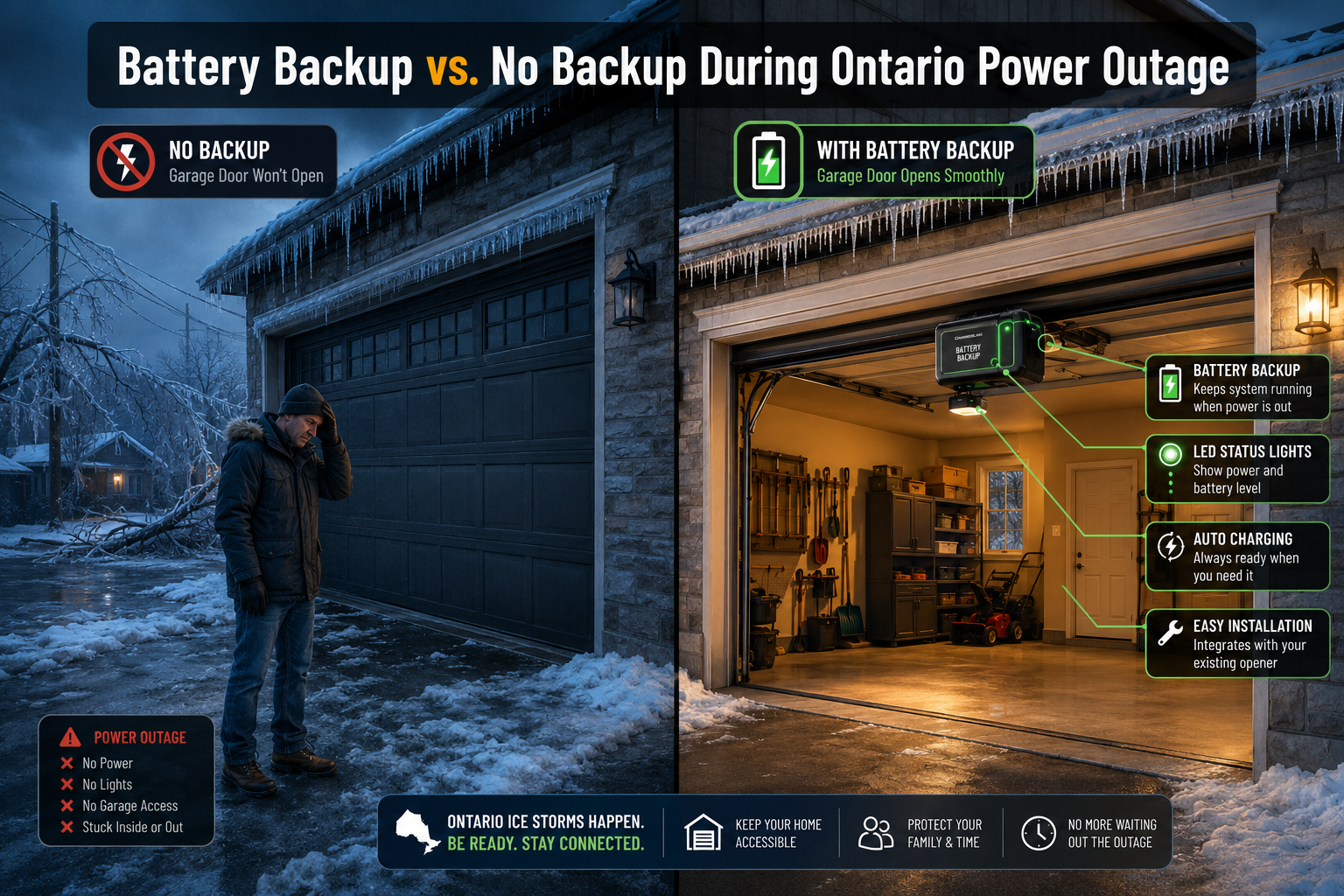
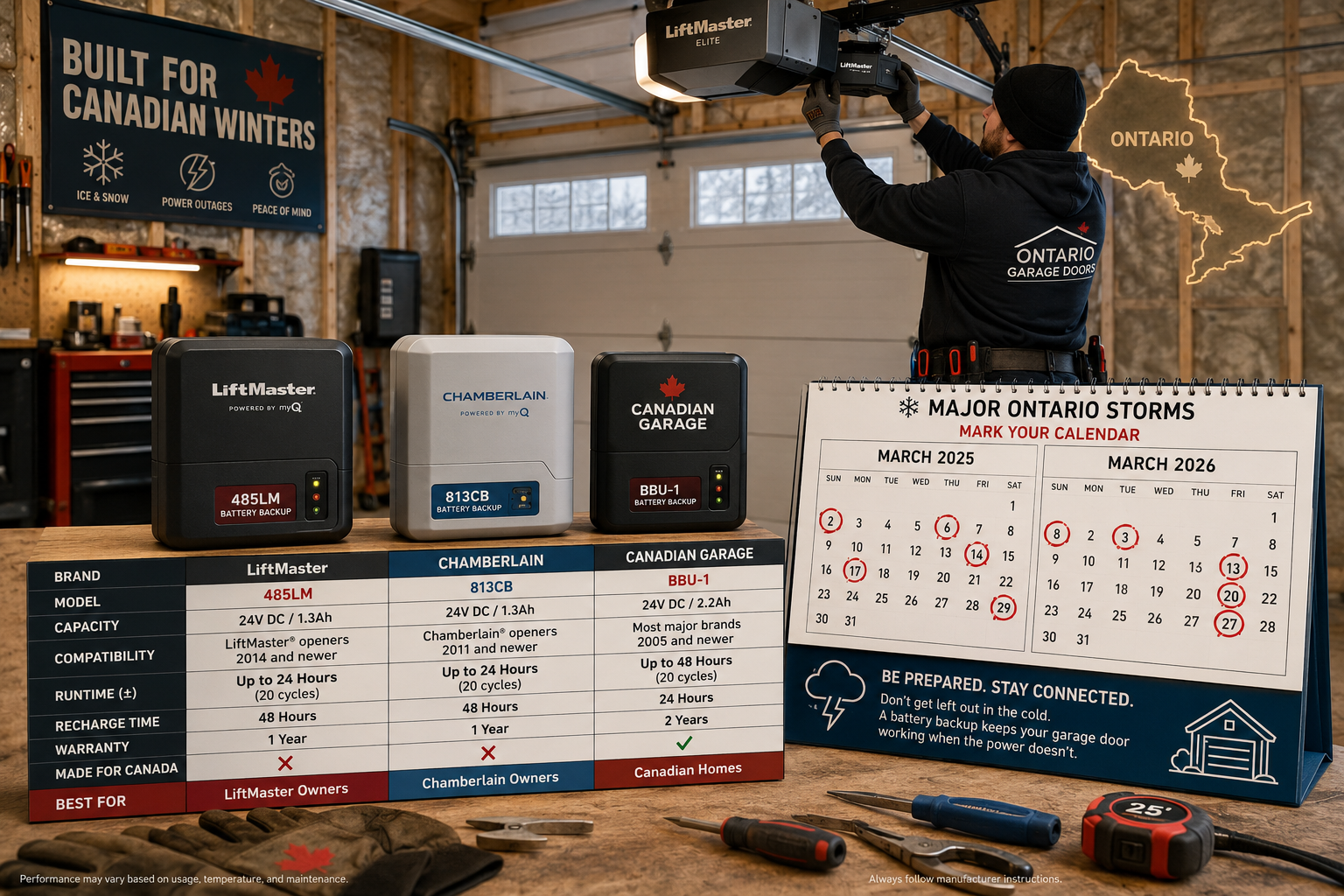
Battery backup garage door openers are especially relevant in Ontario because the province faces some of the most disruptive winter weather conditions in Canada, and power outages here aren’t short. In March 2025, a historic ice storm knocked out electricity for roughly one million Hydro One customers, with over 38,000 still without power a full week after the storm hit. Restoration required more than 4,800 utility and mutual-aid workers. Then, in March 2026, another ice storm caused widespread outages across central and eastern Ontario, with Hydro One reporting over 108,000 customers without power at peak impact.
These aren’t one-off events. The North American Electric Reliability Corporation’s 2025–2026 Winter Reliability Assessment classified much of North America as at elevated risk of supply shortfalls during prolonged cold snaps, and distribution-level outages from ice, freezing rain, and wind remain the dominant threat during Ontario winters. Planning for 7–10 days of self-reliance during a serious blackout is a reasonable assumption for Ontario households.
The garage door problem is specific and practical. Most Ontario homes built in the last 30 years use the garage as the primary entrance. When the power goes out, a standard electric opener stops working entirely. That means no car access, no easy entry or exit, and a potential safety issue if you need to leave quickly.
“Battery backup is an important safety feature that should be added to every home, regardless of where you live.” — Chamberlain product documentation
The 2018 California wildfires made this issue impossible to ignore. Residents died after being unable to open heavy garage doors manually during power outages. California responded with legislation requiring battery backup on all new or replaced residential openers from July 2019 onward. Canada hasn’t passed equivalent national legislation, but industry commentary in Ontario increasingly treats battery backup as a life-safety issue, not just a convenience feature.
How Long Do Battery Backup Garage Door Openers Last During a Power Outage?
Most battery backup garage door openers provide between 20 and 50 open/close cycles on a fully charged battery. In practical terms, that translates to roughly 1–3 days of normal household use during an outage, assuming 4–8 door operations per day.
Several factors affect how long the battery actually lasts:
- Door weight: A heavy double-car door (common in Ontario homes) draws more current per cycle than a single lightweight door.
- Temperature: Cold weather reduces lithium-ion and lead-acid battery capacity. At -10°C to -20°C, which is common in Ontario winters, battery performance can drop by 20–40% compared to room temperature.
- Battery age: A 3-year-old battery holds significantly less charge than a new one.
- Opener motor efficiency: Older or poorly maintained openers work harder per cycle, draining the backup battery faster.
Quick example: A LiftMaster 8550W (a popular Ontario choice) is rated for approximately 50 cycles on battery backup under normal conditions. If a family uses the door 6 times per day during an outage, that’s roughly 8 days of access — but in -15°C weather with a heavy door, expect closer to 4–5 days.
Common mistake: Assuming the rated cycle count applies in a cold garage. Always check whether the manufacturer’s cycle rating was tested at room temperature or at low temperatures. For Ontario winters, cold-temperature ratings matter far more.
Which Battery Backup Garage Door Opener Brands Work Best in Cold Canadian Winters?
LiftMaster and Chamberlain are the most consistently recommended brands for Canadian winter conditions, largely because of their wide dealer network in Ontario, documented cold-weather performance, and integrated battery backup systems that are designed to stay charged in unheated garages.
Here’s a practical comparison of the main options available in Canada:
| Brand | Model Example | Battery Type | Cold-Weather Rating | Approx. CAD Price (Opener Only) |
|---|---|---|---|---|
| LiftMaster | 8550W / 87504-267 | Lithium-ion | Rated to -20°C | $280–$420 |
| Chamberlain | B4545 / B6765 | Lithium-ion | Rated to -20°C | $260–$400 |
| Genie | 7155-TKV | Lead-acid | Rated to -15°C | $220–$350 |
| Craftsman | 57918 | Lead-acid | Rated to -10°C | $200–$320 |
Prices are estimates based on 2026 Canadian retail market data and vary by retailer and region.
Choose LiftMaster or Chamberlain if:
- Your garage is unheated and regularly drops below -10°C in winter.
- You want a lithium-ion battery (faster recharge, longer lifespan, better cold performance than lead-acid).
- You want access to local Ontario dealers for service and warranty support.
Choose a budget option if:
- Your garage is heated or insulated.
- You live in a milder Ontario region (e.g., southern GTA) where temperatures rarely drop below -10°C.
- You’re replacing an opener primarily for convenience, not storm preparedness.
For smart home integration, the LiftMaster 87504-267 with myQ connectivity is worth considering. You can check battery status remotely and receive alerts when the battery needs charging. For more on smart opener features, see this breakdown of the myQ Secure View 3-in-1 Smart Lock.
How Much Does a Battery Backup Garage Door Opener Cost in Ontario?
In Ontario in 2026, a battery backup garage door opener costs between CAD $250 and $700 for the unit alone, with professional installation adding roughly $100–$200 depending on complexity.
Here’s a realistic cost breakdown:
- Budget models (Craftsman, Genie entry-level): $200–$320 for the opener, plus $100–$150 installation = $300–$470 total
- Mid-range models (Chamberlain B-series, LiftMaster 8550W): $260–$420 for the opener, plus $120–$180 installation = $380–$600 total
- Premium/smart models (LiftMaster 87504-267, Chamberlain B6765): $380–$550 for the opener, plus $150–$200 installation = $530–$750 total
Additional costs to factor in:
- Disposal of old opener: $20–$50
- New mounting hardware or rail if the door configuration changed: $30–$80
- Battery replacement every 2–3 years: $40–$90 depending on model
For context, a 2026 Canadian buying guide from Swift Garage Doors lists battery backup as a headline feature for its top recommended opener under CAD $500, suggesting the mid-range is the sweet spot for most Ontario homeowners.
Edge case: If you’re also dealing with other garage door issues at the same time, bundling the opener replacement with garage door opener repair or service can reduce the total labour cost.
Can I Install a Battery Backup System on My Existing Garage Door Opener?
Some existing openers can be retrofitted with a battery backup kit, but compatibility is limited and results vary. Most retrofit kits work only with specific brands and models, and they typically provide fewer backup cycles than an integrated system designed from the factory.
Retrofit is a reasonable option if:
- Your current opener is less than 5 years old and in good working condition.
- The manufacturer offers an official battery backup accessory for your specific model (LiftMaster and Chamberlain both do for select models).
- You want to extend the life of a working opener rather than replace it entirely.
Retrofit is not recommended if:
- Your opener is more than 7–10 years old. Older motors are less efficient and will drain a retrofit battery faster.
- Your opener uses a DC motor that isn’t compatible with add-on battery packs.
- You’ve already had reliability issues with the existing unit.
Step-by-step retrofit process (for compatible models):
- Confirm your opener model number and check the manufacturer’s website for an approved battery backup accessory.
- Purchase the correct kit (not a generic third-party unit — these often void warranties).
- Disconnect power before installation.
- Mount the battery pack to the opener unit following the manufacturer’s guide.
- Connect the wiring harness as specified.
- Restore power and run a test cycle to confirm the battery charges and the door operates normally.
- Test the backup function by unplugging the opener and running 5–10 cycles.
If you’re unsure whether your current opener is compatible or in good enough shape to retrofit, a garage door opener repair consultation can help assess whether repair or replacement makes more sense.
What Happens If My Battery Backup Fails During a Power Outage?
If the battery backup fails during an outage, you’re left with only the manual release option to open or close the door. This is the red cord hanging from the trolley on the opener rail. Pulling it disconnects the door from the motor, allowing you to lift the door by hand.
The manual release works fine for most people under normal conditions. But several scenarios make it unreliable as a sole backup:
- Physical limitations: Older adults, people with disabilities, or anyone with a back or shoulder injury may not be able to safely lift a door that weighs 100–200 lbs (common for double-car doors).
- Darkness or smoke: Finding and pulling a release cord in a dark or smoke-filled garage during an emergency is harder than it sounds.
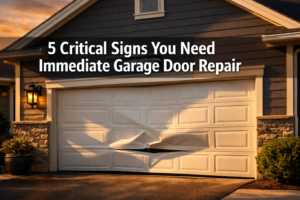
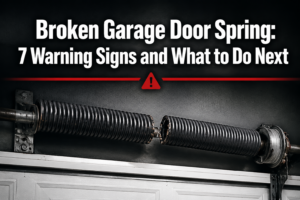
- Unbalanced door: If the torsion springs are worn or broken, the door won’t stay up on its own after manual release and can fall. If you’ve noticed your door struggling to open or close, check for signs you need garage door repair before relying on the manual release.
- Frozen door: In Ontario winters, ice can seal the bottom seal of the door to the ground. Manual lifting against a frozen seal can damage the door or the springs.
What to do if the battery backup fails:
- Check whether the battery is simply depleted (not defective) — most units have an LED indicator.
- If the battery is dead, use the manual release to operate the door temporarily.
- Once power is restored, recharge the battery fully before the next outage.
- If the battery fails to hold a charge after recharging, replace it (see replacement schedule below).
- If the opener itself is malfunctioning beyond the battery, contact a garage door emergency repair service rather than attempting complex repairs during an outage.
Are Battery Backup Garage Door Openers Worth It for Rural Ontario Homes?
For rural Ontario homeowners, battery backup garage door openers are among the most practical investments available. Rural areas consistently experience longer outage durations than urban areas because repair crews prioritize restoring power to the highest density of customers first. During the March 2025 ice storm, rural customers in areas like Simcoe County and Hastings County waited significantly longer than Toronto-area customers for restoration.
Reasons rural Ontario homeowners benefit most:
- Longer average outage duration (often 3–7 days vs. hours in urban areas)
- More likely to rely on the garage as the only practical vehicle exit point
- Less likely to have nearby alternatives (transit, parking garages, etc.)
- More likely to have a generator already, but generators don’t always power the opener unless specifically wired in
Common counterargument: “I have a generator, so I don’t need battery backup.” This is only true if the generator is hardwired to the garage circuit or the opener is plugged into a generator-fed outlet. A portable generator sitting in the driveway doesn’t automatically power the opener. Battery backup is simpler and always-on.
For homeowners in areas like Alliston, Angus, or other communities north of the GTA, the case for battery backup is particularly strong. Oakview Garage Doors serves many of these communities — see their service area for coverage details.
Do Battery Backups Work With All Garage Door Opener Types and Sizes?
Battery backup systems are compatible with most modern belt-drive and chain-drive openers, but not all. The key variables are motor type, door weight, and whether the manufacturer offers an integrated or add-on battery solution.
Compatible in most cases:
- DC motor openers (most models made after 2010)
- Belt-drive openers (quieter, common in attached garages)
- Chain-drive openers with DC motors
- Single-car doors (standard 7–8 ft height, up to ~130 lbs)
Compatibility challenges:
- Very heavy double-car doors (over 200 lbs): The battery drains faster and may not provide the rated number of cycles. Check the opener’s maximum door weight rating before purchasing.
- Screw-drive openers: Many older screw-drive models use AC motors and are not compatible with battery backup systems.
- Commercial-grade doors: Residential battery backup systems are not designed for commercial door weights or high-cycle commercial use.
- Jackshaft/side-mount openers: Some models have battery backup options, but availability is more limited than trolley-style openers.
Decision rule: If your door is a standard residential single or double-car door installed after 2005 with a DC motor opener, battery backup will almost certainly work. If your door is unusually heavy, old, or uses a non-standard opener type, confirm compatibility with a dealer before purchasing.
Common Mistakes People Make When Choosing a Battery Backup System
The most common mistake is choosing a battery backup opener based on price alone, without checking cold-temperature performance ratings. In Ontario, a backup battery that performs well at 20°C but loses 40% capacity at -15°C is far less useful than its spec sheet suggests.
Other frequent mistakes:
Ignoring battery type: Lead-acid batteries are cheaper but perform worse in cold weather and have a shorter lifespan than lithium-ion. For Ontario winters, lithium-ion is the better choice.
Not testing the backup before an outage: Many homeowners never unplug the opener to verify the battery actually works. Test it annually by unplugging the unit and running 5–10 open/close cycles.
Assuming the battery is always charged: If the opener’s charging circuit fails, the battery may sit depleted for months without any visible indication. Check the battery indicator light periodically.
Buying a retrofit kit for an old opener: A 12-year-old opener with a worn motor will drain a retrofit battery quickly and may fail mid-outage anyway. If the opener is near end-of-life, replace the whole unit.
Overlooking the door’s mechanical condition: A battery backup opener can’t compensate for broken springs or misaligned tracks. If the door is hard to open manually, fix the mechanical issue first. A broken spring will prevent the door from opening even with a fully charged battery backup.
Skipping professional installation: Incorrect wiring during installation can damage the battery charging circuit, leading to premature battery failure.
How Do Battery Backup Garage Door Openers Compare to Manual Garage Door Release Mechanisms?
Battery backup openers and manual release cords solve different problems and are not interchangeable. A manual release disconnects the door from the opener so you can lift it by hand. A battery backup keeps the powered opener running so you don’t have to lift it at all.
| Feature | Battery Backup Opener | Manual Release Cord |
|---|---|---|
| Physical effort required | None | Significant (lifting door weight) |
| Works for mobility-limited users | ✅ Yes | ❌ Often no |
| Works in darkness | ✅ Yes (button press) | ⚠️ Difficult (must find cord) |
| Works with frozen door seal | ⚠️ Partially (motor force) | ❌ No |
| Cost | $300–$750 installed | $0 (already built in) |
| Requires maintenance | ✅ Battery replacement | Minimal |
| Safety during fire/emergency | ✅ Fast exit | ⚠️ Slower, physical effort |
The manual release is a last resort, not a primary backup strategy. It’s there if everything else fails. Battery backup is the primary solution for households where the garage is the main entrance and quick, effortless access matters.
Which Garage Door Openers Have the Most Reliable Battery Backup for Frequent Ontario Storms?
For Ontario homeowners dealing with frequent winter storms, the LiftMaster 87504-267 and the Chamberlain B6765 are consistently rated as the most reliable battery backup options available in Canada in 2026.
Both models use lithium-ion batteries, are rated for cold-temperature operation, and include battery health monitoring through their respective smartphone apps (myQ for LiftMaster/Chamberlain). The ability to check battery status remotely is genuinely useful before a forecasted storm.
What makes these models stand out for Ontario conditions:
- Lithium-ion battery with cold-weather performance down to approximately -20°C
- Battery status LED and app notification when charge drops below a safe threshold
- 50+ rated backup cycles (room temperature; expect 30–40 in cold conditions)
- Wide availability through Ontario dealers with local warranty support
- Compatible with standard residential single and double-car doors
For budget-conscious buyers, the Chamberlain B4545 offers integrated battery backup at a lower price point and is widely available at Canadian retailers. It uses a smaller battery pack and provides fewer backup cycles, but it’s a solid choice for single-car doors in attached garages that stay reasonably warm.
Are Battery Backup Garage Door Openers Safe for Homes With Kids or Pets?
Yes, battery backup garage door openers are safe for homes with children and pets, and in some ways they’re safer than relying on manual operation. Modern openers with battery backup include the same safety features as standard openers: auto-reverse sensors, photo-eye obstruction detection, and rolling code security.
Safety advantages specific to battery backup:
- The door can be stopped and reversed immediately during an outage, just as it would during normal operation. Manual release doesn’t offer this.
- No need to prop the door open manually (a risk with manual release, since an unbalanced door can fall).
- Consistent operation reduces the temptation to manually force a door open, which is a common cause of injury.
One safety note: During a power outage, the photo-eye sensors still function on battery backup. However, if the sensors are misaligned or dirty (a common issue in winter), the door may reverse unexpectedly. If your door has been reversing unexpectedly, review why your garage door reverses before closing before relying on battery backup during an outage.
How Often Do I Need to Replace the Battery in a Garage Door Backup System?
Most garage door backup batteries need replacement every 2–3 years under normal use. Lithium-ion batteries (found in premium models) typically last closer to 3 years; lead-acid batteries (found in budget models) often need replacement after 18–24 months, especially in cold climates.
Factors that shorten battery lifespan:
- Frequent deep discharge cycles (using the battery down to near-zero repeatedly)
- Storage in very cold conditions (unheated garages below -15°C regularly)
- Infrequent recharging (a battery left discharged for months degrades faster)
- High-frequency use (more than 10 cycles per day on a regular basis)
Signs the battery needs replacement:
- The backup cycle count drops noticeably (door opens fewer times before battery dies)
- The battery indicator shows low charge even after a full recharge cycle
- The battery takes longer than usual to reach full charge
- The opener struggles or moves slowly during backup operation
Replacement cost: Manufacturer-branded replacement batteries typically cost CAD $40–$90 depending on the model. Third-party batteries are cheaper but may not be compatible with the charging circuit and can void the warranty.
Maintenance tip: Run a full backup test (unplug the opener, operate the door 10 times) once a year, ideally in the fall before Ontario’s storm season begins. This confirms the battery is healthy before you need it.
Frequently Asked Questions
Q: Can a battery backup garage door opener run during a complete blackout with no power at all? Yes. The battery backup is a self-contained rechargeable battery inside the opener unit. It operates the door motor independently of the home’s electrical supply. No external power source is needed during the outage.
Q: How do I know if my current opener has battery backup? Check the model number on the opener unit and look it up on the manufacturer’s website. Alternatively, unplug the opener and try to operate the door with the wall button or remote. If it works, battery backup is present. If nothing happens, it doesn’t have one.
Q: Will a battery backup opener work if the garage door springs are broken? No. The battery backup powers the motor, but the motor relies on properly functioning springs to do the heavy lifting. A broken spring means the motor (and battery) must carry the full door weight, which will either trip the overload protection or drain the battery in very few cycles. Fix the springs first. See garage door spring repair in Oakville for professional service.
Q: Is a whole-home battery system (like a Powerwall) better than a dedicated opener battery? A whole-home energy storage system offers broader coverage but costs $10,000–$25,000+ installed and must meet strict Ontario Electrical Safety Authority requirements for placement and fire separation. A dedicated opener battery costs $300–$750 total and is purpose-built for this one task. For most Ontario homeowners, the dedicated opener battery is the practical choice unless a whole-home system is already planned for other reasons.
Q: Do battery backup openers work with smart home systems like Google Home or Amazon Alexa? Premium models from LiftMaster and Chamberlain with myQ connectivity do integrate with smart home platforms. The battery backup function itself doesn’t require smart home integration, but the app connectivity lets you monitor battery status and operate the door remotely.
Q: How long does it take to recharge the backup battery after an outage? Most lithium-ion backup batteries recharge fully within 4–6 hours once power is restored. Lead-acid batteries can take 8–12 hours for a full recharge.
Q: Can I use a portable generator to power my garage door opener instead of a battery backup? Yes, if the generator is plugged into the same outlet the opener uses. However, this requires running the generator, which has fuel costs, noise, and carbon monoxide risks if used improperly. Battery backup is simpler, silent, and always ready without any setup.
Q: Does cold weather permanently damage the backup battery? Repeated deep discharge in very cold conditions can shorten battery lifespan, but normal cold-weather use doesn’t permanently damage a quality lithium-ion battery. Avoid storing the opener disconnected from power for extended periods in a very cold garage, as this allows the battery to self-discharge to a damaging level.
Q: Are there any Ontario rebates or incentives for battery backup garage door openers? As of 2026, there are no specific Ontario provincial rebates targeting battery backup garage door openers. Some municipalities have general home resilience or energy efficiency programs worth checking, but battery backup openers are not typically covered under standard energy efficiency rebate programs.
Q: What’s the lifespan of the opener itself, not just the battery? A quality garage door opener typically lasts 10–15 years with proper maintenance. The backup battery needs replacement every 2–3 years within that lifespan.
Conclusion: What Ontario Homeowners Should Do Next
Battery backup garage door openers are a practical, well-priced solution to a real problem that Ontario homeowners face every winter. The evidence from the March 2025 and March 2026 ice storms makes clear that multi-day outages are a recurring reality, not a rare edge case. For any home where the garage is the primary entrance, a backup battery is the simplest way to maintain access when the grid fails.
Actionable next steps:
- Check your current opener today. Unplug it and test whether the door operates. If it doesn’t, you have no backup protection.
- Assess your door’s mechanical condition. A battery backup can’t compensate for worn springs, damaged cables, or misaligned tracks. Address any existing issues first.
- Choose lithium-ion over lead-acid if your garage is unheated and regularly drops below -10°C in winter.
- Budget CAD $380–$600 for a reliable mid-range battery backup opener, installed, from a reputable Ontario dealer.
- Test the battery annually in September or October, before storm season starts.
- Replace the battery every 2–3 years, regardless of whether it appears to be working — degraded batteries fail without warning.
For professional assessment, installation, or repair anywhere in the Ontario service area, contact Oakview Garage Doors to discuss the right battery backup solution for your specific door and home setup.