Last updated: July 10, 2026
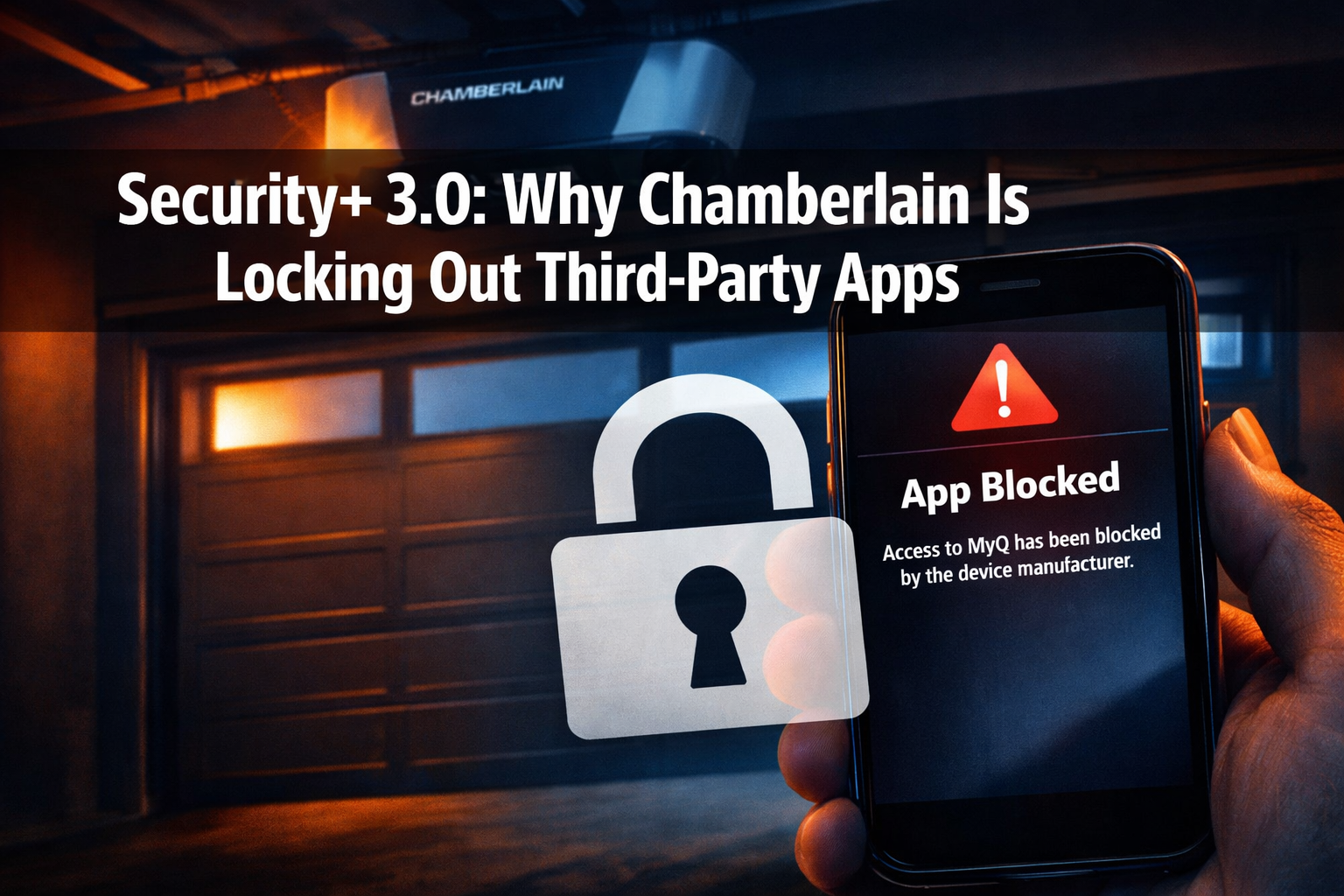
Quick Answer: Chamberlain’s Security+ 3.0 is a rolling-code communication protocol built into newer LiftMaster and Chamberlain garage door openers that deliberately blocks any app or device not authorized by Chamberlain. The result is that popular third-party integrations, including Home Assistant, IFTTT, and most universal smart home controllers, no longer work with these openers. Chamberlain frames this as a security improvement, but the practical effect is that users are funneled into the myQ ecosystem and its paid partner services.
Key Takeaways
- Security+ 3.0 is an encrypted, rolling-code protocol that only authorizes Chamberlain-approved accessories and apps.
- Third-party apps that worked with Security+ 2.0 openers are fully blocked under Security+ 3.0, with no workaround that doesn’t involve hardware changes.
- Chamberlain began rolling out Security+ 3.0 in late 2023, and as of mid-2026, no public reversal of the policy has occurred.
- The myQ app and a small list of paid partner integrations (such as Amazon Key) remain the only supported smart-home connections.
- Home Assistant and the broader open-source community have confirmed that Chamberlain actively blocks unauthorized API access.
- Tailwind, a third-party garage door controller maker, confirmed total incompatibility with Security+ 3.0 hardware.
- Chamberlain’s stated reason is preventing “unauthorized usage” and delivering the “best possible experience,” but critics and tech commentators widely view this as a deliberate lock-in strategy.
- Downgrading from Security+ 3.0 to an older protocol is not possible through software; it would require replacing the opener unit.
- Several alternative brands, including Genie and Meross, still support open integrations as of 2026.
- The debate sits squarely within broader right-to-repair and platform-control conversations.
What Is Chamberlain Security+ 3.0 and Why Did They Add It
Security+ 3.0 is Chamberlain Group’s third-generation rolling-code radio frequency protocol, built into newer LiftMaster and Chamberlain branded garage door openers. Unlike its predecessor, it uses encrypted, device-authenticated communication that requires any accessory or app to hold an approved credential before it can send or receive commands.
Chamberlain publicly stated that the change was designed to close security vulnerabilities that could allow unauthorized access to garage doors. Rolling-code systems have existed since the 1990s, but Security+ 3.0 adds a layer of device-level authentication on top of the encrypted signal. In theory, this prevents replay attacks, signal cloning, and unauthorized remote access.
What changed in practice:
- The opener will only respond to devices that carry Chamberlain-issued authentication tokens.
- Third-party apps that previously used reverse-engineered API calls or direct radio communication are now rejected at the hardware level.
- Firmware updates on some existing openers have extended Security+ 3.0 restrictions retroactively.
Chamberlain began deploying Security+ 3.0 in new hardware from late 2023 onward. By mid-2026, the majority of newly sold LiftMaster and Chamberlain openers ship with it by default.
How Does Security+ 3.0 Block Third-Party Apps
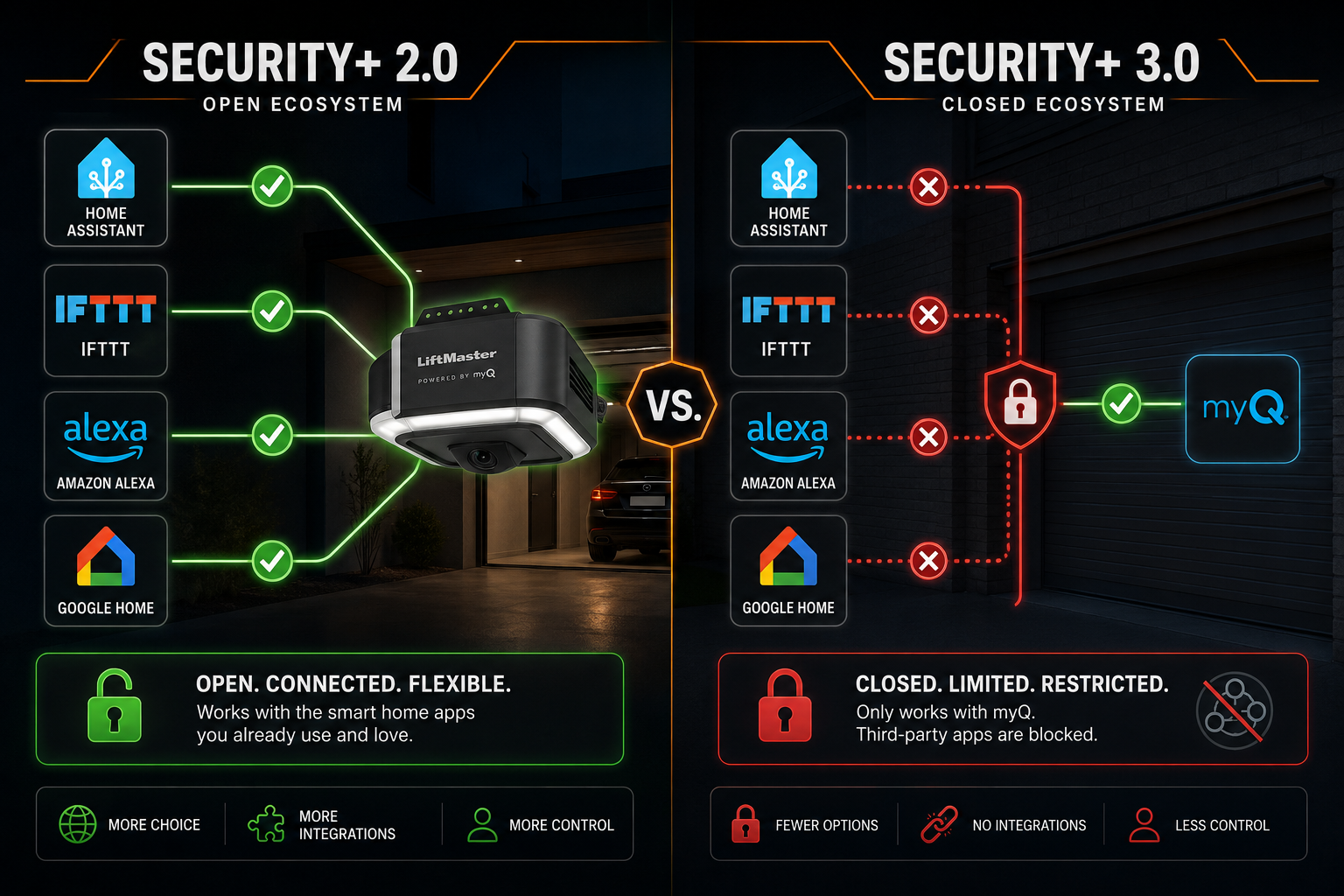
Security+ 3.0 blocks third-party apps by requiring device-level authentication that only Chamberlain controls. Any app or controller that cannot present a valid Chamberlain-issued credential receives no response from the opener, effectively making it invisible to the hardware.
Under Security+ 2.0, the protocol was more open. Developers could reverse-engineer the API, use local network polling through the myQ cloud service, or connect via direct radio frequency commands. Several popular integrations, including Home Assistant’s myQ component and third-party controllers like Tailwind, exploited these pathways.
Security+ 3.0 closes each of those pathways:
- Cloud API access: Chamberlain blocked unauthenticated API calls to its cloud in late 2023, cutting off Home Assistant and similar integrations.
- Local radio commands: The encrypted, authenticated signal means a generic Z-Wave or RF controller cannot trigger the opener.
- Third-party hardware controllers: Devices like Tailwind that physically connect to the opener’s terminal strip still function for basic open/close, but cannot read status or communicate with the Security+ 3.0 radio system for smart features.
The Tailwind president publicly confirmed that Security+ 3.0 hardware is entirely incompatible with their product’s smart features. Home Assistant’s development team has stated that Chamberlain is “persistently hostile to open integration” and removed the official myQ integration from their platform in late 2023 as a direct result.
What Is the Difference Between Security+ 2.0 and 3.0
The core difference is authentication. Security+ 2.0 used rolling-code encryption to prevent signal cloning, but it did not require device-level credentials. Security+ 3.0 adds mandatory authentication, meaning only Chamberlain-approved devices can communicate with the opener.
| Feature | Security+ 2.0 | Security+ 3.0 |
|---|---|---|
| Rolling-code encryption | Yes | Yes (enhanced) |
| Device-level authentication | No | Yes |
| Third-party app support | Possible (via API/RF) | Blocked |
| Home Assistant integration | Supported (officially removed late 2023) | Not supported |
| Open-source controller compatibility | Partial | None |
| myQ app required for smart features | Optional | Mandatory |
| Paid partner integrations available | Some | Yes (Amazon Key, Google, select others) |
The practical gap between the two versions is significant for smart-home users. Security+ 2.0 openers could be integrated into nearly any automation platform with moderate technical effort. Security+ 3.0 openers cannot, regardless of technical skill.
Which Smart Home Apps Work With Chamberlain Garage Doors Now
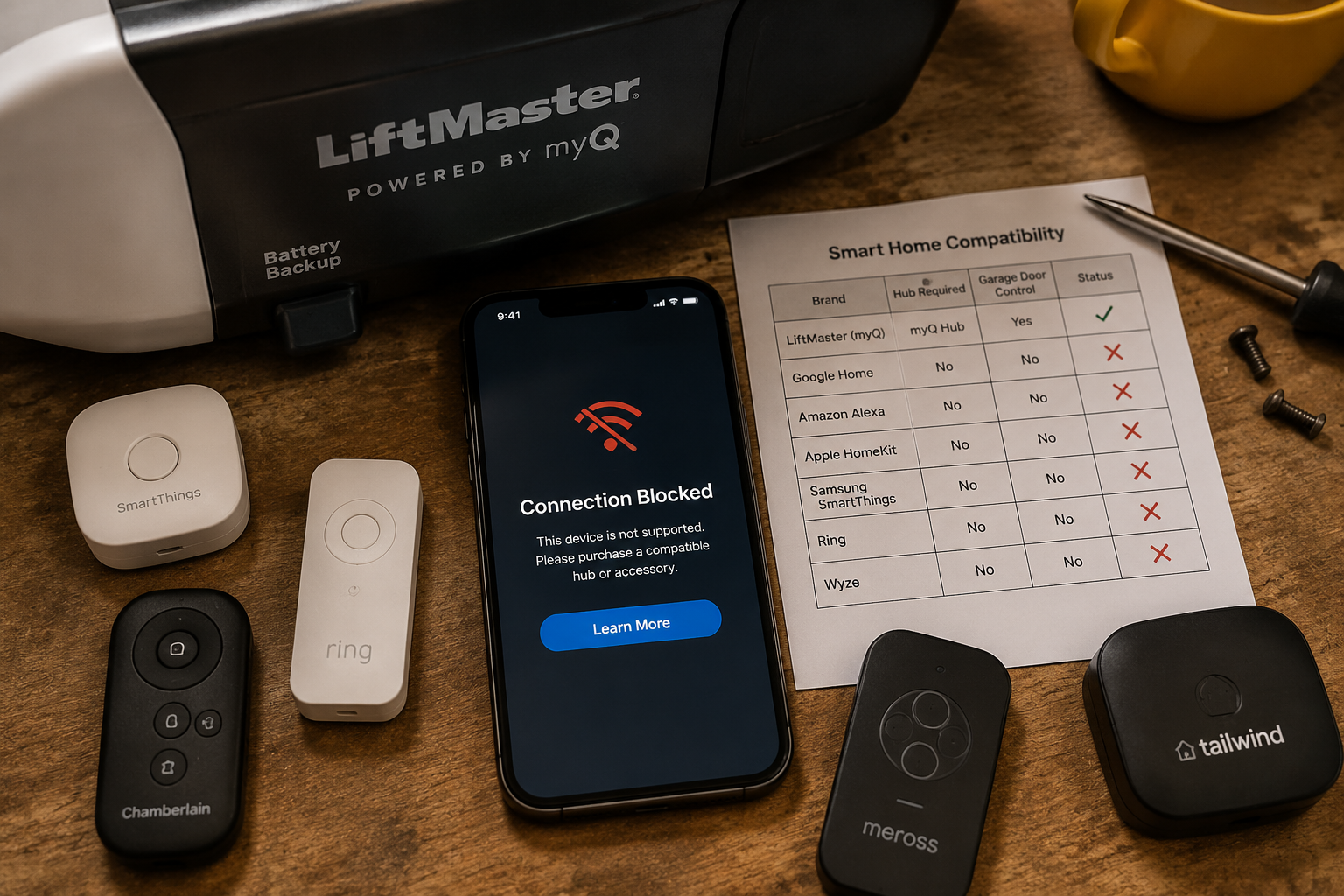
As of mid-2026, the only apps and integrations that reliably work with Security+ 3.0 openers are those Chamberlain has officially authorized. The list is short.
Confirmed working integrations:
- myQ app (Chamberlain’s own, free to download, some features require subscription)
- Amazon Key (paid subscription service for in-garage delivery)
- Google Assistant (via myQ, limited voice command support)
- Amazon Alexa (via myQ skill, limited to open/close/status)
- Apple HomeKit (via myQ Home Bridge accessory, sold separately)
Confirmed not working:
- Home Assistant (integration officially removed and blocked)
- IFTTT (myQ removed IFTTT support in 2021; Security+ 3.0 makes restoration impossible)
- SmartThings (no official support)
- Hubitat
- Tailwind smart controllers (for Security+ 3.0 models)
- Any generic Z-Wave or Zigbee garage door controller
Important note on myQ: The myQ app itself is free, but several of the most useful features, including integration with Amazon Key and the Home Bridge accessory, carry additional costs. This is a recurring complaint in user communities.
If you’re evaluating a new opener and smart-home compatibility matters to you, reviewing the myQ Secure View 3-in-1 Smart Lock is a useful starting point for understanding what the Chamberlain ecosystem actually offers within its own walls.
Can I Still Use My Old Third-Party App With Security+ 3.0
No. If your opener uses Security+ 3.0, third-party apps that previously worked will no longer function. This applies whether the app connected via cloud API, local network, or direct radio frequency. The authentication layer in Security+ 3.0 rejects all non-authorized communication, regardless of how the connection is attempted.
Some users have reported partial success using older hardware controllers wired directly to the opener’s terminal strip (the low-voltage dry-contact terminals). These can still physically trigger an open or close command. However, they cannot read door status, receive alerts, or use any smart features tied to the Security+ 3.0 radio system.
What this means practically:
- A wired relay controller (such as a basic smart relay) can open or close the door if hardwired to the terminals.
- The relay has no way to confirm whether the door is open or closed without a separate tilt sensor.
- No cloud-based third-party app can retrieve status or send commands through the Security+ 3.0 protocol.
This is a significant downgrade for users who built automations around garage door state, such as “close the garage if it’s been open for 20 minutes” routines.
How to Disable or Bypass Chamberlain Security+ 3.0
There is no software method to disable or bypass Security+ 3.0. The protocol is implemented at the firmware and hardware level, and Chamberlain has not released any official option to revert to Security+ 2.0 behavior.
The only practical workarounds available as of 2026 are:
- Use a wired dry-contact relay connected to the opener’s terminal strip to trigger open/close commands. Pair it with a separate tilt or reed sensor on the door to monitor state. This restores basic automation but loses native smart features.
- Replace the opener with a unit that either uses Security+ 2.0 or a competing brand with open integration support.
- Accept the myQ ecosystem and build automations within its supported partner list.
There is no known firmware downgrade path. Chamberlain does not publish firmware files for manual installation, and the Security+ 3.0 authentication keys are not publicly available. Anyone claiming to sell a “Security+ 3.0 bypass” should be treated with significant skepticism, as no credible technical community has validated such a product.
If you’re at the point of considering a full opener replacement, it’s worth consulting a professional. The team at Oakview Garage Doors offers opener repair and replacement services and can advise on which current models retain broader compatibility.
Is Chamberlain Doing This to Make More Money
The honest answer is: almost certainly, yes, at least in part. Chamberlain’s official position is that Security+ 3.0 exists to protect users from unauthorized access and to deliver a better experience. But the commercial architecture around it tells a more complete story.
“Chamberlain has built a system where the only path to smart features runs through a paid or partner-gated service.”
Consider the structure:
- The myQ app is free, but premium integrations (Amazon Key, Apple HomeKit via the Home Bridge hardware accessory) require additional purchases or subscriptions.
- Chamberlain charges third-party developers for API access through its partner program. This is the only legal route to building a Security+ 3.0 compatible product.
- Blocking open-source and free integrations eliminates competition from platforms that would otherwise provide the same functionality at no cost to the user.
Tech commentators and smart-home bloggers have consistently framed this as a deliberate lock-in architecture. The New York Times linked Chamberlain’s choices to broader debates about platform control and right-to-repair. Home Assistant’s public statements have been direct: Chamberlain is not interested in open integration because open integration doesn’t generate revenue.
None of this means the security improvements are fake. Rolling-code authentication does reduce certain attack vectors. But the decision to make that authentication proprietary and non-licensable to open-source developers, while licensing it to paying commercial partners, is a business choice, not a pure security necessity.
Why Chamberlain’s Security+ 3.0 Is Locking Out Third-Party Developers Specifically
Why Chamberlain’s Security+ 3.0 is locking out third-party developers specifically comes down to who gets to monetize the garage door. Chamberlain controls the authentication keys for Security+ 3.0, which means any developer who wants to build a compatible product must go through Chamberlain’s partner program and, in most cases, pay for that access.
This is a well-established platform strategy. By controlling the authentication layer, Chamberlain becomes a gatekeeper for an entire category of smart-home functionality. Partners who pay for access get a certified integration. Everyone else gets blocked.
Why open-source developers are hit hardest:
- Open-source projects like Home Assistant cannot pay commercial licensing fees by nature.
- Reverse-engineering the authentication protocol would likely violate the Computer Fraud and Abuse Act in the United States and equivalent laws in Canada.
- Chamberlain has actively patched API endpoints that open-source developers found and used, demonstrating that the blocking is intentional and maintained.
The Home Assistant community has documented multiple instances where Chamberlain pushed updates specifically to break workarounds that the community had developed. This is not passive incompatibility; it is active enforcement.
What Garage Door Openers Don’t Have Security+ 3.0 Restrictions
Several garage door opener brands do not use Security+ 3.0 and maintain broader third-party compatibility as of 2026.
Brands with more open integration options:
- Genie: Uses its own Aladdin Connect platform, which has maintained Home Assistant and IFTTT compatibility. Genie openers do not use the Security+ protocol.
- Meross: A smart-home focused brand that natively supports Apple HomeKit, Google Home, and Amazon Alexa without a proprietary lock-in layer. Popular with Home Assistant users.
- Ratgdo (DIY board): A community-developed hardware board that can be wired into certain older openers to restore local control. Not compatible with Security+ 3.0 hardware.
- Garadget: A third-party sensor-based controller that works with any opener via a wired connection and a tilt sensor, bypassing the protocol entirely.
Choose an alternative if:
- You run Home Assistant or another open-source automation platform.
- You want local control without cloud dependency.
- You prefer not to pay for partner integrations.
Stick with Chamberlain/LiftMaster if:
- You want the myQ ecosystem and its specific partner integrations (Amazon Key, etc.).
- You prioritize the brand’s reliability and wide service network.
- Smart-home integration is a secondary concern.
For homeowners in the Oakville and Burlington area considering a full opener replacement, Oakview Garage Doors provides garage door installation and opener services and can walk through current model options with compatibility in mind.
Can I Downgrade From Security+ 3.0 to an Older Version
No. Downgrading from Security+ 3.0 to Security+ 2.0 is not possible on any current Chamberlain or LiftMaster opener. The protocol is embedded in the hardware’s radio module and firmware, and Chamberlain does not provide a downgrade path.
Some users have attempted to flash older firmware versions, but Chamberlain does not publish firmware files, and no verified method for doing this exists in the technical community as of mid-2026. Attempting to modify the firmware would also void the warranty and could render the opener non-functional.
The only way to return to Security+ 2.0 compatibility is to use an older opener that shipped with that protocol. These are available on the used market, but they lack current safety features and will eventually fall outside manufacturer support windows.
Practical advice: If open integration is a firm requirement, the more reliable path is choosing a different brand for a new installation rather than trying to work around Security+ 3.0 on existing hardware.
When Did Chamberlain Start Using Security+ 3.0
Chamberlain began deploying Security+ 3.0 in new hardware in late 2023. The most visible public moment came when Chamberlain simultaneously blocked unauthenticated API access to the myQ cloud service, which cut off Home Assistant’s myQ integration. Home Assistant removed the integration from its official add-on store in late 2023 as a result.
By early 2024, the majority of new LiftMaster and Chamberlain opener models shipped with Security+ 3.0 as the default protocol. Through 2024 and 2025, firmware updates on some existing models extended certain Security+ 3.0 restrictions, though the full protocol change generally requires new hardware.
As of mid-2026, the policy has not changed. Chamberlain has continued to expand the myQ ecosystem and its paid partner program while maintaining the block on unauthorized third-party access. No public statement from Chamberlain has indicated any intention to open the protocol.
Is Chamberlain Security+ 3.0 Worth the Security Tradeoff
For users who have no interest in third-party smart-home integration, Security+ 3.0 represents a genuine security improvement with no meaningful downside. The enhanced authentication does reduce the risk of unauthorized access through signal replay or API exploitation.
For users who built automations around open platforms, the tradeoff is significant. The security benefit is real but incremental. Most residential garage doors are not targeted by sophisticated radio frequency attacks. The practical risk that Security+ 3.0 addresses is relatively low for the average homeowner.
The tradeoff in plain terms:
- You gain: Slightly stronger protection against RF signal cloning and unauthorized API access.
- You lose: Compatibility with Home Assistant, IFTTT, SmartThings, Hubitat, Tailwind, and most open-source automation tools.
- You’re pushed toward: The myQ app and paid partner integrations.
Whether that tradeoff is worth it depends almost entirely on how you use your garage door in your smart-home setup. For a homeowner who just wants to open and close the door from their phone, myQ works fine. For someone running a whole-home automation system on Home Assistant, Security+ 3.0 is a hard blocker.
If you’re troubleshooting an opener that’s behaving unexpectedly after a firmware update, the Oakview Garage Doors opener repair service can help determine whether the issue is protocol-related or a mechanical fault.
FAQ
Q: Does Security+ 3.0 affect all Chamberlain and LiftMaster openers? A: Security+ 3.0 is standard on new models released from late 2023 onward. Older openers using Security+ 2.0 are not automatically upgraded to 3.0, but some firmware updates have extended certain restrictions to existing hardware.
Q: Can I use Home Assistant with a Security+ 3.0 opener? A: No. Home Assistant removed its official myQ integration in late 2023 after Chamberlain blocked the API. No supported or reliable workaround exists for Security+ 3.0 hardware as of 2026.
Q: Does the myQ app cost money? A: The myQ app is free to download. However, some integrations (such as Apple HomeKit via the Home Bridge accessory) require additional hardware purchases, and Amazon Key in-garage delivery requires an Amazon Prime subscription.
Q: Will Chamberlain ever open Security+ 3.0 to third-party developers? A: There has been no indication of this as of mid-2026. Chamberlain’s partner program exists for commercial developers willing to pay for access, but open-source and free integrations remain blocked.
Q: Is a wired relay a real solution for third-party control? A: Partially. A wired relay connected to the opener’s terminal strip can trigger open and close commands. But without a separate door-state sensor, you lose the ability to know whether the door is open or closed, which limits most automation use cases.
Q: What is the Ratgdo board and does it work with Security+ 3.0? A: Ratgdo is a community-developed hardware board designed to restore local control to certain Chamberlain openers. It was developed for Security+ 2.0 hardware. It does not work with Security+ 3.0 models.
Q: Can I buy an older Chamberlain opener to avoid Security+ 3.0? A: Yes, older models on the used market use Security+ 2.0. However, they lack current safety certifications, may not receive support, and will eventually become obsolete. A newer opener from a competing brand with open integration is generally a better long-term choice.
Q: Does Genie use Security+ 3.0? A: No. Genie uses its own Aladdin Connect platform, which is separate from Chamberlain’s Security+ protocol family. Genie openers have maintained broader third-party compatibility.
Q: Is this legal? Can Chamberlain block third-party apps? A: Yes, it is legal. Chamberlain owns the protocol and the authentication system. There is no law in the United States or Canada that requires them to allow third-party access. The right-to-repair debate touches on this, but no legislation as of 2026 compels open garage door protocols.
Q: Why did Chamberlain block the myQ API specifically? A: Chamberlain stated that unauthorized API usage created security risks and degraded the experience for paying users. Critics argue the real motivation was to eliminate free integrations that competed with paid partner services.
Q: Does Security+ 3.0 affect the physical remote controls and keypads? A: Standard Chamberlain remotes and keypads are pre-authorized and continue to work normally. The restrictions apply specifically to third-party software and non-authorized hardware accessories.
Q: If I’m replacing my opener, what should I ask about? A: Ask specifically whether the model uses Security+ 3.0 and which smart-home platforms it supports natively. If you use Home Assistant or any open-source platform, ask about the Genie or Meross alternatives before committing.
Conclusion
Why Chamberlain’s Security+ 3.0 is locking out third-party apps is not a complicated story once the commercial architecture is visible. The protocol adds real security improvements, but the decision to make authentication proprietary and to actively block open-source integrations is a platform strategy, not a pure safety measure. The result is that millions of homeowners who built smart-home routines around free, open tools now face a choice: accept the myQ ecosystem and its costs, work around the protocol with limited wired solutions, or replace their opener with a brand that still supports open integration.
Actionable next steps for homeowners in 2026:
- If you already own a Security+ 3.0 opener and need smart features: Use the myQ app and evaluate which paid partner integrations fit your needs. Consider adding a separate tilt sensor if you need door-state data in a third-party platform.
- If you’re buying a new opener and open integration matters: Look at Genie (Aladdin Connect) or Meross as alternatives. Both support Home Assistant and other open platforms without a proprietary lock.
- If you’re troubleshooting an opener that stopped responding to a third-party app: Check the model number against Chamberlain’s Security+ 3.0 rollout. If it’s a 3.0 unit, the app is blocked by design, not by a fault.
- If you want professional guidance on replacement options: A local garage door specialist can assess your current setup and recommend compatible hardware. For homeowners in the Oakville, Burlington, and Mississauga area, Oakview Garage Doors provides same-day opener repair and installation and can advise on current model compatibility.
The broader lesson here is worth noting: when choosing smart-home hardware, the long-term openness of the ecosystem matters as much as the features on the box today. Security+ 3.0 is a clear example of what happens when a manufacturer decides to close a previously open platform, and it won’t be the last.
For more garage door guides and service information, visit the Oakview Garage Doors blog.