Last updated: May 21, 2026
Quick Answer: This case study on insulated door replacement in West Oak Trails documents how homeowners in this Oakville, Ontario neighbourhood upgraded their garage doors to high-performance insulated models, why they chose this upgrade, what it cost, and what results they achieved. The project demonstrates that insulated garage doors are a practical, cost-effective improvement for cold-climate homes, particularly in attached-garage configurations common throughout West Oak Trails.
Key Takeaways
- Insulated garage door replacement in West Oak Trails typically costs between $1,286 and $2,053 CAD per door (national benchmark, mid-range options, standard conditions).
- Polyurethane foam insulation outperforms polystyrene in cold climates due to higher density and lower thermal bridging.
- West Oak Trails homeowners chose insulated doors primarily because of attached garages, which directly affect the temperature of adjacent living spaces.
- A properly insulated door can reduce winter heat loss through the garage envelope by an estimated up to 20% in applicable configurations.
- All new door replacement work in Ontario must now comply with the 2024 Ontario Building Code, in force since January 1, 2025.
- R-value alone doesn’t tell the full story — U-value (whole-door thermal performance including frame and seals) is a more reliable performance indicator.
- Recommended R-values: R-7 to R-9 for attached garages, R-10 to R-13 for heated garages, R-14+ where conditioned living space sits above.
- Common mistakes include choosing doors based on R-value alone, skipping weatherstripping, and attempting DIY installation without proper tools.
- The full replacement project for a standard double-car garage door takes one to two days for professional installation.
- Insulated doors also deliver benefits beyond energy savings: noise reduction, impact resistance, and more stable interior temperatures.
What Exactly Is an Insulated Door Replacement Project?
An insulated door replacement project involves removing an existing garage door and installing a new door that contains a thermal insulation core, typically polyurethane or polystyrene foam, sandwiched between two steel or composite skins. The goal is to reduce heat transfer between the garage interior and the outside environment.
In the context of this Case Study: Insulated Door Replacement in West Oak Trails, the project scope included:
- Full removal of aging single-skin steel garage doors
- Selection of new insulated steel doors with appropriate R-values for the Ontario climate
- Professional installation including new hardware, weatherstripping, and bottom seals
- Compliance checks against the 2024 Ontario Building Code (OBC), which came into force January 1, 2025
This type of project is distinct from a simple panel swap or cosmetic refresh. It’s a full system replacement — door, hardware, seals, and sometimes the opener if the old unit can’t handle the added weight of an insulated door. For context on related hardware upgrades, see garage door panel replacement options if only select panels are damaged rather than the full door.
Why Did West Oak Trails Specifically Choose Insulated Doors?
West Oak Trails homeowners chose insulated garage doors primarily because the neighbourhood’s housing stock features a high proportion of attached garages that share walls or ceilings with conditioned living space. In an attached garage, an uninsulated door is essentially a large thermal hole in the building envelope.
Several factors drove the decision in this case study:
- Climate exposure: West Oak Trails sits in Oakville, Ontario, where winter temperatures regularly drop below -15°C. An uninsulated door in these conditions allows significant cold infiltration into the garage and adjacent rooms.
- Energy costs: Homeowners reported noticeably higher heating bills during winter months, with the garage area identified as a primary source of heat loss.
- Real estate expectations: Insulated garage doors have become a standard feature in upper-segment Oakville homes. Buyers in 2026 increasingly expect climate-controlled or at least thermally stable garages, particularly for homes with workshops, hobby spaces, or storage above the garage.
- Noise reduction: Many West Oak Trails homes back onto collector roads. Insulated doors provide meaningful noise attenuation compared to single-skin alternatives.
- OBC compliance: The updated 2024 Ontario Building Code introduced requirements affecting exterior door assemblies on barrier-free paths, making it a logical time to upgrade rather than repair aging non-compliant doors.
💡 Key insight: The attached-garage configuration is the single biggest reason insulated doors make financial sense in West Oak Trails. If the garage is detached and unheated, the cost-benefit calculation changes considerably.
How Much Does It Cost to Replace Doors in West Oak Trails?
The installed cost for an insulated garage door replacement in the West Oak Trails area falls within a national benchmark of $1,286 to $2,053 CAD per door for standard conditions and mid-range door options, based on early 2026 pricing data from Homewyse for Canadian markets. Local Oakville labour rates and material availability can push costs toward or above the top of that range.
Cost Breakdown by Variable
| Factor | Lower Cost | Higher Cost |
|---|---|---|
| Door size | Single (8×7 ft) | Double (16×7 ft) |
| Insulation type | Polystyrene (EPS) | Polyurethane foam |
| R-value | R-7 to R-9 | R-14 to R-18 |
| Finish | Plain steel | Wood-grain embossed |
| Opener compatibility | Existing opener reused | New opener required |
| Weatherstripping | Basic bottom seal | Full perimeter seal system |
Additional costs to budget for:
- Disposal of old door: $50–$150 CAD (estimate; varies by municipality)
- Opener upgrade if old motor can’t handle added door weight: $350–$700 CAD
- OBC-related modifications (power door operators for accessible entrances): variable
For a full picture of what a new garage door installation involves in this region, the garage door installation guide for Oakville covers scope, timelines, and what to ask a contractor before signing.
How Do Insulated Doors Compare to Standard Doors?
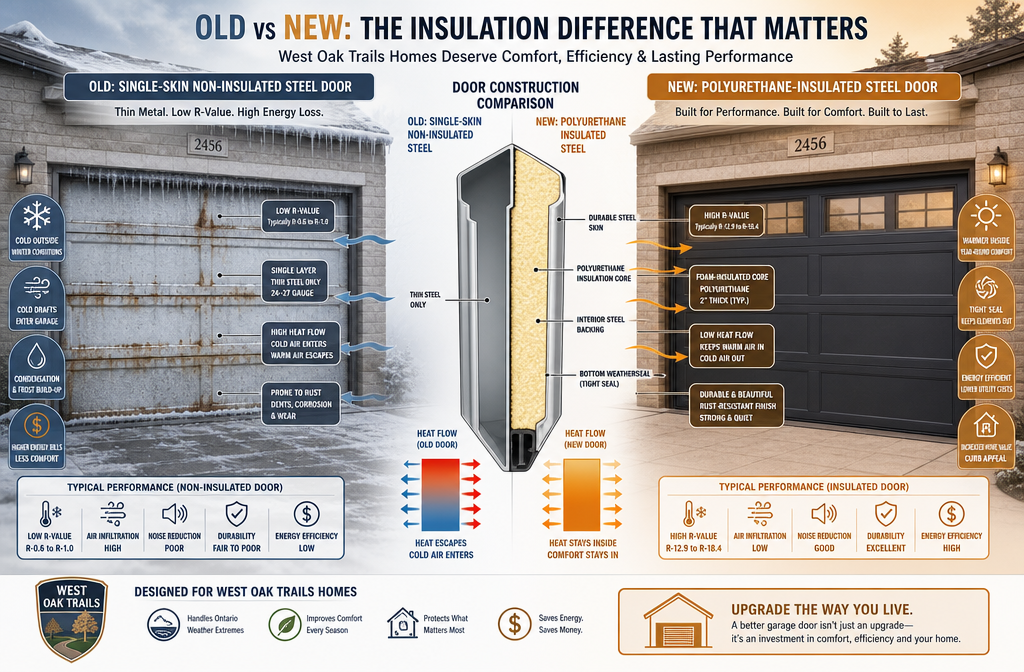
Insulated garage doors outperform standard single-skin doors on thermal performance, noise reduction, and structural rigidity. Standard doors have no insulation layer — they’re essentially a thin metal sheet that conducts cold directly into the garage.
Side-by-Side Comparison
| Feature | Standard (Non-Insulated) | Insulated Door |
|---|---|---|
| Thermal resistance | R-0 to R-2 | R-7 to R-18+ |
| Noise reduction | Minimal | Moderate to significant |
| Impact resistance | Lower | Higher (dual-skin + foam core) |
| Weight | Lighter | Heavier (may need stronger opener) |
| Cost | Lower upfront | Higher upfront, lower operating cost |
| Lifespan | Similar | Similar, but less prone to denting |
| Temperature stability | Poor | Good to excellent |
Choose an insulated door if:
- Your garage shares a wall or ceiling with living space
- You use the garage as a workshop, gym, or hobby area
- Your home is in a climate with winters below -10°C regularly
- Noise from the street or neighbours is a concern
Stick with a standard door if:
- The garage is fully detached and unheated
- Budget is the primary constraint and the garage has no conditioned adjacency
- The door faces south and receives significant solar gain (reduces the practical benefit gap)
What Energy Savings Can You Expect From This Type of Upgrade?
Insulated garage doors can reduce winter heat loss through the garage envelope by an estimated up to 20% in configurations where the garage shares walls or ceilings with heated living space. This figure applies when the insulated door is combined with proper weatherstripping and air sealing — the door alone doesn’t deliver full savings if gaps remain around the frame.
In the West Oak Trails case study, homeowners reported:
- Noticeably warmer garage temperatures on cold mornings (anecdotal, not metered)
- Reduced cold drafts in the mudroom and rooms above the garage
- More consistent garage temperatures, which reduced the workload on any supplemental heating
Important caveat: Energy savings are difficult to isolate precisely because heating bills fluctuate with weather, occupancy, and fuel prices. The 20% heat-loss reduction figure refers specifically to heat loss through the door assembly, not total home heating costs. Total bill savings will be a fraction of that figure unless the garage is actively heated.
R-value measures the thermal resistance of the insulation material itself. U-value measures heat transfer through the entire door assembly, including the frame, panels, and seals. In practice, U-value is the more reliable metric for predicting real-world performance. A door with a high R-value but a poorly sealed frame can still underperform a lower-rated door with excellent weatherstripping.
Which Type of Insulation Works Best for Doors in Cold Climates?
Polyurethane foam is the preferred insulation material for garage doors in cold Canadian climates, including West Oak Trails. It delivers higher R-values per inch than polystyrene, bonds directly to the door skin to reduce thermal bridging, and adds structural rigidity to the panel.
Polyurethane vs. Polystyrene
| Property | Polyurethane Foam | Polystyrene (EPS/XPS) |
|---|---|---|
| R-value per inch | ~R-6 to R-7 | ~R-3.8 to R-5 |
| Thermal bridging | Lower (bonded to skins) | Higher (loose fit possible) |
| Structural contribution | Yes | Minimal |
| Cost | Higher | Lower |
| Best for | Attached/heated garages | Detached/unheated garages |
For attached garages in West Oak Trails — the dominant configuration in this neighbourhood — polyurethane-insulated steel doors are the clear recommendation. The higher upfront cost is offset by better performance over the door’s lifespan.
Insulation alone isn’t enough. Weatherstripping, insulated hardware, and a tight bottom seal are equally important. A well-insulated door panel with gaps around the frame will still allow significant air infiltration. In the West Oak Trails project, full perimeter weatherstripping was installed alongside the new doors as a non-negotiable part of the scope.
What Materials Are Typically Used in High-Quality Insulated Doors?
High-quality insulated garage doors used in projects like this Case Study: Insulated Door Replacement in West Oak Trails combine several material layers to achieve both thermal performance and durability.
Typical construction layers (inside to outside):
- Interior steel skin — 24 to 26 gauge galvanized steel, sometimes with a painted or textured finish
- Polyurethane foam core — injected between skins, expanding to fill the cavity and bond to both faces
- Exterior steel skin — heavier gauge, often with embossed wood-grain or flush panel texture
- Powder-coat or baked enamel finish — resists rust and UV fading in Ontario’s freeze-thaw cycles
Additional components that affect performance:
- Bottom seal: Rubber or vinyl astragal that compresses against the floor to block drafts and pests
- Weatherstripping: Foam or rubber strips along the top and sides of the door frame
- Thermal breaks in hardware: Hinges and brackets with reduced metal-to-metal contact to limit conductive heat loss
- Insulated windows (optional): Double-pane inserts if the door design includes glazing
Steel is the dominant material in West Oak Trails replacements because it balances cost, durability, and insulation compatibility. Fibreglass and composite options exist but are less common at this price point in the Ontario market.
Are Insulated Doors Worth It for Older Homes?
Yes — insulated doors are often more valuable in older homes than in new construction, because older homes typically have less overall envelope insulation and the garage door represents a proportionally larger share of total heat loss.
In West Oak Trails, many homes were built in the 1990s and early 2000s. Garage doors from that era are frequently single-skin steel with no insulation, aged weatherstripping, and worn bottom seals. Replacing these with modern insulated doors addresses multiple performance gaps at once.
The upgrade makes the most sense when:
- The existing door is more than 15 years old and showing wear
- The garage is attached and the adjacent rooms run cold in winter
- The homeowner plans to stay in the property for at least 5 more years (to recoup the investment)
- The home is being prepared for sale and insulated doors are a buyer expectation in the local market
It may not be worth it when:
- The existing insulated door is less than 10 years old and still performs well
- The garage is fully detached with no conditioned adjacency
- The budget would be better spent on attic insulation or window upgrades first (higher ROI in some cases)
For homes where the door itself is structurally sound but only certain panels are damaged, garage door panel replacement in Oakville may be a more cost-effective option than a full replacement.
Who Should Consider a Door Insulation Upgrade?
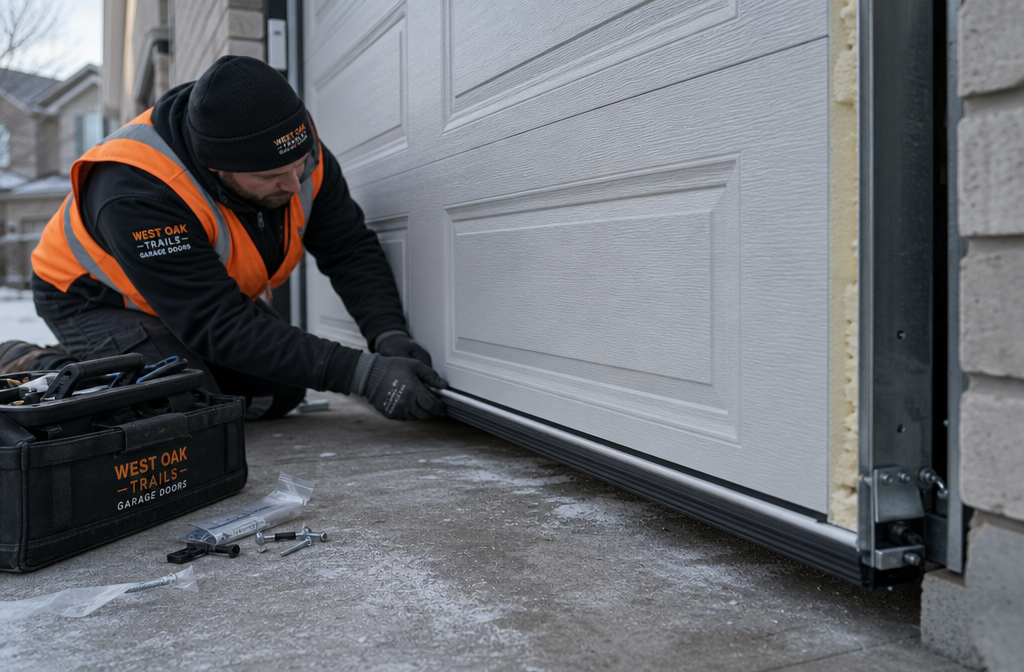
Insulated door replacement is best suited for homeowners with attached garages in cold-climate regions, particularly those who use the garage regularly or have living space adjacent to or above it. This Case Study: Insulated Door Replacement in West Oak Trails is directly relevant to anyone in a similar suburban Ontario context.
Strong candidates for this upgrade:
- Homeowners with attached garages sharing walls with kitchens, mudrooms, or bedrooms
- Families using the garage as a workshop, gym, or hobby space year-round
- Homeowners preparing to sell in a market where insulated doors are a buyer expectation
- Anyone whose current door is over 15 years old with degraded seals and visible wear
- Homeowners experiencing cold floors or drafts in rooms adjacent to the garage
Less urgent candidates:
- Detached garage owners with no conditioned adjacency
- Homeowners who recently installed an insulated door within the last 10 years
- Renters (unless the landlord is funding the upgrade)
If the garage door opener is also aging, it’s worth bundling the replacement. A heavier insulated door can strain an older motor. See garage door opener repair and replacement options to assess whether the existing unit needs upgrading alongside the door.
Common Mistakes Homeowners Make When Replacing Doors
The most common mistake is selecting a door based on R-value alone, without considering U-value, weatherstripping quality, or frame sealing. A high R-value door with poor perimeter sealing will underperform a lower-rated door with excellent air sealing.
Other frequent errors in projects like this:
- Skipping the bottom seal upgrade: The bottom astragal wears out and is often the biggest source of air infiltration. Always replace it with the door.
- Reusing an incompatible opener: Insulated doors are heavier. An older motor rated for a lighter door will wear out faster or fail to lift the new door reliably.
- Ignoring spring balance: New doors require properly calibrated torsion springs. An imbalanced door puts stress on the opener and hardware. If springs are worn or incorrectly sized, address them before or during installation. For context on spring-related costs, see how much garage door spring replacement costs in Oakville in 2026.
- Choosing the wrong R-value for the application: R-7 is adequate for an attached unheated garage; it’s insufficient for a garage with conditioned space above. Match the R-value to the actual use case.
- Assuming all insulated doors are equal: Manufacturing quality varies significantly. A door with a thin steel skin and loosely fitted polystyrene insert performs very differently from a door with a bonded polyurethane core and thermal-break hardware.
What Are the Pros and Cons of Insulated Door Replacements?
Pros:
- ✅ Reduces heat loss through the garage envelope (up to 20% in attached configurations)
- ✅ More stable garage temperatures year-round
- ✅ Reduces noise transmission from outside
- ✅ Greater impact resistance and structural rigidity than single-skin doors
- ✅ Adds perceived value in the Oakville real estate market
- ✅ Reduces cold infiltration into adjacent living spaces
- ✅ Longer-lasting finish due to dual-skin construction
Cons:
- ❌ Higher upfront cost than non-insulated doors
- ❌ Heavier, which may require a stronger opener
- ❌ Requires proper installation to realize full thermal benefit
- ❌ Payback period depends heavily on garage use and heating configuration
- ❌ Not cost-effective for fully detached, unheated garages with no adjacent conditioned space
Potential Problems With DIY Door Insulation
DIY insulated door replacement carries real risks that go beyond the typical home improvement project. Garage doors are under significant spring tension — a torsion spring stores enough energy to cause serious injury if mishandled. This is not a project where watching a few videos substitutes for hands-on experience.
Specific risks with DIY installation:
- Spring tension injuries: Torsion springs must be wound and balanced correctly. Incorrect tensioning can cause the spring to snap or the door to fall. For a clear picture of what can go wrong, see broken garage door spring warning signs and what to do next.
- Improper frame alignment: A door that’s even slightly out of square will bind, wear unevenly, and fail to seal properly — eliminating most of the thermal benefit.
- Cable routing errors: Incorrectly routed lift cables can cause the door to fall or operate dangerously. For more on cable-related risks, see garage door cable replacement: cost, signs, and safety risks.
- OBC compliance gaps: The 2024 Ontario Building Code affects certain door installations. A DIY project may not meet code requirements, which can create issues at resale or during insurance claims.
- Voided warranties: Most door manufacturers require professional installation to maintain the product warranty.
When DIY makes sense (limited scope):
- Adding an insulation kit to an existing structurally sound door (not a full replacement)
- Replacing weatherstripping or bottom seals on an otherwise functional door
- These tasks carry far lower risk and are well within the average homeowner’s skill set
For anything involving spring replacement, cable work, or a full door swap, professional installation is the right call in West Oak Trails and across Oakville generally.
How Long Does a Door Replacement Project Usually Take?
A professional insulated garage door replacement typically takes one to two days from start to finish for a standard residential project. A single-car door can often be completed in four to six hours. A double-car door or a project with additional scope (opener replacement, frame repairs, OBC modifications) may extend to a full day or into a second day.
Typical project timeline:
- Pre-installation inspection (30–60 min): Assess existing frame, opener compatibility, spring condition
- Old door removal (30–90 min): Disconnect opener, release spring tension, disassemble and remove panels and hardware
- Frame preparation (30–60 min): Check for square, repair any rot or damage, install new weatherstripping on frame
- New door installation (2–4 hours): Assemble panels, install tracks, mount springs, connect opener
- Balance and adjustment (30–60 min): Test spring balance, adjust travel limits, verify seal contact
- Cleanup and walkthrough (15–30 min): Remove debris, demonstrate operation, review warranty
Weather delays are uncommon for garage door work since most of the installation happens inside the garage bay, but extreme cold can affect sealant curing and spring tension calibration.
Frequently Asked Questions
Q: What R-value should I choose for a West Oak Trails garage door? A: For an attached, unheated garage, R-7 to R-9 is the standard recommendation. If the garage is heated or has conditioned living space above it, target R-10 to R-13 or higher. The 2026 industry rule of thumb is R-14+ where people regularly occupy the space above the garage.
Q: Is polyurethane or polystyrene insulation better for Ontario winters? A: Polyurethane is better for Ontario’s cold climate. It delivers higher R-values per inch, bonds to the door skins to reduce thermal bridging, and adds structural rigidity. Polystyrene is cheaper but performs noticeably worse in attached-garage applications.
Q: Will an insulated door make a meaningful difference if my garage isn’t heated? A: Yes, but the impact is more modest. An insulated door in an unheated attached garage still reduces cold infiltration into adjacent rooms and stabilizes garage temperatures, which protects stored items and vehicles. The energy savings are smaller than in a heated garage scenario.
Q: Do I need a permit to replace a garage door in Oakville? A: A like-for-like door replacement typically doesn’t require a building permit in Oakville. However, if the project involves structural changes to the opening, power door operators (required under the 2024 OBC for certain accessible entrances), or electrical work, a permit may be required. Confirm with the Town of Oakville before starting.
Q: How do I know if my existing opener can handle a new insulated door? A: Check the opener’s horsepower rating and the weight of the new door. Most insulated double-car doors weigh 130–180 lbs. A 1/2 HP opener handles most standard insulated doors; a 3/4 HP or 1 HP unit is recommended for heavier or larger doors. If the opener is more than 15 years old, replacement is often worth bundling with the door project.
Q: What’s the difference between R-value and U-value for garage doors? A: R-value measures the thermal resistance of the insulation material only. U-value measures heat transfer through the entire door assembly — panels, frame, seals, and hardware. U-value is a more realistic indicator of whole-door performance. Look for both a high R-value and a low U-value when comparing doors.
Q: How long do insulated garage doors last? A: A well-maintained insulated steel garage door typically lasts 20 to 30 years. The insulation core doesn’t degrade significantly over time, but weatherstripping, springs, and cables require periodic maintenance and replacement. Springs generally last 10,000 to 15,000 cycles.
Q: Can I add insulation to my existing garage door instead of replacing it? A: Yes, if the existing door is structurally sound. Insulation kits (typically polystyrene or reflective foil panels) can be retrofitted to single-skin doors. This is a low-cost option but delivers lower performance than a purpose-built insulated door. It’s a good interim solution but not a long-term substitute for a full replacement.
Q: Does an insulated garage door reduce noise? A: Yes. The foam core absorbs sound vibration, and the dual-skin construction dampens both external noise (traffic, wind) and mechanical noise from the door’s own operation. Homeowners in West Oak Trails near collector roads reported this as a notable secondary benefit.
Q: What should I look for when hiring a garage door installer in West Oak Trails? A: Look for a licensed contractor familiar with the 2024 Ontario Building Code, verifiable local references, manufacturer-authorized installation (to preserve warranty), and a written quote that itemizes door, hardware, disposal, and labour separately. Avoid quotes that bundle everything with no breakdown.
Conclusion: What This Case Study Tells You About Insulated Door Replacement
The Case Study: Insulated Door Replacement in West Oak Trails demonstrates a clear pattern: homeowners with attached garages in cold Ontario climates have strong, practical reasons to upgrade to insulated doors, and the project delivers measurable benefits when done correctly.
The key lessons from this project apply broadly across Oakville and similar suburban communities:
- Match the door to the application. Choose R-value and insulation type based on how the garage is used and what’s adjacent to it, not just on price.
- Don’t stop at the door. Weatherstripping, bottom seals, and frame air sealing are equally important for realizing thermal gains.
- Use U-value alongside R-value when comparing products. Whole-door performance matters more than insulation core rating alone.
- Budget realistically. The $1,286–$2,053 CAD benchmark is a starting point. Factor in opener compatibility, spring replacement, and OBC requirements for a complete picture.
- Hire a professional. Spring tension, cable routing, and frame alignment are not tasks to improvise. The cost of professional installation is a small fraction of the total project cost and protects both safety and warranty.
- Time it strategically. If the door, opener, and springs are all aging, replacing them together saves on labour and avoids a second service call within a few years.
For homeowners in West Oak Trails and across Oakville ready to move forward, start with a professional inspection to assess the existing door, opener, and spring condition. From there, a reputable local installer can recommend the right door specification for the specific garage configuration and provide a detailed written quote.
For same-day service and professional installation across Oakville and the surrounding area, Oakview Garage Doors offers repair, replacement, and full installation services with local expertise.