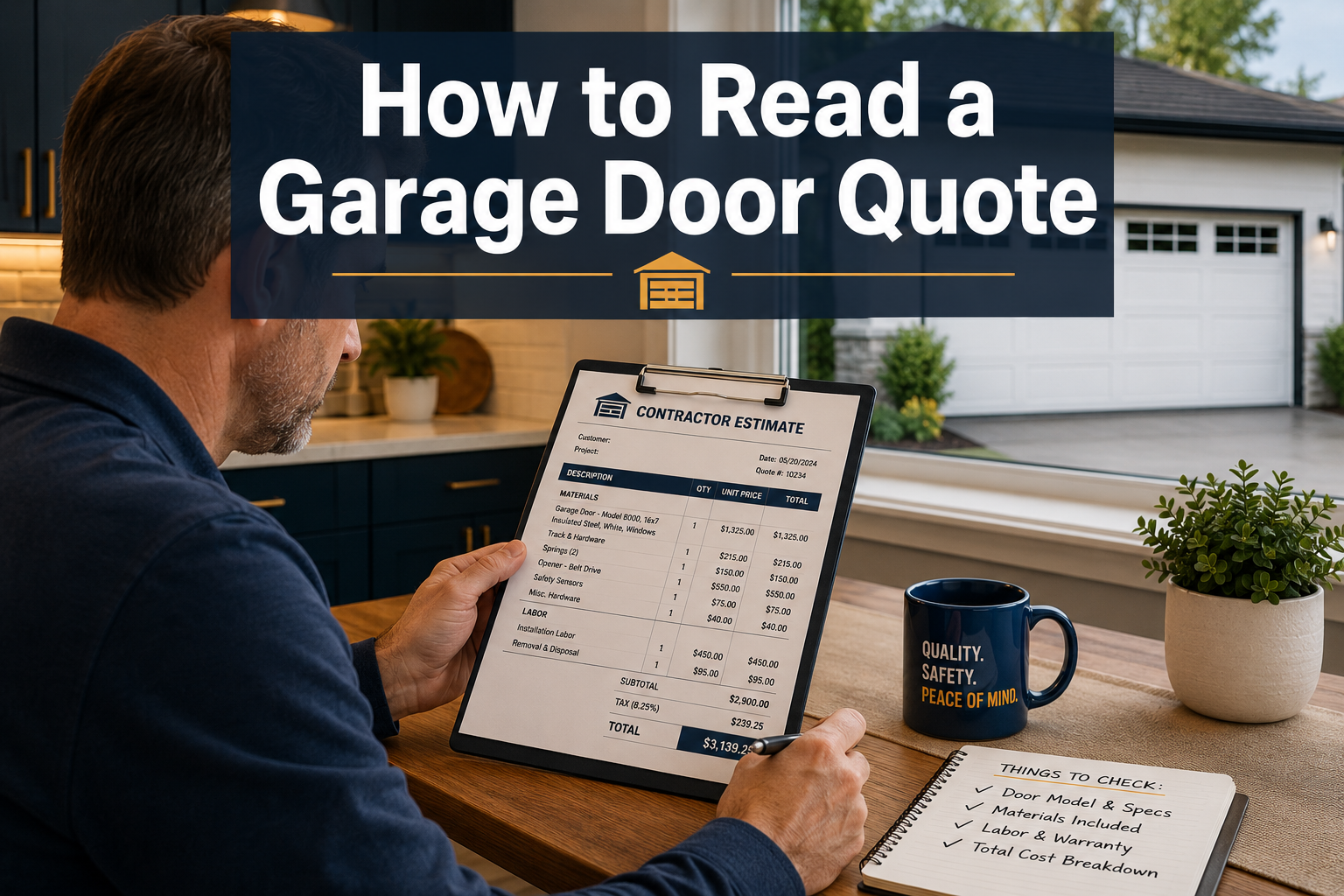
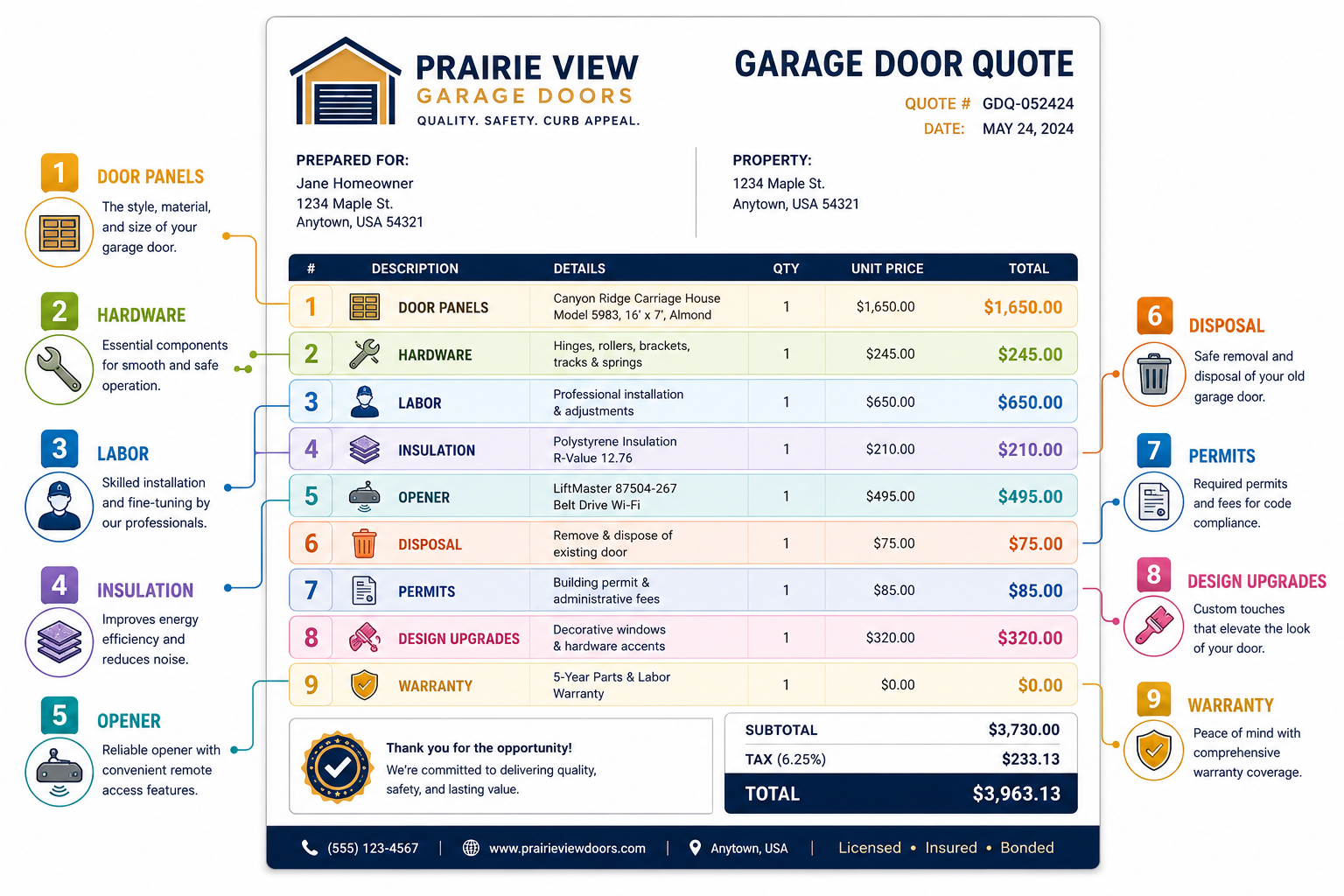
A garage door quote should be fully itemized, separating the door itself, hardware, labor, insulation, opener, disposal, permits, design upgrades, and warranty into distinct line items. Most homeowners who overpay or face surprise charges do so because they accepted a single lump-sum number without understanding what each component costs. Knowing how to read a garage door quote gives you the leverage to compare bids fairly and avoid hidden fees.
Key Takeaways
- The door panels or slab typically account for 60–75% of the total project cost and should specify brand, material, size, and series.
- Labor, disposal, and permit fees are the three line items most commonly omitted from low-ball quotes.
- Insulation (and its R-value) should always be listed separately so you can compare apples to apples across quotes.
- A quote missing springs, safety sensors, or tracks is incomplete, these are not optional components.
- Design upgrades like windows, custom colors, and decorative hardware can add hundreds to thousands of dollars and should appear as distinct add-ons.
- Always ask for a warranty breakdown covering the door, hardware, opener, and labor separately.
- Get at least three itemized quotes before signing anything.
- A suspiciously low quote almost always means something is missing, not that the company is more efficient.
What Are the Most Important Things to Look for in a Garage Door Quote?
A legitimate garage door quote will clearly separate every major cost component rather than bundling everything into one number. The most important things to look for are full itemization, named brands and specifications, and explicit statements about what is and is not included.
Here is what a complete, trustworthy quote should contain:
- Door panels/slab — brand, material, model, size, and style
- Hardware — springs, tracks, cables, rollers, and fasteners
- Insulation — listed separately with R-value specified
- Opener — make, model, and horsepower (if applicable)
- Labor — installation hours or flat rate, clearly stated
- Old door removal and disposal — often called “haul-away”
- Permit fees — required in many municipalities
- Design upgrades — windows, custom finishes, decorative hardware
- Warranty — covering door, parts, opener, and labor individually
Pull quote: “A quote that lists only ‘garage door installed – $1,800’ tells you almost nothing. A quote that breaks out nine line items tells you everything.”
If a quote you receive does not include all nine of these categories, ask the contractor to revise it before you compare prices.
How Much Does a Typical Garage Door Installation Actually Cost?
For most Ontario homeowners in 2026, a professionally installed single-car steel garage door runs roughly $1,200–$2,500 all-in. Double-car doors, premium materials, or custom designs push that range significantly higher.
Here is a general cost breakdown by door type (installed, including standard hardware and labor):
| Door Type | Estimated Installed Cost (CAD) |
|---|---|
| Single steel, non-insulated | $900 – $1,500 |
| Single steel, insulated (R-9 to R-18) | $1,200 – $2,500 |
| Double steel, insulated | $1,800 – $3,500 |
| Wood or wood composite | $3,000 – $7,000+ |
| Aluminum / full-view glass | $3,500 – $10,000+ |
| Custom carriage-house style | $4,000 – $10,000+ |
Note: These are estimates based on typical contractor pricing in the Greater Toronto Area as of mid-2026. Actual costs vary by supplier, door specs, and site conditions.
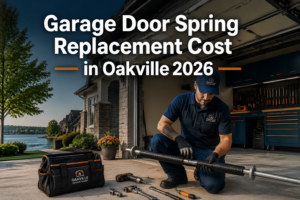
These ranges assume standard installation on a prepared opening. Add-ons like a new opener, framing repairs, or upgraded hardware will increase the total. For a detailed look at one common repair cost, see how much garage door spring replacement costs in Oakville in 2026.
Line Item 1–9: A Full Breakdown of How to Read a Garage Door Quote
Understanding how to read a garage door quote means knowing exactly what each line item covers and what questions to ask about it. Below is a section-by-section guide to all nine components.
Line Item 1: Door Panels or Slab
The door itself is almost always the largest single cost, typically 60–75% of the total project price. A quote should specify:
- Brand and model (e.g., Clopay Gallery Series, Amarr Hillcrest)
- Material (steel, wood, aluminum, composite, glass)
- Size (width × height)
- Style (raised panel, flush, carriage-house)
Red flag: If the quote just says “garage door” with no brand or model, you have no way to compare it to another contractor’s bid.
Line Item 2: Hardware (Springs, Tracks, Cables, Rollers)
Hardware is where many low-ball quotes hide their omissions. A complete quote will list torsion or extension springs, tracks, cables, rollers, and mounting hardware as either a bundled hardware package or individual components.
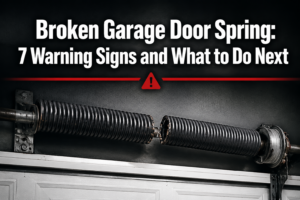
Springs alone are a significant cost. If you ever need to address this separately, our guide on broken garage door springs and warning signs explains what to watch for.
Common mistake: Accepting a quote that lists door panels and labor but says nothing about springs or tracks. These parts will appear later as “extra parts needed” once the installer is already on-site.
Line Item 3: Insulation
Insulation should be listed separately, not buried inside the door price. The quote should state:
- Whether the door is insulated or non-insulated
- The R-value (e.g., R-9, R-12, R-18)
- Whether insulation is polyurethane (injected, better) or polystyrene (layered, less effective)
An insulated door costs more upfront but improves thermal comfort and can lower heating costs in attached garages. If two quotes show different prices, check whether one includes insulation and the other doesn’t — this is a very common source of confusion.
Line Item 4: Opener
If the quote includes a new opener, it should list the brand, model, drive type (belt, chain, or screw), and horsepower rating. These details matter because a $150 chain-drive opener and a $450 belt-drive smart opener are very different products.
If you’re keeping your existing opener, the quote should say so explicitly. For smart opener upgrades, see our overview of garage door opener repair and options.
Line Item 5: Labor
Labor should be listed as either a flat installation fee or an hourly rate with an estimated number of hours. A standard single-door installation typically takes two to four hours for an experienced crew.
Choose flat-rate labor if: You want cost certainty. Choose hourly if: The job has unusual complexity and the contractor is willing to cap the hours.
Line Item 6: Old Door Removal and Disposal
Haul-away fees are frequently omitted from initial quotes and added at the end. A fair quote will state whether removal of your existing door and hardware is included or listed as a separate charge.
Disposal of a full steel door and hardware is not trivial — expect this to add $75–$200 if it’s not already included.
Line Item 7: Permit Fees
Many municipalities in Ontario require a permit for garage door replacement, especially if framing or structural work is involved. The quote should either include permit fees or explicitly state that permits are the homeowner’s responsibility.
Edge case: If the contractor says “permits aren’t needed for this job,” ask them to put that in writing. If a permit is later required and not pulled, you could face fines or issues when selling your home.
Line Item 8: Design Upgrades
Windows, custom paint or stain colors, carriage-house trim, decorative hinges, and handles are all add-ons that should appear as distinct line items. High-end custom doors with these features can run $3,000–$10,000 or more.
A clear quote will list each upgrade separately (e.g., “Arch window package – $320,” “Decorative hardware kit – $180”) so you can remove individual items to bring the total down if needed.
Line Item 9: Warranty
Warranty terms should be broken out for at least three things: the door itself (manufacturer warranty), the hardware and springs (parts warranty), and the installation labor (workmanship warranty). These are often different lengths and cover different things.
A professional installer should offer a labor warranty of at least one year. Manufacturer warranties on quality steel doors often range from five years to lifetime on panels.
What Line Items Usually Surprise Homeowners in a Garage Door Estimate?
The three line items that most often catch homeowners off guard are disposal fees, permit costs, and hardware upgrades. These are routinely left out of a headline price and added once work begins.
Other common surprises include:
- Framing repairs — if the rough opening is out of square or the header needs reinforcement
- Electrical work — if a new outlet is needed for the opener
- Safety sensor installation — sometimes listed separately from the opener
- Weather stripping — bottom seal and side seals may not be included in the base price
Ask every contractor to confirm in writing: “Does this quote include everything needed to complete the job, or are there items that could be added later?”
What Mistakes Do People Make When Reviewing Garage Door Quotes?
The single biggest mistake is comparing total prices without checking whether the quotes cover the same scope of work. A $1,400 quote and a $1,900 quote are not directly comparable if one includes disposal and permits and the other doesn’t.
Other common mistakes:
- Choosing based on price alone without checking brand, model, or R-value
- Not asking about warranty until after signing
- Assuming all hardware is included when the quote only mentions the door
- Skipping the permit question entirely
- Accepting verbal promises instead of written line items
Decision rule: If you can’t tell from the written quote exactly what brand of door, what R-value, and what hardware is included, ask for a revised quote before comparing prices.
Who Should Get a Professional Garage Door Quote vs. DIY?
Almost every homeowner should get a professional quote, even if they’re considering a DIY installation. The exception is someone with direct experience in garage door installation, access to the right tools, and a clear understanding of spring tension safety.
DIY garage door installation carries real risk. Torsion springs are under extreme tension and can cause serious injury if handled incorrectly. For most homeowners, the labor cost of professional installation is worth it for safety alone.
Get a professional quote if:
- You’re replacing a full door and hardware system
- Your existing framing may need adjustment
- You want a warranty on the installation
- You’re unfamiliar with torsion spring systems
DIY may be reasonable if:
- You’re replacing only a single damaged panel (see garage door panel replacement)
- You have prior experience with garage door systems
- The opener and hardware are staying in place
How Do I Know If a Garage Door Quote Is Fair or Overpriced?
A quote is likely fair if it’s fully itemized, the door brand and model are specified, and the total falls within the typical installed range for your door type and region. A quote is likely overpriced if it’s significantly above the top of the typical range without a clear reason (custom work, premium brand, difficult installation).
A quote is likely too low if it’s missing line items. Contractors who omit springs, disposal, or permits to win the bid will add those costs later.
Steps to check fairness:
- Get at least three written, itemized quotes.
- Look up the retail price of the door brand and model listed.
- Subtract the door cost from the total to estimate labor and hardware charges.
- Compare labor rates across quotes — wide variation often signals missing items in the cheaper quote.
- Check online reviews for the contractor, specifically for comments about surprise charges.
For professional installation in the Oakville and Burlington area, Oakview Garage Doors’ installation service provides fully itemized quotes as standard practice.
What Warranties Should I Expect With a Professional Garage Door Installation?
A professional installation should come with three separate warranties: a manufacturer warranty on the door (often five years to lifetime on panels), a parts warranty on hardware and springs (typically one to five years), and a labor or workmanship warranty from the installer (at minimum one year).
Ask for all warranty terms in writing before signing. Key questions to ask:
- What does the labor warranty cover, and what voids it?
- Are springs covered under the parts warranty or excluded?
- Is the opener warranty handled by the manufacturer or the installer?
- What is the process for making a warranty claim?
Red flag: Any installer who offers no written labor warranty should be avoided. Reputable companies stand behind their work.
Are There Any Hidden Fees to Watch Out for in a Garage Door Estimate?
Yes — and they’re common enough that asking about them directly is standard advice from industry professionals. The most frequently hidden fees in garage door estimates are disposal/haul-away, permit fees, and framing or structural repairs discovered on-site.
Additional fees to ask about explicitly:
- Trip or service call fees (sometimes charged even on installation jobs)
- After-hours or emergency rates (relevant if you need urgent service — see emergency garage door repair options)
- Hardware upgrades if the installer decides existing tracks or springs aren’t compatible
- Sales tax — confirm whether the quoted price is before or after tax
The simplest protection is to ask: “Is there anything that could increase this total after work begins?” and get the answer in writing.
Are Wood or Steel Garage Doors Cheaper in the Long Run?
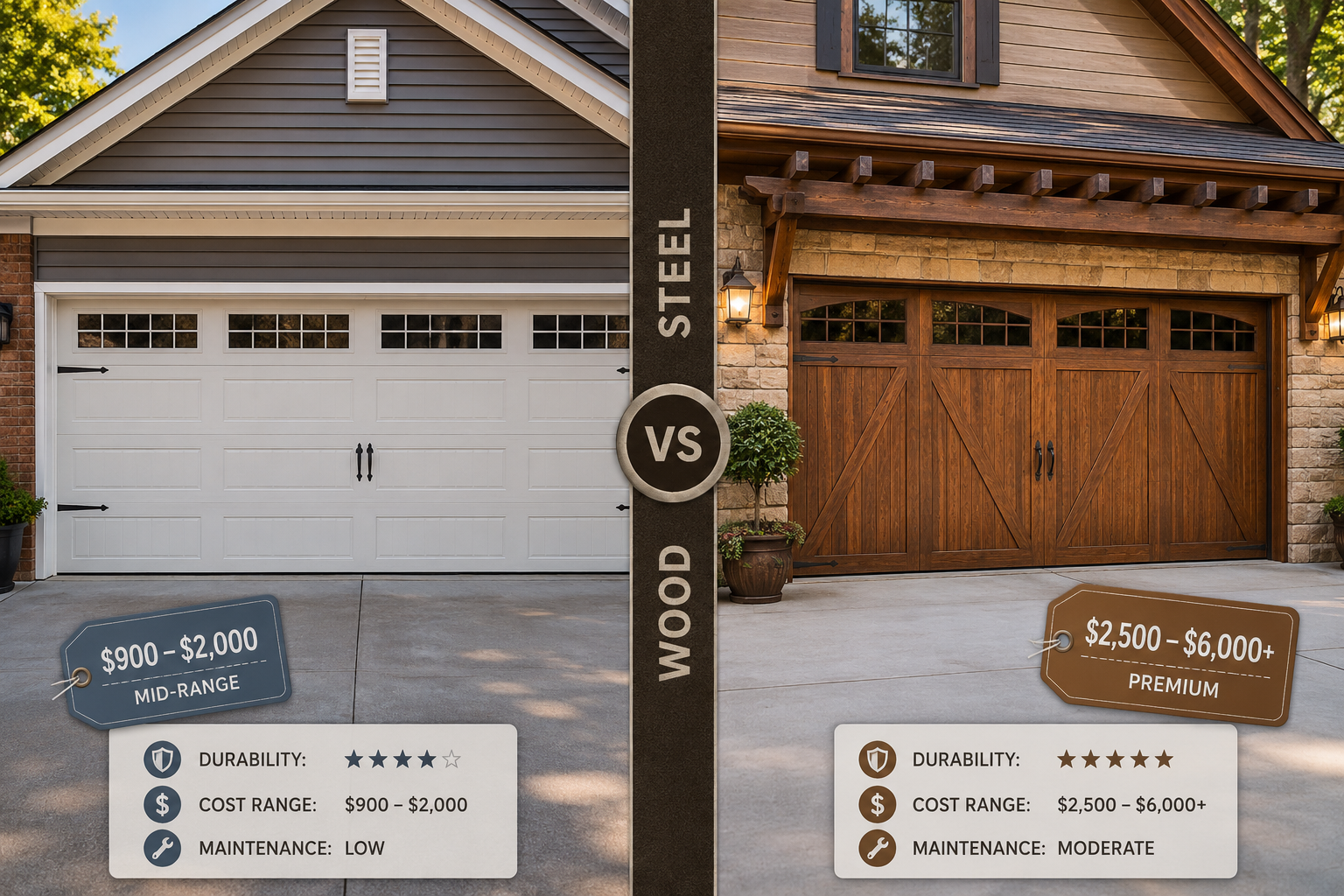
Steel doors are almost always cheaper in the long run for most homeowners. They cost less upfront, require less maintenance, resist warping and cracking, and typically carry longer manufacturer warranties than wood.
| Factor | Steel | Wood |
|---|---|---|
| Upfront cost | Lower ($1,200–$3,500 installed) | Higher ($3,000–$7,000+) |
| Maintenance | Low (occasional paint touch-up) | High (annual sealing/staining) |
| Durability | High (resists moisture, pests) | Moderate (susceptible to rot) |
| Insulation options | Excellent (polyurethane fill) | Moderate (depends on construction) |
| Curb appeal | Good (wide style range) | Excellent (premium aesthetic) |
| Lifespan | 20–30 years with care | 15–25 years with regular maintenance |
Wood doors make sense if curb appeal is a top priority and you’re prepared for ongoing maintenance costs. For most homeowners, insulated steel is the better value.
How Do Different Garage Door Materials Compare in Price and Durability?
Each garage door material has a different cost-to-durability profile, and the right choice depends on your climate, budget, and aesthetic goals.
- Steel: Best all-around value. Durable, low-maintenance, widely available in many styles. Susceptible to dents but can be repaired. Best for most Ontario climates.
- Wood: Premium look, but requires consistent maintenance. Best for homeowners who prioritize aesthetics and are willing to invest in upkeep.
- Aluminum: Lightweight and rust-resistant, but dents easily. Often used for modern/contemporary full-view designs. Higher cost for glass panel versions.
- Composite/wood composite: Looks like wood but resists moisture better. Mid-range cost, lower maintenance than real wood.
- Glass/aluminum frame: High-end, modern aesthetic. Excellent for design-forward homes but offers less insulation and privacy. Highest cost range.
When reading a quote, make sure the material is clearly stated. “Steel door” and “wood composite door” at the same price are not equivalent products.
What Questions Should I Ask My Garage Door Installer Before Signing?
Asking the right questions before signing a quote protects you from surprises and helps you evaluate the contractor’s professionalism. Here are the most important ones:
- Is this quote fully itemized, and does it include everything needed to complete the job?
- What brand and model is the door, and can I look it up independently?
- Is the door insulated, and what is the R-value?
- Are springs, tracks, and hardware included in this price?
- Is old door removal and disposal included?
- Do I need a permit, and is that cost included?
- What warranties do you offer on labor, parts, and the door itself?
- Are there any conditions that could change this price once work starts?
- Are you licensed and insured?
- What is your process if something goes wrong after installation?
A contractor who answers all ten questions clearly and in writing is a contractor worth hiring.
FAQ: How to Read a Garage Door Quote
Q: What does a fully itemized garage door quote look like? A fully itemized quote lists at least nine separate line items: door panels, hardware, insulation, opener, labor, disposal, permits, design upgrades, and warranty terms. Each item should include a description, quantity or scope, and a price.
Q: Is it normal for a garage door quote to include permit fees? Yes, in many Ontario municipalities a permit is required for full door replacement, especially if structural work is involved. A professional contractor should either include permit fees in the quote or clearly state they are the homeowner’s responsibility.
Q: Why do some quotes look much cheaper than others? Cheaper quotes almost always omit line items. Common omissions include springs, disposal, permits, and safety sensors. Always ask what is not included before assuming a lower quote is a better deal.
Q: How long does a garage door installation typically take? A standard single-door installation by an experienced crew takes two to four hours. Complex installations with framing repairs or custom doors may take a full day.
Q: Should I pay a deposit before installation begins? A deposit of 10–30% is standard and reasonable. Be cautious of any contractor who asks for full payment upfront before any work is done.
Q: What is a good labor warranty for garage door installation? At minimum, one year on workmanship is standard. Reputable installers often offer two years. This should be stated in writing, not just verbally.
Q: Can I negotiate a garage door quote? Yes. Once you have multiple itemized quotes, you can ask contractors to match or beat specific line items. Design upgrades and disposal fees are often the most negotiable.
Q: What happens if the installer finds extra work needed once they start? A reputable contractor will stop and discuss any additional costs before proceeding. Ask about this policy before signing, and get a written change-order clause in the contract.
Q: Is an opener always included in a garage door quote? Not automatically. Some quotes include a new opener; others assume you’re keeping your existing one. Always confirm this in writing.
Q: What is the difference between torsion and extension springs, and does it affect the quote? Torsion springs (mounted above the door) are more durable and safer than extension springs (mounted on the sides). Torsion spring systems typically cost more but last longer. The quote should specify which type is included.
Q: How do I know if the door brand listed in the quote is a quality product? Look up the brand independently. Reputable brands in Canada include Clopay, Amarr, and Wayne Dalton. If the quote lists a brand you can’t find information on, ask the contractor for product specifications and warranty documentation.
Q: What should I do if I notice a problem after installation? Contact the installer immediately and reference the labor warranty in your signed contract. For urgent issues, same-day garage door repair services are available in many areas.
Conclusion: Actionable Next Steps
Understanding how to read a garage door quote is not complicated once you know what to look for. The nine line items covered in this guide — door panels, hardware, insulation, opener, labor, disposal, permits, design upgrades, and warranty — give you a complete framework for evaluating any estimate you receive.
Here’s what to do next:
- Request itemized quotes from at least three contractors. If a contractor won’t provide a line-by-line breakdown, move on.
- Use the nine line items as a checklist. If any are missing, ask for a revised quote before comparing prices.
- Verify the door brand and model independently. Look up the product to confirm it matches what’s described.
- Ask the ten questions listed above before signing anything.
- Get all warranty terms in writing — labor, parts, and manufacturer separately.
- Confirm the total is tax-inclusive and that no additional charges are expected after work starts.
A well-read quote protects your budget, sets clear expectations, and helps you choose a contractor based on value rather than just price. If you’re ready to get a professional, fully itemized quote for your home, contact Oakview Garage Doors to get started.